
Uranus
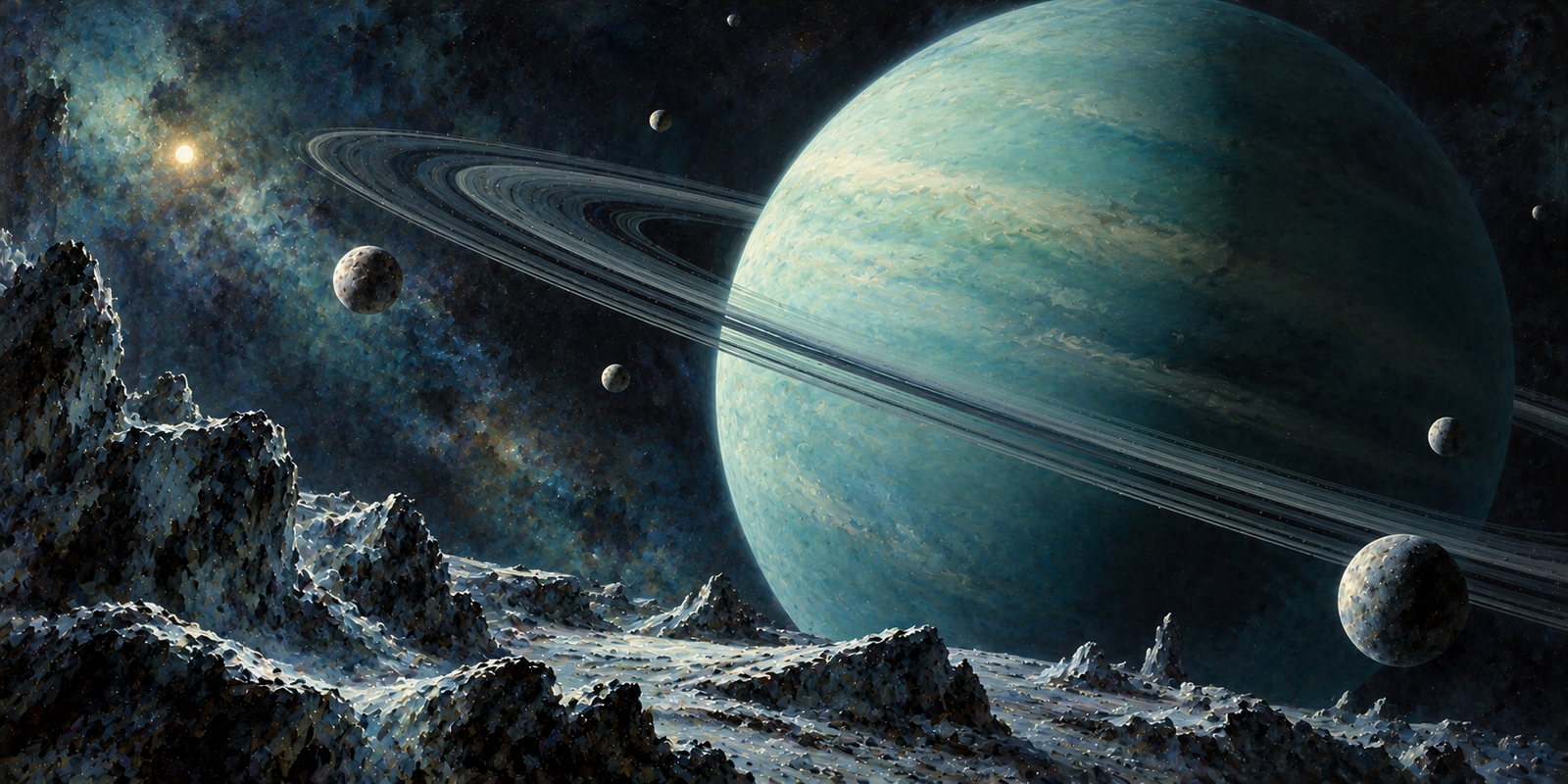
Seventh planet from the Sun · The sideways ice giant.
Uranus is a pale blue-green giant that turns almost on its side. Its poles spend long stretches facing toward or away from the Sun, giving the planet seasons unlike those of Earth. Beneath the high clouds lies no familiar solid ground for a traveller to cross. A vessel can circle the planet and visit its moons, but a descent into its atmosphere is an entirely different undertaking.

A planet that seems to roll
Uranus’s axis is tilted by about ninety-eight degrees relative to its orbit. As it slowly circles the Sun, each pole in turn experiences unusually prolonged light and darkness. Methane in its atmosphere absorbs red light, helping produce the planet’s characteristic blue-green colour. High winds and extreme cold rule the cloudtops.
It is called an ice giant, but the name does not mean it is a frozen sphere with a walkable surface. Dense hot fluids and gases lie deeper within it, and increasing pressure makes descent destructive to an ordinary craft. That makes the moons, not the planet’s interior, the more useful places for an expedition to set foot.
Rings and distant moons
Uranus carries narrow, dark rings that are much less prominent than Saturn’s. They are not safe bridges or solid roads. Its moons include Miranda, Ariel, Umbriel, Titania and Oberon. Miranda is especially striking, with varied ice and rock terrain, ancient cliffs and signs of great disruption. A route laid across one ridge may end at a drop too steep for a laden traveller to descend.
A convoy seeking a stable place to repair its vessel chooses a moon rather than the planet’s cloudtops. Its charts disagree over the height of a canyon rim on Miranda, and a heavy lander cannot be lifted twice with the remaining power. Sending a small survey party first costs time; gambling on the chart risks damaging the only craft capable of reaching orbit again.
The sky god and the planet
The name Uranus recalls the ancient sky power known to Hellenic traditions. The deity Uranus belongs to the setting’s divine histories and sacred relationships, not to a scientifically established population upon this ice giant. A temple’s claim of a holy route must be judged as a claim about a crossing or other realm, not a map of the gas and clouds seen around this planet.
Continue to Saturn and Neptune, or return to the Solar System. For passage hazards consult Outer Space Terrain.
Physical astronomy: NASA — Uranus facts.
Keep this reference growing
If this page helped with your reading or game, you can support its upkeep or explore the curated books.
Explore the Bookshop — epics, classics and stories behind imagined worlds.