
Werebear — Shapechanging Guardian of the Wilds
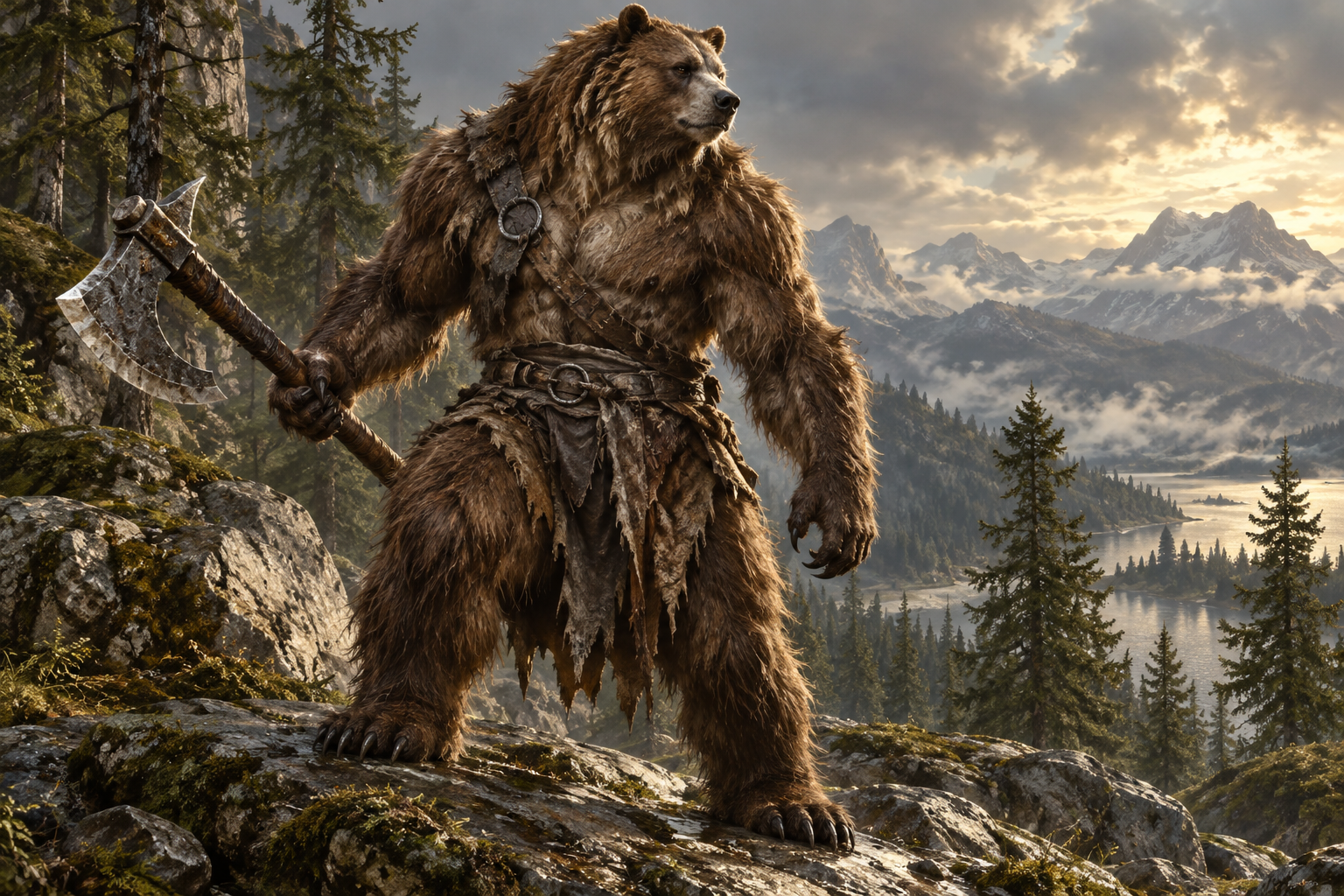
Natural Lycanthrope · Solitary Woodland Guardian · Three Changing Forms
Werebear at a Glance
| Creature | Werebear — an intelligent humanoid capable of assuming the shape of a bear or bear-humanoid hybrid. |
|---|---|
| Size and Type | D&D 2024: Medium or Small Monstrosity (Lycanthrope), becoming Large in bear or hybrid form. D&D 2014: Medium Humanoid (Human, Shapechanger), becoming Large. Pathfinder 1e and D&D 3.5e: Humanoid (Human, Shapechanger). |
| Temperament | Reclusive, territorial, protective and normally slow to provoke. |
| Alignment | Usually good; Neutral Good in fifth edition and Lawful Good in the Pathfinder and D&D 3.5e examples. |
| Combat Role | Powerful close-combat defender, grappler and guardian. |
| Signature Abilities | Shapechanging, claws, crushing strength, keen senses and the curse of lycanthropy. |
| Habitat | Ancient forests, secluded mountain valleys, wooded hills and bear country. |
| Campaign Range | The northern forests associated with Midgard, and suitable woodland regions represented in the Slavic and Celtic creature collections. |
| Challenge | D&D 2024: CR 5; D&D 2014: CR 5; Pathfinder 1e: CR 4; D&D 3.5e: CR 5. |
Rules by Edition
A werebear retains its intelligence while changing shape, but its attacks, defenses and curse differ considerably between editions. Each rules profile stands independently.
Werebear — D&D 5.5e / 2024
Medium or Small Monstrosity (Lycanthrope), Neutral Good
AC 15
Initiative +3 (13)
HP 135 (18d8 + 54)
Speed 30 ft.;
40 ft. in bear form only;
Climb 30 ft. in bear form only.
| STR | DEX | CON | INT | WIS | CHA |
|---|---|---|---|---|---|
| 19 (+4) | 10 (+0) | 17 (+3) | 11 (+0) | 12 (+1) | 12 (+1) |
Skills Perception +7
Gear Four handaxes
Senses Darkvision 60 ft.;
Passive Perception 17
Languages Common
(cannot speak in bear form)
CR 5 (1,800 XP; PB +3)
Actions
Multiattack. The werebear makes two attacks with Handaxe, Rend or a combination of the two. It may replace one of these attacks with Bite.
Bite (Bear or Hybrid Form Only). Melee Attack Roll: +7, reach 5 ft. Hit: 17 (2d12 + 4) Piercing damage.
If the target is a Humanoid, it must make a DC 14 Constitution saving throw. On a failure, the target becomes cursed. If the cursed creature would drop to 0 Hit Points, it instead transforms into a Werebear under the DM’s control with 10 Hit Points. On a successful saving throw, the creature becomes immune to this particular werebear’s curse for 24 hours.
Handaxe (Humanoid or Hybrid Form Only). Melee or Ranged Attack Roll: +7, reach 5 ft. or range 20/60 ft. Hit: 14 (3d6 + 4) Slashing damage.
Rend (Bear or Hybrid Form Only). Melee Attack Roll: +7, reach 5 ft. Hit: 13 (2d8 + 4) Slashing damage.
Bonus Actions
Shape-Shift. The werebear changes into a Large bear, a Large bear-humanoid hybrid, or its original humanoid form. Its game statistics remain unchanged apart from its size. Worn and carried equipment does not transform.
Combat Notes
The werebear can mix a Bite with another attack in its Multiattack routine, allowing it to spread its curse without sacrificing both attacks. Unlike the 2014 creature, this werebear does not possess immunity to ordinary nonmagical weapons. Its hybrid form does not gain the bear’s increased movement or climbing speed.
Werebear — D&D 5e / 2014
Medium Humanoid (Human, Shapechanger), Neutral Good
Armor Class
10 in humanoid form;
11 (natural armor) in bear or hybrid form.
Hit Points 135 (18d8 + 54)
Speed 30 ft.;
40 ft. and Climb 30 ft. in bear or hybrid form.
| STR | DEX | CON | INT | WIS | CHA |
|---|---|---|---|---|---|
| 19 (+4) | 10 (+0) | 17 (+3) | 11 (+0) | 12 (+1) | 12 (+1) |
Skills Perception +7
Damage Immunities
Bludgeoning, Piercing and Slashing damage
from nonmagical attacks that are not silvered.
Senses Passive Perception 17
Languages Common
(cannot speak in bear form)
Challenge
5 (1,800 XP; PB +3)
Traits
Shapechanger. As an action, the werebear transforms into a Large bear, a Large bear-humanoid hybrid, or its original humanoid form. Its statistics remain unchanged except for size and Armor Class. Its equipment does not change form. When slain, it returns to humanoid form.
Keen Smell. The werebear has advantage on Wisdom (Perception) checks involving smell.
Actions
Multiattack. In bear form, the werebear makes two Claw attacks. In humanoid form, it makes two Greataxe attacks. In hybrid form, it may employ either attack routine.
Bite (Bear or Hybrid Form Only). Melee Weapon Attack: +7 to hit, reach 5 ft., one target. Hit: 15 (2d10 + 4) Piercing damage.
A Humanoid struck by the bite must succeed on a DC 14 Constitution saving throw or acquire the curse of werebear lycanthropy.
Claw (Bear or Hybrid Form Only). Melee Weapon Attack: +7 to hit, reach 5 ft., one target. Hit: 13 (2d8 + 4) Slashing damage.
Greataxe (Humanoid or Hybrid Form Only). Melee Weapon Attack: +7 to hit, reach 5 ft., one target. Hit: 10 (1d12 + 4) Slashing damage.
Combat Notes
Silvered or magical attacks are particularly important against this werebear. Its natural immunity to ordinary nonmagical weapons makes direct combat hazardous for poorly equipped adventurers.
The bite can transmit lycanthropy, but it is not part of the normal two-attack Multiattack routine. Shapechanging requires an action.
Werebear — Pathfinder 1e
A natural werebear built from a fourth-level human ranger. The creature retains its ranger training while assuming its animal and hybrid shapes.
Humanoid Form — CR 4
Werebear (Humanoid Form)
CR 4;
XP 1,200
Human natural werebear ranger 4
LG Medium Humanoid (Human, Shapechanger)
Init +2;
Senses Low-Light Vision, Scent;
Perception +8
Defense
AC
16, touch 12, flat-footed 14
(+4 armor, +2 Dex)
hp 34 (4d10+8)
Fort +5;
Ref +6;
Will +2
Offense
Speed 30 ft.
Melee
Masterwork battleaxe +9 (1d8+4/×3)
Ranged
Masterwork throwing axe +7 (1d6+3)
Special Attacks
Favored enemy (orcs +2)
Ranger Spells Prepared
(CL 1st; concentration +2)
1st — Detect Poison
Statistics
Str 16; Dex 14; Con 13; Int 12; Wis 12; Cha 8
Base Atk +4; CMB +7; CMD 19
Feats Endurance, Point-Blank Shot, Power Attack, Run, Weapon Focus (battleaxe).
Skills Climb +8, Handle Animal +6, Heal +8, Knowledge (nature) +8, Perception +8, Stealth +7, Survival +8, Swim +8.
Languages Common, Sylvan
SQ Change shape (human, hybrid, grizzly bear; polymorph), favored terrain (forest +2), hunter’s bond (companions), lycanthropic empathy (bears and dire bears), track +2.
Hybrid Form — CR 4
Werebear (Hybrid Form)
CR 4;
XP 1,200
Human natural werebear ranger 4
LG Large Humanoid (Human, Shapechanger)
Init +2;
Senses
Low-Light Vision, Scent;
Perception +8
Defense
AC
23, touch 11, flat-footed 21
(+4 armor, +2 Dex, +8 natural, −1 size)
hp 46 (4d10+20)
Fort +6;
Ref +6;
Will +2
DR 10/silver
Offense
Speed 30 ft.
Melee
Masterwork battleaxe +10 (2d6+5/×3),
bite +3 (1d8+2 plus curse of lycanthropy),
claw +3 (1d6+2 plus grab).
Ranged
Masterwork throwing axe +7 (1d6+5)
Space 10 ft.;
Reach 10 ft.
Special Attacks
Favored enemy (orcs +2)
Ranger Spells Prepared
(CL 1st; concentration +2)
1st — Detect Poison
Statistics
Str 21; Dex 14; Con 19; Int 12; Wis 12; Cha 8
Base Atk +4; CMB +10 (+14 grapple); CMD 22
Feats Endurance, Point-Blank Shot, Power Attack, Run, Weapon Focus (battleaxe).
Skills Climb +10, Handle Animal +6, Heal +8, Knowledge (nature) +8, Perception +8, Stealth +3, Survival +8, Swim +10.
Languages Common
SQ Change shape (human, hybrid and bear; polymorph), favored terrain (forest +2), hunter’s bond (companions), lycanthropic empathy (bears and dire bears), track +2.
Ecology
Environment Any forests
Organization
Solitary, pair, family (3–6),
or troupe (3–6 plus 1–4 black or grizzly bears).
Treasure
NPC gear (chain shirt, masterwork battleaxe,
two masterwork throwing axes, other treasure).
Special Abilities
Change Shape (Su). A natural werebear can change among humanoid, hybrid and bear forms as a move-equivalent action. Equipment is retained between humanoid and hybrid shape, but melds into animal form.
Curse of Lycanthropy (Su). A natural werebear’s bite in animal or hybrid form can infect a Humanoid with lycanthropy. A DC 15 Fortitude saving throw negates the curse. The victim must be within one size category of the werebear.
Lycanthropic Empathy (Ex). The werebear can communicate with bears and dire bears. It gains a +4 racial bonus on Diplomacy checks made to influence their attitudes.
Favored Enemy. The werebear gains its ranger bonus against orcs.
Favored Terrain. Its ranger training grants a +2 bonus in forests.
Grab (Ex). A successful claw attack can initiate a grapple using the appropriate natural attack rules.
An afflicted werebear uses the lycanthrope template’s different control and transformation rules, including the limitations imposed by involuntary changes.
Werebear — D&D 3.5e
The standard werebear is a natural lycanthrope formed from a first-level human warrior and six brown bear racial Hit Dice. Its three forms share the same hit points and Challenge Rating.
Humanoid Form — CR 5
| Size/Type | Medium Humanoid (Human, Shapechanger) |
|---|---|
| Hit Dice | 1d8+1 plus 6d8+30 (62 hp) |
| Initiative | +0 |
| Speed | 30 ft. (6 squares) |
| Armor Class | 15 (+2 natural, +3 studded leather armor), touch 10, flat-footed 15 |
| Base Attack/Grapple | +5/+6 |
| Attack | Greataxe +6 melee (1d12+1/×3), or throwing axe +5 ranged (1d6+1) |
| Full Attack | Greataxe +6 melee (1d12+1/×3), or throwing axe +5 ranged (1d6+1) |
| Space/Reach | 5 ft./5 ft. |
| Special Attacks | — |
| Special Qualities | Alternate form, bear empathy, low-light vision, scent |
| Saves | Fort +8, Ref +5, Will +4 |
| Abilities | Str 13, Dex 11, Con 12, Int 10, Wis 11, Cha 8 |
| Skills | Handle Animal +3, Listen +4, Spot +4, Swim +1 |
| Feats | Endurance, Iron Will (bonus), Multiattack, Power Attack, Run, Track (bonus) |
| Environment | Cold forests |
| Organization | Solitary, pair, family (3–4), or troupe (2–4 plus 1–4 brown bears) |
| Challenge Rating | 5 |
| Treasure | Standard |
| Alignment | Always Lawful Good |
| Advancement | By character class |
| Level Adjustment | +3 |
Bear Form — CR 5
| Size/Type | Large Humanoid (Human, Shapechanger) |
|---|---|
| Hit Dice | 1d8+1 plus 6d8+30 (62 hp) |
| Initiative | +1 |
| Speed | 40 ft. (8 squares) |
| Armor Class | 17 (−1 size, +1 Dex, +7 natural), touch 10, flat-footed 16 |
| Base Attack/Grapple | +5/+18 |
| Attack | Claw +13 melee (1d8+9) |
| Full Attack | Two claws +13 melee (1d8+9) and bite +11 melee (2d6+4) |
| Space/Reach | 10 ft./5 ft. |
| Special Attacks | Improved grab, curse of lycanthropy |
| Special Qualities | Alternate form, bear empathy, damage reduction 10/silver, low-light vision, scent |
| Saves | Fort +12, Ref +6, Will +4 |
| Abilities | Str 29, Dex 13, Con 20, Int 10, Wis 11, Cha 8 |
| Skills | Handle Animal +3, Listen +4, Spot +4, Swim +13 |
| Feats | Endurance, Iron Will (bonus), Multiattack, Power Attack, Run, Track (bonus) |
| Environment | Cold forests |
| Organization | Solitary, pair, family (3–4), or troupe (2–4 plus 1–4 brown bears) |
| Challenge Rating | 5 |
| Treasure | Standard |
| Alignment | Always Lawful Good |
| Advancement | By character class |
| Level Adjustment | +3 |
Hybrid Form — CR 5
| Size/Type | Large Humanoid (Human, Shapechanger) |
|---|---|
| Hit Dice | 1d8+1 plus 6d8+30 (62 hp) |
| Initiative | +1 |
| Speed | 30 ft. (6 squares) |
| Armor Class | 17 (−1 size, +1 Dex, +7 natural), touch 10, flat-footed 16 |
| Base Attack/Grapple | +5/+18 |
| Attack | Greataxe +11 melee (1d12+13/×3), or claw +13 melee (1d6+9) |
| Full Attack | Claw +13 melee (1d6+9), greataxe +9 melee (1d12+4/×3), and bite +11 melee (1d8+4); or two claws +13 melee (1d6+9) and bite +11 melee (1d8+4) |
| Space/Reach | 10 ft./10 ft. |
| Special Attacks | Curse of lycanthropy |
| Special Qualities | Alternate form, bear empathy, damage reduction 10/silver, low-light vision, scent |
| Saves | Fort +12, Ref +6, Will +4 |
| Abilities | Str 29, Dex 13, Con 20, Int 10, Wis 11, Cha 8 |
| Skills | Handle Animal +3, Listen +4, Spot +5, Swim +9 |
| Feats | Endurance, Iron Will (bonus), Multiattack, Power Attack, Run, Track (bonus) |
| Environment | Cold forests |
| Organization | Solitary, pair, family (3–4), or troupe (2–4 plus 1–4 brown bears) |
| Challenge Rating | 5 |
| Treasure | Standard |
| Alignment | Always Lawful Good |
| Advancement | By character class |
| Level Adjustment | +3 |
Combat
In animal form, the werebear uses its claws, bite and considerable grappling strength. In humanoid or hybrid form, it normally chooses heavy weapons such as greataxes or greatswords.
Its Medium greataxe can be held in one hand while the werebear is in its Large hybrid form.
Special Abilities
Alternate Form (Su). A werebear can assume the shape of a brown bear or a bear-humanoid hybrid.
Bear Empathy (Ex). The werebear communicates with bears and dire bears, receiving a +4 racial bonus on Charisma-based checks involving them.
Curse of Lycanthropy (Su). A Humanoid or Giant hit by the werebear’s bite in animal or hybrid form must succeed on a DC 15 Fortitude saving throw or contract lycanthropy.
Improved Grab (Ex). In bear form, a successful claw attack allows the werebear to attempt a grapple as a free action without provoking an attack of opportunity.
Skills. Werebears receive a +4 racial bonus on Swim checks while in bear forms.
This example begins as a first-level human warrior with the following base ability scores: Str 13, Dex 11, Con 12, Int 10, Wis 9, Cha 8.
The Guardian Beneath the Bearskin
There is no mistaking a werebear when it rises to its full height. Its shoulders broaden beneath a heavy mantle of fur, long claws emerge from powerful hands, and a blunt muzzle replaces the familiar human face.
In this shape, a werebear possesses enough strength to crush an armed warrior or tear apart a wooden door. Yet violence is seldom its first answer. Most would prefer to drive unwanted visitors away rather than kill them.
In humanoid form, werebears are usually broad-shouldered, muscular people with thick hair and the appearance of having spent their lives in hard physical work. Brown, black, reddish or pale hair often reflects the colouring of their animal form.
Their clothing is generally simple, made from durable materials that can be removed or repaired easily. They favour isolated homes, hunting lodges, forest shelters and secluded valleys where curious neighbours seldom disturb them.
A werebear is not merely a bear with human intelligence. It remembers old friendships, keeps grudges, understands obligations and may defend a stretch of woodland as fiercely as a knight protects a fortress.
Where Werebears Are Found
Werebears favour old northern forests, wooded hills, mountain valleys and isolated river systems where living bears still find food and shelter.
Their territories may lie far from settlements, although some guard the routes between remote villages and dangerous wilderness. In northern traditions they may be encountered alongside the creatures recorded in the Midgard Bestiary.
Comparable bear-shifting tales belong to the wider traditions represented among Slavic creatures and Celtic creatures. Such stories do not establish that every northern forest shelters a werebear.
Most werebears live alone or with a small family. A few maintain relationships with ordinary bears, allowing them to share feeding grounds or occupy nearby dens.
A powerful werebear may know every ford, game trail, fallen tree and abandoned hunting camp within several miles. It can detect intruders long before they reach its dwelling.
Behaviour
A werebear prefers solitude and rarely welcomes strangers immediately. It may watch travellers for hours before deciding whether to reveal itself.
Those who respect the forest may find a cautious but surprisingly generous host. Travellers who hunt wastefully, destroy woodland or set indiscriminate traps are treated with far greater suspicion.
Most werebears avoid conflict with ordinary villagers, though years of persecution can make an individual bitter or violent. The creature’s underlying character matters more than its species.
Werebears form lasting attachments and can be fiercely loyal. They remember assistance given during a hard winter, a promise kept against great difficulty, or a life saved from a hunting party.
The same memory serves their enemies poorly. A werebear whose home has been burned or whose family has been threatened may pursue those responsible relentlessly.
Signs of a Werebear
Tracks. Large bear prints appearing beside recognisably humanoid footprints.
Territorial Warnings. Broken traps, stripped bark, clawed tree trunks, disturbed camps or equipment placed conspicuously across a path.
Unusual Encounters. Bears that appear unusually calm near a solitary forester, or a powerful stranger who knows the movements of local wildlife with remarkable precision.
Hidden Dwellings. Well-kept shelters deep in the forest, large stores of winter provisions and traces of both human and animal habitation.
If Violence Starts
A werebear normally places itself between intruders and whatever it is protecting: its den, its family, a sacred place or a wounded companion.
It begins by confronting the most obvious threat. A foe carrying fire, setting traps or preparing to attack a vulnerable creature is especially likely to draw its attention.
In bear form, the werebear relies on overwhelming strength, claws and grappling. In hybrid form, it may combine a heavy axe with savage natural attacks.
A werebear fighting to drive away trespassers may halt once the intruders retreat. It seldom pursues a fleeing enemy far beyond the boundary of its territory unless the threat remains unresolved.
When defending young, a helpless companion or its last refuge, however, a werebear may continue fighting even against overwhelming odds.
Using a Werebear in Play
A werebear is particularly effective as an uncertain wilderness encounter. The adventurers may initially encounter an intimidating creature without knowing whether it is a threat, a guardian or a potential ally.
Encounter: The Broken Traps
Several steel traps have been found smashed beside a woodland path. The trapper insists that a monstrous bear is deliberately destroying his livelihood.
The werebear responsible claims that the traps have crippled animals and threatened children using the forest. Neither side is prepared to surrender without some assurance of safety.
Encounter: The Unexpected Ally
An isolated hunter offers to guide the adventurers through a dangerous stretch of forest. The hunter knows more about the region’s monsters than any ordinary woodsman should.
When danger strikes, the guide reveals its true nature. The werebear has been watching the enemy for weeks but lacks the numbers to confront it alone.
Encounter: The False Accusation
Villagers blame a reclusive werebear for several brutal killings. A closer examination of the remains, tracks and witnesses suggests that another shapechanger is responsible.
The werebear refuses to surrender to an armed crowd but may cooperate with adventurers willing to investigate.
Challenge and Counterplay
A werebear’s greatest advantages are its durability, close-combat strength and knowledge of its home territory. A narrow ravine, dense forest or fast river may favour the creature considerably.
Under the 2014 D&D rules, ordinary nonmagical weapons are ineffective unless silvered. Pathfinder and D&D 3.5e instead use damage reduction against unsuitable weapons.
The 2024 werebear has different defenses, stronger attack combinations and a curse that can transform a defeated victim. These distinctions can change the outcome of a battle considerably.
Negotiation, retreat and an understanding of the creature’s motives may prove far more valuable than simply bringing greater numbers into the woods.
Adventure Hooks
The Axes at the Ford
Two foresters disappear after carrying silver weapons towards an isolated bridge. Their axes are discovered hanging from a tree beside the crossing.
A werebear admits disarming the men but insists that they are still alive. Finding them may reveal why they came armed with silver in the first place.
The Winter Bargain
A remote hamlet has long enjoyed the protection of a powerful forest guardian. In exchange, its inhabitants promised never to fell the trees of an ancient grove.
A merchant offers a fortune for the timber. As the first trees fall, the guardian emerges from the forest to demand that the old agreement be honoured.
The Moon-Marked Child
A young villager transforms into a bear for the first time and flees into the surrounding wilderness.
A family of werebears offers refuge and help in understanding the transformation. Frightened villagers demand that the child be returned to face their judgment.
The Guardian’s Last Stand
A wounded werebear has been seen near the remains of a ruined woodland shrine. Its enemies believe that the creature is guarding buried treasure.
The guardian is actually protecting something that must not be disturbed. The adventurers must decide whom to trust before the hunters arrive.
Myth and Historical Context
Stories of people assuming animal forms, wearing powerful skins or sharing the nature of wild beasts appear across northern and eastern Europe.
Bears were associated with formidable physical strength, dangerous courage and the wilderness beyond settlement. A person capable of taking on a bear’s nature could therefore represent both protection and terrifying violence.
Berserkers and Bear Imagery
Old Norse accounts describe warriors known as berserkir, famous for extraordinary ferocity in battle. Bear imagery is frequently associated with these traditions, although the origin of the term and its relationship to animal disguise remain debated.
Such warriors were not necessarily believed to transform physically into bears. Their reputation nevertheless offers a powerful model for the fearsome aspect of a werebear.
Further reading: Encyclopaedia Britannica — Berserker .
Humans Transformed into Bears
The ancient story of Callisto concerns a woman transformed into a bear and later associated with the constellations.
This is a tale of supernatural transformation rather than contagious lycanthropy, but it demonstrates the longstanding fascination with the boundary between human and animal existence.
The Bear in Historical Art
The painting attributed to Carl Borromäus Andreas Ruthart depicts the dangers of confronting a living bear. Such works illustrate human fear and fascination with powerful wild animals.

These historical traditions can inform the character of a werebear without requiring every bear legend to describe a literal shapechanger.
After the Encounter
A werebear’s dwelling may contain durable weapons, supplies, hunting tools, protective charms and maps of otherwise inaccessible wilderness.
A defeated werebear may leave behind dependants, allies or a territory that other creatures quickly occupy. Slaying one may therefore create dangers that were previously kept beyond the boundaries of civilisation.
A werebear spared by adventurers may repay that mercy with safe passage, shelter or information concerning a dangerous creature in the region.
Its friendship is rarely offered casually, but a promise made by a trustworthy werebear may endure for many years.
Werebear Lore and Ecology
Dungeons and Dragons Lore: Werebear — AJ Pickett
Werebears are among the most benevolent of the traditional lycanthropes. This examination of their lore explores their solitary lives, their transformation into bears and their role as protectors of the woodland.
Sources and Licensing
D&D 5.5e / 2024. Werebear, System Reference Document 5.2.1, Wizards of the Coast LLC. Licensed under Creative Commons Attribution 4.0 International . 2024 Basic Rules creature statistics .
D&D 5e / 2014. Werebear, System Reference Document 5.1, Wizards of the Coast LLC. Licensed under Creative Commons Attribution 4.0. 2014 Basic Rules .
Pathfinder First Edition. Werebear, Pathfinder RPG Bestiary 2, page 181, Paizo Publishing, LLC. Open Game License 1.0a. Statistics available from the Archives of Nethys — Humanoid Form and Hybrid Form .
D&D 3.5e. Werebear and Lycanthrope, System Reference Document, Wizards of the Coast, Inc. Open Game License 1.0a. D20 SRD — Lycanthrope .
Additional historical game references include the Monster Manual, Monstrous Manual, Monstrous Compendium, and Rules Cyclopedia.
Historical Artwork. Bärenhatz, seventeenth-century oil painting attributed to Carl Borromäus Andreas Ruthart (1630–1703). The painting is retained from the existing image archive with attribution.
Keep this reference growing
If this page helped with your reading or game, you can support its upkeep or explore the curated books.
Explore the Bookshop — epics, classics and stories behind imagined worlds.