
At a Glance
- Identity
- Queen Morgause (Margawse) of Orkney, political ruler and witness to the fall of a royal house
- Nature
- Mortal human queen, negotiator and guardian of difficult dynastic secrets
- Time
- A surviving hour of Camelot after Lot’s death but before Morgause’s murder; accessed from 1454 only by an older-time Fey crossing
- Family
- Widow of King Lot; mother of Gawain, Agravain, Gaheris, Gareth and Mordred in Malory’s genealogy
- Relations
- Half-sister of Arthur and of Morgan le Fay in Malory’s account; later involved with Lamorak
- Allegiance
- The Orkney household, its children, its dependants and her own royal authority
- Alignment
- Neutral — capable of courage and generosity, but often guards dangerous secrets over easy candour
- Languages
- Brythonic and northern court speech; Latin for diplomacy
- Immediate danger
- A sealed accusation threatens to turn an Orkney quarrel into open violence before a witness can be heard
What Is Happening Right Now?
The queen has ordered every shutter opened in the northern hall. A sealed letter lies upon the council table, bearing the name of Lamorak and the mark of a man who died with King Lot. A messenger insists the seal proves treachery; a scribe quietly admits it could have been pressed after the death of its supposed owner. Morgause has one night to find the truth before her sons return.
In 1454 the queen’s death is part of the remembered Arthurian past. A way through Faerie may reach this earlier court while she yet lives. The traveller who meets her there does not meet an undead queen, an impostor or a magically preserved survivor. Her actions belong to the fragile days before her death at the hands of Gaheris.
First Meeting
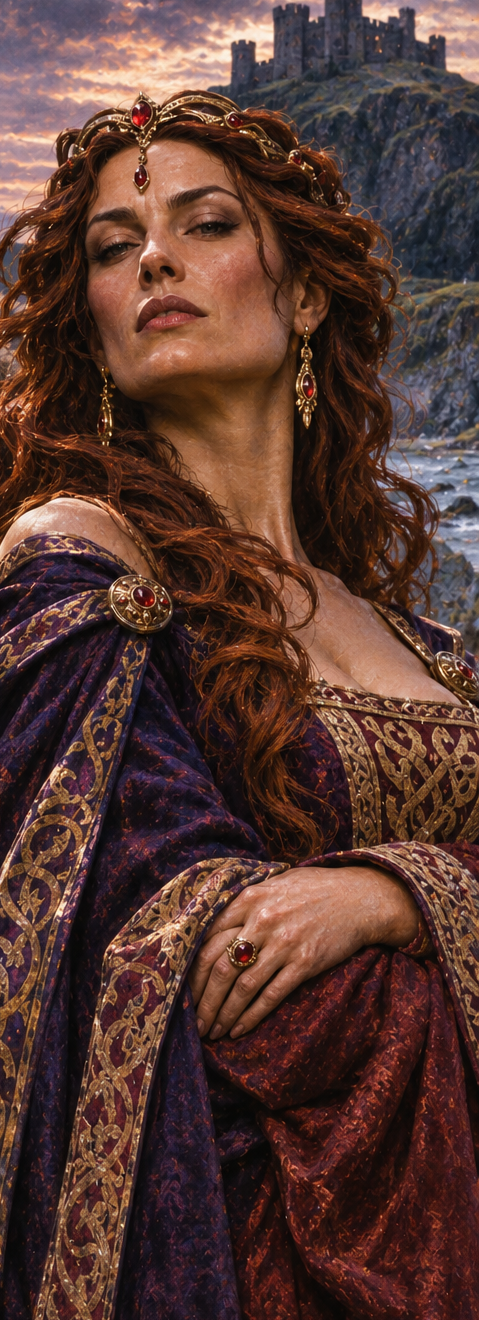
Morgause wears a purple mantle embroidered at its edges, but she sits without a crown while hearing petitioners. She has a judge’s habit of allowing a witness to finish even when the account is distasteful. At the mention of Orkney she grows still; at the mention of Arthur she asks the speaker to state the king’s precise claim.
She does not need sorcery to command a hall. She knows the order in which nobles take precedence, the costs of a winter garrison and the marriages that kept the northern kingdoms from fragmenting. She may offer sanctuary, a sealed pass or an honourable hearing. She cannot guarantee that angry warriors will obey her once their family pride is engaged.
Three Scenes Tonight
The broken seal. Two witnesses disagree on whether a letter authorises the arrest of a knight. The real seal-bearer has fled to the kitchens.
The guest in danger. Lamorak’s envoy claims the customary protection of a host. A northern captain has positioned guards to arrest him after sunset. Morgause must choose between appearing partial and allowing a guest to be killed.
The four sons. News arrives that Gawain, Agravain, Gaheris and Gareth have quarrelled over their father’s death. Morgause asks the characters to carry four different messages, because no single argument will reach them all.
Appearance and Character
Morgause knows how a fragile family becomes a political force. She is sometimes compassionate in private and calculating in public, not because the two qualities cancel one another but because her children live inside a dangerous royal settlement. A well-timed refusal to speak may protect an innocent person; it may also leave a rumour alive long enough to destroy a household.
Ambition: preserve Orkney’s honour without surrendering the lives of her sons. Pressure: the blood feud with Pellinore’s house and hostile gossip about Arthur and Mordred. Private knowledge: a witness to a family dispute still lives and fears both sides. Flaw: she expects royal authority to calm passions that have already outgrown the law.
Family, Crime and Consequence
In Malory’s genealogy, Morgause is Arthur’s half-sister and mother of his son Mordred. He is therefore maternal half-brother to the four sons of Lot, not a son of Lot in that version of the family. Earlier Arthurian traditions preserve different parentages; the differences are recorded as textual variants rather than simultaneously true events.
After Pellinore kills Lot, the Orkney family’s feud extends to Pellinore and his son Lamorak. Morgause enters a relationship with Lamorak. Her son Gaheris eventually kills her; the act is a murder, not a lawful sentence, and it does not make Lamorak responsible for the deed. Others later kill Lamorak, continuing the feud. The queen deserves a history of her own beyond the deaths of men around her.
Oaths, Hospitality and the Passage of Years
An audience with Morgause is often more perilous than a duel. She can recognise a valid claim to sanctuary while knowing that granting it will anger her household. A party may recover testimony, keep an envoy alive or prevent a forged command from setting brothers against brothers. No court favour compels a stranger’s obedience; influence must rest upon witnesses, obligation and trust.
When a traveller returns to 1454, this earlier queen remains a figure of the past. Her portrait, seals and surviving stories may exert political influence, but the normal laws of life and death are unchanged.
Game Statistics
Queen Morgause — D&D 2024
Medium Humanoid (Human), Neutral
Armor Class 13 (concealed leather armour); Initiative +2 (12); Hit Points 49 (9d8 + 9); Speed 30 ft.; Challenge 2 (450 XP; PB +2).
| STR | DEX | CON | INT | WIS | CHA |
|---|---|---|---|---|---|
| 10 (+0) | 14 (+2) | 12 (+1) | 16 (+3) | 14 (+2) | 18 (+4) |
Saving Throws Wis +4, Cha +6; Skills Deception +6, History +5, Insight +4, Perception +4, Persuasion +8; Senses passive Perception 14; Languages Brythonic, northern Brittonic court speech, Latin.
Traits
Royal Witness. When Morgause makes a Charisma (Persuasion) check to negotiate a truce or confirm a pledge with someone who acknowledges her position at court, she has Advantage. This is a social circumstance, not enchantment.
Remembered Oaths. Morgause can accurately recall the terms of an oath she personally witnessed unless magic has altered her memory.
Actions
Ceremonial Dagger. Melee Attack Roll: +4, reach 5 ft., one target. Hit: 4 (1d4 + 2) Piercing damage.
Royal Command (Recharge 5–6). Up to two allied creatures within 30 feet who hear and recognise Morgause can each use their Reaction to move up to half their Speed without provoking Opportunity Attacks. Only one of those allies may instead make one weapon attack. She cannot command a creature that refuses her authority.
Bonus Actions
Take Shelter. Morgause takes the Disengage action. She cannot use this feature again until she finishes a Short or Long Rest.
Reactions
Diplomatic Intervention (2/Day). When an allied creature within 30 feet that hears Morgause fails a Wisdom saving throw against being Frightened, she grants it a new saving throw. The ally uses the second result.
Tactics
She leaves open combat to guards. Her challenge arises from alliances, witness testimony and authority; she neither casts spells nor controls minds by royal birth.
Queen Morgause — D&D 2014
Medium humanoid (human), neutral. Armor Class 13 (leather armour); Hit Points 49 (9d8 + 9); Speed 30 ft.; Challenge 2 (450 XP).
| STR | DEX | CON | INT | WIS | CHA |
|---|---|---|---|---|---|
| 10 (+0) | 14 (+2) | 12 (+1) | 16 (+3) | 14 (+2) | 18 (+4) |
Saving Throws Wis +4, Cha +6; Skills Deception +6, History +5, Insight +4, Perception +4, Persuasion +8; Senses passive Perception 14; Languages Brythonic, northern court speech, Latin.
Traits
Royal Witness. Morgause has advantage on Charisma (Persuasion) checks concerning a truce, pledge or testimony that she witnessed when the other party recognises her courtly standing.
Remembered Oaths. She remembers every oath she personally witnessed unless magical memory alteration intervenes.
Actions
Dagger. Melee Weapon Attack: +4 to hit, reach 5 ft., one target. Hit: 4 (1d4 + 2) piercing damage.
Royal Command (Recharge 5–6). Up to two willing allies within 30 feet who can hear Morgause can each use their reactions to move up to half their speeds without provoking opportunity attacks. One ally may instead make a weapon attack.
Bonus Actions
Take Shelter (1/Short or Long Rest). Morgause takes the Disengage action as a bonus action, provided she is not Incapacitated.
Reactions
Diplomatic Intervention (2/Day). When an allied creature within 30 feet who hears Morgause fails a Wisdom saving throw against being frightened, she allows it to repeat that saving throw immediately, using the second result.
Tactics
Morgause withdraws behind her guard and bargains for hostages, witnesses or time. She is no battle mage; without sworn allies she is an ordinary court noble whose dagger is a last defence.
Queen Morgause — Pathfinder 1e
Queen Morgause CR 5; XP 1,600; N Medium humanoid (human), female human aristocrat 7; Init +5; Senses Perception +14.
Defense
AC 15, touch 12, flat-footed 14 (+3 studded leather, +1 Dex, +1 deflection); hp 38 (7d8 + 7); Fort +3, Ref +3, Will +9.
Offense
Speed 30 ft.; Melee masterwork dagger +6 (1d4/19–20); Ranged light crossbow +6 (1d8/19–20); Special Attack command the household.
Statistics
Str 10, Dex 12, Con 12, Int 16, Wis 14, Cha 18; Base Atk +5; CMB +5; CMD 17 (including +1 deflection).
Feats Improved Initiative, Iron Will, Skill Focus (Diplomacy), Skill Focus (Knowledge [nobility]), Alertness. Skills Bluff +14 (7 ranks), Diplomacy +17 (7 ranks), Intimidate +14 (7 ranks), Knowledge (nobility) +16 (7 ranks), Knowledge (history) +13 (7 ranks), Linguistics +13 (7 ranks), Perception +14 (7 ranks), Sense Motive +14 (7 ranks); Languages Brythonic, northern court speech, Latin (further regional languages at the GM’s discretion); Gear masterwork dagger, court clothes, concealed studded leather, ring of protection +1, ceremonial seals.
Special Abilities
Command the Household (Ex, 3/day). As a standard action Morgause gives up to two willing allied creatures who hear her a +2 morale bonus on saving throws against fear and on Sense Motive checks for 3 rounds. The benefit is not a compulsion and ends if she is unconscious.
Royal Audience (Ex). Her office can secure a hearing at a cooperative northern court. It provides no bonus against an enemy who does not recognise her authority.
Tactics and Ecology
Environment royal residences, camps and travelled courts; Organization unique (usually with household staff and guards); Treasure NPC gear above. Her challenge rating reflects NPC class levels and access to resources, not her ability to win a duel. She orders a retreat if a negotiation turns violent.
Queen Morgause — D&D 3.5e
Queen Morgause — Female human aristocrat 7; Medium humanoid (human); neutral; Challenge Rating 6; Hit Dice 7d8+7 (38 hp); Initiative +5; Speed 30 ft. (6 squares).
Defense
Armor Class 15 (+3 studded leather, +1 Dex, +1 deflection), touch 12, flat-footed 14; Fort +3, Ref +3, Will +9.
Offense
Base Attack/Grapple +5/+5; Attack masterwork dagger +6 melee (1d4/19–20) or light crossbow +6 ranged (1d8/19–20); Full Attack as attack; Space/Reach 5 ft./5 ft.
Abilities
Str 10, Dex 12, Con 12, Int 16, Wis 14, Cha 18; Feats Improved Initiative, Iron Will, Skill Focus (Diplomacy), Negotiator; Skills Bluff +14 (10 ranks), Diplomacy +19 (10 ranks), Intimidate +14 (10 ranks), Knowledge (nobility and royalty) +13 (10 ranks), Knowledge (history) +13 (10 ranks), Listen +12 (10 ranks), Sense Motive +14 (10 ranks), Spot +12 (10 ranks); Languages Brythonic, northern court speech, Latin; Possessions masterwork dagger, light crossbow, studded leather armour, ring of protection +1, personal seals and witnesses.
Special Abilities
Household Command (Ex, 3/day). As a standard action she gives up to two willing allied creatures who can hear her a +2 morale bonus on saving throws against fear for 3 rounds. This campaign-specific order is not an aristocrat spell or magical charm. Court Audience (Ex). She can use Diplomacy to request an audience among northern lords who acknowledge her office, subject to ordinary circumstances and opposition.
Tactics
Morgause stays protected by guards, relies on social leverage and tries to prevent a murder becoming a new war. In combat she defends herself but does not command absent troops or possess magical powers merely because of her lineage.
Sources and Licensing
Sir Thomas Malory, Le Morte d’Arthur, Book II (Lot, Morgause and their sons) and the later books treating Lamorak and the death of Morgause: public-domain text, volume I. For the family feud’s generational consequences, see Karen Cherewatuk, “Emotional Inheritance in Malory’s Morte Darthur,” Arthurian Literature XXXVIII (2023), DOI record. Other Arthurian lineages sometimes name different parents for Mordred; Malory’s genealogy is used here to match the published Orkney cluster.
The four NPC stat blocks are original RPG adaptations. The court-command actions are identified as original capabilities of this NPC, not official aristocrat class features. Artwork: original painted Morgause portrait prepared for the Arthurian NPC collection.
Browse Arthurian characters.
Keep this reference growing
If this page helped with your reading or game, you can support its upkeep or explore the curated books.
Explore the Bookshop — epics, classics and stories behind imagined worlds.