
The Inquisition of Flame and Iron
At a Glance
| Type | Inquisitorial faction; permanent network of tribunals, agents and armed officers |
|---|---|
| Leader | Tomás de Torquemada, Grand Inquisitor |
| Headquarters | Santa Cruz and the central chancery, Segovia |
| Power base | Crown of Castile and León |
| Wider network | Aragon, Catalonia, Valencia, Mallorca, Navarre, Granada, Aragonese Mediterranean possessions and Spanish-connected overseas settlements |
| Alignment | Lawful Evil under Torquemada; individual officials vary |
| Public faith | Sanctioned Olympian cults |
| Secret patron | Belial, known to a small inner circle |
| Mark | An iron ring and crimson flame above a two-pronged fork |
| Resources | Prisons, confessors, examiners, trained guards, regional archives, informants, confiscated wealth and spellcasting specialists |
The mounted officers enter the market before the gates close. Their leader presents a black writ bearing the flame-and-fork seal, and the town watch captain recognises it immediately. The named prisoner has fled. By dawn, his workshop is sealed and his neighbours are being questioned.
The Inquisition of Flame and Iron is one of the most feared institutions in the Spanish lands. It can follow a fugitive across borders, quietly impoverish a guild or compel a noble to answer a public accusation. Its greatest strength is not the number of soldiers it commands, but the records, patronage and terror that let it mobilise other people’s soldiers.
What Is Happening Right Now?
The crown and the tribunal clash. Henry IV wants an accounting of seized estates and the release of a royal officer. Torquemada demands renewed protection for his examiners and refuses to surrender the original interrogation ledger.
A letter reaches Palermo. A courier brings names of suspects who crossed from Valencia to Sicily. A Sicilian magistrate challenges the seal, while a courtier offers to deliver the prisoners discreetly for the right payment.
An inconvenient witness survives. A Castilian clerk has discovered a genuine infernal signature hidden beneath a tribunal warrant. His superiors order him to return to Segovia for questioning. He has already sent a copy to Princess Isabella.
Across the Spanish Lands
The Inquisition is one of the most powerful organisations in the Spanish lands. Its great courts are rooted in Castile and León, but its agents, patrons and rivals operate throughout Aragon, Catalonia, Valencia, Mallorca, Navarre, Granada and the islands and ports tied to the Iberian crowns. Its seal is recognised far beyond Torquemada’s own kingdom, though not every ruler is obliged to obey it. A traveller fleeing Castile may still find an informer waiting in Zaragoza, Valencia, Pamplona or Málaga. The Inquisition operates across political borders through cooperating courts, paid agents, merchant correspondence and covert missions, not by pretending all these lands are one kingdom.
Supreme head: Grand Inquisitor Tomás de Torquemada, who controls senior appointments, the central archive and the cases most dangerous to his office. Headquarters: Santa Cruz, Segovia. Jurisdiction: Established and publicly enforced across Castile and León. Wider influence: Powerful overt and covert networks throughout the other Spanish kingdoms, their frontier roads, ports and islands. Aragonese, Navarrese and Granadan rulers retain their sovereignty, and their courts can contest the Inquisition’s demands even when local officials or nobles cooperate with it.
Offices, Officers and Forces
- Central Council of Flame and Iron: Senior inquisitors, the Keeper of the Seals, the Master of Confiscations and a commander of armed officers manage the grand tribunal’s business. Torquemada judges disputes among them and keeps each dependent on his favour.
- Regional tribunals: Six principal Castilian circuits direct permanent and itinerant offices serving Segovia, Valladolid, Burgos, Toledo and the southern cities. Beyond Castile, Aragonese, Valencian, Catalan, Balearic and Navarrese allies maintain liaison offices or courts of their own; in Granada the Inquisition depends on concealed correspondents and collaborators. Provincial inquisitors seek witnesses and seize records where their patrons give them enforcement power.
- Examiners and clerks: Investigators, spellcasters, scribes, interpreters and record keepers preserve a network of depositions and confiscation registers. This memory is among the faction’s greatest weapons. A person acquitted in one town may find their name waiting in another.
- Captains and armed officers: Sworn bailiffs, mounted couriers, jailers and veterans carry out arrests and protect tribunals. When a major operation requires more force, the Inquisition draws on cooperating royal and municipal garrisons. These soldiers do not all belong personally to Torquemada.
- Informers and patrons: Merchants, guild rivals, frightened witnesses and ambitious nobles help the institution reach households no patrol could watch continuously. Most are not sworn members; several will sell information to an enemy if offered safety.
Where Its Influence Reaches
Castile and León: Its principal power base. Permanent courts, bailiffs, prisons, confiscation offices and access to garrisons give its orders practical force in the royal cities and surrounding territories. Castilian-controlled Atlantic islands and voyages encounter the same investigators through royal ports and shipping networks.
Aragon, Catalonia, Valencia and the Balearics: The Inquisition has influential court patrons, local collaborators and maritime intelligence. Its officers seek the aid of established authorities rather than simply replacing their laws. In Zaragoza an examiner can work through a noble ally; in Barcelona or Valencia merchants may be questioned through port inspections; Mallorca passes dangerous names between ships. Aragon’s overseas courts in Sardinia, Sicily and Naples can receive reports and fugitives’ descriptions through the same routes, though Torquemada has no blanket right to command them.
Navarre: Its succession struggle gives the Inquisition opportunities to finance informers, influence rival claimants and follow refugees across the Pyrenean passes. A local lord might invite inquisitorial assistance against a rival; a different faction may arrest the same agents as foreign spies.
Granada: The independent Nasrid court rejects Castilian tribunal rule. Torquemada nevertheless maintains agents in frontier markets and ports, pays smugglers for information, and supports collaborators near Málaga, Almería and the mountain roads. Their work is espionage and political interference, not lawful Granadan authority.
Portugal: A separate neighbouring kingdom, not one of the Spanish jurisdictions governed by Torquemada. Its merchants and Atlantic ports may encounter inquisitorial agents from Castile, but any local operation relies on Portuguese allies or covert activity rather than an automatic right to arrest.
Overseas Spanish Outposts and Claims
Torquemada also follows the Iberian crowns’ people, cargo and officials beyond Europe. In ports and islands where a Castilian or Aragonese governor actually controls a fort, quay or settlement, the Inquisition can request an inquiry, send an examiner, or receive prisoners and confiscation records through the colonial administration. On ships it can question sailors and passengers backed by an authorised captain. It does not gain jurisdiction over a whole island or coast merely because a European charter names it.
The Canary Islands: Torquemada’s influence reaches the Castilian-linked lordships and settlements on Lanzarote, Fuerteventura and El Hierro, and through supporters seeking control elsewhere in the archipelago. In 1454 the islands are not a single fully conquered Spanish possession. Gran Canaria, La Palma and Tenerife retain powerful independent island communities; their rulers and sacred practices are not subject to inquisitorial summons. Agents following Castilian captains may pursue fugitives or pressure local rulers, but an island court’s reach ends where its guards and allies cannot enforce it.
Eastern Hispaniola: The small foreign garrisons around the Ozama can receive inquisitorial visitors and requests for suspected fugitives. Their writ does not bind the Indigenous communities controlling inland roads and rivers, or the independent western shores.
The Gulf and New Spain claims: Torquemada seeks information from seaborne claimants, captains and merchants. Foreign charters promise more than their holders control: his agents can inspect an Iberian ship or work through a friendly coastal outpost, but they cannot issue enforceable orders to Totonac, Huastec, Maya or other independent authorities.
Spanish-connected western settlements and the ocean routes: Investigators travel with merchants, colonial officers and armed escorts where those communities exist, and report back to the central tribunal at Segovia. The reach of an informer is greater than the reach of an arresting force. Overseas abuses, disputes over local sovereignty and forged writs can therefore create enemies in Europe as well as across the Atlantic.
The Power It Exercises
Political: The grand tribunal can embarrass or ruin noble families, challenge royal magistrates and bargain directly with Henry IV’s councillors. It can influence which prisoners a town will surrender and whether a provincial lord’s allies remain free. An official who questions a confiscation risks becoming a subject of investigation.
Financial: Royal grants, religious endowments, confiscated estates and powerful patrons support its courts, guarded prisons, archives, horses and travelling officers. Rival administrators compete for control of those revenues. A noble might publicly praise Torquemada while privately demanding a share of the property he seizes.
Military: The Inquisition can close gates, escort prisoners across provinces, hold its buildings and make local guards assist in raids. It does not replace the crown’s armies, but it can make opposition costly without winning a pitched battle. The destruction of Hammerdeep shows what happens when its political connections permit a larger armed expedition.
Magical: Specialist examiners deploy divination, binding rites and protective spells. A smaller secret inner circle draws assistance from Belial. Ordinary officers need not know of the pact; some genuinely believe they are defending Castile against evil magic, even while the institution uses fear and false evidence to persecute the innocent.
Allies, Enemies and Fault Lines
King Henry IV: The crown has reasons to use the Inquisition and reasons to fear it. Torquemada can resist royal interference by threatening to expose supporters of rival cults within the court, but he still requires political allies and soldiers to enforce his judgments.
Princess Isabella: At twenty-four she is a powerful adult claimant. Her household may cooperate with honest investigators while sheltering witnesses from the tribunal’s abuses. Torquemada wants her support and her intelligence network, not her guardianship.
Independent nobles, towns and guilds: Some finance inquisitorial raids against business rivals; others hide endangered craftspeople or obstruct a warrant. Even inside the Inquisition, scrupulous examiners, corrupt captains and infernally compromised superiors pursue different ends.
Secret masters: Torquemada owes the hierarchy of Phlegethos an obedience he would never admit publicly. His own regional inquisitors would have grounds to turn against him if they obtained proof. The most dangerous record in the organisation is the one connecting his sacred proclamations to his infernal creditor.
What Its Reach Looks Like in Play
An inquisitor arrives with a clerk, an escort and a genuine seal; the gate captain knows the seal and lets them pass. The party can fight the escort, but the next morning the tribunal may close its workshop, impound its horses and question its friends. Conversely, a recovered ledger, an honest senior judge or an intervention from Isabella’s household can protect people without a battle. A local victory saves lives; a campaign against the faction follows the evidence through several towns until Torquemada’s authority itself is challenged.
The Inquisition has the discipline and resources to remain dangerous after a failed raid, yet it is not a single evil mind. Its internal divisions, genuine investigations and dependence on allies give the party choices beyond obedience or massacre.
Membership, Rewards and Punishments
New officers enter through patronage from an approved temple, a royal court or an established tribunal. Candidates are assigned to a superior, examined and entrusted with limited records. Some are earnest investigators of dangerous magic. Others are ambitious nobles, priests, mercenaries and administrators whose fortunes depend on Torquemada. Clerks who can verify handwriting, identify false testimony or keep accurate accounts are often more useful than an inexperienced spellcaster.
Members receive introductions to allied magistrates, protection from powerful patrons, access to archives, lodging at tribunal seats, escort for legitimate missions and the opportunity to command professional investigators. Successful examiners may become provincial judges; trusted captains can requisition guards from cooperating towns.
Members owe written obedience, sealed reports, official silence about pending trials and a duty to report failures. The institution rewards diligence and loyalty predictably, then punishes disobedience as a threat to order. A superior who invents evidence against an innocent family may be protected if the case benefits Torquemada, while an honest clerk who questions it may be prosecuted.
The Inquisition is not one evil mind. Honest examiners, frightened jailers, venal captains and covert servants of Hell inhabit the same institution. Their competing loyalties allow adventurers to protect victims, turn informers, expose corruption or enlist the help of officials who believe the tribunal has betrayed its mission.
What the Inquisition Can Do
Locate a fugitive: Circulate a description through merchants, hostels, patrol leaders, courier routes and friendly foreign offices. A traveller may be named on a second town’s notice before arriving there.
Ruin a household: Impound stock, question creditors, detain witnesses and prevent a craft guild from trading. These measures can destroy livelihoods without a single execution.
Counter a curse: Assign trained diviners, ward important documents and protect witnesses against enchantment. The danger is that a useful magical investigation may also become an excuse for confiscation.
Cross the sea: Rely on cooperating captains, port officials and local patrons to carry reports or prisoners through the Mediterranean and into Castilian-linked Atlantic settlements. Their actual jurisdiction does not extend merely because a map uses a Spanish name.
Be resisted: A forged writ can be unmasked, a confiscation ledger recovered, a vulnerable informer rescued, a regional judge persuaded or a competing lawful authority convinced to intervene. A broken chain of command can isolate one tribunal even while the wider organisation remains strong.
Adventure Hooks
The Two Warrants
Two inquisitorial courts demand the same prisoner, one in Castile and another in Valencia. Both seals are genuine, but the charges contradict each other. A frightened scribe says the second warrant was issued by the Grand Inquisitor’s private circle without the local court’s knowledge.
A Prisoner of Palermo
A captain refuses to surrender a dwarf wanted for heresy until the foreign examiner can prove the court has jurisdiction. The prisoner carries a metal tablet identifying the true purchaser of an infernal reliquary. Rival merchants have begun bidding for it.
The Council’s Secret Vote
A senior inquisitor plans to challenge Torquemada, but he needs support from three regional chiefs and proof that a devil entered the central archives. One chief is corrupt, another frightened, and the third requires evidence that an imprisoned witness is alive.
Running the Faction
Start with the people and institutions it can actually call upon. A local arrest force might consist of a clerk, one examiner and half a dozen guards. The provincial tribunal can bring veterans, diviners and allied officials. A politically sensitive case may eventually draw one of Torquemada’s inner-circle agents, and only the most serious threat brings the Grand Inquisitor himself. Use the actual participants’ statistics to judge a battle; the faction’s prestige does not make every guard a legendary opponent.
When adventurers defy an arrest, the next response may be a seized warehouse, a ruined commercial agreement, an informer following a friend or a rival court threatening to intervene. Let the characters earn concrete victories: a saved witness, a freed family, an exposed examiner, a legitimate reprieve or a great lord who will no longer enforce Torquemada’s orders. The institution changes when its people, money and allies change.
Sources and Artwork
The Inquisition of Flame and Iron and its supernatural allegiance are part of the setting’s alternate 1454 history. Its political jurisdiction is not a description of the historical Spanish Inquisition, founded in the late fifteenth century; likewise, older Atlantic charters and foreign outposts do not establish the colonial administrations of later centuries.
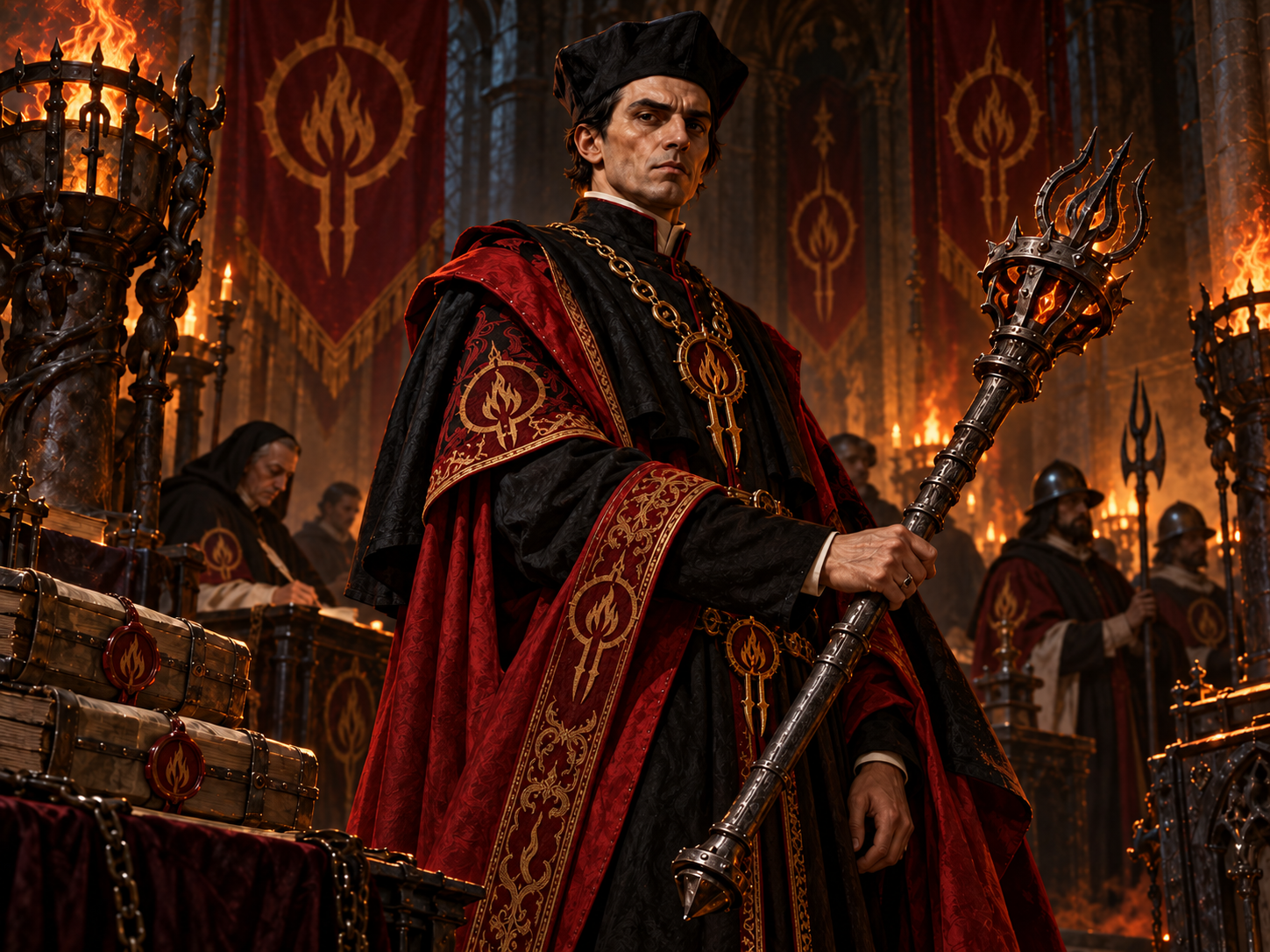
Hero: the painted Torquemada tribunal illustration already held in the site’s media library.
Keep this reference growing
If this page helped with your reading or game, you can support its upkeep or explore the curated books.
Explore the Bookshop — epics, classics and stories behind imagined worlds.