
At a Glance
| Location | Leicestershire · River Soar |
|---|---|
| Landscape | River Soar crossings, castle, civic hall, market and old Roman walls |
| Character | Major county town, castle jurisdiction and trading centre |
| Local authority | County and borough officers, noble households and trading guilds |
| Livelihood | Wool and cloth, leather, grain, legal business and river mills |

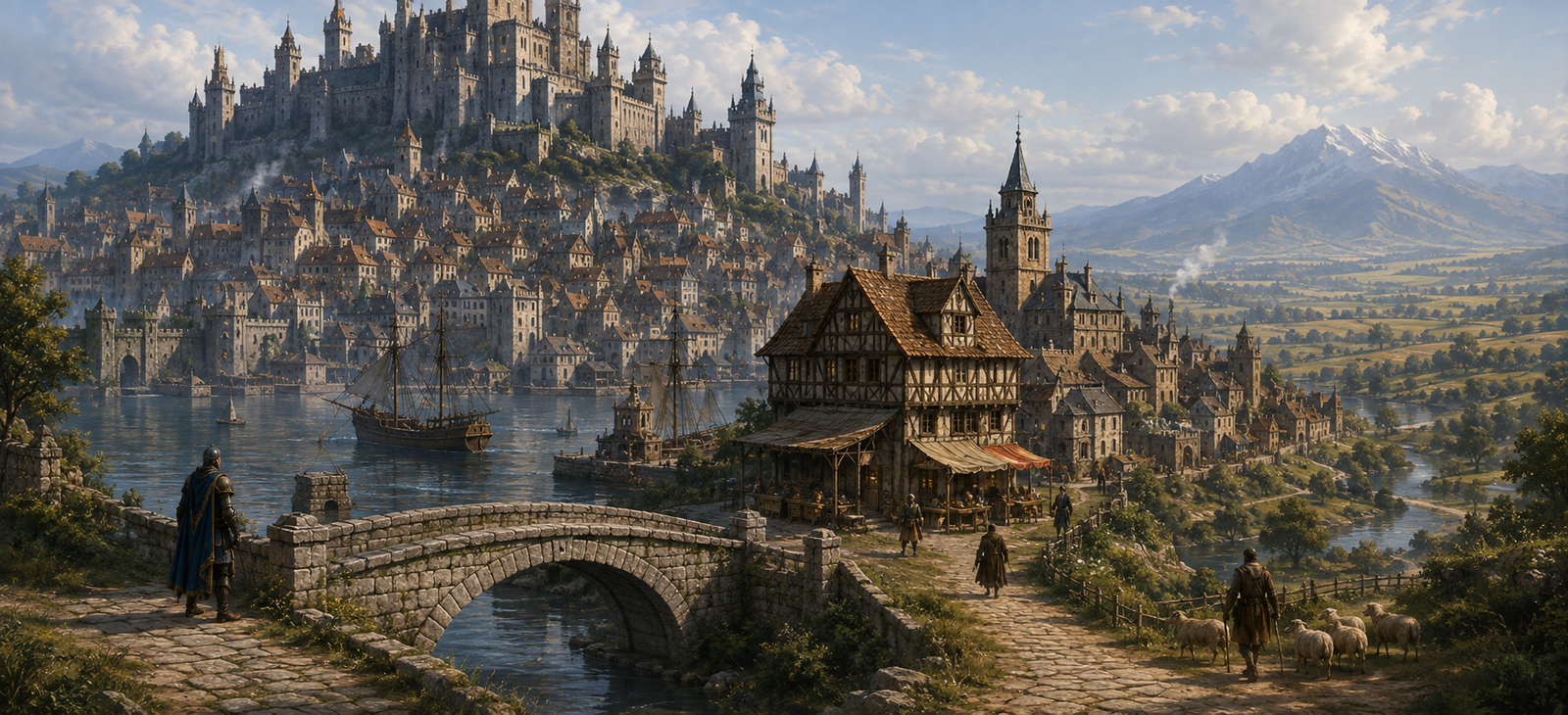
Leicester draws in wool traders, attorneys, apprentices and noble retainers with business at the castle. Its older streets still follow the Roman town in places. Beyond the busy market stand the castle hall and the Newarke precinct, where the county’s political business is as important as the price of flour.
What Is Happening Right Now?
A merchant guild has summoned a public meeting after a powerful household failed to pay for cloth delivered to the castle. The steward insists the material was requisitioned for royal business. A rival trader claims the warehouse record bears an altered signature.
Messengers arrive from London and Northampton carrying news of the protectorate. The town’s officers want peace in the market; men wearing rival badges already buy weapons in the same street.
Streets and Landmarks
The Castle and Great Hall
Leicester’s castle complex stands near the River Soar with a substantial hall for administrative and aristocratic business. A clerk may hear complaints there, but the authority to rule on a debt is contested.
The Guildhall
An important timber-framed hall has stood since about 1390 and is expanding in the fifteenth century. Its assembly rooms provide a meeting place for wealthy townspeople and guild interests, not a modern municipal council chamber.
Market and High Street
Cloth dealers, food sellers and leather workers crowd the busy trading streets. Commercial rivalry is visible in stalls, apprentices and official measures, and a stolen merchant’s seal could ruin more than one business.
The Newarke Precinct and Old Walls
The castle’s neighbouring sacred college houses shrines and clerks in this polytheistic setting. Surviving Roman walls and gates still shape movement. Older masonry draws antiquarians, masons and those looking for somewhere to hide contraband.
The Soar and Mills
Mills need predictable water, but their dams and wheel races can interfere with neighbours’ river access. A traveller hoping to transport bales north must first learn where carts can ford or cross.
Where to Eat, Drink, Sleep and Find Help
The Guilded Shears — market lane
Comfortable, costly. Host Cecily Mott keeps curtained beds, roast capon when stocked, wine, a guarded walled stable and private meeting space. Cloth factors and lawyers work here. Cecily has a ledger that contradicts a steward’s account of castle deliveries.
The Soar Reed — mill approach
Cheap, noisy and honest. Keeper Bartram Venn serves pottage, fish, coarse ale and shared straw pallets. Millworkers, boatmen and apprentices discuss the river’s condition. His key tenant has disappeared after a warehouse search.
Guild Scribes, Armourers and Bakers
Leicester can supply carefully copied charters, forged iron, travel food and horseshoes. Famous craftsmen do not accept every commission: the castle and major guilds have standing contracts.
People and Local Powers
Cecily Mott knows how court officials settle private debts; Bartram Venn represents river workers who cannot afford lost mill days. Guild factor Roland Fen suspects a falsified cloth account, while a noble steward insists politics, not trade, determines who pays. These are campaign roles rather than assertions of historical appointments.
Merchants, shrine officials and castle officers all wield different forms of authority. Reports from Nottingham about forest arrests concern Leicester traders who use that road.
Castle disputes and merchant rivalries still shape daily life. Outside the western approaches Black Annis takes animals from the Dane Hills holdings, and householders pay for locked doors and escorts after sunset. Merchants cannot ignore her when the roads bringing their livestock to market pass her hunting ground.
Dangers, Encounters and Choices
- Escort a guild clerk and the original wool account to a castle hearing.
- Investigate which mill sluice was opened at night, flooding two merchants’ storage yards.
- Keep rival retainers from fighting during a public oath ceremony at the hall.
Black Annis of Dane Hills
The Cave Beneath the Oak
Black Annis lives in a cave cut into the stone of the Dane Hills west of Leicester. Her face is blue, her claws are iron-hard, and she can tear at the rock with them. She comes out at night to take livestock and unwary people. Parents along the western approaches bar their doors before dusk, while drovers take longer roads rather than pass her hill alone.
She is not an ordinary annis hag encountered at random throughout England. The Dane Hills are her home. Nearby farms know which paths she uses, whose sheep she has taken and where the claw scores appear beside the cave. Her attacks have a cost: missing workers, abandoned grazing and travellers unwilling to bring animals into Leicester’s market.
The missing flock: sheep have disappeared from a hillside holding, and the shepherd’s youngest helper has seen Annis carrying one towards the oak. The party can track her, protect the next drove or enter the cave. Killing or driving her off is possible, but the hill is her chosen ground and the villagers need more than a promise that she will not return.
Travel, Roads and Local Law
The road south leads through Market Harborough to Northampton and thence London; north lies Loughborough, the Soar crossings and Nottingham. Travellers may also follow the river corridor or take roads toward the east Midlands, but those are not identical to the main itinerary.
County, borough and noble jurisdictions overlap. Carry a copy of any trade licence, and distinguish a lawful court order from a retainer’s personal demand.
Deeper History
Roman Ratae Corieltauvorum provides much of the town’s ancient street pattern. The Norman castle grew into a significant lordly and royal site. The medieval timber-framed Guildhall began about 1390 and was enlarged in the fifteenth century. Leicester’s later connection with Richard III’s death in 1485 is a future development, not something the people of the present campaign already remember.
Map and Geographic Orientation
This locator shows the present-day position of Leicester; its roads and buildings are not a reconstruction of the campaign town.
Sources and Continue Travelling
Local folklore research: Story of Leicester: Black Annis · Leicestershire Hidden Gems: Black Annis.
Historical geography, markets and buildings are documented in the sources below. Names of most innkeepers, current disputes and adventure hooks are original parts of the campaign.
Historic England — Leicester Guildhall · Leicester Museums — Guildhall
On the route: London · St Albans · Dunstable · Stony Stratford · Towcester · Northampton · Market Harborough · Leicester · Loughborough · Nottingham.
Keep this reference growing
If this page helped with your reading or game, you can support its upkeep or explore the curated books.
Explore the Bookshop — epics, classics and stories behind imagined worlds.