
Carboniferous · c. 359–299 million years ago
The Swamp Crown
Coal forests cover immense tropical lowlands. Giant arthropods cross drowned ground, amphibious hunters wait in black water, the first amniotes push beyond the swamps—and among the oldest forests, the first Elder Treants become living witnesses to a changing Earth.
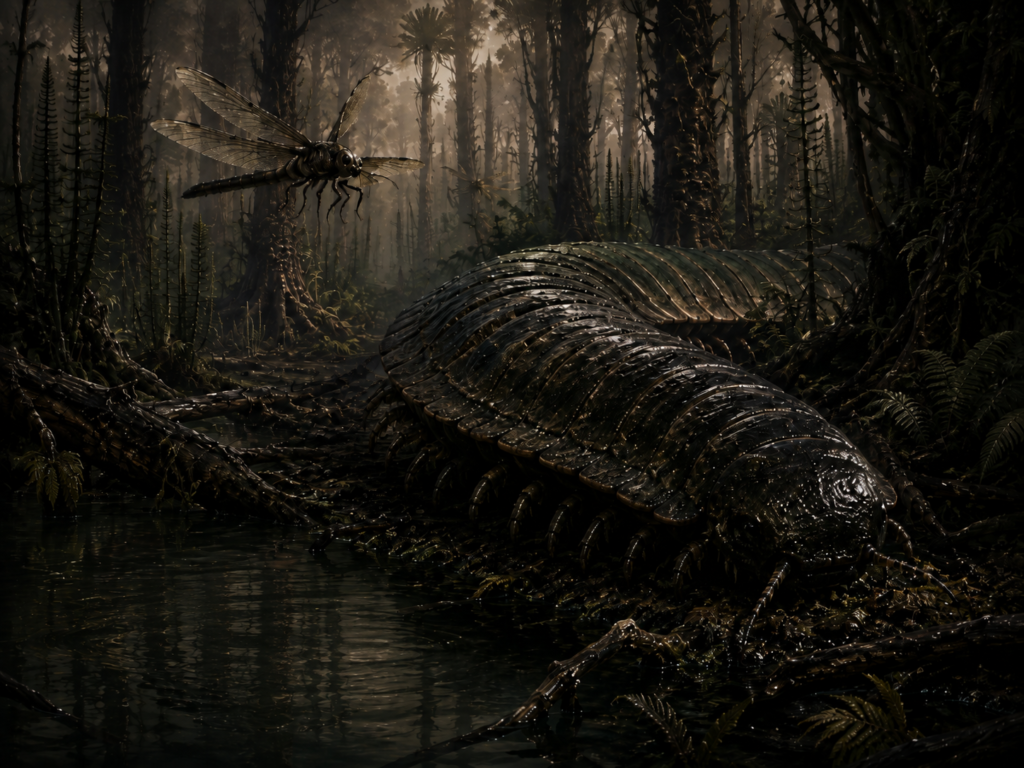
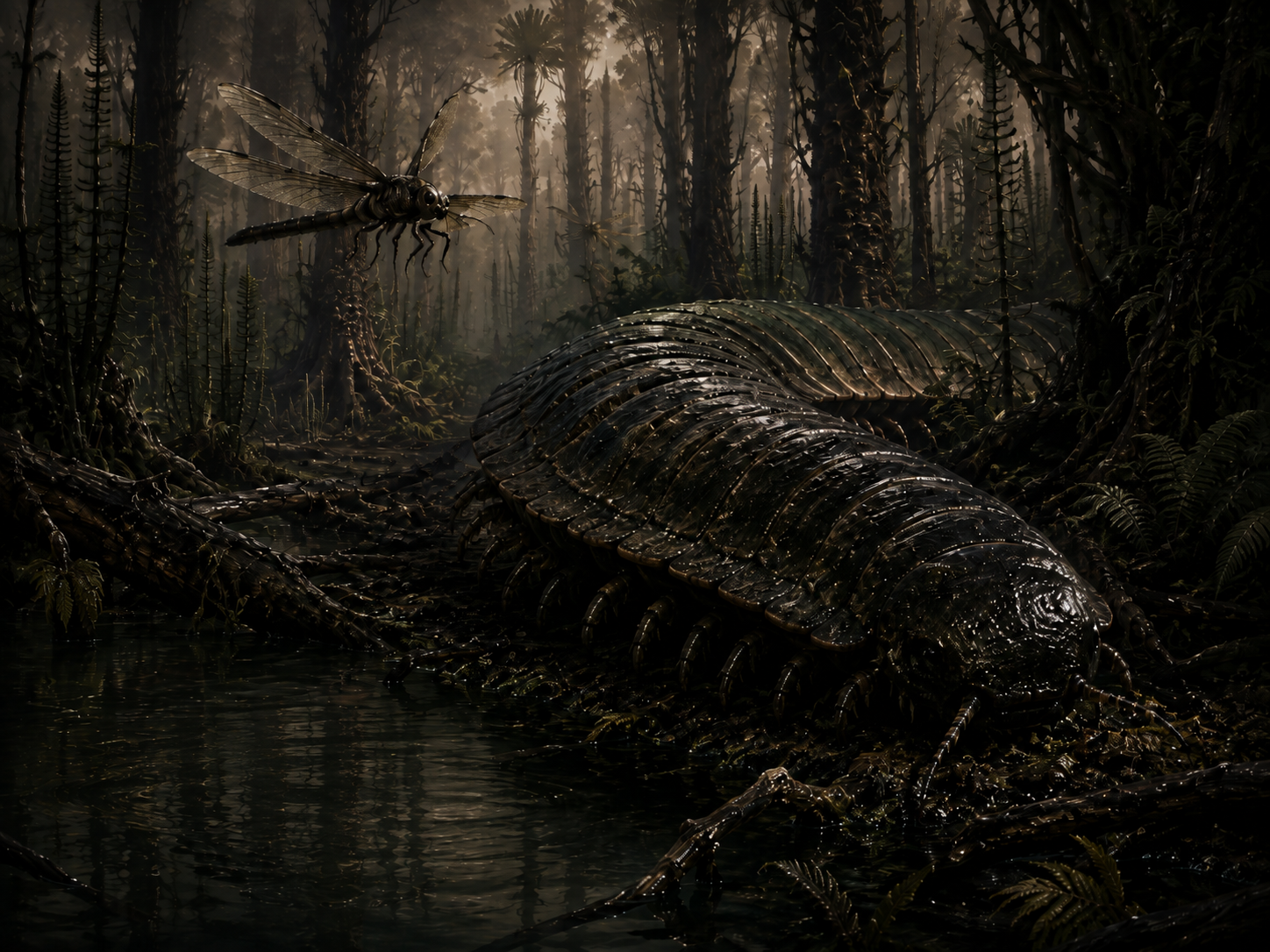
The Carboniferous is not merely an age of oversized insects. It is the first great terrestrial monster world in the chronology: a planet where dense forests alter the atmosphere, enormous arthropods move beneath the canopy, extinct tetrapods dominate many waterways and a quiet evolutionary innovation—the amniotic egg—begins to loosen vertebrate life from permanent dependence on open water.
A forest unlike any woodland of 1454
There is no grass beneath this canopy and no flowering meadow at its edge. Towering lycopsids, calamites, ferns and seed plants crowd immense tropical wetlands. Dead vegetation accumulates in waterlogged ground; buried and transformed across geological time, these forests become the coal seams mined hundreds of millions of years later.
Arthropleura beneath the trees
The most imposing traveller on the forest floor is Arthropleura. Its armoured segments ripple between roots and fallen trunks, leaving broad tracks across mudbanks. Over open water, enormous griffinflies can be represented by the Giant Dragonfly.
Something moves in the black water
Large tetrapods patrol pools, channels and drowned forest margins. Eogyrinus is a long-bodied ambush hunter suited to these slow, vegetation-choked waters. Calling such animals “amphibians” is convenient, but the Carboniferous is not a world of enlarged modern frogs: it is filled with extinct forms unlike anything a later natural philosopher will see alive.
The creatures that leave the swamp
Some small tetrapods acquire a decisive advantage: reproduction no longer requires eggs to remain in open water. Their descendants can push into woodland, uplands and seasonally dry country. From these lineages will eventually come both the mammal-line synapsids of the Permian and the reptilian dynasties of the Mesozoic.
The first living pillars
The oldest Elder Treants belong to the Carboniferous. They are not rulers of the planet and they do not command every forest. They are colossal, sentient hazards and witnesses: beings so vast that ordinary non-sentient animals barely register to them. Their concern is the health, continuity and memory of forests as wholes.
They arise within real Carboniferous ecosystems rather than replacing them. The coal forests are still built from terrestrial plant lineages; the Elder Treants are extraordinary inhabitants of those forests, not their supernatural explanation.
Treants emerge later
By the later Carboniferous, smaller and more mobile Treants appear. These are not merely juvenile Elder Treants. They become a distinct surviving people of living wood, capable of defending groves, remembering vanished climates and carrying fragmentary traditions into later ages.
The first monstrous plant predators
The late Carboniferous also sees predatory plant forms such as the Giant Flytrap. Plant monsters have distinct origins: there is no single global plant empire, no assumption that every carnivorous plant shares an origin, and no automatic civilisation attached to creature type.
Zuggtmoy and the breaking of the green refuges
By the later Carboniferous and into the Permian, the corruption associated with Zuggtmoy brings war into ancient fungal and plant ecologies. The conflict destroys many of the oldest living pillars. Surviving Elder Treants and Treants retreat into hidden refuges, sealed valleys, deep forests and places later ages will mistake for primeval wilderness untouched by history.
Wars no fossil can record
Earth is already ancient in the history of the Elder Things. Their surviving southern and undersea installations belong to a much older colonisation, and Carboniferous conflicts occur against that deep background.
Elder traditions also place renewed activity by Cthulhu and his Star-Spawn in this broad age. Their wars cross coastlines and ocean basins that later vanish. R’lyeh can survive as a remembered name; modern Pacific geography cannot simply be projected backwards hundreds of millions of years.
The green empire breaks—without vanishing
Ice advances and retreats across southern Gondwana. Sea level changes repeatedly. Climate becomes more seasonal, and once-continuous wet forests fragment. The famous coal-swamp world contracts into separated ecological refuges while drier-adapted vertebrates gain ground.
The giant arthropods do not disappear overnight. Amphibious predators remain in rivers and lakes. Treants survive. Hidden Elder Treants endure in increasingly isolated forests. But the balance has changed: the Swamp Crown is giving way to the drier supercontinent of the Permian.
What survives into later ages?
Treant refuges, buried plant sanctuaries, ancestral fungal scars, Carboniferous fossils, coal seams and isolated monster lineages can all survive into the campaign present.
Campaign use
A mine can break into a sealed forest chamber rather than ordinary coal; an Elder Treant can remember a coastline older than Pangaea; a supposedly “new” Zuggtmoy cult may be reopening a Carboniferous wound.
Carboniferous sequence
c. 359 Ma
Carboniferous begins; extensive tropical wetlands expand across equatorial regions.
Early–Middle Carboniferous
Giant arthropods and diverse tetrapods flourish; the oldest Elder Treants become established in great forest systems.
Late Carboniferous
Amniotes diversify; ordinary Treants and predatory plant monsters become established; ancient green refuges enter conflict with Zuggtmoy’s corruption.
c. 299 Ma
The Permian begins as Pangaea continues assembling and continental interiors become increasingly seasonal and dry.
Scientific and literary foundations
- International Commission on Stratigraphy — geological time boundaries and current chronostratigraphic framework.
- University of California Museum of Paleontology — Carboniferous — period overview, environments and life.
- H. P. Lovecraft’s Cthulhu Mythos supplies Cthulhu, Star-Spawn and the deep-time cosmic-horror tradition; That tradition is adapted here to the maintained chronology.
- Game-stat links lead to separate Bestiary pages; this timeline chapter is setting and chronology material rather than a stat block.
The Father of Serpents watches
Much later, the oldest cults of Yig remember the Carboniferous expansion of scaled life as the first great serpent-marking of the land.
The claim is not that Yig invents reptiles from nothing. Natural lineages are already diversifying across Earth. Serpent tradition instead claims that the Father of Serpents recognises certain bloodlines, favours them, alters some and begins a relationship with scaled life that will outlast continents.
The Carboniferous beneath 1454
Coal Forests
Every deep coal seam is a compressed forest. Mines may expose fossil roots, giant arthropod tracks or sealed pockets where ancient ecosystems survived.
Arthropleura Roads
Fossilised trackways left by Arthropleura may continue through stone into caverns where the tracks become fresh.
Black-Water Refuges
Deep rivers can preserve creatures resembling Eogyrinus in ecosystems untouched by surface ages.
Green Memory
Treants and the rare surviving Elder Treants can remember climates, forests and coastlines that existed before Pangaea fully assembled. Their testimony is living prehistory rather than folklore.
Adventures from the Swamp Crown
The Coal Road
Miners open a chamber filled with living Carboniferous vegetation. Fresh Arthropleura tracks cross the newly broken wall.
Black Water
Something shaped like Eogyrinus follows a boat through a subterranean river without once breaking the surface.
The Living Pillar
An Elder Treant awakens beneath a forest and recognises neither the kingdom above it nor the modern shape of the land. Its memory begins with vanished swamps and ends with a warning about an older fungal wound.
The Oldest Scar
A supposedly new cult of Zuggtmoy is actually reopening a Carboniferous refuge sealed after the destruction of ancient living pillars.
The real Carboniferous beneath the chronicle
The Carboniferous spans roughly 359–299 million years ago and includes vast coal-forming forest systems, giant arthropods, diverse tetrapods and the early radiation of amniotes. Supernatural inhabitants and hidden histories unfold within that geological framework.