
Sir Mordred — Arthur’s Rival and the Fall of Camelot
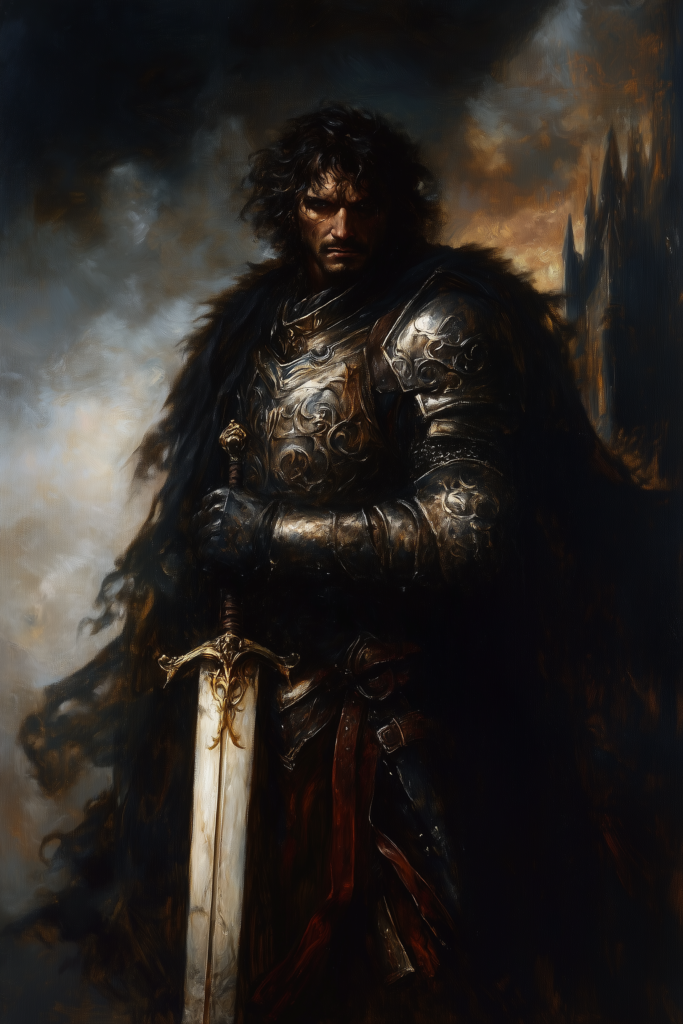
In 1454, a storm-dimmed passage beyond a barrow opens onto Camelot in the days before Camlann. Sir Mordred has been given command of a garrison during Arthur’s absence. A courier enters the hall carrying a letter that declares the king gravely wounded and urges the lords to recognise a new ruler. Mordred orders the doors closed until the message can be authenticated, while the herald beside him quietly begins replacing Arthur’s banners.
At a Glance
- Identity
- Sir Mordred, knight and would-be ruler of Britain
- Nature
- Human commander and political usurper; trained knight of the Round Table
- Family
- Son of Arthur and Queen Morgause in Malory; maternal half-brother of Gawain, Agravain, Gaheris and Gareth. Older traditions call him Lot’s son.
- Allegiance
- His own claim, garrisons willing to support it, discontented nobles and Agravain before the latter’s death
- Opposition
- Arthur, Guinevere and loyal officers who reject his forged claim
- Alignment
- Lawful Evil — uses the forms of authority, deliberate deceit and force to take a crown he has not lawfully earned
- Languages
- Brythonic, French court tongue and Latin
- Immediate danger
- A royal letter is false, and an official who examined its seal has vanished
On screen: Mordred is portrayed by Robert Addie in Excalibur (1981), a free adaptation of Arthurian legend.
What Is Happening Right Now?
Arthur’s fleet is abroad and his deputy must decide how the kingdom is governed. Mordred claims that the king has died and prepares to have himself crowned; the evidence consists of an official seal and a messenger whose account cannot be tested. Guinevere refuses the marriage he proposes and makes plans for refuge, while guards at the city gates are instructed to stop anyone carrying contrary news.
First Meeting
Mordred meets petitioners beneath Arthur’s banner, not his own. His black armour is carefully maintained, his sword an ordinary lethal weapon of good quality. He asks whether each visitor supports the safety of the realm. When challenged, he speaks of orderly government and the danger of civil war; he rarely admits that his orders created the crisis.
Three Scenes Tonight
- The sealed command: a royal scribe has disappeared after handling the alleged death letter.
- The queen’s refusal: Guinevere has sent a trusted maid to ask for discreet passage into safety.
- The western gate: a captain is being paid to seize anyone who bears Arthur’s genuine seal.
Appearance and Manner
Mordred looks like a capable noble soldier rather than a supernatural monster. He wears dark, finely worked plate and carries a straight sword and shield. His speech is formal when he needs the law on his side and coldly brief when he believes a listener can be frightened. He is persuasive because many people fear what will follow Arthur’s departure.
Ambition, Pressure and Private Knowledge
- Ambition: rule Britain in Arthur’s absence and force other lords to acknowledge his claim.
- Pressure: the approaching return of Arthur, the doubtful loyalty of his captains and the risk that Guinevere will reach the king first.
- Private knowledge: the claimed death letter does not match Arthur’s most recent instructions.
- Flaw: he treats public obedience as evidence that subjects believe him.
- Offer: a safe conduct, command of a gate or apparent legal title that becomes worthless if his fraud is exposed.
Relationships and Allegiances
Malory makes Mordred the son of Arthur and Morgause, half-brother to Gawain, Agravain, Gaheris and Gareth. He and Agravain conspire to expose the relationship between Lancelot and Guinevere; Agravain dies during the chamber confrontation, not at the subsequent rescue. Arthur leaves Mordred holding the realm while pursuing Lancelot abroad. Mordred then fabricates authority, attempts to force a marriage with Guinevere, and is defeated in the final battle at Camlann. In Geoffrey of Monmouth and some earlier accounts, his genealogy and conduct differ. He must not be made a son of Morgan le Fay simply because both names begin alike.
Game Statistics
Mordred is a commander of troops, witness to court secrets and skilled manufacturer of false authority. His power derives from loyal soldiers and political timing. He prefers forged orders, a sealed gate and disciplined armed followers to an open charge against the king.
Sir Mordred — D&D 2024
Medium Humanoid (Human), Lawful Evil
Armor Class 20 (plate, shield); Initiative +2 (12); Hit Points 150 (20d8 + 60); Speed 30 ft.; Challenge 10 (5,900 XP; PB +4).
| STR | DEX | CON | INT | WIS | CHA |
|---|---|---|---|---|---|
| 18 (+4) | 14 (+2) | 16 (+3) | 14 (+2) | 12 (+1) | 16 (+3) |
Saving Throws Str +8, Con +7, Wis +5, Cha +7; Skills Athletics +8, Deception +11, Intimidation +7, Insight +5; Senses passive Perception 11; Languages Brythonic and neighbouring court tongues.
Traits
Unyielding Claim (2/Day). If Mordred fails a saving throw, he can choose to succeed instead. His resolve does not compel other people to obey him.
Seize Authority. Mordred has Advantage on Charisma (Deception) checks to pass as a lawful officer where his seal has already been accepted, though witnesses can expose the forgery.
Marshal's Discipline. Allies within 30 feet who can hear Mordred gain a +2 bonus to saving throws against being Frightened, provided he is not Incapacitated.
Actions
Multiattack. Mordred makes three Black Longsword attacks. A mounted lance charge is a separate action, not part of Multiattack.
Black Longsword +1. Melee Attack Roll: +9 to hit, reach 5 ft., one creature. Hit: 9 (1d8 + 5) Slashing. The blade is a finely made royal weapon, not a source of automatic necrotic damage.
Mounted Charge. Melee Attack Roll: +8 to hit, reach 10 ft., one creature while mounted. Hit: 9 (1d10 + 4) Piercing plus 9 (2d8) Piercing if his mount moves at least 20 feet in a straight line toward the target before the attack. One attack only.
Close the Road (Recharge 5–6). Up to three willing allies within 30 feet who can hear Mordred may use their Reactions to move up to 15 feet without provoking Opportunity Attacks, ending in a position that threatens a gate, path or doorway.
Bonus Actions
Countermand (2/Day). Mordred chooses one allied creature within 30 feet that can hear him. It gains 10 Temporary Hit Points and can immediately move 5 feet without provoking Opportunity Attacks.
Reactions
Parry. When hit by an attack he can see, Mordred adds +3 AC against that attack, potentially making it miss. He must have his sword or shield at hand.
Legendary Actions
Advance (1 Use). Mordred moves up to half his Speed without provoking Opportunity Attacks.
Cut Down (1 Use). Mordred makes one Black Longsword attack. He has two legendary-action uses, regained at the start of his turn, which he spends at the end of another creature’s turn while not Incapacitated.
Tactics
Mordred wins with legal-looking orders, loyal garrisons, watchful scouts and surprise reinforcements. He turns away from a duel if a forged command can win the gate; his power is military and political rather than an assumed curse.
Sir Mordred — D&D 2014
Medium humanoid (human), lawful evil
Armor Class 20 (plate, shield); Hit Points 150 (20d8 + 60); Speed 30 ft.; Challenge 10 (5,900 XP; PB +4).
| STR | DEX | CON | INT | WIS | CHA |
|---|---|---|---|---|---|
| 18 (+4) | 14 (+2) | 16 (+3) | 14 (+2) | 12 (+1) | 16 (+3) |
Saving Throws Str +8, Con +7, Wis +5, Cha +7; Skills Athletics +8, Deception +11, Intimidation +7, Insight +5; Senses passive Perception 11; Languages Brythonic and neighbouring court tongues.
Traits
Unyielding Claim (2/Day). If Mordred fails a saving throw, he can choose to succeed instead. His resolve does not compel other people to obey him.
Seize Authority. Mordred has Advantage on Charisma (Deception) checks to pass as a lawful officer where his seal has already been accepted, though witnesses can expose the forgery.
Marshal's Discipline. Allies within 30 feet who can hear Mordred gain a +2 bonus to saving throws against being Frightened, provided he is not Incapacitated.
Actions
Multiattack. Mordred makes three Black Longsword attacks. A mounted lance charge is a separate action, not part of Multiattack.
Black Longsword +1. Melee Weapon Attack: +9 to hit, reach 5 ft., one creature. Hit: 9 (1d8 + 5) Slashing. The blade is a finely made royal weapon, not a source of automatic necrotic damage.
Mounted Charge. Melee Weapon Attack: +8 to hit, reach 10 ft., one creature while mounted. Hit: 10 (1d12 + 4) Piercing plus 9 (2d8) Piercing if his mount moves at least 20 feet in a straight line toward the target before the attack. One attack only.
Close the Road (Recharge 5–6). Up to three willing allies within 30 feet who can hear Mordred may use their Reactions to move up to 15 feet without provoking Opportunity Attacks, ending in a position that threatens a gate, path or doorway.
Bonus Actions
Countermand (2/Day). Mordred chooses one allied creature within 30 feet that can hear him. It gains 10 Temporary Hit Points and can immediately move 5 feet without provoking Opportunity Attacks.
Reactions
Parry. When hit by an attack he can see, Mordred adds +3 AC against that attack, potentially making it miss. He must have his sword or shield at hand.
Legendary Actions
Advance (1 Use). Mordred moves up to half his Speed without provoking Opportunity Attacks.
Cut Down (1 Use). Mordred makes one Black Longsword attack. He has two legendary-action uses, regained at the start of his turn, which he spends at the end of another creature’s turn while not Incapacitated.
Tactics
Mordred wins with legal-looking orders, loyal garrisons, watchful scouts and surprise reinforcements. He turns away from a duel if a forged command can win the gate; his power is military and political rather than an assumed curse.
Sir Mordred — Pathfinder 1e
Sir Mordred, CR 13; XP 25,600; human fighter 14; Medium humanoid (human); Init +6.
Defense
AC 27, touch 13, flat-footed 25 (+10 armor, +4 shield including Shield Focus, +2 Dex, +1 deflection); hp 133 (14d10 + 42, Toughness +14); Saving Throws Fort +14, Ref +8, Will +9.
Offense
Speed 30 ft. in armour (Armour Training 3); Melee +2 longsword +25/+20/+15 (1d8+13/17–20); Ranged javelin +16/+11/+6 (1d6+4); BAB +14; CMB +18; CMD 31.
Statistics
Str 18, Dex 14, Con 16, Int 14, Wis 12, Cha 16
Feats Weapon Focus (longsword), Greater Weapon Focus (longsword), Weapon Specialization (longsword), Greater Weapon Specialization (longsword), Improved Critical (longsword), Power Attack, Cleave, Great Cleave, Improved Initiative, Mounted Combat, Ride-By Attack, Spirited Charge, Combat Reflexes, Iron Will, Shield Focus, Toughness.
Skills Ride +16 (including full-plate and shield penalties), Intimidate +20, Bluff +17, Diplomacy +17.
Equipment
+1 full plate, +1 heavy steel shield, +2 longsword, cloak of resistance +2, ring of protection +1, warhorse and sealed letters
Special Abilities and Tactics
Armour Training 3, Bravery +4, Weapon Training (heavy blades) +3. Shield Focus supplies +1 additional shield AC. No spellcasting.
He directs reserves through gates and keeps trusted officers near the royal seal. His ambition is dangerous because people recognise his authority, not because his blade casts dark magic.
Sir Mordred — D&D 3.5e
Sir Mordred, CR 14; human fighter 14; Medium humanoid (human); Init +6.
Defense
AC 24, touch 12, flat-footed 23 (+9 armor, +3 shield, +1 Dex, +1 deflection); hp 119 (14d10 + 42); Saving Throws Fort +14, Ref +8, Will +9.
Offense
Speed 20 ft. in plate; Melee +2 longsword +22/+17/+12 (1d8+10/17–20); Ranged javelin +16/+11/+6 (1d6+4); BAB +14; Grapple +18.
Statistics
Str 18, Dex 14, Con 16, Int 14, Wis 12, Cha 16
Feats Weapon Focus (longsword), Greater Weapon Focus (longsword), Weapon Specialization (longsword), Greater Weapon Specialization (longsword), Improved Critical (longsword), Power Attack, Cleave, Great Cleave, Improved Initiative, Mounted Combat, Ride-By Attack, Spirited Charge, Combat Reflexes, Iron Will.
Skills Ride +19, Intimidate +20, Bluff +11, Sense Motive +8.
Equipment
+1 full plate, +1 heavy steel shield, +2 longsword, cloak of resistance +2, ring of protection +1, royal seal and warhorse
Special Abilities and Tactics
Fighter bonus feats, mounted combat and martial weapon proficiency, without the Pathfinder Armour Training or 5e legendary actions.
A disciplined commander who uses written authority and strong defenders; trained enemies can still rally people against a forged order.
Running Sir Mordred
Do not make Mordred merely shout that he is the rightful king. He makes plans, negotiates with wavering officials and expects his men to act before a challenge becomes public. Characters who acquire authentic letters or protect a trustworthy witness may weaken his power more effectively than challenging him in the courtyard.
Five Encounters
- The false death letter: the sealed order is contradicted by a rider who has seen Arthur alive.
- The altered gate book: a list of authorised messengers now names Mordred’s captains as royal officers.
- The queen at the tower: Guinevere has taken refuge while the usurper orders guards to block her exit.
- The broken oath: a knight asks the adventurers to witness his resignation rather than serve a forged regency.
- The road to Camlann: a battlefield messenger seeks the last chance to prevent the two armies from charging.
Six Adventure Hooks
- A document bearing Arthur’s seal appears in 1454, but it is dated to the week of Mordred’s coup.
- A guard captain knows the king is alive and is being held so he cannot contradict Mordred’s herald.
- Guinevere needs discreet escort while the city gates are watched.
- An officer who joined the rebellion wants proof that Mordred lied before he changes sides.
- One of Agravain’s servants has concealed evidence about the night in Guinevere’s chamber.
- A magical road leads from 1454 to Camlann at the hour when a single honest messenger could prevent the first attack.
Equipment, Travel and Consequences
Mordred carries a sword, shield, full armour and the seals of the royal government; a reliable warhorse carries him to the field. His authority in the older court is supported by garrisons and couriers, not by modern institutions or an army of undead. A crossing from the campaign’s 1454 world reaches the crisis before Camlann; the historical battle is not an event happening at the contemporary English court.
Deeper History
In the Welsh annals Medraut is named at Camlann without an explicit judgement of betrayal. Geoffrey of Monmouth makes Mordred a nephew of Arthur and usurper in the king’s absence; the Vulgate cycle and Malory use Arthur’s son by his unknown half-sister. In Malory he and Agravain seek proof against Lancelot and Guinevere, and the violent loss of the queen’s defenders drives Gawain to demand war. Mordred exploits Arthur’s continental campaign, claims the throne and tries to marry Guinevere. His final encounter with Arthur destroys them both as earthly rulers; the king is carried to Avalon. A tale of prophecy may frame the tragedy, but the usurper’s lies and orders remain his own decisions.

Sources and Related People
- University of Rochester, Camelot Project — frequently asked questions, Mordred traditions.
- Malory, Le Morte d’Arthur, the last war and Gawain’s final letter.
- Camelot Project — Morgause, the parentage in the Vulgate and Malory.
- Related: Arthur, Gawain, Agravain, Guinevere, Lancelot.
Keep this reference growing
If this page helped with your reading or game, you can support its upkeep or explore the curated books.
Explore the Bookshop — epics, classics and stories behind imagined worlds.