
Johannes Kepler — Celestial Navigator of Prague
At a Glance
| Role | Johannes Kepler, human mathematician and celestial navigator |
|---|---|
| Alignment | Lawful Neutral, seeking precision despite powerful patrons |
| Campaign present | 1454; working with Prague’s celestial project |
| Allies and rivals | Nicolaus Copernicus, Tycho Brahe and scholars commissioned by competing Bohemian factions |
| Languages | German, Latin and scholarly Greek |
| Beliefs | Private devotion; studies several celestial traditions without serving a single temple |
| Family and colleagues | Swabian correspondents, Prague scholars and experienced navigators |
| Resources | Observations, astrolabes, orreries and navigation tables; his science is not innate combat magic |
| Personal threat | Noncombatant scholar |
An expedition waits for the dawn departure, but Kepler’s astronomical tables show that its advertised course is impossible. Someone has altered the observations, and the patron demands silence.
What Is Happening Right Now?
One copy of the Prague Celestial Project’s departure chart has vanished, while a rival copy directs a vessel into an untested celestial crossing. Kepler wants the original observations recovered before the crew departs. Both sides in the Bohemian court want him to endorse their chart, and one has offered the adventurers a sealed warrant to seize his notes.
In Prague in 1454, Johannes Kepler calculates the paths of worlds for vessels that dare to travel between them. He was born in Weil der Stadt in Swabia and learned mathematics through scholars, travelling instrument makers and celestial records far older than the Bohemian Crown. His work now brings him into the dispute between Ladislaus the Posthumous’s household and George of Poděbrady’s officers: both want charts they can trust, and neither will accept responsibility for a lost ship.
Kepler’s studies have brought him into contact with the remarkable instruments and returned voyage records of the Prague Celestial Project. He reads the paths of planets from observations, reconstructed star tables and the testimony of navigators who have seen the heavens from beyond Earth. His calculations show that a famous chart may point to two very different destinations, depending on the date of departure. He has begun to suspect that an ancient navigator deliberately concealed the true interval.
Kepler searches for mathematical order in the heavens, but he does not presume that any single temple or court owns the truth. His notebooks compare observations with old cosmologies and surviving accounts of the planets. He is willing to contradict a powerful patron when an instrument gives a different result, which makes him useful to fellow scholars and dangerous to those trying to conceal a failed expedition.
The next aethership is being provisioned while Kepler, Copernicus and Tycho Brahe argue over its departure chart. A copied record has disappeared from the university; the original shows a position in space at which an earlier crew ceased sending signals. Kepler wants an independent party to trace the stolen sheet before the ship departs under a false course.
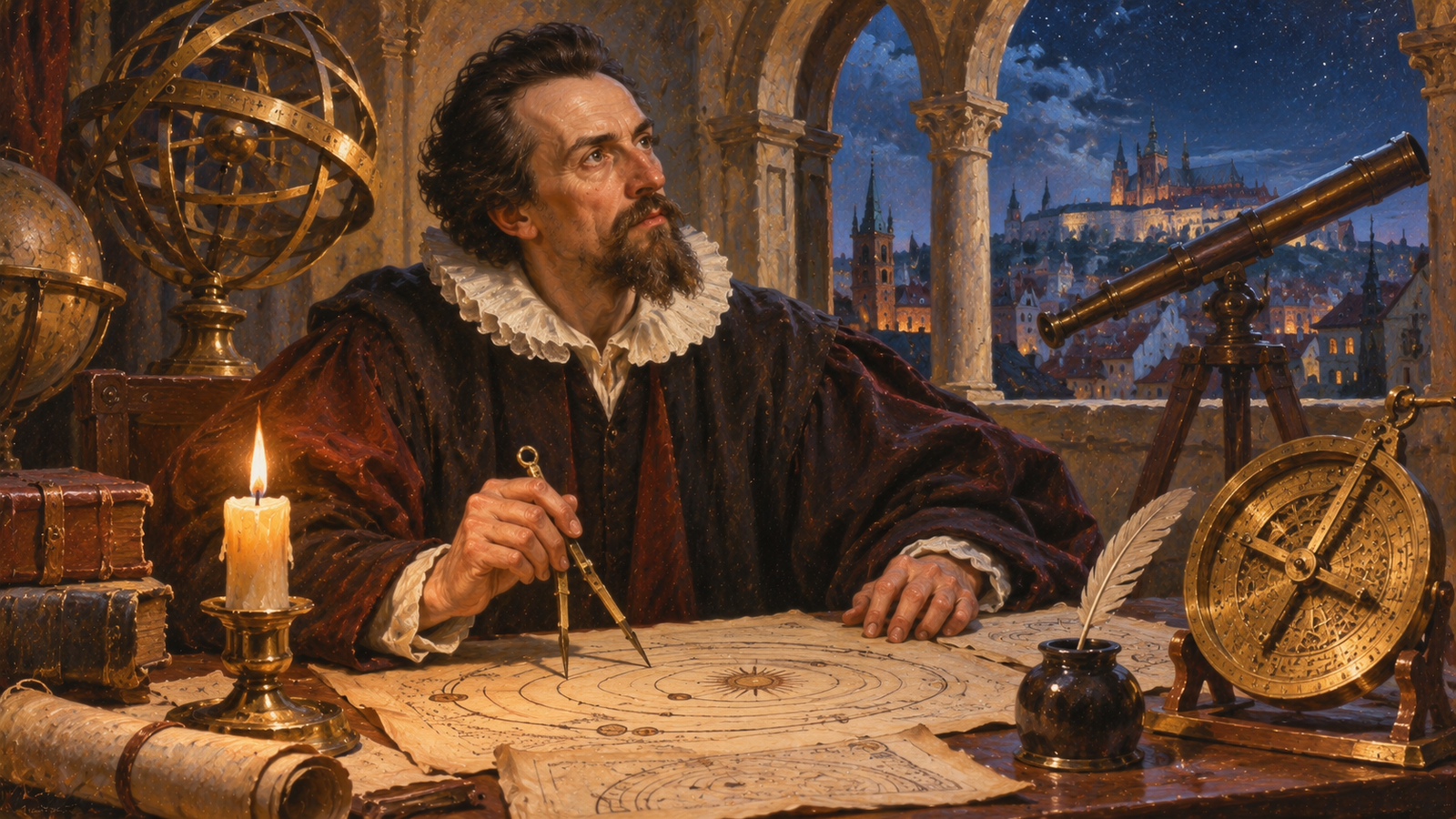
Kepler is a reserved, ink-stained scholar who carries finely ruled charts, a brass instrument case, a long sighting tube and an enchanted telescope capable of observing faint celestial movements. His quarters contain an orrery assembled from several centuries of parts. He often forgets a meal while reducing a column of figures, yet notices immediately when someone has disturbed the order of his notes.
The Navigator in Person
Kepler enters a discussion with a stack of closely written tables and an impatient objection to a misleading measurement. He is courteous toward careful work and sharp with boastful patrons who demand the right answer before an experiment begins. His Lawful Neutral outlook values method, exact recordkeeping and obligations to the crew; his caution can make him slow to tell a powerful sponsor an inconvenient truth.
Appearance and voice. He wears practical academic clothing, carries a well-used brass rule and keeps sheets of numerical corrections in his sleeve. He speaks briskly, interrupts himself to correct a figure and stares past a visitor when he sees a pattern forming. His intensity is not madness or a supernatural gift. When an ally brings him trustworthy evidence, he sets aside his pride and revises the chart.
Factions, Relationships and Resources
Tycho Brahe supplies exact sightings; Kepler challenges explanations that fit only part of the evidence. Copernicus offers a sun-centred model and scholarly correspondence. The Prague Celestial Project provides access to an instrument chamber, expedition records and political patrons, but not a private army. Bohemian court officers, merchants and temple scholars each want different uses for the same observations.
Kepler maintains an astrolabe, sighting tube, annotated observations, an orrery and an enchanted telescope whose reach depends on the instrument’s enchantment. A reliable chart can be traded, copied or forged. He can teach a skilled crew how to verify a departure course, but he cannot summon magic missiles, teleport in combat or create time rifts through mathematical insight alone.
Secrets, Rumours and Adventures
- The altered ephemeris. A navigation chart contains a deliberate one-day shift. Its author may be protecting a hidden route rather than merely sabotaging a voyage.
- Tycho’s missing lens. A precision lens is replaced by a poor copy before the final observation. Find the thief without accusing every astronomer who entered the chamber.
- The two patrons. A messenger from the Bohemian crown and one from a rival lord offer opposite instructions; Kepler has promised impartial testimony to both.
- The silence beyond the moon. A returned vessel carries a map of a place where its sister ship stopped signalling. Kepler needs a crew willing to check the coordinates.
- The false comet. A preacher announces a celestial omen based on an observation nobody can repeat. Is it a hoax, an illusion or a new body in the heavens?
Rewards and Consequences
If a party recovers the records, Kepler can provide a corrected departure table, access to the Prague instrument chamber and a recommendation to reputable pilots. If the forged calculation reaches an expedition first, people may die before the error is traced. His testimony can shame a court patron but cannot force a Bohemian noble to obey. The central danger lies in how powerful patrons use his calculations.
What the Observatory Offers
His laboratory houses star tables, an orrery and an enchanted telescope whose unusual range is a property of that particular item, not a power innate to Kepler. Sabotaging the telescope can endanger aether travel without changing Kepler’s own abilities.
Travel, Law and Connections
Kepler’s work brings visitors to the Prague Celestial Project. Its patronage does not guarantee safe passage elsewhere in the Empire. The Empire NPC directory includes scholars and political patrons with competing interests in celestial travel.
NPC Statistics
Johannes Kepler — D&D 2024
Medium Humanoid (Human), Lawful Neutral
AC 12 (travelling clothes)
Initiative +2 (12)
HP 18 (4d8)
Speed 30 ft.
| Ability | Score | Mod | Save |
|---|---|---|---|
| STR | 8 | −1 | −1 |
| DEX | 14 | +2 | +2 |
| CON | 10 | +0 | +0 |
| INT | 20 | +5 | +5 |
| WIS | 16 | +3 | +3 |
| CHA | 10 | +0 | +0 |
Skills Arcana +9, History +9, Investigation +9, Perception +5
Senses Passive Perception 15
Languages German, Latin, Greek
CR 1/8 (25 XP; PB +2).
Traits
Orbital Mathematics. Kepler has Advantage on Intelligence (Investigation) checks to identify faulty celestial calculations when he has appropriate records and at least 10 minutes of uninterrupted work.
Actions
Dagger. Melee or Ranged Attack Roll: +4, reach 5 ft. or range 20/60 ft. Hit: 4 (1d4+2) Piercing damage.
Reactions
Spot the Error (1/Day). When a creature within 30 feet of Kepler makes an Intelligence (Investigation) check using a table of observations Kepler can see, he can use his Reaction to add 1d4 to that roll before its outcome is known.
Johannes Kepler — D&D 2014
Medium humanoid (human), lawful neutral
Armor Class 12 (travelling clothes)
Hit Points 18 (4d8)
Speed 30 ft.
| STR | DEX | CON | INT | WIS | CHA |
|---|---|---|---|---|---|
| 8 (−1) | 14 (+2) | 10 (+0) | 20 (+5) | 16 (+3) | 10 (+0) |
Skills Arcana +9, History +9, Investigation +9, Perception +5
Senses passive Perception 15
Languages German, Latin, Greek
Challenge 1/8 (25 XP).
Traits
Orbital Mathematics. Kepler has advantage on Intelligence (Investigation) checks to check a chart against his observations after 10 minutes of work.
Actions
Dagger. Melee or Ranged Weapon Attack: +4 to hit, reach 5 ft. or range 20/60 ft., one target. Hit: 4 (1d4+2) piercing damage.
Reactions
Spot the Error (1/Day). When a creature within 30 feet of Kepler makes an Intelligence (Investigation) check to interpret observations he can see, Kepler can use his reaction to add 1d4 to the roll before the outcome is known.
Johannes Kepler — Pathfinder 1e
LN Medium humanoid (human), expert 6
CR 4; XP 1,200; Init +2; Senses Perception +14.
Defense
AC 12, touch 12, flat-footed 10; hp 27 (6d8); Fort +2, Ref +4, Will +10.
Offense
Speed 30 ft.; Melee dagger +3 (1d4−1/19–20); Ranged dagger +6 (1d4−1/19–20).
Statistics
Str 8, Dex 14, Con 10, Int 20, Wis 16, Cha 10; BAB +4; CMB +3; CMD 15; Skills Knowledge (arcana) +17, Knowledge (geography) +17, Knowledge (the planes) +14, Knowledge (history) +14, Linguistics +14, Perception +14, Profession (astronomer) +12, Craft (instruments) +14, Knowledge (engineering) +14, Sense Motive +12; Feats Skill Focus (Knowledge [arcana]), Skill Focus (Knowledge [geography]), Iron Will, Alertness; Languages German, Latin, Greek; Gear star charts, astrolabe, papers, dagger; Class skills the ten listed skills.
Special Abilities
Charting Instruments (Ex). After using accurate instruments for 10 minutes, Kepler gains a +2 circumstance bonus on Knowledge (geography) checks to calculate a known celestial route.
Johannes Kepler — D&D 3.5e
Human expert 6, lawful neutral
| Size/Type | Medium Humanoid (Human) |
|---|---|
| Hit Dice | 6d6 (21 hp) |
| Initiative | +2 |
| Speed | 30 ft. (6 squares) |
| Armor Class | 12, touch 12, flat-footed 10 |
| Base Attack/Grapple | +4/+3 |
| Attack | Dagger +3 melee (1d4−1/19–20) or +6 ranged (1d4−1/19–20) |
| Full Attack | Dagger +3 melee (1d4−1/19–20) or +6 ranged (1d4−1/19–20) |
| Space/Reach | 5 ft./5 ft. |
| Special Attacks | — |
| Special Qualities | Careful ephemerides |
| Saves | Fort +2, Ref +4, Will +10 |
| Abilities | Str 8, Dex 14, Con 10, Int 20, Wis 16, Cha 10 |
| Skills | Knowledge (arcana) +17, Knowledge (geography) +17, Knowledge (the planes) +14, Knowledge (history) +14, Decipher Script +14, Spot +14, Listen +14, Craft (instruments) +14, Profession (astronomer) +12, Knowledge (architecture and engineering) +14 |
| Feats | Skill Focus (Knowledge [arcana]), Skill Focus (Knowledge [geography]), Iron Will, Alertness |
| Environment | Prague and academic communities |
| Organization | Solitary or scholarly colleagues |
| Challenge Rating | 5 |
| Treasure | Observatory notes, sighting instruments, dagger |
| Alignment | Lawful neutral |
| Advancement | By character class |
| Level Adjustment | +0 |
| Languages | German, Latin, Greek |
Special Qualities
Careful Ephemerides (Ex). After at least 10 minutes using accurate instruments and records, Kepler gains a +2 circumstance bonus on Knowledge (geography) checks to calculate known celestial routes.
Historical Sources
The historical Johannes Kepler lived from 1571 to 1630 and was associated with Tycho Brahe and Prague. He formulated three laws of planetary motion, including the elliptical orbit of Mars. His collaboration with the Prague Celestial Project and its aether voyages is fictional campaign history. Historical background: Stanford Encyclopedia of Philosophy and NASA JPL. Related encounters: Copernicus, Tycho Brahe and the Empire NPCs. The original landscape hero is an artistic interpretation of the campaign astronomer.
Rules Licensing
Original unofficial NPC profiles. Pathfinder and D&D 3.5e rules derived from Open Game Content are designated Open Game Content; setting prose and artwork are excluded.
This work includes material from the System Reference Document 5.2.1 (“SRD 5.2.1”) by Wizards of the Coast LLC, available at https://www.dndbeyond.com/srd. The SRD 5.2.1 is licensed under the Creative Commons Attribution 4.0 International License.
This work includes material from the System Reference Document 5.1 (“SRD 5.1”) by Wizards of the Coast LLC, available at https://www.dndbeyond.com/srd. The SRD 5.1 is licensed under the Creative Commons Attribution 4.0 International License.
Open Game License v1.0a & applicable Section 15 notices
OPEN GAME LICENSE Version 1.0a
The following text is the property of Wizards of the Coast, Inc. and is Copyright 2000 Wizards of the Coast, Inc (“Wizards”). All Rights Reserved.
1. Definitions: (a) “Contributors” means the copyright and/or trademark owners who have contributed Open Game Content; (b) “Derivative Material” means copyrighted material including derivative works and translations (including into other computer languages), potation, modification, correction, addition, extension, upgrade, improvement, compilation, abridgment or other form in which an existing work may be recast, transformed or adapted; (c) “Distribute” means to reproduce, license, rent, lease, sell, broadcast, publicly display, transmit or otherwise distribute; (d) “Open Game Content” means the game mechanic and includes the methods, procedures, processes and routines to the extent such content does not embody the Product Identity and is an enhancement over the prior art and any additional content clearly identified as Open Game Content by the Contributor, and means any work covered by this License, including translations and derivative works under copyright law, but specifically excludes Product Identity; (e) “Product Identity” means product and product line names, logos and identifying marks including trade dress; artifacts; creatures characters; stories, storylines, plots, thematic elements, dialogue, incidents, language, artwork, symbols, designs, depictions, likenesses, formats, poses, concepts, themes and graphic, photographic and other visual or audio representations; names and descriptions of characters, spells, enchantments, personalities, teams, personas, likenesses and special abilities; places, locations, environments, creatures, equipment, magical or supernatural abilities or effects, logos, symbols, or graphic designs; and any other trademark or registered trademark clearly identified as Product identity by the owner of the Product Identity, and which specifically excludes the Open Game Content; (f) “Trademark” means the logos, names, mark, sign, motto, designs that are used by a Contributor to identify itself or its products or the associated products contributed to the Open Game License by the Contributor; (g) “Use”, “Used” or “Using” means to use, Distribute, copy, edit, format, modify, translate and otherwise create Derivative Material of Open Game Content; (h) “You” or “Your” means the licensee in terms of this agreement.
2. The License: This License applies to any Open Game Content that contains a notice indicating that the Open Game Content may only be Used under and in terms of this License. You must affix such a notice to any Open Game Content that you Use. No terms may be added to or subtracted from this License except as described by the License itself. No other terms or conditions may be applied to any Open Game Content distributed using this License.
3. Offer and Acceptance: By Using the Open Game Content You indicate Your acceptance of the terms of this License.
4. Grant and Consideration: In consideration for agreeing to use this License, the Contributors grant You a perpetual, worldwide, royalty-free, non-exclusive license with the exact terms of this License to Use, the Open Game Content.
5. Representation of Authority to Contribute: If You are contributing original material as Open Game Content, You represent that Your Contributions are Your original creation and/or You have sufficient rights to grant the rights conveyed by this License.
6. Notice of License Copyright: You must update the COPYRIGHT NOTICE portion of this License to include the exact text of the COPYRIGHT NOTICE of any Open Game Content You are copying, modifying or distributing, and You must add the title, the copyright date, and the copyright holder’s name to the COPYRIGHT NOTICE of any original Open Game Content you Distribute.
7. Use of Product Identity: You agree not to Use any Product Identity, including as an indication as to compatibility, except as expressly licensed in another, independent Agreement with the owner of each element of that Product Identity. You agree not to indicate compatibility or co-adaptability with any Trademark or Registered Trademark in conjunction with a work containing Open Game Content except as expressly licensed in another, independent Agreement with the owner of such Trademark or Registered Trademark. The use of any Product Identity in Open Game Content does not constitute a challenge to the ownership of that Product Identity. The owner of any Product Identity used in Open Game Content shall retain all rights, title and interest in and to that Product Identity.
8. Identification: If you distribute Open Game Content You must clearly indicate which portions of the work that you are distributing are Open Game Content.
9. Updating the License: Wizards or its designated Agents may publish updated versions of this License. You may use any authorized version of this License to copy, modify and distribute any Open Game Content originally distributed under any version of this License.
10. Copy of this License: You MUST include a copy of this License with every copy of the Open Game Content You Distribute.
11. Use of Contributor Credits: You may not market or advertise the Open Game Content using the name of any Contributor unless You have written permission from the Contributor to do so.
12. Inability to Comply: If it is impossible for You to comply with any of the terms of this License with respect to some or all of the Open Game Content due to statute, judicial order, or governmental regulation then You may not Use any Open Game Material so affected.
13. Termination: This License will terminate automatically if You fail to comply with all terms herein and fail to cure such breach within 30 days of becoming aware of the breach. All sublicenses shall survive the termination of this License.
14. Reformation: If any provision of this License is held to be unenforceable, such provision shall be reformed only to the extent necessary to make it enforceable.
15. COPYRIGHT NOTICE
Open Game License v 1.0a Copyright 2000, Wizards of the Coast, Inc.
System Reference Document. Copyright 2000, Wizards of the Coast, Inc.; Authors Jonathan Tweet, Monte Cook, Skip Williams, based on material by E. Gary Gygax and Dave Arneson.
Pathfinder Roleplaying Game Reference Document. © 2011, Paizo Publishing, LLC; Author: Paizo Publishing, LLC.
Pathfinder Roleplaying Game Core Rulebook. © 2009, Paizo Publishing, LLC; Author: Jason Bulmahn, based on material by Jonathan Tweet, Monte Cook, and Skip Williams.
Pathfinder Roleplaying Game Bestiary. © 2009, Paizo Publishing, LLC; Author: Jason Bulmahn, based on material by Jonathan Tweet, Monte Cook, and Skip Williams.
Johannes Kepler — original NPC adaptation, copyright © 2026 SpiralWorlds.
Keep this reference growing
If this page helped with your reading or game, you can support its upkeep or explore the curated books.
Explore the Bookshop — epics, classics and stories behind imagined worlds.