
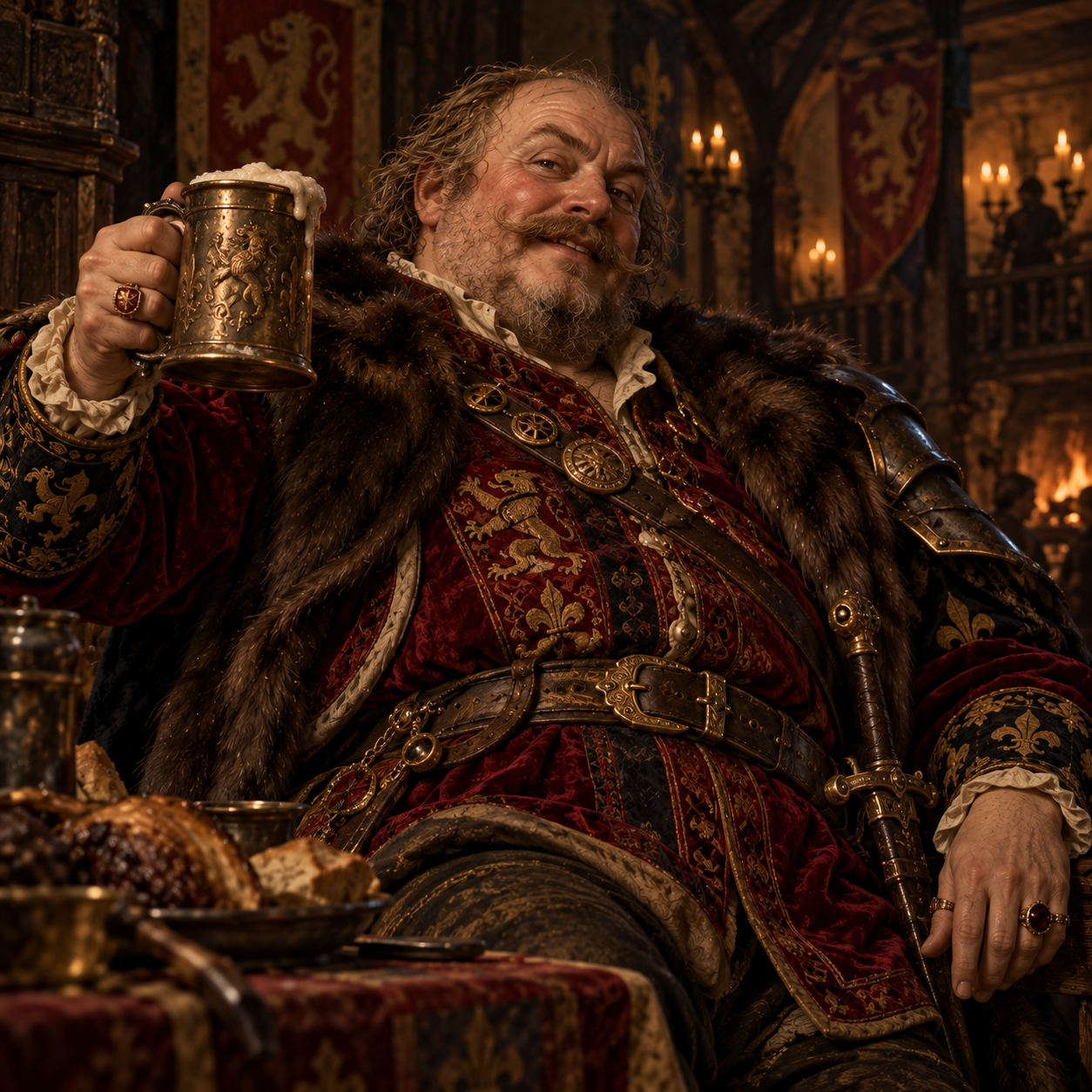
A full tankard, an empty purse, and a heroic tale that improves with every telling.
At a Glance
- Identity: Sir John Falstaff
- Race: Human
- Role: Knight, braggart, raconteur and opportunistic rogue
- Age: Elderly
- Alignment: Chaotic Neutral
- Region: London and the roads of England
- Associates: Bardolph, Pistol, Mistress Quickly and a shifting company of tavern companions
- Interests: Wine, comfort, ready money, good company and avoiding unnecessary danger
Sir John Falstaff is a veteran English knight, a master of extravagant promises and an unreliable guide to his own military achievements. He passes his days between London, the coaching inns of the great roads and the tables of men willing to pay for a good story. A companion of princes and rogues alike, he knows more about soldiers, taverns, debts and courtly embarrassments than many better-regarded gentlemen. He is valuable company, an expensive friend and a dangerous person to trust with the purse.
Appearance and Manner
Portly, grey-bearded and richly expressive, Falstaff dresses in worn finery whose impressive cut no longer conceals its age. His sword is serviceable but his belt has acquired more notches from tavern tables than battle. He enters a room as though invited to preside over it, greets strangers as old comrades and claims the best chair by instinct. His booming laugh, rolling oaths and endless embellishments can turn an angry creditor into an amused listener—at least until the account is mentioned again.
Personality
Falstaff is charming, vain, quick-witted, generous with praise and extremely reluctant to part with money. He mocks the pretensions of honour while demanding the respect due a knight. He will tell a lie to escape embarrassment, another to make the first sound plausible, and a third if it earns him supper. Yet he has affection for his companions and more insight into pride, fear and hypocrisy than his critics care to admit. He is not merely a fool: he knows exactly when laughter can disarm an enemy and when a compliment can open a locked door.
Ambitions and Methods
Wants: Comfort, good wine, a secure income, admiring company and continued access to influential people. Fears: Prison, creditors, poverty, a hopeless battle and public humiliation. Methods: Flattery, invented credentials, old acquaintances, gossip, borrowed money and strategic retreat. He seldom attacks directly when another person can be persuaded to take the risk.
Portraying Falstaff
Speak grandly, affectionately and at greater length than the question requires. Falstaff addresses adventurers as trusted friends within minutes of meeting them, gives heroic advice he has no intention of following and tries to convert every setback into proof of his judgement. When challenged, he changes the subject with a joke; when threatened, he bargains; when cornered, he pleads for reason. He may unexpectedly stand by someone he has come to love, but he would prefer to arrange matters so that courage is unnecessary.
Game Statistics
When cornered, Falstaff stalls with a boast, lands a cowardly opportunistic blow and escapes behind the nearest convincing excuse.
Sir John Falstaff — D&D 2024
Medium Humanoid (Human), Chaotic Neutral
Armor Class 14 (reinforced leather); Initiative +2 (12); Hit Points 65 (10d8 + 20); Speed 30 ft.
| STR | DEX | CON | INT | WIS | CHA |
|---|---|---|---|---|---|
| 14 (+2) | 14 (+2) | 14 (+2) | 13 (+1) | 12 (+1) | 18 (+4) |
Saving Throws Dex +4, Cha +6; Skills Deception +8, Insight +3, Perception +3, Performance +6, Persuasion +6, Sleight of Hand +4
Senses Passive Perception 13; Languages English; Challenge 1 (200 XP; PB +2)
Traits
Magnificent Coward. Falstaff has Advantage on Charisma (Deception) checks to disguise his fear or excuse his absence from danger. This grants no benefit on saving throws.
Opportunist (1/Turn). Falstaff deals an extra 7 (2d6) damage with a Shortsword attack if he has Advantage on the attack roll or an ally is within 5 feet of the target, provided he does not have Disadvantage.
Actions
Multiattack. Falstaff makes two Shortsword attacks.
Shortsword. Melee Attack Roll: +4, reach 5 ft. Hit: 5 (1d6 + 2) Piercing damage.
Magnificent Distraction (Recharge 5–6). One creature within 30 feet that can hear Falstaff must succeed on a DC 14 Wisdom saving throw or have Disadvantage on its next attack roll before the end of its next turn. One ally of Falstaff within 30 feet may immediately use its Reaction to move up to half its Speed without provoking Opportunity Attacks from that creature.
Bonus Actions
Quick Retreat. Falstaff takes the Dash, Disengage, or Hide action.
Reactions
Legendary Excuse (1/Day). Immediately after an attack misses Falstaff, he moves up to 10 feet without provoking Opportunity Attacks.
Sir John Falstaff — D&D 2014
Medium humanoid (human), chaotic neutral
Armor Class 14 (studded leather); Hit Points 65 (10d8 + 20); Speed 30 ft.
| STR | DEX | CON | INT | WIS | CHA |
|---|---|---|---|---|---|
| 14 (+2) | 14 (+2) | 14 (+2) | 13 (+1) | 12 (+1) | 18 (+4) |
Saving Throws Dex +4, Cha +6; Skills Deception +8, Insight +3, Perception +3, Performance +6, Persuasion +6, Sleight of Hand +4; Senses passive Perception 13; Languages English; Challenge 1 (200 XP)
Traits
Magnificent Coward. Falstaff has advantage on Charisma (Deception) checks made to conceal fear or excuse cowardice.
Opportunist (1/Turn). Falstaff deals an extra 7 (2d6) damage with a finesse weapon attack when he has advantage on that attack roll, or when another enemy of the target is within 5 feet of it and Falstaff doesn’t have disadvantage.
Actions
Multiattack. Falstaff makes two shortsword attacks.
Shortsword. Melee Weapon Attack: +4 to hit, reach 5 ft., one target. Hit: 5 (1d6 + 2) piercing damage.
Magnificent Distraction (Recharge 5–6). One creature within 30 feet that can hear Falstaff makes a DC 14 Wisdom saving throw. On a failure, it has disadvantage on its next attack roll before the end of its next turn, and one ally of Falstaff within 30 feet may use its reaction to move up to half its speed without provoking opportunity attacks from that creature.
Bonus Actions
Cunning Action. Falstaff takes the Dash, Disengage, or Hide action.
Reactions
Legendary Excuse (1/Day). When an attack misses Falstaff, he moves up to 10 feet without provoking opportunity attacks.
Sir John Falstaff — Pathfinder 1e
Sir John Falstaff CR 6; XP 2,400
Male human rogue 4/bard 3; CN Medium humanoid (human)
Init +6; Senses Perception +11
Defense
AC 15, touch 12, flat-footed 13 (+3 studded leather, +2 Dex); hp 45 (7d8+14); Fort +4, Ref +9, Will +5; Defensive Abilities evasion, uncanny dodge
Offense
Speed 30 ft.; Melee shortsword +8 (1d6+2/19–20); Ranged dagger +7 (1d4+2/19–20); Special Attacks sneak attack +2d6
Bardic Performance 12 rounds/day (countersong, distraction, fascinate, inspire courage +1, inspire competence +2)
Bard Spells Known (CL 3rd; concentration +7): 1st—charm person (DC 15), grease (DC 15), vanish; 0 (at will)—detect magic, ghost sound (DC 14), message, prestidigitation, read magic
Statistics
Str 14, Dex 14, Con 14, Int 13, Wis 12, Cha 18; Base Atk +5; CMB +7; CMD 19
Feats Dodge, Improved Initiative, Skill Focus (Bluff), Weapon Focus (shortsword); Skills Bluff +14, Diplomacy +14, Perception +11, Perform (oratory) +14, Sense Motive +11, Sleight of Hand +12, Stealth +12; Languages English, court French
Gear Studded leather, shortsword, dagger, debt papers, counterfeit commissions and a wine flask
Special Abilities
Rogue Talent — Fast Stealth. Falstaff may move at full speed while using Stealth without taking the normal penalty. He flees when an encounter turns against him.
Sir John Falstaff — D&D 3.5e
Size/Type Medium Humanoid (Human); Classes Rogue 4/Bard 3; Hit Dice 7d6+14 (38 hp); Initiative +6; Speed 30 ft.
Armor Class 15 (+2 Dex, +3 studded leather), touch 12, flat-footed 13; Base Attack/Grapple +5/+7
Attack Shortsword +8 melee (1d6+2/19–20); Full Attack Shortsword +8 melee (1d6+2/19–20); Space/Reach 5 ft./5 ft.
Special Attacks Sneak attack +2d6, bardic music 3/day (countersong, fascinate, inspire courage +1, inspire competence)
Special Qualities Evasion, trapfinding, trap sense +1, uncanny dodge, bardic knowledge
Saves Fort +4, Ref +9, Will +5; Abilities Str 14, Dex 14, Con 14, Int 13, Wis 12, Cha 18
Skills Bluff +14, Diplomacy +14, Perform (oratory) +14, Sleight of Hand +12, Spot +11, Listen +11, Sense Motive +11
Feats Dodge, Improved Initiative, Skill Focus (Bluff), Weapon Focus (shortsword)
Bard Spells Known (caster level 3rd; save DC 14 + spell level): 1st—charm person, grease; 0—detect magic, ghost sound, message, prestidigitation, read magic
Environment Taverns and old roads of England; Organization Solitary or with hangers-on; Challenge Rating 7; Treasure Standard; Alignment Chaotic neutral; Advancement By character class; Level Adjustment +0
What Is Sir John Falstaff Doing Now?
Falstaff has secured a commission to recruit men for a noble household, spent most of his advance in London’s taverns and now needs a credible escort to meet his employer. He has uniforms, a roll of names and enough confidence to explain away the missing wages. Unfortunately, several recruits have arrived to demand payment, and the household steward is sending an armed messenger to inspect the company. Falstaff offers the adventurers a share of a future reward for making the recruits look presentable and keeping everyone calm.
Encounters and Adventure Hooks
- The Borrowed Commission. A forged recruiting warrant bears Falstaff’s signature. He swears the seal is genuine and asks the party to discover which of his companions sold copies to rival captains.
- An Honourable Duel. Falstaff has insulted a young knight whose family expects satisfaction at dawn. He needs witnesses, a plausible apology or someone willing to expose the challenger as a cheat.
- The Missing Pay Chest. Soldiers hired on Falstaff’s recommendation have not been paid. Their sergeant is ready to seize a merchant’s goods, while Falstaff suspects the paymaster has fled towards London.
- A Friend at Court. Falstaff knows who carried a secret letter between two powerful households but will only speak after the adventurers settle a debt that could send him to gaol.
Allies and Rivals
Bardolph is a familiar companion whose loyalty survives endless insults and unpaid expenses. Pistol is a swaggering associate whose boasts rival Falstaff’s own. Mistress Quickly knows Falstaff’s habits and debts better than his creditors do. Tavern keepers, clerks, soldiers and minor courtiers may be fond of him, furious with him or both. His best contacts are people he has entertained, not necessarily people he has paid.
Falstaff responds warmly to wit and hospitality, suspiciously to official questions and with injured dignity to any challenge to his rank. Treat him as a possible patron, source of gossip, troublesome fellow traveller or unreliable ally; his friendships are sincere enough to complicate his selfishness.
Equipment and Rewards
Falstaff carries a shortsword, a dagger, worn protective leather, a wine flask, riding spurs, a fur-lined hat, unpaid tavern bills and several impressive-looking commissions. His purse is seldom as full as he claims. In return for help he can offer introductions to officers, access to a sympathetic innkeeper, gossip from noble households, a safe place to hide or information about soldiers on the roads. He promises gold readily; a wise adventurer asks to see it first.
First Meeting
Falstaff is occupying the warmest place beside the inn fire, holding an audience of carters and young soldiers captive with a story of a battle in which he supposedly rescued half the English army. He welcomes the adventurers as long-lost comrades and orders wine in their honour. Before they have finished their cups, a stern-faced sergeant enters with a list of recruits, an unpaid account and the authority to arrest their new friend. Falstaff gestures towards the party and announces that his most trusted officers have just arrived.
If the characters help: Falstaff becomes a useful informant and troublesome travelling companion. If they expose him: he attempts to talk his way free, nursing wounded pride but retaining a grudging respect for clever opponents. If violence begins: he stays behind cover, distracts the boldest attacker and seeks an exit rather than a heroic last stand.
Connections and Sources
London · England · Henry VI · British Isles NPCs · Sir John Falstaff
Background and Reputation
Sir John has enjoyed the favour of noble companions, the hospitality of countless inns and the ire of creditors who know his promises by heart. His military service is the subject of competing accounts, most supplied by Falstaff himself. He understands the vanities of the court and the hardships of ordinary soldiers, though he is notably more interested in sharing their wine than their dangers. His friendship is not always reliable, but his conversation, gossip and ingenuity make him useful to travellers who can tolerate his appetite.
Literary source: William Shakespeare’s Henry IV plays and The Merry Wives of Windsor; see Falstaff for background on the character.
Keep this reference growing
If this page helped with your reading or game, you can support its upkeep or explore the curated books.
Explore the Bookshop — epics, classics and stories behind imagined worlds.