
Burke and Hare — Edinburgh Body-Sellers
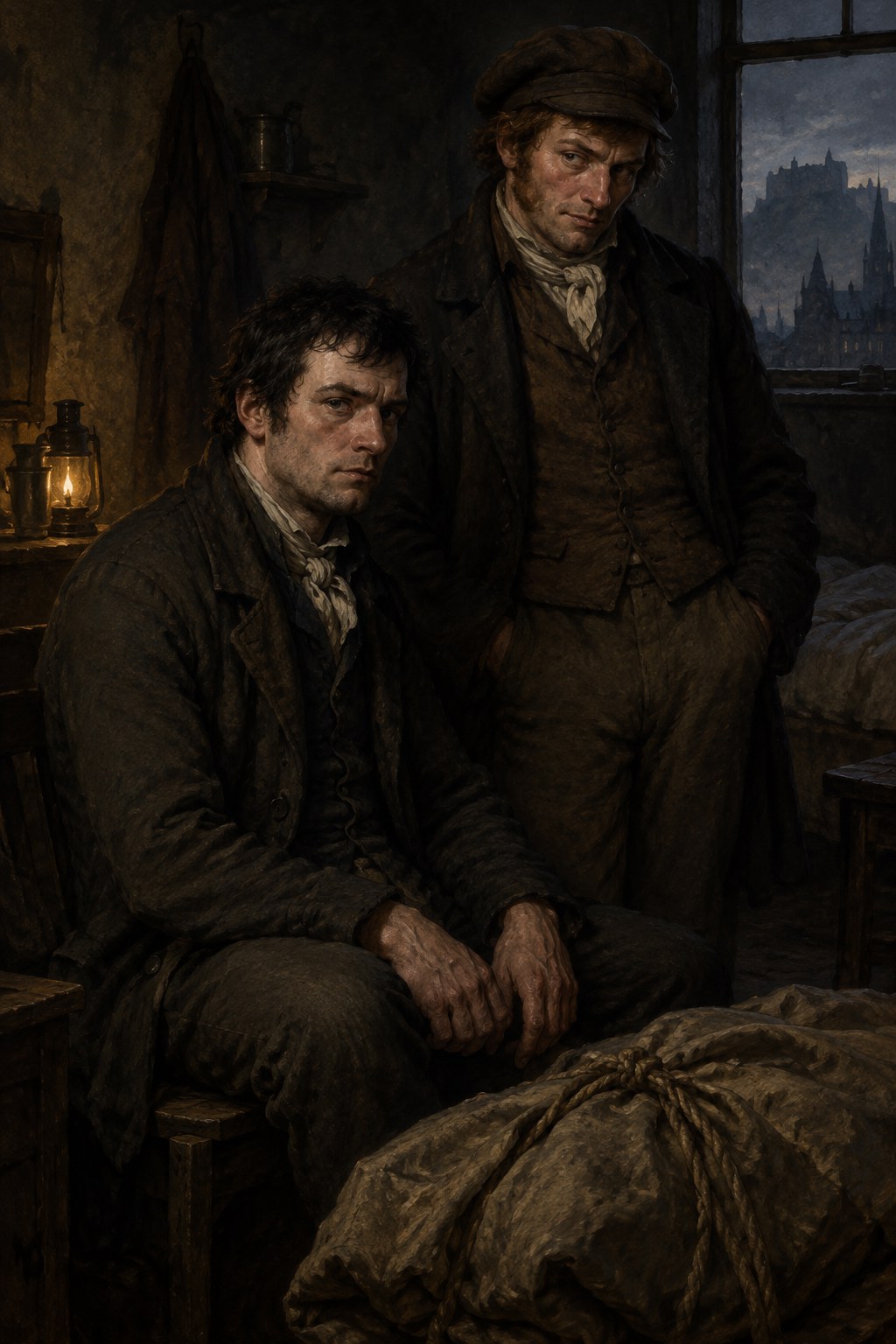
Two lodging-house opportunists have discovered that Edinburgh’s hungry anatomical market pays better for a fresh body than honest work ever did.
William Burke and William Hare operate on the edge of Edinburgh’s lodging houses, ale rooms and medical trade. What begins as the illicit sale of an unclaimed corpse becomes a business model. In this version they are active in 1454, supplying a clandestine anatomist who wants bodies for dissection and magical-medical research but does not ask enough questions about where the dead came from. The pair are small-time criminals made dangerous by a market that rewards silence.
At a Glance
- Role: Lodging-house killers and illicit body-sellers
- Primary region: Edinburgh
- Status: Alive and active
- Campaign use: Urban-horror suspects, low-level killers, doorway into a larger medical conspiracy
- Threat: Ambush, grappling, deception and disposal networks
Game Statistics
5.5e / 2024
Burke and Hare — two CR 3 Medium Humanoids; AC 14; HP 42 each; Str 15, Dex 14, Con 14. Skills Athletics +5, Deception +5, Stealth +5. Two Against One. One has advantage on a grapple check while the other is within 5 feet of the target. Quiet Work. Their first attack against a surprised or grappled creature deals an extra 2d6 damage. Shared Alibi. While both are free and able to speak, they have advantage on Deception checks made to support the same prepared story.
William Burke and William Hare — 5e / 2014
Two separate Medium humanoids (human), neutral evil
Armor Class 14 each; Hit Points 42 each; Speed 30 ft. each; Challenge 1 (200 XP) each; proficiency bonus +2. Award and budget XP for two combatants when both participate.
STR 15 (+2), DEX 14 (+2), CON 14 (+2), INT 11 (+0), WIS 12 (+1), CHA 13 (+1).
Skills Athletics +4, Deception +3, Perception +3, Stealth +4; Senses passive Perception 13; Languages English, Scots.
Traits
Two Against One. Each has advantage on a Strength (Athletics) check to grapple a creature when the other is within 5 feet of that creature and is not incapacitated.
Quiet Work (1/Encounter per Character). The first melee weapon attack that each makes against a surprised or grappled creature deals an extra 7 (2d6) bludgeoning damage if it hits.
Shared Alibi. Both have advantage on Charisma (Deception) checks to maintain the same rehearsed story while the other remains free, conscious and able to speak. Evidence can still contradict them.
Actions
Club. Melee Weapon Attack: +4 to hit, reach 5 ft., one target. Hit: 5 (1d6 + 2) bludgeoning damage.
Grapple. Each can attempt a grapple against a target within 5 feet using Strength (Athletics) +4 against the target’s Strength (Athletics) or Dexterity (Acrobatics), following 2014 rules.
Reaction
Cover the Other. When an allied accomplice within 5 feet is attacked, one may impose disadvantage on a single attack roll against the accomplice if the reacting character can see the attacker and has a free hand. The reaction is expended whether the attack succeeds or fails.
Original 5e/2014 two-NPC conversion. The crimes are treated as an investigation and a tragedy for victims, not as a procedural guide. Their historical lives belong to 1828 Edinburgh, not 1454.
Pathfinder 1e
Burke and Hare — CR 4 each; human commoner 2/rogue 3; hp 36; AC 17; sneak attack +2d6; Bluff +10, Disguise +8, Stealth +10, Grapple-focused feats and teamwork bonuses.
D&D 3.5e
Burke and Hare — CR 4 each; human commoner 2/rogue 3; hp 30; AC 16; sneak attack +2d6; Improved Grapple, Deceitful and teamwork tactics.
What Is Burke and Hare Doing Right Now?
A body delivered to a private anatomical room carries injuries inconsistent with the story that it was found dead in the street. The buyer has realised the truth and is deciding whether fear, greed or curiosity matters most.
Burke is trying to keep the operation calm and profitable. Hare is drinking more, boasting more and becoming the weak link.
Encounters
- A cheap room is offered to an isolated traveller on a stormy night.
- An apprentice anatomist asks the party to trace a corpse before his master is implicated.
- A porter saw the handcart at dawn but wants payment before naming the street.
- Burke and Hare separately give accounts that are almost identical—too identical.
Personality, Appearance and Manner
Burke is smoother, quieter and better at reassurance. Hare is volatile, opportunistic and more likely to panic under pressure.
Neither looks like a grand villain. Their threat lies in ordinary clothes, ordinary rooms and the assumption that missing poor travellers will not be investigated.
Relationships and Influence
- Edinburgh lodging-house network: cheap rooms provide both opportunity and witnesses.
- Private anatomist: buyer, potential accomplice and eventual liability.
- Porters and carters: people who notice movement after dark.
- Watch officers: initially dismissive until the pattern becomes undeniable.
Equipment and Possessions
- Rough travelling clothes
- Cord, blankets and handcart
- Keys to rented rooms
- Illicit coin from body sales
- Ale-room contacts and false stories
Using This NPC at the Table
They avoid fair fights. They isolate one target, exploit surprise and run if faced by armed adventurers. Capturing one alive should put pressure on the other rather than automatically solve the conspiracy.
Adventure Hooks
- The Anatomist’s Ledger: payments prove more bodies were bought than legally obtained.
- The Empty Bed: a traveller vanishes from a room whose door was supposedly locked.
- The Wrong Buyer: someone else begins buying corpses and the killers suddenly have competition.
- Hare Talks: drink loosens one detail that does not fit the public story.
- Beyond the Pair: the real campaign question becomes who profits enough to keep the market open.
Related Places and People
Mythical and Historical Context
The historical William Burke and William Hare committed the West Port murders in Edinburgh in 1828, not 1454. This campaign presents fictional medieval counterparts and centres investigation, victims, justice and the danger of trading human remains. No nineteenth-century anatomy school, police system or documented victim is asserted to exist in this earlier year. See the National Library of Scotland’s account and the National Museums Scotland research. The campaign crimes and encounter mechanics are original fiction.
Sources and Adaptation
Inspired by the historical Burke and Hare murders, translated into a fifteenth-century Edinburgh where illicit anatomy, alchemy and poor-record keeping create the same structural danger without reproducing nineteenth-century institutions.
Keep this reference growing
If this page helped with your reading or game, you can support its upkeep or explore the curated books.
Explore the Bookshop — epics, classics and stories behind imagined worlds.