
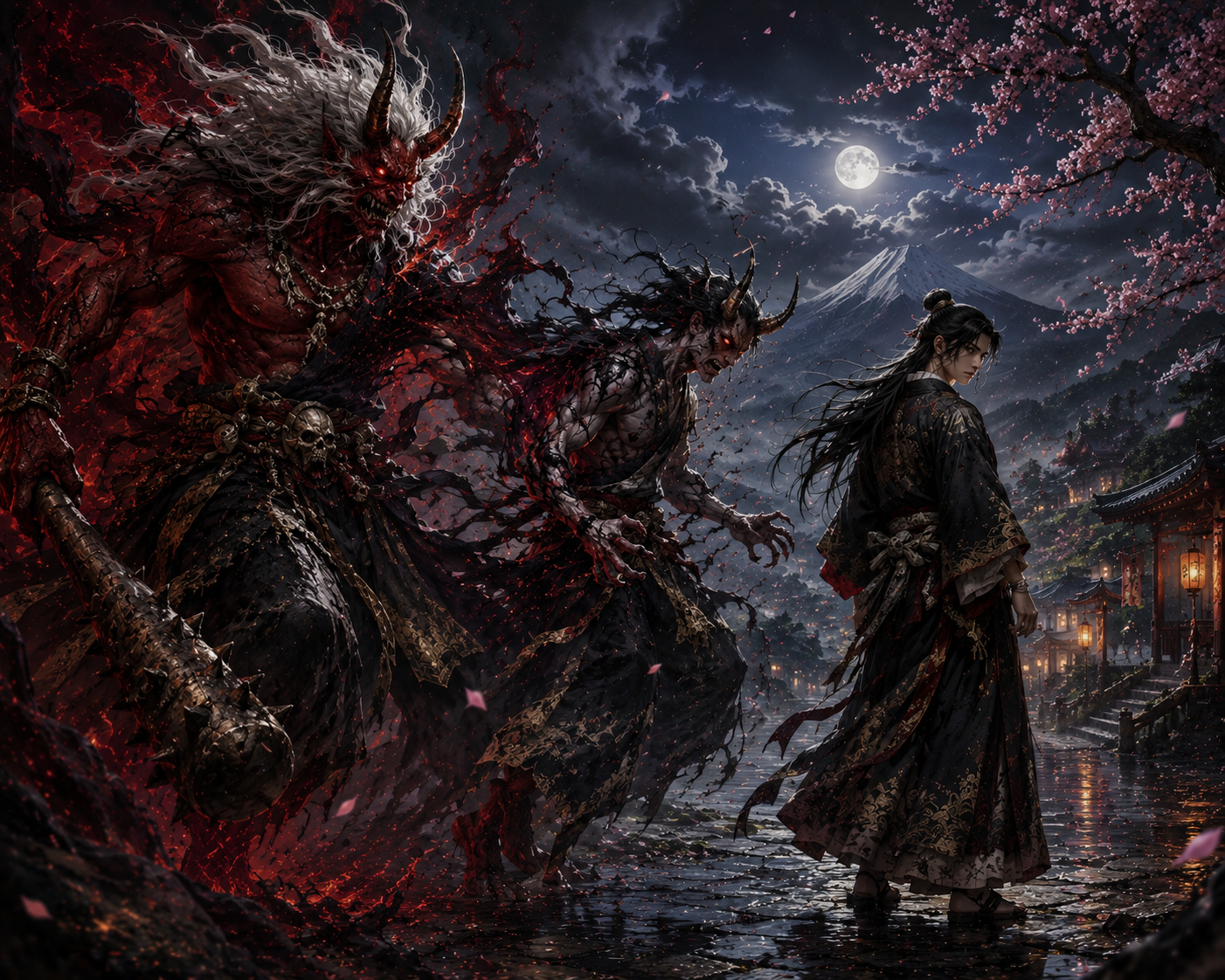
Oni
Horned demons, shape-changing tyrants and insatiable predators, oni hide monstrous appetites behind borrowed faces and establish hidden dominions long before they reveal their true forms.
The monster at the gate is rarely the most dangerous oni. The dangerous one has already passed through the gate, learned everyone’s name, bought the loyalty of useful officials and persuaded the village that its disappearances have an entirely ordinary cause.
An oni is a powerful supernatural predator associated above all with Japan. In its true shape it is a terrifying horned humanoid — often enormous, tusked and unnaturally coloured — yet many oni can exchange that obvious monstrosity for a convincing mortal appearance.
They exploit this talent to enter settlements, gather servants, corrupt institutions and indulge their appetites without exposing the creature responsible. Some remain solitary hunters. Others become bandit chiefs, warlords, corrupt courtiers, false shrine-keepers, wealthy patrons, hidden landlords or advisers standing immediately behind a mortal throne.
Game Statistics
Oni differ significantly between rules editions. Choose the version that matches your campaign. The current SpiralWorlds baseline is a CR 7 shape-changing fiend; Pathfinder presents the classic ogre-bodied oni as a native outsider, while D&D 3.5e uses the earlier Ogre Mage as a Large Giant.
Oni
Large Fiend (Shapechanger), typically Lawful Evil
Armor Class 17
Hit Points 114 (12d10 + 48)
Speed 30 ft., fly 30 ft. (hover)
Saving Throws
Dex +4, Con +7, Wis +4, Cha +6
Skills
Deception +9,
Insight +4,
Perception +4,
Stealth +4
Damage Resistance cold
Senses
darkvision
60 ft., passive Perception 14
Languages
Japanese, Giant; an oni often learns the languages used by
the people it infiltrates
Challenge 7 (2,900 XP)
PB +3
Traits
Regeneration. If the oni begins its turn with at least 1 hit point, it regains 10 hit points.
Borrowed Face. While shapechanged, the oni has Advantage on Charisma (Deception) checks made to pass as an ordinary member of the people whose form it has assumed. After studying a particular individual for at least 10 minutes, the oni can reproduce that person’s general appearance, although memories, relationships, habits and private knowledge must still be learned.
Actions
Multiattack. The oni makes two attacks, using its Kanabō, Claw or Dread Bolt in any combination.
Kanabō. Melee Weapon Attack: +8 to hit, reach 10 ft., one target. Hit: 14 (2d8 + 5) bludgeoning damage plus 3 (1d6) psychic damage.
Claw. Melee Weapon Attack: +8 to hit, reach 10 ft., one target. Hit: 12 (2d6 + 5) slashing damage plus 4 (1d8) necrotic damage.
Dread Bolt. Ranged Spell Attack: +6 to hit, range 60 ft., one creature. Hit: 12 (2d8 + 3) psychic damage. The target must succeed on a DC 14 Wisdom saving throw or have the Frightened condition until the end of its next turn.
Shapechanger. The oni assumes the outward form of a Small or Medium humanoid, a Large giant-like humanoid, or returns to its true form. Its game statistics remain unchanged except for its size and the physical limitations of the assumed body. Equipment does not transform with it.
Innate Spellcasting. Charisma is the oni’s spellcasting ability (spell save DC 14, +6 to hit with spell attacks). It requires no material components.
- 2/day each: Darkness, Invisibility
- 1/day each: Charm Person, Cone of Cold, Gaseous Form, Sleep
Bonus Actions
Vanish (Recharge 4–6). The oni becomes Invisible until the start of its next turn. The effect ends early if the oni makes an attack or deals damage.
Oni, Ogre Mage
LE Large outsider (giant, native, oni, shapechanger)
CR 8 XP 4,800
Init +7
Senses
darkvision
60 ft., low-light vision;
Perception +13
Defense
AC
21, touch 12, flat-footed 18
(+4 Japanese lamellar armour, mechanically chain shirt;
+3 Dex, +5 natural, –1 size)
hp
92 (8d10+48);
regeneration 5 (fire or acid)
Fort +12,
Ref +5,
Will +10
SR 19
Offense
Speed
40 ft., fly 60 ft. (good)
Melee
ōdachi +14/+9
(3d6+10; mechanically greatsword)
Ranged
yumi +10
(2d6+7; mechanically composite longbow)
Space 10 ft.;
Reach 10 ft.
Spell-Like Abilities (CL 9th)
- Constant: fly
- At will: darkness, invisibility
- 1/day: charm monster (DC 17), cone of cold (DC 18), gaseous form, deep slumber (DC 16)
Statistics
Str 24,
Dex 17,
Con 23,
Int 14,
Wis 14,
Cha 17
Base Atk +8;
CMB +16;
CMD 29
Feats Combat Expertise, Combat Reflexes, Improved Initiative, Iron Will
Skills Bluff +14, Disguise +14, Fly +5, Intimidate +14, Knowledge (arcana) +13, Perception +13, Sense Motive +13, Spellcraft +13, Use Magic Device +14
Languages Japanese, Giant
SQ
change shape (Small, Medium or Large humanoid), flight
Ecology
Environment
hills, mountains and settled regions
Organization
solitary, pair, or patrol
(1–2 oni plus 2–4
ogres)
Treasure
double
(Japanese lamellar armour, ōdachi, yumi with 20 arrows,
other treasure)
See the dedicated Oni Mage entry.
Ogre Mage
Large Giant, usually Lawful Evil
Challenge Rating 8
Hit Dice
5d8+15 (37 hp)
Initiative +4
Speed
40 ft.; fly 40 ft. (good)
Armor Class
18
(–1 size, +5 natural,
+4 Japanese lamellar armour,
mechanically chain shirt),
touch 9, flat-footed 18
Base Attack/Grapple +3/+12
Attack
ōdachi +7 melee
(3d6+7/19–20; mechanically greatsword)
or yumi +2 ranged
(2d6/×3; mechanically longbow)
Space/Reach
10 ft./10 ft.
Special Attacks
spell-like abilities
Special Qualities
change shape,
darkvision
60 ft.,
low-light vision,
regeneration 5,
spell resistance 19
Saves Fort +7, Ref +1, Will +3
Skills
Concentration +11,
Listen +10,
Spellcraft +10,
Spot +10
Feats
Combat Expertise,
Improved Initiative
Environment cold hills
Organization
solitary, pair, or troupe
(1–2 plus 2–4
ogres)
Treasure double standard
Level Adjustment +7
Spell-Like Abilities
Caster level 9th. Save DCs are Charisma-based.
- At will: darkness, invisibility
- 1/day: charm person (DC 14), cone of cold (DC 18), gaseous form, sleep (DC 14)
Flight
The ogre mage can begin or end its supernatural flight freely. While in gaseous form it retains its normal fly speed and becomes extremely manoeuvrable.
Change Shape
The creature can assume the form of a Small, Medium or Large humanoid or giant.
Regeneration
Fire and acid inflict normal damage rather than being converted by its regeneration.
Appearance
No single colour or costume defines every oni. Their true forms are nevertheless difficult to mistake for ordinary mortals. Horns rise from brow or scalp; fangs or tusks distort the mouth; hands end in heavy nails or claws; and the body often possesses the exaggerated strength of an ogre or giant.
Skin may be red, blue, grey, greenish, blackened or otherwise unnatural. Hair is frequently wild and heavy. Some oni go bare-armed in rough garments; others dress as warriors, officials or wealthy masters.
The great iron kanabō or tetsubō is particularly associated with them: an intimidating weapon well suited to the strength of a giant supernatural warrior. Oni are not restricted to it. A creature that has spent decades among warriors, bandits or soldiers may become expert with the arms appropriate to that life.
Nature and Origins
Oni are supernatural beings strongly rooted in the Material Plane. Japan is their greatest cultural and mythic heartland, although they can travel far beyond it and establish themselves wherever fear, isolation, violence or corrupt authority gives them room to operate.
The name describes a supernatural family rather than a single mortal species. An oni’s body may resemble an ogre, human, giant or another broadly humanoid people without making the creature a member of that race. Its monstrous form is an expression of its supernatural nature.
Oni and the Fallen Kami
Some oni were once spirits associated with duties resembling those of the kami, but abandoned, betrayed or corrupted the thing they were meant to protect. Such beings are especially hated by guardian spirits.
Not every oni has this origin. Others arise from malignant spirits, supernatural corruption, curses, wicked souls or strange transformations whose circumstances differ from one region and lineage to another.
Behaviour
Oni are creatures of appetite joined to intelligence. Food, drink, luxury, fear, violence, authority, magical knowledge and pleasure can all become obsessions. Possession rarely satisfies them; acquiring one thing merely creates the desire for another.
This makes control more attractive than simple predation. A village, household, gang, shrine, estate or military company provides a continuing supply of wealth, victims and obedience. A patient oni can therefore be far more dangerous than one encountered openly on a mountain road.
Predators
Solitary oni hunt roads, forests, ravines, caves, abandoned shrines and isolated settlements. They may demand tribute, kidnap travellers or cultivate a reputation as a local terror.
Infiltrators
Shape-changing oni prefer identities that cause ordinary people to protect their secret unknowingly: steward, magistrate, merchant, bodyguard, shrine attendant, healer, adviser or minor noble.
Tyrants
An oni that rules openly surrounds itself with creatures less powerful than itself. Bandits, mercenaries, ogres and other brutal followers make useful retainers.
Collectors
Long-lived oni accumulate identities, favours, weapons, art, blackmail, secret passages and treasure. Killing the monster may uncover evidence of crimes extending back decades.
Habitat
Oni naturally haunt wild and liminal places — mountains, caves, forests, ravines and abandoned structures — but a shapechanger need not remain outside civilisation. An urban oni can be considerably more dangerous than a monster openly ruling a mountain valley.
In Japan, an oni might inhabit a mountain fortress overlooking a trade road, occupy a ruined shrine, control a bandit settlement, hide beneath a prosperous town house or live for years within the residence of a lord whose retainers believe the creature to be human.
Outside Japan, oni adapt their clothing, language and assumed identity to local society. The disguise changes; the supernatural appetite does not.
Oni and Kami
The enmity between kami and oni creates one of the strongest adventure relationships between the two supernatural families.
Kami protect wards: trees, springs, shrines, stones, roads, forests, mountains and other places bound to their duty. Oni seek possession, exploitation and dominion. Even an oni that was never a fallen kami may find a guardian spirit intolerable because it prevents the monster from claiming everything around it.
Adventure clue: if a normally responsive kami suddenly refuses to appear, the spirit may be hiding from, imprisoned by, wounded by or attempting to warn the characters about an oni already living among the inhabitants of its ward.
Modus Operandi
1. Observe
The oni learns who holds authority, who is isolated, which roads are poorly watched and which relationships can be exploited.
2. Assume a Face
It chooses an identity that grants access without attracting the attention its true form would provoke.
3. Create Dependence
Bribery, magical influence, fear and carefully arranged crises make others increasingly reliant upon the disguised oni.
4. Isolate Opposition
Witnesses disappear. Rivals are accused. Guardians are driven away. Outsiders receive contradictory explanations.
5. Feed
Once secure, the oni takes what it wants: treasure, obedience, victims, luxury, magical objects, political power or terror.
6. Escape or Rule
If exposed too early, it adopts another identity. If unchallenged, the deception becomes a permanent hidden tyranny.
Oni Lineages
Oni vary dramatically in body, affinity and supernatural power. The following established forms have dedicated entries in the SpiralWorlds Bestiary.
Oni Mage
The classic great oni: a mighty ogre-like shapechanger combining physical power, regeneration, flight and sorcery.
Kuwa
A human-associated oni particularly suited to disguise, infiltration and concealed influence within settlements.
Fire Yai
A mighty giant-bodied oni associated with flame, destruction and brutal domination.
Water Yai
A towering aquatic oni that haunts seas, coasts and deep waters while retaining the shape-changing cunning of its kind.
Void Yai
An exceptionally powerful oni whose supernatural mastery places it among the most dangerous members of the wider family.
Oni Daimyo
Ordinary oni covet control. The greatest turn that impulse into sovereignty. These exceptional beings are known as oni daimyo: monstrous lords whose authority can extend over lesser oni, mortal cults, fortresses and entire territories.
| Oni Daimyo | Title | Associated Form |
|---|---|---|
| Akuma | The Horned King | Oni Mage |
| Chimon | Hunter of Blood | Oni Mage |
| Guyuku | The Sea Devil | Water Yai |
| Inma | Empress of the World | Void Yai |
| Muronna | The Dark Mother | Oni Mage |
| Nataka | The Red King | Fire Yai |
| Onmyuza | Dancer in Flesh | Oni Mage |
| Ushitora | Keeper of the Oni Gate | Void Yai |
| Uzumae | Daimyo of the North | Kuwa |
| Yabu | Lord of the Kazan Caldera | Fire Yai |
An oni daimyo should not normally be treated as a random encounter. Its existence changes an entire region. Lesser monsters gather around it, mortal rulers bargain with it or deny its existence, shrines fail, tribute moves along guarded roads and apparently unrelated local problems reveal themselves as parts of the same dominion.
Combat and Tactics
An intelligent oni rarely begins a fight merely because the characters enter attack range. By the time battle starts, it should already know something about them.
Before Combat
- Observe the party while shapechanged.
- Separate vulnerable characters from stronger allies.
- Choose terrain that gives flight an advantage.
- Arrange servants, hostages or false witnesses nearby.
- Use darkness or invisibility to test the party’s response.
During Combat
- Avoid a static exchange of blows with the strongest warrior.
- Exploit flight against opponents with weak ranged attacks.
- Use fear and concealment to fragment the party.
- Let regeneration punish opponents who fail to finish the fight.
- Retreat when the encounter turns decisively against the oni.
An oni that escapes can become more dangerous than one that dies. Shape-changing lets it return under another face, frame an innocent person for its crimes or strike at the characters’ allies instead.
Signs of an Oni
The strongest oni adventures begin before the characters know what they are hunting. Use several clues rather than relying upon a single revelation.
Adventure Hooks
The Magistrate Has Two Faces
A magistrate’s policies have become increasingly cruel, yet his childhood friend insists the man has forgotten details only the two of them should know. The real magistrate disappeared months ago.
The Silent Cedar
A guardian kami that answered villagers for generations no longer appears. The local shrine-keeper insists nothing is wrong and discourages outsiders from approaching the grove.
Tribute on the Mountain Road
Caravans pay a hidden toll to unusually disciplined bandits. Their masked commander is an oni gathering enough wealth and manpower to take control of a nearby castle.
The Returned Retainer
A warrior believed dead several years ago returns to his lord’s service. He remembers public battles perfectly but avoids anyone who knew him intimately.
The Feast That Never Ends
A wealthy household buys enormous quantities of food and drink while its servants grow thinner. None will speak against their master while inside the estate.
The Daimyo’s Gate
Several unrelated oni suddenly move through the same province. Their arrival is not migration but mobilisation: a greater oni lord is preparing to establish a permanent domain.
Historical and Mythological Context
Oni are among the most recognisable supernatural beings in Japanese legend and visual culture, but the term is broader than a single modern fantasy monster. English translations commonly use demon or ogre, although neither term captures every traditional use.
Historical representations frequently show oni as powerful humanoid monsters with horns and fierce faces. Tusks, claws, exaggerated musculature and unusual skin colours also became familiar elements of their imagery, although details differ greatly between stories and periods.
One of the best-known legendary oni figures is Shuten Dōji, a monstrous lord associated with a mountain stronghold and defeated by the warrior Minamoto no Yorimitsu, also known as Raikō. The story provides an excellent model for an oni ruler whose threat extends beyond personal combat to followers, fortifications, captives and regional fear.
The systematic division of oni into numerous supernatural lineages belongs to later fantasy gaming rather than historical Japanese folklore. SpiralWorlds retains those lineages where they create useful monsters while keeping historical tradition and campaign cosmology distinct.
Oni in Myth and Legend
These two films complement rather than repeat one another: the first provides a general introduction to oni, while the second focuses on the Shuten Dōji legend.

What is Oni?
A concise introduction to the appearance, reputation and supernatural role of oni in Japanese mythology.
Watch on YouTube →
The Story of Shuten Dōji
A retelling of the celebrated oni lord and the warriors who entered his mountain stronghold to defeat him.
Watch on YouTube →Oni in SpiralWorlds
In 1454, oni belong naturally within the supernatural landscape of Japan. They are not merely wandering monsters waiting beside a road for adventurers. Their greatest strength is their ability to insert themselves into an already complicated human society.
Political division, mountain communities, travelling merchants, military households, shrines, local rivalries and difficult roads all give a patient shapechanger opportunities. An oni does not need to conquer Japan to matter. Control of one bridge, mountain pass, household or frightened village may place hundreds of lives beneath its influence.
Oni can also travel beyond Japan. Such creatures adapt their assumed identity, clothing and language to the society around them rather than carrying a fixed Japanese disguise wherever they go. Their supernatural nature remains; the mask changes.
Related SpiralWorlds Entries
Kami
Guardian spirits whose protection of sacred places places them in direct opposition to predatory oni.
Oni Mage
The classic ogre-bodied oni: shapechanger, spellcaster and supernatural warlord.
Kuwa
A human-associated oni especially suited to infiltration and hidden-antagonist adventures.
Fire Yai
A mighty fire-associated oni suited to high-level encounters and oni warbands.
Water Yai
A powerful aquatic oni inhabiting seas, coasts and supernatural waters.
Void Yai
One of the most formidable established oni lineages in the SpiralWorlds Bestiary.
Ogre
A mortal giant often dominated or recruited by the classic ogre-bodied oni.
Japan
The principal earthly cultural and mythological heartland of oni in SpiralWorlds.
Sources
- Japanese folklore, literature and visual traditions concerning oni and the Shuten Dōji legend.
- D&D 3.5e d20 System Reference Document material concerning the Ogre Mage.
- Pathfinder Roleplaying Game material concerning the Ogre Mage, oni subtype and oni lineages.
- Existing SpiralWorlds entries for Kami, Oni Mage, Kuwa, Fire Yai, Water Yai and Void Yai.
Pathfinder Section 15 notice:
Pathfinder Roleplaying Game Bestiary 3, © 2011,
Paizo Publishing, LLC; Authors Jesse Benner, Jason Bulmahn,
Adam Daigle, James Jacobs, Michael Kenway, Rob McCreary,
Patrick Renie, Chris Sims, F. Wesley Schneider,
James L. Sutter, and Russ Taylor, based on material by
Jonathan Tweet, Monte Cook, and Skip Williams.
Keep this reference growing
If this page helped with your reading or game, you can support its upkeep or explore the curated books.
Explore the Bookshop — epics, classics and stories behind imagined worlds.