
Divine Magic • Core Spell Reference
Planar Ally
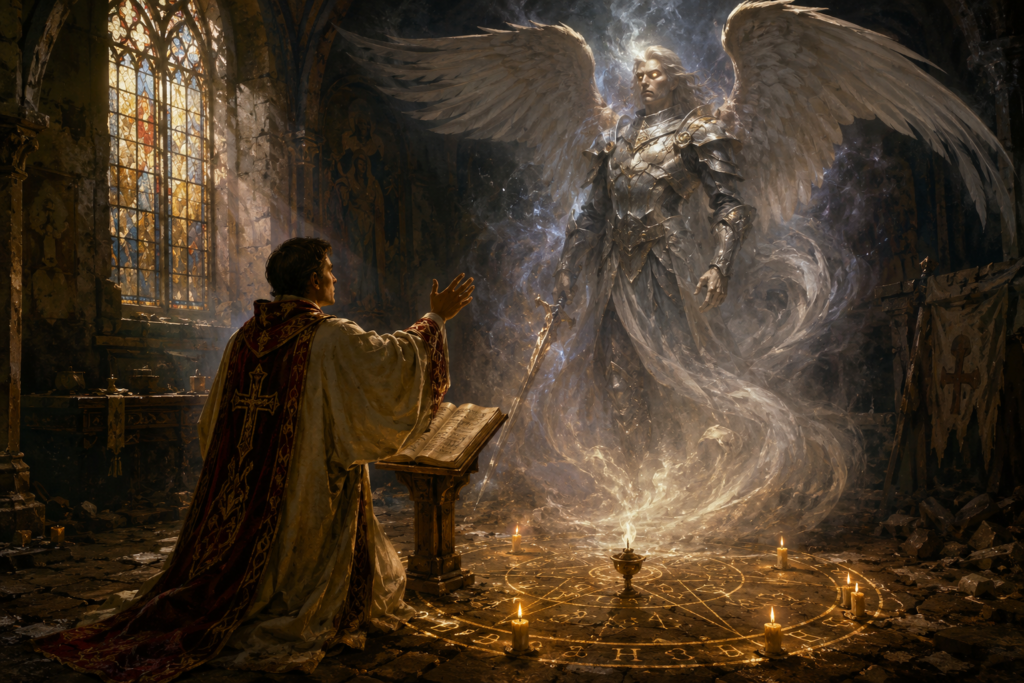
Choose your edition before using the spell. Its level, casting procedure, targets, effects, and limits follow the rules in the selected panel.
Planar Ally at a Glance
| 5.5e (2024) | Level 6 |
|---|---|
| 5e (2014) | Level 6 |
| Pathfinder 1e | Level 6 |
| D&D 3.5e | Level 6 |
| Browse | Cleric spells • Cleric class |
Spell Rules
Planar Ally — 5.5e (2024)
Cleric spell level 6. Edition source.
| Spell | Level 6 Conjuration (Cleric) |
|---|---|
| Casting Time | 10 minutes |
| Range | 60 feet |
| Components | V, S |
| Duration | Instantaneous |
You beseech an otherworldly entity for aid. The being must be known to you: a god, a demon prince, or some other being of cosmic power. That entity sends a Celestial, an Elemental, or a Fiend loyal to it to aid you, making the creature appear in an unoccupied space within range. If you know a specific creature’s name, you can speak that name when you cast this spell to request that creature, though you might get a different creature anyway (GM’s choice). When the creature appears, it is under no compulsion to behave a particular way. You can ask it to perform a service in exchange for payment, but it isn’t obliged to do so. The requested task could range from simple (fly us across the chasm, or help us fight a battle) to complex (spy on our enemies, or protect us during our foray into the dungeon). You must be able to communicate with the creature to bargain for its services. Payment can take a variety of forms. A Celestial might require a sizable donation of gold or magic items to an allied temple, while a Fiend might demand a living sacrifice or a gift of treasure. Some creatures might exchange their service for a quest undertaken by you. A task that can be measured in minutes requires a payment worth 100 GP per minute. A task measured in hours requires 1,000 GP per hour. And a task measured in days (up to 10 days) requires 10,000 GP per day. The GM can adjust these payments based on the circumstances under which you cast the spell. If the task is aligned with the creature’s ethos, the payment might be halved or even waived. Nonhazardous tasks typically require only half the suggested payment, while especially dangerous tasks might require a greater gift. Creatures rarely accept tasks that seem suicidal. After the creature completes the task, or when the agreed-upon duration of service expires, the creature returns to its home plane after reporting back to you if possible. If you are unable to agree on a price for the creature’s service, the creature immediately returns to its home plane.
Planar Ally — 5e (2014)
Cleric spell level 6. Edition source.
| Spell | 6th-level conjuration |
|---|---|
| Casting Time | 10 minutes |
| Range | 60 feet |
| Components | V, S |
| Duration | Instantaneous |
You beseech an otherworldly entity for aid. The being must be known to you: a god, a primordial, a demon prince, or some other being of cosmic power. That entity sends a celestial, an elemental, or a fiend loyal to it to aid you, making the creature appear in an unoccupied space within range. If you know a specific creature’s name, you can speak that name when you cast this spell to request that creature, though you might get a different creature anyway (GM’s choice). When the creature appears, it is under no compulsion to behave in any particular way. You can ask the creature to perform a service in exchange for payment, but it isn’t obliged to do so. The requested task could range from simple (fly us across the chasm, or help us fight a battle) to complex (spy on our enemies, or protect us during our foray into the dungeon). You must be able to communicate with the creature to bargain for its services. Payment can take a variety of forms. A celestial might require a sizable donation of gold or magic items to an allied temple, while a fiend might demand a living sacrifice or a gift of treasure. Some creatures might exchange their service for a quest undertaken by you. As a rule of thumb, a task that can be measured in minutes requires a payment worth 100 gp per minute. A task measured in hours requires 1,000 gp per hour. And a task measured in days (up to 10 days) requires 10,000 gp per day. The GM can adjust these payments based on the circumstances under which you cast the spell. If the task is aligned with the creature’s ethos, the payment might be halved or even waived. Nonhazardous tasks typically require only half the suggested payment, while especially dangerous tasks might require a greater gift. Creatures rarely accept tasks that seem suicidal. After the creature completes the task, or when the agreed-upon duration of service expires, the creature returns to its home plane after reporting back to you, if appropriate to the task and if possible. If you are unable to agree on a price for the creature’s service, the creature immediately returns to its home plane. A creature enlisted to join your group counts as a member of it, receiving a full share of experience points awarded.
Planar Ally — Pathfinder 1e
Cleric spell level 6. Edition source.
| School | conjuration (calling) [see text for lesser planar ally ] |
|---|---|
| Level | cleric 6 |
| Casting Time | 10 minutes |
| Components | V, S, M (offerings worth 1,250 gp plus payment), DF |
| Range | close (25 ft. + 5 ft./2 levels) |
| Effect | one or two called outsiders, totaling no more than 12 HD, which cannot be more than 30 ft. apart when they appear |
| Duration | instantaneous |
| Saving Throw | none |
| Spell Resistance | no |
Base Procedure
By casting this spell, you request your deity to send you an outsider (of 6 HD or less) of the deity’s choice. If you serve no particular deity, the spell is a general plea answered by a creature sharing your philosophical alignment. If you know an individual creature’s name, you may request that individual by speaking the name during the spell (though you might get a different creature anyway).
You may ask the creature to perform one task in exchange for a payment from you. Tasks might range from the simple to the complex. You must be able to communicate with the creature called in order to bargain for its services.
The creature called requires a payment for its services. This payment can take a variety of forms, from donating gold or magic items to an allied temple, to a gift given directly to the creature, to some other action on your part that matches the creature’s alignment and goals. Regardless, this payment must be made before the creature agrees to perform any services. The bargaining takes at least 1 round, so any actions by the creature begin in the round after it arrives.
A task taking up to 1 minute per caster level requires a payment of 100 gp per HD of the creature called. For a task taking up to 1 hour per caster level, the creature requires a payment of 500 gp per HD. A long-term task, one requiring up to 1 day per caster level, requires a payment of 1,000 gp per HD.
A nonhazardous task requires only half the indicated payment, while an especially hazardous task might require a greater gift. Few if any creatures will accept a task that seems suicidal (remember, a called creature actually dies when it is killed, unlike a summoned creature). However, if the task is strongly aligned with the creature’s ethos, it may halve or even waive the payment.
At the end of its task, or when the duration bargained for expires, the creature returns to its home plane (after reporting back to you, if appropriate and possible).
Note: When you use a calling spell that calls an air, chaotic, earth, evil, fire, good, lawful, or water creature, it is a spell of that type.
Changes and Additional Effects
Changes for this spell: you may call a single creature of 12 HD or less, or two creatures of the same kind whose HD total no more than 12. The creatures agree to help you and request your return payment together.
Planar Ally — D&D 3.5e
Cleric spell level 6. Edition source.
| School | Conjuration (Calling) [see text for lesser planar ally ] |
|---|---|
| Level | Clr 6 |
| Components | V, S, DF, XP |
| Casting Time | 10 minutes |
| Range | Close (25 ft. + 5 ft./2 levels) |
| Effect | One or two called elementals or outsiders, totaling no more than 12 HD, which cannot be more than 30 ft. apart when they appear |
| Duration | Instantaneous |
| Saving Throw | None |
| Spell Resistance | No |
Base Procedure
By casting this spell, you request your deity to send you an elemental or outsider (of 6 HD or less) of the deity’s choice. If you serve no particular deity, the spell is a general plea answered by a creature sharing your philosophical alignment. If you know an individual creature’s name, you may request that individual by speaking the name during the spell (though you might get a different creature anyway).
You may ask the creature to perform one task in exchange for a payment from you. Tasks might range from the simple to the complex. You must be able to communicate with the creature called in order to bargain for its services.
The creature called requires a payment for its services. This payment can take a variety of forms, from donating gold or magic items to an allied temple, to a gift given directly to the creature, to some other action on your part that matches the creature’s alignment and goals. Regardless, this payment must be made before the creature agrees to perform any services. The bargaining takes at least 1 round, so any actions by the creature begin in the round after it arrives.
A task taking up to 1 minute per caster level requires a payment of 100 gp per HD of the creature called. For a task taking up to 1 hour per caster level, the creature requires a payment of 500 gp per HD. A long-term task, one requiring up to one day per caster level, requires a payment of 1,000 gp per HD.
A nonhazardous task requires only half the indicated payment, while an especially hazardous task might require a greater gift. Few if any creatures will accept a task that seems suicidal (remember, a called creature actually dies when it is killed, unlike a summoned creature). However, if the task is strongly aligned with the creature’s ethos, it may halve or even waive the payment.
At the end of its task, or when the duration bargained for expires, the creature returns to its home plane (after reporting back to you, if appropriate and possible).
Note: When you use a calling spell that calls an air, chaotic, earth, evil, fire, good, lawful, or water creature, it is a spell of that type.
XP Cost: 100 XP.
Changes and Additional Effects
Changes for this spell: you may call a single creature of 12 HD or less, or two creatures of the same kind whose Hit Dice total no more than 12. The creatures agree to help you and request your return payment together.
XP Cost: 250 XP.
Why This Spell Is Dangerous in the World
Planar Ally is dangerous because it makes the politics of the planes visible in mortal life. A baron who sees a priest call a winged judge to testify in court may never again believe law belongs only to kings. A cult that hires a fiend to murder a rival has not merely committed a crime; it has opened a line of debt. A city that repeatedly calls elemental servants to repair walls, flood mines, or burn plague districts may discover that the elements remember service and insult.
The spell also exposes the caster’s religion to scrutiny. When a divine ally answers, witnesses learn something about the caster’s patron. When nothing answers, they learn something else. If the wrong creature arrives, the problem may be theological, political, or cosmic.
In a late medieval campaign, this spell belongs in temples, royal courts, crusading orders, plague hospitals, forbidden chapels, siege camps, and high-stakes diplomacy. It is not common village magic. It is the kind of spell that changes who has authority in a room.
Historical and Mythic Context
The idea behind Planar Ally belongs to an old family of stories about mortals petitioning powers beyond ordinary human reach. Ancient oracles, household spirits, daimones, genii, jinn, angels, demons, and divine messengers all preserve variations of the same dramatic pattern: a mortal asks, a greater or stranger power answers, and the answer comes with obligation.
In Greek religion, a daimon could be understood as a supernatural power or spirit associated with divine action, fate, or intervention. The later idea of a benevolent guiding spirit also appears in the Agathos Daimon, a protective good spirit. Roman religion preserved related ideas in the genius, including guardian powers of people, places, households, and institutions.
The spell also echoes the logic of oracles, where divine communication is requested through recognised ritual channels. The petitioner does not own the god’s answer. The petitioner approaches a sacred system and must live with what comes back.
Jinn traditions offer another useful parallel for campaign play. A jinni is not simply a monster, but a powerful unseen being with will, form, and moral agency. That distinction matters for this spell: the called creature is not a spell effect pretending to be alive. It is an actual participant in the world.
For fantasy gaming, Planar Ally works best when treated as sacred diplomacy rather than divine shopping. The caster is not buying a stat block. The caster is inviting a supernatural person, servant, officer, witness, or power into mortal affairs.
Rules Sources and Licensing
This work includes material from the System Reference Document 5.2.1 and/or 5.1 by Wizards of the Coast LLC. The original documents are available at D&D Beyond and are licensed under CC BY 4.0. Presentation and formatting have been changed.
The Pathfinder and 3.5 spell mechanics and their tables are Open Game Content under the Open Game License v1.0a. Artwork and original setting prose are excluded from that designation.
Open Game License v1.0a and copyright notices
Permission to copy, modify and distribute the files collectively known as the System Reference Document (“SRD”) is granted solely through the use of the Open Gaming License, Version 1.0a.
This material is being released using the Open Gaming License Version 1.0a and you should read and understand the terms of that license before using this material.
The text of the Open Gaming License itself is not Open Game Content. Instructions on using the License are provided within the License itself.
The following items are designated Product Identity, as defined in Section 1(e) of the Open Game License Version 1.0a, and are subject to the conditions set forth in Section 7 of the OGL, and are not Open Content: Dungeons & Dragons, D&D, Player’s Handbook, Dungeon Master, Monster Manual, d20 System, Wizards of the Coast, d20 (when used as a trademark), Forgotten Realms, Faerûn, proper names (including those used in the names of spells or items), places, Red Wizard of Thay, the City of Union, Heroic Domains of Ysgard, Ever-Changing Chaos of Limbo, Windswept Depths of Pandemonium, Infinite Layers of the Abyss, Tarterian Depths of Carceri, Gray Waste of Hades, Bleak Eternity of Gehenna, Nine Hells of Baator, Infernal Battlefield of Acheron, Clockwork Nirvana of Mechanus, Peaceable Kingdoms of Arcadia, Seven Mounting Heavens of Celestia, Twin Paradises of Bytopia, Blessed Fields of Elysium, Wilderness of the Beastlands, Olympian Glades of Arborea, Concordant Domain of the Outlands, Sigil, Lady of Pain, Book of Exalted Deeds, Book of Vile Darkness, beholder, gauth, carrion crawler, tanar’ri, baatezu, displacer beast, githyanki, githzerai, mind flayer, illithid, umber hulk, yuan-ti.
All of the rest of the SRD is Open Game Content as described in Section 1(d) of the License.
More information on the Open Game License can be found at www.wizards.com/d20.
The terms of the Open Gaming License Version 1.0a are as follows:
OPEN GAME LICENSE Version 1.0a
The following text is the property of Wizards of the Coast, Inc. and is Copyright 2000 Wizards of the Coast, Inc (“Wizards”). All Rights Reserved.
1. Definitions: (a)”Contributors” means the copyright and/or trademark owners who have contributed Open Game Content; (b)”Derivative Material” means copyrighted material including derivative works and translations (including into other computer languages), potation, modification, correction, addition, extension, upgrade, improvement, compilation, abridgment or other form in which an existing work may be recast, transformed or adapted; (c) “Distribute” means to reproduce, license, rent, lease, sell, broadcast, publicly display, transmit or otherwise distribute; (d)”Open Game Content” means the game mechanic and includes the methods, procedures, processes and routines to the extent such content does not embody the Product Identity and is an enhancement over the prior art and any additional content clearly identified as Open Game Content by the Contributor, and means any work covered by this License, including translations and derivative works under copyright law, but specifically excludes Product Identity. (e) “Product Identity” means product and product line names, logos and identifying marks including trade dress; artifacts; creatures characters; stories, storylines, plots, thematic elements, dialogue, incidents, language, artwork, symbols, designs, depictions, likenesses, formats, poses, concepts, themes and graphic, photographic and other visual or audio representations; names and descriptions of characters, spells, enchantments, personalities, teams, personas, likenesses and special abilities; places, locations, environments, creatures, equipment, magical or supernatural abilities or effects, logos, symbols, or graphic designs; and any other trademark or registered trademark clearly identified as Product identity by the owner of the Product Identity, and which specifically excludes the Open Game Content; (f) “Trademark” means the logos, names, mark, sign, motto, designs that are used by a Contributor to identify itself or its products or the associated products contributed to the Open Game License by the Contributor (g) “Use”, “Used” or “Using” means to use, Distribute, copy, edit, format, modify, translate and otherwise create Derivative Material of Open Game Content. (h) “You” or “Your” means the licensee in terms of this agreement.
2. The License: This License applies to any Open Game Content that contains a notice indicating that the Open Game Content may only be Used under and in terms of this License. You must affix such a notice to any Open Game Content that you Use. No terms may be added to or subtracted from this License except as described by the License itself. No other terms or conditions may be applied to any Open Game Content distributed using this License.
3.Offer and Acceptance: By Using the Open Game Content You indicate Your acceptance of the terms of this License.
4. Grant and Consideration: In consideration for agreeing to use this License, the Contributors grant You a perpetual, worldwide, royalty-free, non-exclusive license with the exact terms of this License to Use, the Open Game Content.
5.Representation of Authority to Contribute: If You are contributing original material as Open Game Content, You represent that Your Contributions are Your original creation and/or You have sufficient rights to grant the rights conveyed by this License.
6.Notice of License Copyright: You must update the COPYRIGHT NOTICE portion of this License to include the exact text of the COPYRIGHT NOTICE of any Open Game Content You are copying, modifying or distributing, and You must add the title, the copyright date, and the copyright holder’s name to the COPYRIGHT NOTICE of any original Open Game Content you Distribute.
7. Use of Product Identity: You agree not to Use any Product Identity, including as an indication as to compatibility, except as expressly licensed in another, independent Agreement with the owner of each element of that Product Identity. You agree not to indicate compatibility or co-adaptability with any Trademark or Registered Trademark in conjunction with a work containing Open Game Content except as expressly licensed in another, independent Agreement with the owner of such Trademark or Registered Trademark. The use of any Product Identity in Open Game Content does not constitute a challenge to the ownership of that Product Identity. The owner of any Product Identity used in Open Game Content shall retain all rights, title and interest in and to that Product Identity.
8. Identification: If you distribute Open Game Content You must clearly indicate which portions of the work that you are distributing are Open Game Content.
9. Updating the License: Wizards or its designated Agents may publish updated versions of this License. You may use any authorized version of this License to copy, modify and distribute any Open Game Content originally distributed under any version of this License.
10. Copy of this License: You MUST include a copy of this License with every copy of the Open Game Content You Distribute.
11. Use of Contributor Credits: You may not market or advertise the Open Game Content using the name of any Contributor unless You have written permission from the Contributor to do so.
12. Inability to Comply: If it is impossible for You to comply with any of the terms of this License with respect to some or all of the Open Game Content due to statute, judicial order, or governmental regulation then You may not Use any Open Game Material so affected.
13. Termination: This License will terminate automatically if You fail to comply with all terms herein and fail to cure such breach within 30 days of becoming aware of the breach. All sublicenses shall survive the termination of this License.
14. Reformation: If any provision of this License is held to be unenforceable, such provision shall be reformed only to the extent necessary to make it enforceable.
15. COPYRIGHT NOTICE
Open Game License v 1.0a Copyright 2000, Wizards of the Coast, Inc.
System Reference Document Copyright 2000-2003, Wizards of the Coast, Inc.; Authors Jonathan Tweet, Monte Cook, Skip Williams, Rich Baker, Andy Collins, David Noonan, Rich Redman, Bruce R. Cordell, John D. Rateliff, Thomas Reid, James Wyatt, based on original material by E. Gary Gygax and Dave Arneson.
Pathfinder Roleplaying Game Core Rulebook. © 2009, Paizo Publishing, LLC; Author: Jason Bulmahn, based on material by Jonathan Tweet, Monte Cook, and Skip Williams. END OF LICENSE
Keep this reference growing
If this page helped with your reading or game, you can support its upkeep or explore the curated books.
Explore the Bookshop — epics, classics and stories behind imagined worlds.