
Bacchus — Roman God of Wine, Ecstasy and Liberation
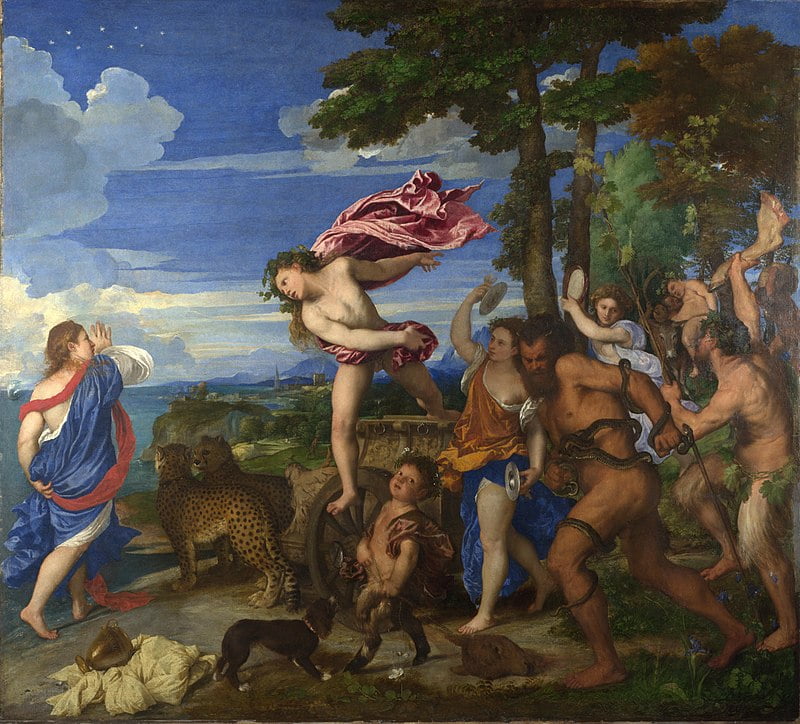
Bacchus at a Glance
Tradition
Roman, strongly shaped by Greek Dionysian religion
Divine standing
Intermediate Deity
Campaign alignment
Chaotic Neutral
Portfolio
Wine, ecstasy, altered states, theatre, liberation, frenzy and mystery initiation
Principal names
Bacchus; Liber Pater in overlapping Roman tradition
Sacred places
Vineyards, theatres, private mystery shrines, caves and festival spaces
Emblems
Thyrsus, ivy, vine, cup, leopard and theatre mask
Favoured weapon
Thyrsus or staff
Hellenic relationship
Closely identified with Dionysus, while Roman Bacchanalia and Liberalia traditions have their own political and ritual history.
Related Roman powers
Roman Pantheon · Wine · Ecstasy · Liberation · Theatre · Mystery Cult
Bacchus is the Roman god of wine, ecstasy, altered states and liberation. His Roman story is not one festival. The Bacchanalia mystery cult and the Liberalia belong to different ritual contexts, and the campaign keeps that distinction visible.
Same Deity, Different Cultural Aspect
Bacchus is the Roman aspect of Dionysus: one god expressed through Roman wine, ecstasy, liberation and mystery-cult traditions. The Dionysus page presents the Hellenic aspect. Both pages remain separate and self-canonical because they describe different cults and cultural presentations, not different cosmic beings.
Divine Mechanics
Bacchus — 5.5e Rules-Facing Form
Medium Celestial (Deity), Chaotic Neutral
CR 36 (custom epic) · PB +10 · Campaign Divine Tier 34
AC 27 · HP 730 · Speed 40 ft.
| STR | DEX | CON | INT | WIS | CHA |
|---|---|---|---|---|---|
| 26 (+8) | 28 (+9) | 30 (+10) | 26 (+8) | 26 (+8) | 32 (+11) |
Saving Throws Dex +19, Con +20, Wis +18, Cha +21
Skills Deception +19, Insight +16, Performance +19, Persuasion +19, Religion +16
Damage Resistances poison, psychic, radiant; bludgeoning, piercing and slashing from nonmagical attacks
Condition Immunities Charmed, Frightened, Poisoned
Senses Truesight 120 ft. · Languages all; telepathy 120 ft.
Traits
Legendary Resistance (6/Day). If Bacchus fails a saving throw, he can choose to succeed instead.
Magic Resistance. Bacchus has Advantage on saving throws against spells and other magical effects.
Lord of Ecstasy. Bacchus cannot be affected by another creature’s Charmed, Frightened or Poisoned condition effects. A creature Charmed by Bacchus still knows who it is and may speak freely unless another effect says otherwise.
Unmask the Self. Creatures within 30 feet have Disadvantage on checks made to maintain a deliberate false identity, disguise or role they no longer wish to perform.
Divine Spellcasting
Bacchus has access to every spell granted by the deity’s portfolio domains in the edition being used: Wine · Liberation · Revelry · Trickery. Those spells are always prepared or available to the deity.
Actions
Multiattack. Bacchus makes three Thyrsus attacks.
Thyrsus. Attack: +21 to hit, reach 10 ft. Hit: 30 (4d10 + 8) bludgeoning plus 22 (4d10) psychic damage.
Festival Without End (Recharge 5–6). Creatures of Bacchus’s choice in a 60-foot radius make a DC 29 Wisdom save. On a failure, a hostile creature takes 66 (12d10) psychic damage and is Charmed until the end of its next turn; chosen allies may immediately end Charmed or Frightened on themselves and move up to half Speed.
Bonus Actions
Spill the Cup. One creature within 60 feet gains Advantage on its next Charisma check or Wisdom save before the end of its next turn.
Reactions
Break the Restraint. When a creature within 60 feet becomes Grappled, Restrained or magically compelled, Bacchus allows it to repeat the relevant saving throw or escape check immediately.
Legendary Actions
- Move. Move up to half Speed without provoking Opportunity Attacks.
- Divine Strike. Make one Thyrsus attack.
- Riot of Masks (Costs 2). One creature within 90 feet must succeed on a DC 29 Charisma save or be unable to benefit from a disguise, illusionary identity or shapechanging deception until the end of its next turn.
Bacchus — Pathfinder 1e
Campaign epic extension; true deities are not normally given standard PF1e stat blocks.
CR benchmark 30 · hp about 760 · AC about 48 · Primary attack +41 · Primary DC 35 · Good saves +31 · Poor save +26.
Divine expression. Express Bacchus through enchantment, morale shifts, confusion, freedom of movement, performance and altered-state effects rather than by treating drunkenness itself as the whole deity.
Spell-Like Abilities. At will—freedom of movement, greater heroism, suggestion, true seeing; 3/day—mass suggestion, greater restoration, irresistible dance; 1/day—miracle. Use caster level 30 for the combat benchmark.
Statistics
CR 36 (custom epic) · AC 54 · hp 940 · Fort +36 · Ref +33 · Will +34
Str 26 · Dex 28 · Con 30 · Int 26 · Wis 26 · Cha 32
Base Atk +36 · CMB +44 · CMD 95
Domain Access
Bacchus has full access to the deity’s linked portfolio domains in their Pathfinder-facing versions or clearly marked campaign adaptations.
Bacchus — D&D 3.5e
Intermediate Deity; Divine Rank 13; Chaotic Neutral Medium Outsider (Extraplanar)
Divine Rank 13 · DR 25/epic · SR 45 · Domain SLA caster level 23.
Divine rules. Divine rank adds to attacks, saves and checks; natural armour is rank + 13; divine AC bonus equals rank; deflection uses Charisma modifier.
Salient Divine Abilities. Alter Reality, Divine Inspiration, Shapechange, Divine Skill Focus and rank-appropriate freedom or ecstasy abilities.
Statistics
Challenge benchmark 42. Ability scores may exceed 30 where the deity’s divine nature requires it; Divine Rank remains the primary measure of cosmic authority.
Domain Access
Bacchus can use every spell-like ability granted by the deity’s portfolio domains at the caster level determined by Divine Rank.
Regional Effects
Where Bacchus’s presence is strong, a major sanctuary can project the following effects across roughly six miles. A small shrine normally manifests only one effect in a smaller area. Unless another divine power contests them, the effects fade over 1d10 days after the sanctuary is abandoned or desecrated.
Vines Answer
Grapevines and fruiting creepers grow vigorously around festivals and shrines, but wither around deliberate poisoning or joyless coercion.
Masks Speak Freely
During consecrated revels, a creature wearing a ritual mask can speak a truth it genuinely fears to say; listeners still choose how to respond.
Chains Loosen
Nonmagical restraints used solely to imprison unwilling celebrants, actors or devotees develop faulty clasps and weakened knots within the region.
Bacchus in Roman Religion
The Bacchanalia were mystery rites associated with Bacchus/Dionysus and became the subject of an extraordinary Roman suppression in 186 BCE. Ancient accounts are hostile and politically charged, so the campaign treats them as evidence for conflict around secret initiation and uncontrolled association rather than as a neutral ethnography of every Bacchic worshipper.
The Liberalia was different. It continued as a public Roman festival associated with Liber Pater, merriment, offerings and the assumption of the toga virilis by young men. The page therefore does not collapse Bacchanalia and Liberalia into one ritual.
What Is Bacchus Doing Right Now?
Courts, guilds and cities are tightening control over speech, assembly and public celebration. Bacchus becomes active wherever people need spaces in which ordinary rank temporarily stops deciding who may speak, dance, confess or change.
That does not make every Bacchic cult harmless. Ecstasy can liberate, manipulate or expose. The most dangerous Bacchic leaders are those who claim that freedom means surrendering judgement to them personally.
Worship in the Campaign Present
Vintners, actors, poets, tavern communities and mystery congregations all invoke Bacchus in different ways. Public festivals are loud and social; private initiatory cults can be secretive and intensely personal.
Authorities often distrust the god because ecstatic religion can create loyalties outside family, guild and state. Bacchus does not automatically oppose law, but he is hostile to systems that insist people must permanently remain inside one assigned identity.
Domains, Spells and Divine Gifts
Bacchus’s clergy favour Trickery, Nature, Life, Freedom and Performance themes. Suitable spells include Charm Person, Heroism, Calm Emotions, Suggestion, Freedom of Movement, Confusion, Greater Restoration and Irresistible Dance.
Gift: Speak Without the Mask
Once per long rest, the devotee may speak one sentence that cannot be magically altered, silenced or disguised.
Gift: Break the Chain
The devotee has Advantage on one saving throw each long rest against Charmed, Restrained or magical compulsion.
Artifacts and Relics
The Ivy Thyrsus
Major Divine Artifact · Weapon (staff)
Attunement: Required by a creature that has freed another from unlawful confinement or coercion.
The Ivy Thyrsus expresses liberation before revelry: locked places flower when those behind them are being held without lawful or freely accepted cause.
5.5e
The Thyrsus is a +3 quarterstaff. On a hit it deals an extra 9 (2d8) Psychic damage.
Ivy Finds the Prisoner. Within 30 feet, locked doors, barred windows and restraints holding a creature unlawfully or through magical coercion sprout living ivy visible to you.
Break the Bonds (3/Day). As an action, end one grapple, mundane restraint, Charmed condition or magical effect reducing a willing creature’s Speed to 0 within 30 feet. Artifact-level restraints require a successful DC 22 spellcasting ability check.
Festival of Release (1/Day). For 1 minute, allies within 30 feet have Advantage on saves against Charmed and Frightened and may move through allied spaces without treating them as difficult terrain.
Pathfinder 1e
Major Artifact · CL 20th · overwhelming enchantment and transmutation.
Functions as a +5 merciful quarterstaff. The bearer automatically notices nearby unlawful restraints as supernatural ivy. 3/day: break enchantment or freedom of movement; 1/day: allies within 30 feet gain a +4 morale bonus against fear and compulsion for 10 rounds.
D&D 3.5e
Major Artifact · CL 20th · strong enchantment and transmutation.
Functions as a +5 merciful quarterstaff. 3/day: break enchantment or freedom of movement; 1/day: allies within 30 feet gain a +4 morale bonus against fear and compulsion for 10 rounds.
Destroying the Thyrsus
The Thyrsus can be destroyed only if a bearer uses it to free someone from unjust confinement and that freed person, acting without coercion, chooses to return voluntarily and seal the door behind them.
The Cup of Unmasking
Lesser Divine Relic · Wondrous Item (cup)
A willing creature that drinks from the Cup sees itself for 1 minute without disguise, illusion or chosen false appearance. The effect does not force confession. In 5.5e it suppresses magical disguises on the drinker for that minute; in PF1e and 3.5e it functions as true seeing limited to the drinker’s own form and reflection.
Relationships
Ceres overlaps with Bacchus through Liber and the Aventine religious world; Venus shares his interest in desire and release; Mercury in movement and clever speech; Apollo in music and performance, though Apollo favours clarity where Bacchus embraces altered states.
Use Bacchus Tonight
The Banquet Will Not End
A noble feast reaches dawn, but nobody inside can remember agreeing to stay.
The Toga Is Missing
Every youth due to enter adult civic life finds their ceremonial garment replaced by ivy.
The Theatre Speaks Back
Actors performing a censored play begin improvising secrets known only to the audience.
Deep Dive
Continue through the Roman Pantheon, Dionysus 2, Ceres, Venus, Mercury, Apollo. Follow the cult into Rome and wider Italy, or use the Cleric and Cleric Domains pages for player-facing worship.
Historical Sources and Rules Compatibility
- Bacchanalia — Roman suppression of Bacchic mysteries and the distinction from the Liberalia.
Historical cult material is separated from campaign invention. The 5.5e block respects SRD 5.2.1 numeric ceilings; the higher Campaign Divine Tier is setting-only. Pathfinder 1e deity mechanics are explicitly a campaign epic extension. D&D 3.5e uses divine-rank structure.
Rules licensing. D&D 5.5e terminology derived from the System Reference Document 5.2.1 is used under CC BY 4.0 where applicable. Pathfinder 1e and D&D 3.5e deity statistics on this page are original campaign conversions rather than official published deity stat blocks.
Keep this reference growing
If this page helped with your reading or game, you can support its upkeep or explore the curated books.
Explore the Bookshop — epics, classics and stories behind imagined worlds.