
Central Andes — Cusco, Chimú and the Highland Kingdoms
At a Glance
| Region | The central and northern Andes, from the Pacific valleys across the high plateau to the cloud forests of the eastern slopes |
|---|---|
| Principal powers | The growing Inca state of Pachacuti around Cusco; the independent Chimú kingdom of Chan Chan; Aymara-speaking lake and plateau lordships; northern Andean and Ecuadorian communities beyond imperial rule |
| Important places | Cusco, Chan Chan, the Urubamba Valley, the Lake Titicaca country, Cañari and northern highland settlements |
| Peoples | Quechua-speaking groups, Chimú, Chincha, Aymara-speaking Colla and Lupaqa peoples, Cañari, Caranqui, Pasto and many distinct valley and forest communities |
| Travel | Footpaths and stone roads, rope bridges, llama caravans, runners, coastal boats, lake craft and river canoes on eastern tributaries |
| Trade and support | Maize, potatoes, quinoa, camelid wool, salt, textiles, dried fish, metalwork, coca leaves, guides, storehouses and repair of bridges and caravan gear |
| Principal dangers | Cold passes, altitude, sudden rain, broken bridges, military expeditions, guarded irrigation waters and treacherous routes into the forest |
| Present year | 1454 CE |
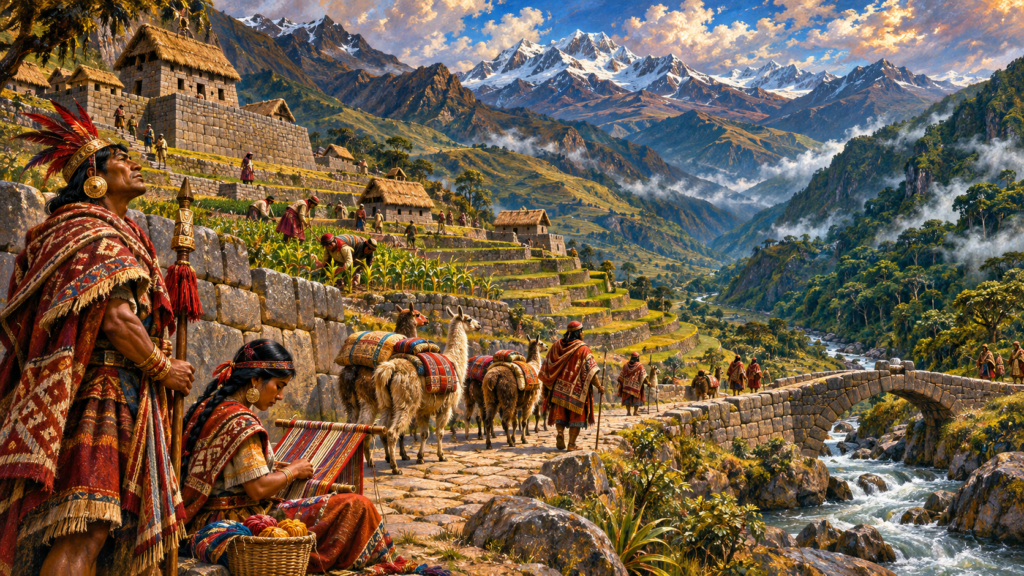
A runner from Cusco arrives at the mountain station with dust on his sandals and a knotted message cord in his hand. Beyond the pass, a village has raised its bridge and refuses the royal officers. Southward the plateau darkens under rain; westward the desert roads carry news from a coastal court not yet conquered. The next journey depends less on a sword than on whose welcome a traveller can earn.
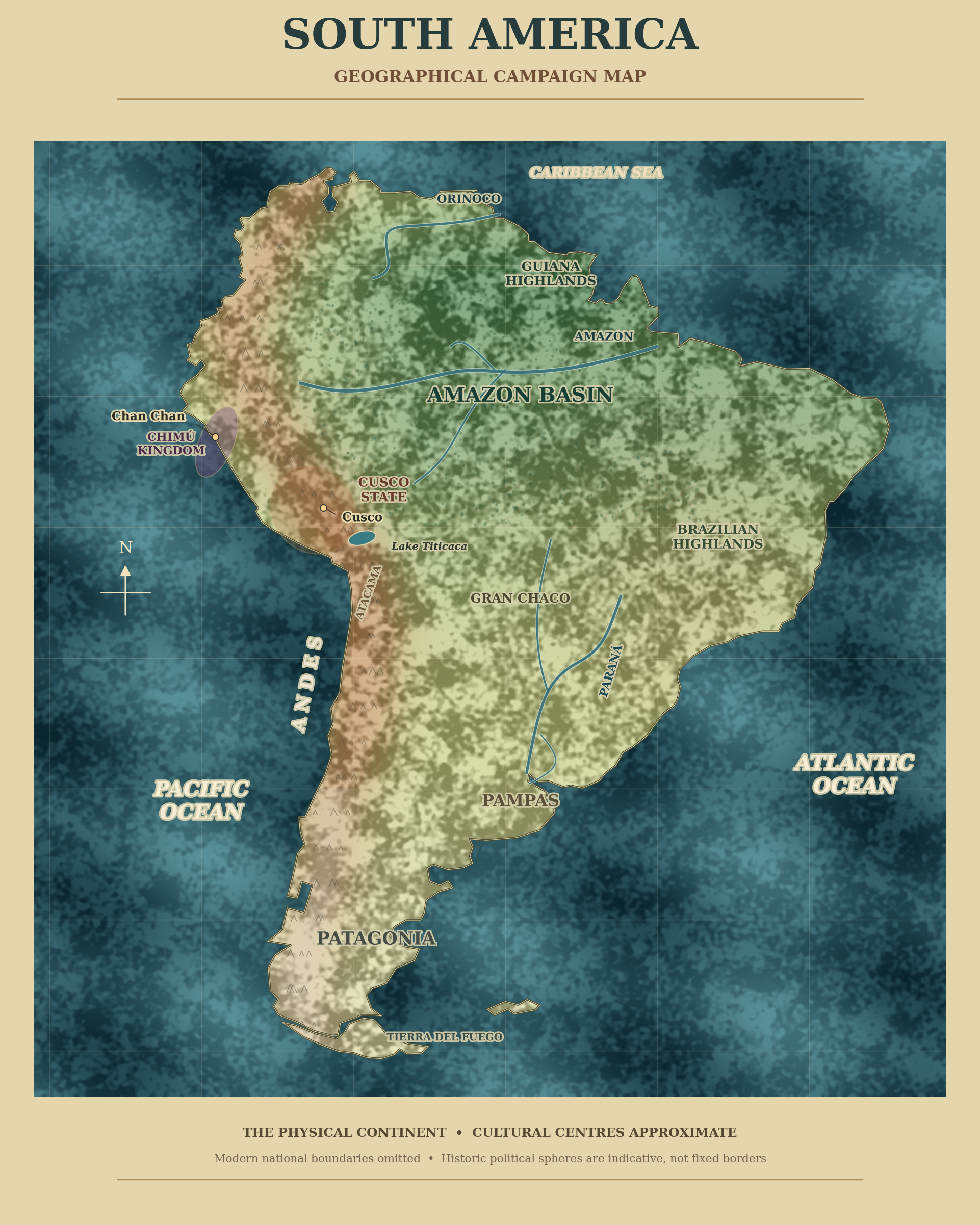
The mountains are crossed by old paths, cultivated valleys and territories whose people already know their boundaries. From Cusco, Pachacuti enlarges his state through embassies, organised labour and the force of his armies. On the north coast, the Chimú still command canals, workshops and the adobe palaces of Chan Chan. Across the Titicaca plateau, lake and pasture communities guard their own alliances. Farther north, the people of the Ecuadorian highlands have rulers, markets and sacred places of their own.
Geographical Campaign Map
What Is Happening Right Now?
The Bridge Above the Urubamba
A section of road needed by Pachacuti’s couriers passes across a rope bridge maintained by villagers whose crop fields have been trampled by a supply convoy. The bridge keeper has removed the walkway cords, leaving messengers trapped on opposite sides of the gorge. A royal officer wants the crossing restored before the next caravan arrives; the villagers want grain returned and the damaged terraces repaired. A party that escorts an army across without settling the loss makes an enemy of the next valley.
Water for the Chimú Coast
At a northern coastal canal, a night watch discovers a newly opened spillway that has diverted irrigation water towards fields belonging to a powerful household. The lower workshops lose their water as the planting season begins. Chan Chan’s administrator sends artisans to repair the breach, but one family threatens to block their passage. The missing stone plug lies in a neighbour’s store, though no one agrees who placed it there. Work, testimony and control of the upstream gate matter more than a pitched battle.
Two Boats on Lake Titicaca
A highland household must carry winter stores and a sacred offering to relatives across the lake before a storm closes the crossing. A second group claims the same safe landing, and the ferryman refuses to launch while the two sides threaten to settle the quarrel aboard his reed craft. Old promises between lakeside families, a ruined jetty and the gathering wind leave very little time for an agreement.
Courts, Cities and Settlements
Cusco — The Seat of Pachacuti
Stone-walled streets climb between royal compounds, workshops and houses occupied by families whose obligations reach far beyond the city. Officers oversee storehouses, runners carry news and priests prepare ceremonies to Inti at the solar precincts. The ruler rewards communities that send labour and provisions as agreed; those who resist may face soldiers or the removal of local privileges. A visiting caravan finds food, a translator and stoneworkers through households willing to sponsor it, not through an anonymous market of hired adventurers.
Chan Chan — The Chimú Royal City
Along the dry Pacific coast, the great Chimú city rises in vast adobe compounds decorated with reliefs. Its wealth flows through irrigation canals, fishing settlements, weaving houses and the work of accomplished metalworkers. Palace households control much of what reaches the city and punish theft from their protected stores. Sea traders and coastal couriers bring news of the growing mountain power. Some senior craftsmen fear conquest as keenly as the court does: a new master might seize their skills and move them elsewhere.
The Northern Highlands — Cañari, Caranqui and Their Neighbours
Farther north, roads run through green basins, cultivated slopes and forested passes where several peoples hold land outside Cusco’s immediate authority. Cañari communities maintain their own settlements and sacred landscapes, while Caranqui and Pasto territories have rulers and networks of exchange. Cloth, salt, ceramics and food move between the elevations; alliances need to be made anew at each important crossing. No imperial garrison can be assumed to speak for every household in the country called Ecuador by later mapmakers.
The Titicaca Plateau — Colla and Lupaqa Country
Cold grasslands rise around the deep blue lake. Aymara-speaking Colla and Lupaqa leaders hold settlements, pasture and lakeshore resources, sometimes competing with one another while watching the growing strength of Cusco. Camelid herds graze above the shores; boats carry passengers, fish and offerings across the water. The old stone precincts of Tiwanaku still command awe, but its ancient city is not the capital of a living empire. Visitors may find shelter with a farming family, yet an unrelated lakeside lord may not honour that family’s assurances.
The Urubamba Estates
The terraced valley is threaded with tracks to mountain storehouses, bridge crossings and royal retreats. Machu Picchu is a guarded estate of Pachacuti’s circle rather than a bustling free city. Stone masons, terrace keepers, cultivators and bearers sustain its resident households. A traveller carrying official messages may be admitted; a stranger arriving without an introduction is likely to be turned back by attendants before seeing the royal buildings.
People, Households and Faith
The Inca court is disciplined but not gentle. It builds roads, stores grain against shortages and protects those who serve its ambitions, while commanders can requisition labour and remove a rebellious household from land held for generations. The Chimú court exercises authority through palace households, guarded water and the skill of its craftspeople. Neither power can control every mountain village simply by declaring itself sovereign. Local headpeople and lakeside families have their own loyalties, feuds, customs and sacred places.
In Cusco, servants of Inti tend the solar ceremonies. Across the mountains, reverence for ancestral places, local huacas and mighty peaks accompanies the work of fields and herds. Beliefs and rites vary from valley to valley: the lakeshore communities of the southern plateau do not surrender their traditions merely because an envoy from Cusco demands obedience. A stolen offering may bring a procession to a halt; a cracked irrigation wall can be a graver offence than insults to a court official.
Along the Roads — Food, Shelter and Travel
A company leaving Cusco for the Urubamba follows a route of steep roads, terraced farmsteads and narrow bridges. A known guide is valuable where the road crosses shifting scree and wet slopes. Supplies come from village households, caravan contacts and, for authorised travellers, the state’s storehouses. Shoes, warm blankets, dried potatoes, maize, water and repair cord are more useful than a heavy horse-drawn wagon; llamas carry loads but cannot serve as ordinary riding mounts.
To reach Chan Chan from the highland interior, caravans descend towards dry valleys where river water feeds the coast’s fields. The journey passes communities whose acceptance of the Inca state cannot be assumed. Along the Pacific coast, boats move between fishing places when weather permits, while the desert paths depend on water carried or obtained at settled valleys. Eastward, mountain tracks fall through cloud forest towards the Amazonian riverlands, where canoes, local river pilots and different foods replace the llama road.
Southward, the road enters the cold Altiplano and approaches Lake Titicaca. A party accustomed to the coastal heat may struggle with altitude and freezing nights; a good caravan leader knows which village offers shelter and whether a bridge or high pass is open. The way beyond reaches the neighbouring southern valleys and lands of Chile. A northern route follows highland exchange networks towards the territories described in northern South America.
Wilderness and Dangerous Creatures
The clear air and high ridgelines are home to the immense Andean condor, whose shadow can pass over an exposed trail while travellers struggle towards a windy saddle. Wild camelids and predators inhabit the grasslands, and the narrowest roads leave little room to retreat from frightened pack animals. Below the eastern slopes, dense forest and flooded channels shelter the creatures of the South American Bestiary. A party crossing from highland terraces into the rainforest changes not just climate, but the sounds, tracks and dangers it must recognise.
There is no single enchantment hanging over all the Andes. A specific shrine may be guarded by its own custodians, a royal tomb by descendants who maintain its observances, and a mountain crossing by a community unwilling to let outsiders damage a sacred place. Such claims have consequences for travel and friendship even where no creature takes up arms.
Older Roads and Rival Kingdoms
Long before Pachacuti, builders of Tiwanaku, Wari and other Andean societies laid roads, raised ceremonial centres and shaped valleys with terraces and irrigation. Some of their walls still stand, used by younger households or left exposed in lonely ground. Chan Chan’s compounds and canals bear the wealth of an independent coastal kingdom, while the highland Inca state continues to grow out of Cusco.
From the northern mountain basins to the shores of Titicaca, travellers pass through lands governed by different courts, communities and allied or contested territories. Pachacuti’s roads and armies grow more formidable, but the Chimú palaces still hold the coast, and the northern highlands are not his to command. A caravan needs new friends at each political frontier, even where the mountain road itself continues.
Historical and Geographical Sources
Smithsonian National Museum of the American Indian — Inka history and road timeline · UNESCO — City of Cuzco · UNESCO — Chan Chan · UNESCO — Qhapaq Ñan, Andean Road System · Metropolitan Museum of Art — Central and Southern Andes, 1400–1600.
For the royal roads and towns around Cusco, continue to Peru — the Andean Heartland. The northern highlands, the Chimú coast and Titicaca lead into distinct neighbouring countries and communities.
Keep this reference growing
If this page helped with your reading or game, you can support its upkeep or explore the curated books.
Explore the Bookshop — epics, classics and stories behind imagined worlds.