
Brazil — Coast, Forests and River Worlds
South America · Atlantic rainforest · River societies · Highlands · 1454 CE
At a Glance
| Campaign present | 1454 CE |
|---|---|
| Geographical region | The lands of present-day Brazil; the name is a guide for readers, not a contemporary kingdom |
| Rule | Independent communities, chiefs, councils and regional alliances; no single crown or capital |
| Peoples | Distinct Tupi-speaking coastal societies, Jê-speaking inland communities, Arawakan- and Cariban-speaking river peoples, and many others |
| Landscapes | Atlantic rainforest, coastal bays, São Francisco basin, eastern uplands, Amazonian wetlands, southern grasslands |
| Travel | Canoes, coastal boats, inland tracks, portages and experienced local guides |
| Pressures | River floods, broken alliances, uncertain crossings, raiders and territorial predators |
Many peoples, no single ruler
The coast, highlands and great river basins belong to independent communities. One settlement’s agreement offers no automatic passage through the next territory.
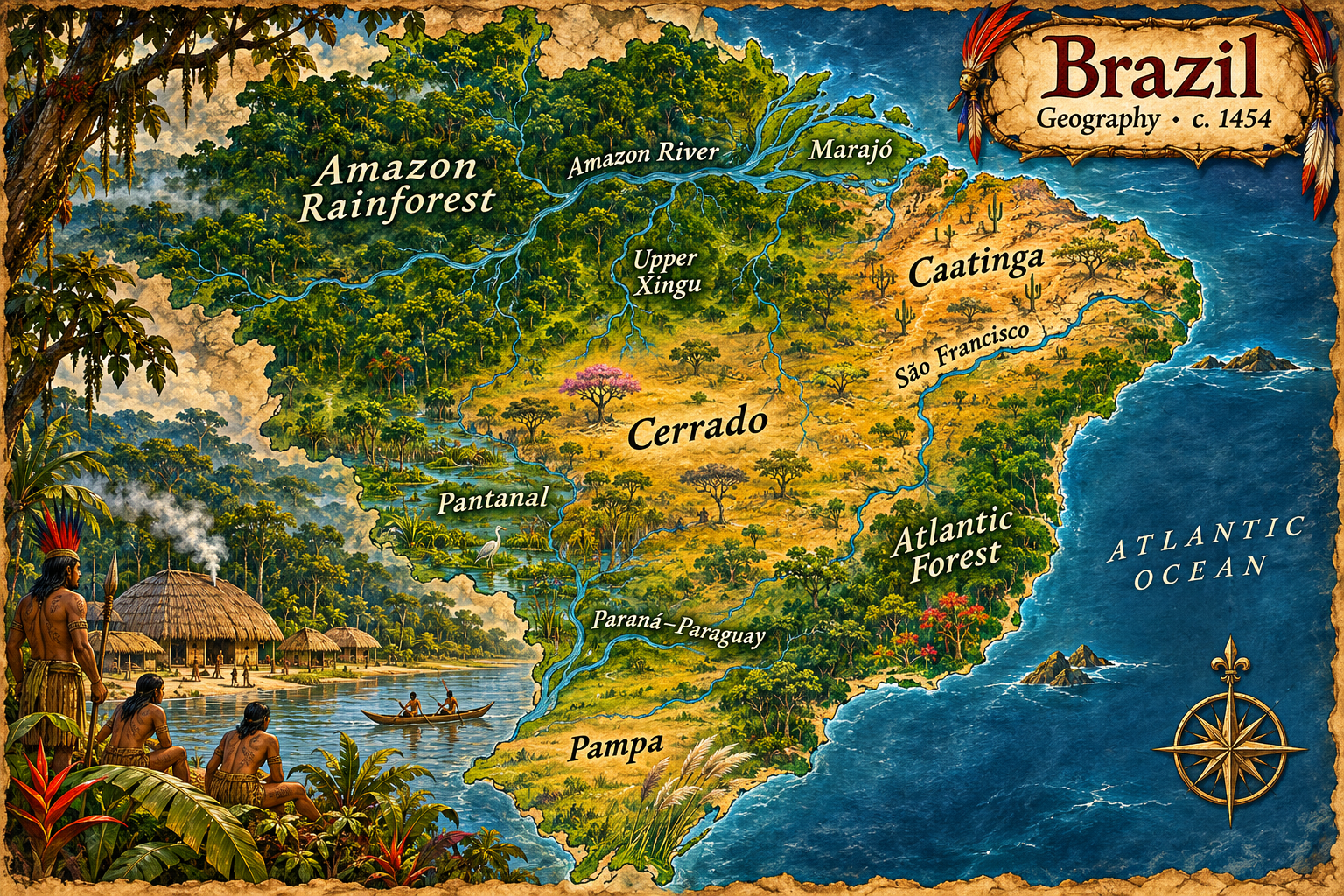
Geographical Map
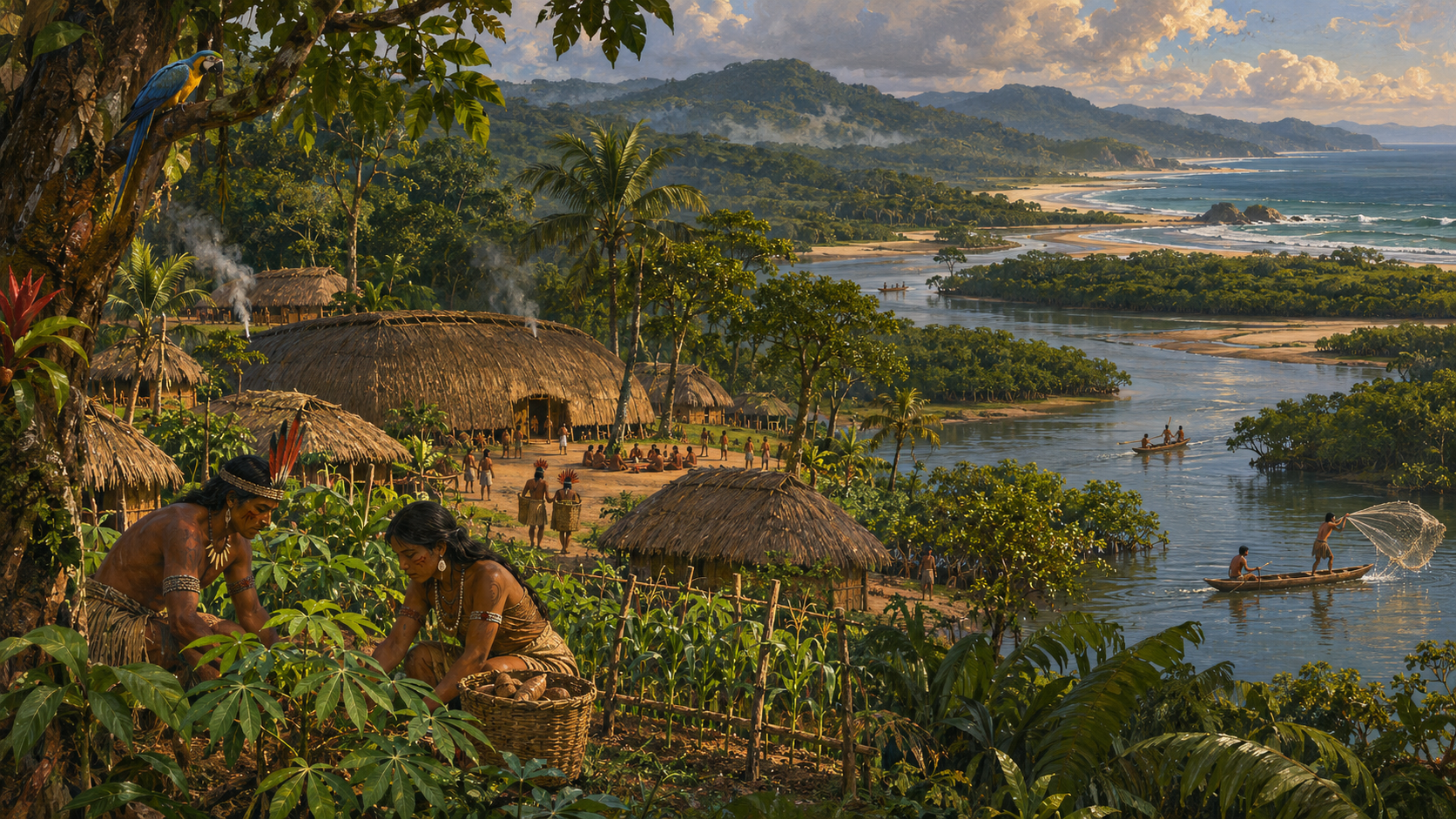
A canoe moves through an estuary beneath densely wooded hills. Fishers bring their nets ashore while families tend gardens above the tide. The pilot slows before the next bend: two neighbouring settlements are in dispute, and strangers who enter the wrong channel may be mistaken for enemies.
Beyond the coast, rivers connect fields, forest clearings, wetlands and upland settlements. The country is not empty or waiting to be claimed. Families, hunters, growers, boatbuilders and community leaders know the routes, maintain alliances, and remember debts. The surest way forward is often to be introduced by someone trusted.
What Is Happening Right Now?
The estuary is closed
Two coastal communities have barred a river channel after a canoe crew disappeared during a dispute over a marriage agreement. A third settlement cannot carry its fish to an inland gathering. One leader demands the return of the crew, another demands compensation, and a trader knows where the missing canoe was last seen. The characters can investigate, escort negotiators or help restore the route before families run short of food.
The flooded gardens
Rising water threatens a settlement’s raised stores and garden plots. Its boatwrights can ferry people to higher ground, but another village needs those same boats. Timber, labour and food have to be shared before the next storm. A party that protects only its paying patron may survive the flood but lose every useful ally along the river.
Tracks at the forest crossing
Game disappears from a path between two settlements. An injured hunter describes an enormous spotted animal; others fear something stranger. A dire jaguar might be hunting near its young, while deeper in the Amazon a Mapinguari could force an entire route to close. Neither need behave as an evil villain; instinct, territory and the choices of frightened people create the danger.
Peoples and Political Life
The Atlantic coast
Along much of the eastern coast, different Tupi-speaking peoples maintain villages, gardens, fisheries and canoe routes. Shared languages or related traditions do not make every community the same polity. Exchange, marriage ties, feuds and temporary alliances shape who may land at a beach or pass a river mouth. Authority rests partly on persuasion, kinship, generosity and demonstrated leadership rather than a distant national court.
The inland plateaus and southern lands
Jê-speaking peoples and other communities inhabit open highlands, woodland margins and river basins. Their languages, methods of cultivation and patterns of settlement differ from those of coastal neighbours. A journey across several territories demands more than one local agreement. Neither coastal nor inland peoples should be reduced to one culture or a single alignment.
The great river societies
Amazonian waterways connect villages, productive forests, fields and managed wetlands. Archaeology supports complex settlement and communication networks, notably in the Upper Xingu and other southern Amazonian landscapes. Plazas, earthworks, raised roads and cultivated ground may be maintained by living communities, not abandoned ruins awaiting treasure hunters. Follow the dedicated Amazon Rainforest entry for deeper travel and regional encounters.
Behaviour and consequence: one leader shares stored food during famine and wins loyal partners; another seizes canoes to intimidate neighbours and soon finds every landing closed against them. Defending a sacred place can be a just cause even when it inconveniences travellers. A community’s conduct matters more than a simplistic label applied to all its members.
Five Regions to Explore
Atlantic forest and coastal bays
Mangroves, beaches, river bars and forested slopes create sheltered settlements and difficult approaches. Tides and surf matter as much as the weather inland. Local fishing grounds, gardens and canoe routes are valuable possessions; careless visitors can damage them without drawing a sword.
The São Francisco basin and eastern highlands
The great eastern river and its tributaries bring people and goods through different landscapes. Rapids, shallows and long portages make some passages seasonal. Upland communities may control the safest forest tracks and maintain ties with both river and coastal settlements. Reliable introductions are often worth more than a map copied far away.
The Amazon mouth and Marajó wetlands
Broad channels, islands, seasonal floodwaters and raised ground form an immense maritime and river world. Older earthworks and managed wetlands reveal long histories of settlement. A landing that serves many canoes in the dry season may disappear under rising water. Residents know which higher banks and channels remain safe.
Upper Xingu and southern tributaries
Planned settlements, plazas, raised approaches and productive woodland can support powerful regional networks. Repairing a causeway, arranging a meeting or protecting stored crops may carry greater political weight than recovering a sword. Outsiders must not assume that every old structure is unoccupied.
Paraná–Paraguay rivers and the southern grasslands
Southern routes pass through different forests, wetlands and open country. Water remains a road, but shallows and overland gaps shape movement. The people living here have their own territories and alliances; customs learned on the northern coast cannot simply be imposed on the south.
Regional names: names such as Brazil and São Francisco identify familiar geographical features for readers. They do not imply that later colonial cities, borders or institutions already exist.
People, Services and Exchange
An estuary pilot knows the safe channels, but refuses to steer armed strangers past a neighbour’s gardens without an introduction. A river boatwright can repair paddles and hulls, provided someone helps replace flood-damaged timber. A keeper of shared food stores protects provisions pledged to several households and rejects an offer that would leave one hungry. A visiting negotiator moves between settlements, carrying news and obligations that must be kept in confidence.
Visitors may obtain food, woven goods, medicine, fishing equipment, boat repairs and guides by exchange, work or hospitality. There is no chain of inns or identical market in every village. Good treatment of hosts brings introductions and help. Theft, threats or abandoned promises spread along the same routes as trade.
Sacred Places, Magic and Monsters
Ritual and healing knowledge belong to particular communities. Ancestors, seasonal ceremonies, protected places and spiritual obligations have different meanings from one region to another; no universal priesthood or single pantheon governs the entire land. In the campaign, a healer may offer remedies but refuse to violate a burial place, while a ceremonial specialist asks a disputing family to repair an old wrong before giving aid.
Ordinary wildlife can be deadly without being malevolent. Jaguars, snakes and river predators hunt, hide and defend territory. Use the dire jaguar for a powerful forest predator with separate game statistics, or the Mapinguari for a monstrous Amazonian threat. The South American Bestiary offers further encounters. Reports of a monster may also conceal raiding, rivalry or simple misunderstanding.
Dangers and Rumours
A broken canoe, a vanishing fishing ground, a sudden silence among the forest birds or a great cat seen near the gardens may signal an ordinary danger, a dispute between neighbours or something monstrous. Families have immediate reasons to respond; visitors who investigate carefully can discover which danger is real before a feud begins.
Travel and Custom
Rain, heat, floods, surf, submerged wood and insects change travel from season to season. River canoes often make better progress than an expedition carrying everything on foot. The safest campsite may belong to somebody. Foreign weapons or coin cannot replace a guide who knows the next crossing, or an interpreter who can explain why the path is closed.
Custom is learned through hosts: where to fish, cut wood, land a canoe, enter a home or approach a ceremonial place. A settlement may welcome trade but not an armed party. Hospitality entails restraint and reciprocity. The Forest Terrain guide provides environmental rules where a journey needs mechanical adjudication.
History Beneath the Forest
People have inhabited and reshaped these landscapes for thousands of years. Cultivation, fishing, forest management, pottery, wetlands engineering and long-distance exchange precede the campaign’s present. Archaeological evidence shows sophisticated settlement networks in parts of Amazonia, but no single historical model describes all the region’s different peoples.
In 1454 there are no Portuguese captaincies, plantation colonies, Brazilian provincial capitals or later national government. The label Brazil lets readers find this vast area on a modern map; it is not the name of a unified contemporary realm. Later European colonisation does not belong to the present-day politics of this entry.
Continue the Journey
Follow the Amazon Rainforest, browse the South American Bestiary, return to South America, or consult the world atlas to travel farther.
Historical Sources
Oxford Research Encyclopedia — Indigenous Societies in Brazil before European Arrival; The Cambridge History of Latin America — The Indians of Brazil in 1500; The Domestication of Amazonia Before European Conquest. The named example situations and local characters are playable campaign fiction.
Keep this reference growing
If this page helped with your reading or game, you can support its upkeep or explore the curated books.
Explore the Bookshop — epics, classics and stories behind imagined worlds.