
Cusco — Royal Capital of Pachacuti
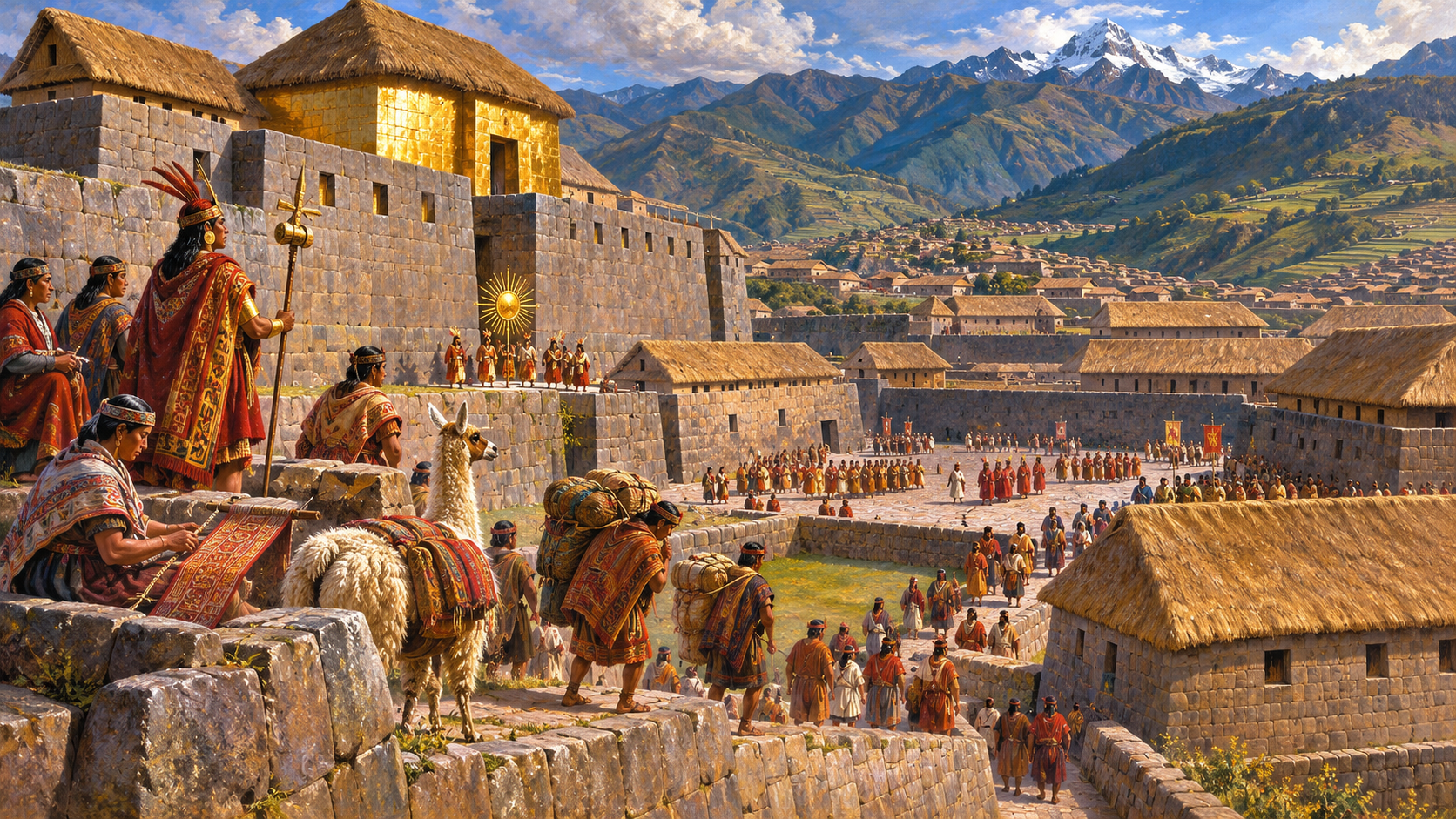
Cusco · Central Andes · Royal city of Pachacuti · 1454 CE
At a Glance
| Place | Royal capital and principal sacred city of the growing Inca state |
|---|---|
| Ruler | Pachacuti, Sapa Inca |
| Landscape | High Andean valley, rivers, neighbouring hills and terraced farmland |
| People | Royal households, local families, craftspeople, porters, messengers and representatives of allied or conquered communities |
| Faith | The worship of Inti, ancestral powers and sacred mountains, waters and places |
| Approaches | Highland roads, llama caravans, messengers’ routes and steep valley paths |
| Campaign present | 1454 CE |
Before sunrise, runners arrive at Cusco with dust on their legs and sealed messages for the royal households. Stonecutters move immense blocks through narrow streets; women barter vegetables, textiles and grain in the markets; and beyond the city, terraces climb towards the cold mountain ridges. Pachacuti’s victories have made this valley the centre of a power that is still growing. Visitors feel that confidence immediately—but the arguments inside the court are as sharp as its stonework.
What Is Happening Right Now?
Pachacuti is reshaping Cusco as a seat of government and worship while his officers extend roads and their authority beyond the valley. Delegations arrive with gifts, petitions and disputes. Some communities welcome secure travel and access to stores; others resist obligations imposed in the name of order. The balance is not simply conquerors against victims: a new road may feed a mountain settlement in winter while its construction exhausts the neighbouring village.
A series of damaged bridge ropes has delayed three messengers from the north. The road office accuses a hostile community, but the men who maintain the crossing say the material was deliberately cut from the city side. Someone inside Cusco wants a message to arrive late.
On the northern coast, the independent Chimú kingdom retains its great capital at Chan Chan. Its metalworkers and administrators are watched with interest by Cusco’s nobles, who disagree over whether the coast should be approached through diplomacy, trade or armed force.
Streets and Places to Explore
The Great Central Square
Ceremonies, audiences, festivals and proclamations draw crowds into the city’s public heart. Officials gather delegations under their own banners; an unfamiliar traveller can learn more from the waiting petitioners than from a palace herald. The square is a political stage where failure to honour a guest is remembered.
Qorikancha, Sanctuary of the Sun
Fine stonework surrounds an extraordinarily important shrine of Inti. Priests preserve ritual order, while servants manage offerings and the practical needs of visitors. To enter restricted places without permission is to challenge both sacred custodians and the ruler whose authority is entwined with the Sun.
The Royal Households and Noble Precincts
Political households maintain their own servants, relatives, interests and rivalries. A request rejected by one official may be welcomed by another seeking influence. Messages are guarded; servants who understand the corridors can be as useful as a soldier with a key.
The Valley Workshops
Skilled craftspeople fashion cloth, tools and metal objects for court use. Supervisors measure deliveries, and shortages create arguments between the craftsmen and the officials who control raw materials. A workshop may be commanded to deliver gifts for an envoy who has not yet arrived.
Fields, Storehouses and Approaching Roads
Beyond the central precincts, cultivated land and stores sustain the city. Road stations and porters connect Cusco to distant communities. The valley is a living landscape of food production and work, not just temples and palaces.
People, Households and Loyalties
Pachacuti is the commanding power, ambitious for an ordered and enduring state. He protects successful allies yet expects tangible service. His officers must make decisions that can bring either stability or resentment.
Mayta Rumi, a road steward, knows which messengers are late and which rope-bridge inspections have been falsified. He seeks reliable workers, not brave speeches, and fears his superiors will blame a distant village for corruption inside the capital.
Killa Ñawi, an attendant attached to the solar sanctuary, is concerned that a ritual supply meant for a public festival has been diverted to a private household. Her obligations are sacred, but her evidence could bring a powerful family into disgrace.
Foreign envoys and hill chiefs are never merely decorative guests. They represent communities whose work, food and freedom are affected by decisions made in this city.
Food, Shelter, Healing and Magic
Travellers with an established local sponsor can seek hospitality through households and recognised roadside arrangements. Those without one must negotiate with caravan leaders, market families or the stewards of a visiting delegation. Food includes highland grains, potatoes and other cultivated produce; llama caravans carry supplies too valuable to waste. Healers and ritual specialists serve both household and sacred needs, but access to a royal or temple specialist depends on relationships, not on a fixed marketplace price.
The city’s supernatural life is tied to the places its people revere. A mountain shrine, spring or ancestral chamber may answer an insult through omen or misfortune. Such claims have consequences: even a sceptical official hesitates before ordering work that a whole district regards as sacrilege.
Dangers and Adventure Hooks
- The cut ropes. Repair a damaged bridge and determine why its maintenance marks were altered. If a distant valley is blamed, its hostages may be brought to Cusco before the evidence is heard.
- The missing offering. A solar festival depends on a precious object held by a court family. The sanctuary’s custodians refuse to proceed unless it is returned, but the family’s servants claim the item was never delivered.
- Before the ambassadors arrive. A disputed mountain community sends two delegations, each claiming authority to accept Pachacuti’s terms. A bad decision may divide the community for a generation.
- The stores on the road. Travellers report a provisioning station that is full on paper and empty in fact. Find the missing grain before an army or a winter storm reaches the pass.
Travel, Roads and Boundaries
The great Andean network of roads radiates from Cusco and is being strengthened during the present reign. Runners carry messages; llama trains move goods; mountain paths are often stairs or narrow ledges rather than wheeled roads. Use local guides for the wet season and high passes. A traveller from Cusco can move through the Urubamba valley to Machu Picchu, south toward the Titicaca highlands or north through lands whose loyalties change from valley to valley.
A visiting group may be welcomed on one road and challenged at the next district. The city’s officials are organised, but their authority beyond the valley depends upon agreements and the presence of loyal people.
Deeper History
Cusco occupies a long-settled Andean valley. During the fifteenth century Pachacuti refashions it as a royal, sacred and administrative capital of an expanding state. Its elaborate buildings reflect earlier Andean traditions as well as the ambitions of the current ruler. The far-flung Inca domains familiar from later centuries are not yet wholly within Cusco’s grasp in 1454; the northern Chimú kingdom remains independent.
Historical Sources and Onward Routes
UNESCO — City of Cuzco · UNESCO — Qhapaq Ñan · Metropolitan Museum — Andes chronology.
Travel to Machu Picchu, the Central Andes or the South America atlas.
Keep this reference growing
If this page helped with your reading or game, you can support its upkeep or explore the curated books.
Explore the Bookshop — epics, classics and stories behind imagined worlds.