
Karelia
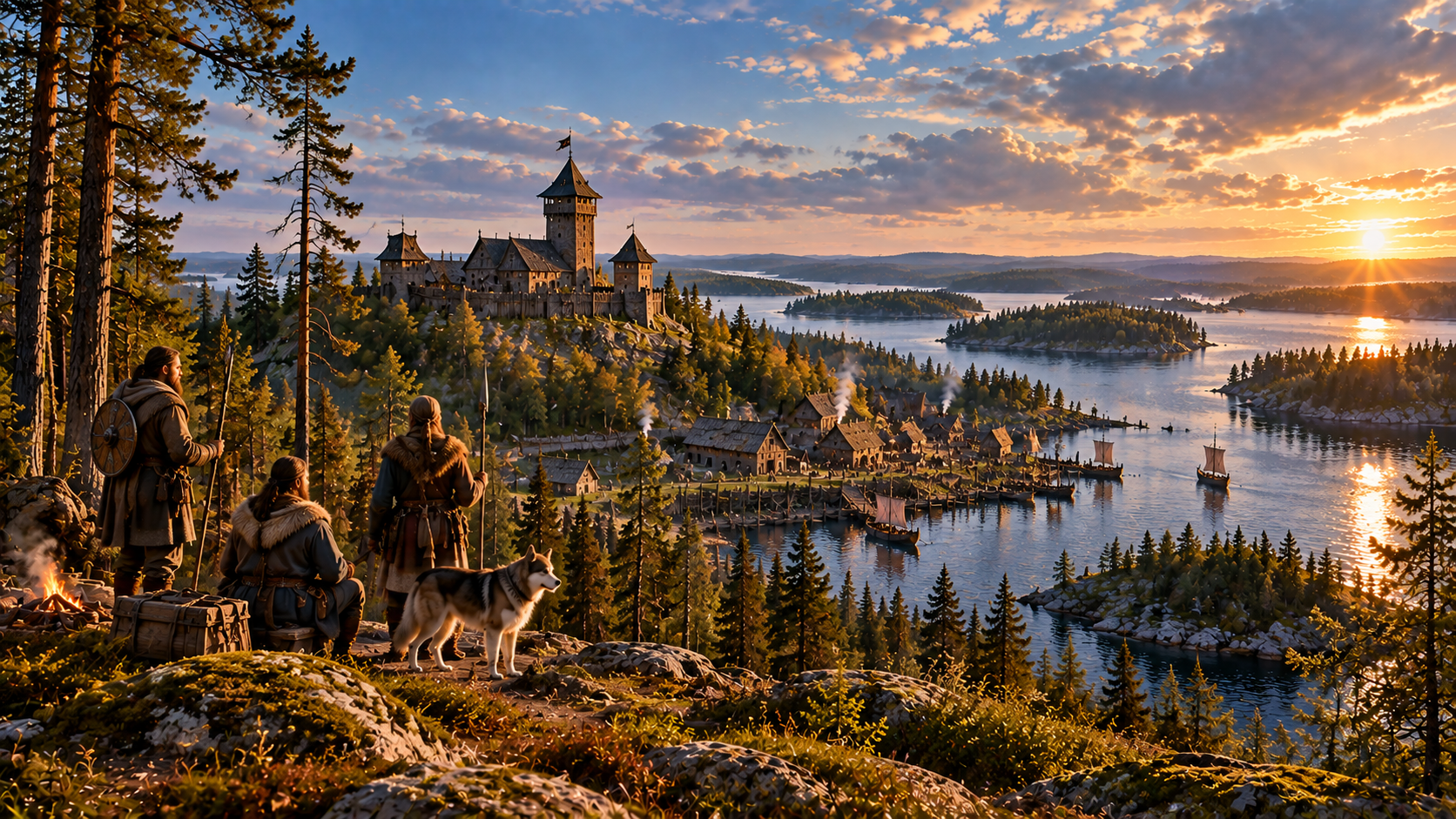
The divided eastern borderland where Swedish and Novgorodian power meet Karelian communities, trade routes and rune-song traditions
At a Glance
| Region | Eastern borderlands around the Karelian Isthmus, Ladoga routes and territories extending northward |
|---|---|
| Political Division | Split between the Swedish realm in the west and south-west and the Republic of Novgorod farther east and north |
| Western Stronghold | Viborg, principal Swedish fortress and market on the Karelian Isthmus |
| Border Basis | The Treaty of Nöteborg (1323), precise in some southern districts and increasingly disputed farther north |
| Peoples and Languages | Karelian, Finnish and Swedish communities with Novgorodian, Baltic and other trading contacts |
| Faith | Karelian and Finnish sacred traditions, rune-song, ancestral rites, Catholic institutions in Swedish-held districts and Orthodox Christianity in Novgorodian Karelia |
| Campaign Themes | Border diplomacy, divided families, trade, espionage, rune-singers, sacred landscapes, disputed sovereignty and cultural crossroads |
Karelia is not one province neatly belonging to Finland; it is a broad cultural and political borderland divided between western and eastern powers. The Swedish realm controls Viborg and western districts, while Novgorod holds territories farther east. Karelian communities, kin groups and traders cross that political division in ways neither side fully controls.
The 1323 Treaty of Nöteborg created the first formal boundary between Sweden and Novgorod across this region. In the south its meaning is relatively clear. Farther north, the border becomes a contest of routes, tribute, hunting, settlement and memory.
Religion marks the frontier without simplifying it. Catholic institutions stand on the Swedish side, Orthodox Christianity has deep roots in Novgorodian Karelia, and older sacred traditions remain alive across both. Rune-song, family memory and landscape obligations can cross the political boundary more easily than armies do.
Explore: Savonia · Finland · Republic of Novgorod · Pohjola · Finnish Pantheon
What Is Happening Right Now?
Viborg Is Watching Novgorod
Swedish officers treat every unusual movement east of the frontier as potentially strategic. Merchants and local families know that most travellers are simply trading, visiting kin or following seasonal routes—which makes actual spies harder to identify.
Novgorod’s Future Is Uncertain
The Republic remains powerful, but Moscow’s growing influence farther east makes western officials wonder whether the border they know will soon face a different master.
Rune-Songs Are Crossing the Border
Verses carried from village to village contain names and events that authorities interpret as coded intelligence. The singers insist the songs are older than the states trying to censor them.
A Boundary Shrine Has Two Priests and Three Owners
A sacred site stands where political, religious and family claims overlap. Removing any claimant risks turning a local disagreement into a wider crisis.
Places to Use in Play
Viborg and the Karelian Isthmus
Viborg is the Swedish realm’s great eastern fortress and market, controlling routes between the Gulf of Finland, inland Karelia and the Novgorodian sphere. Court agents, merchants and military men all pass through its gates.
Ladoga Routes
Lake Ladoga and its river connections link eastern trade networks that reach far beyond Karelia. Goods, pilgrims, information and magic all move along the same water.
Border Villages
Families near the political line often possess kin and obligations on both sides. They are ideal places for diplomacy, divided loyalties and adventures where helping one relative can appear treasonous to a distant ruler.
The Northern Wilderness
Beyond the better-defined southern border, claims overlap. Karelians, Savonians, Tavastians, Sámi and tribute collectors may use the same territory according to different traditions.
People and Powers
| Power | What It Wants | Adventure Pressure |
|---|---|---|
| Viborg’s Swedish Authorities | Secure the eastern frontier, collect revenue and identify genuine Novgorodian threats. | Espionage, escorts, border negotiations and missing messengers. |
| Novgorodian Officials and Traders | Maintain eastern routes, tribute relationships and influence across Karelia. | Trade disputes, rival agents and negotiations over captives or cargo. |
| Karelian Communities | Protect land, kinship, trade and religious practices across a border imposed by larger powers. | Divided loyalties, family rescue, village disputes and conflicting demands. |
| Rune-Singers and Sacred Specialists | Preserve songs, ritual knowledge and relationships with local powers. | Prophecy, magical song, censored traditions and sacred journeys. |
| Merchants | Keep routes open between Baltic, Ladoga and eastern markets. | Convoys, tolls, stolen cargo and commercial intelligence. |
Dangers, Rumours and Adventure Hooks
- The Two Baptisms. A noble heir has valid religious records from both sides of the frontier under different names.
- The Song of the Border. A rune-song accurately describes every boundary marker except one that moved last winter.
- The Novgorodian Chest. A merchant cargo contains letters linking Swedish officials to private eastern deals.
- The Missing Icon. An Orthodox sacred image disappears and is found in a western shrine where it is producing miracles.
- The Family Across the Line. A village asks the party to recover relatives detained as spies even though some of them actually are.
- The Lake Road. A winter route across frozen water opens onto a shore that belongs to neither Sweden nor Novgorod.
Travel and Law
Rivers, lakes and portages dominate movement. The frontier matters at castles, toll points and recognised roads, but travellers can move through wilderness where sovereignty is hard to enforce. Local guides often understand political risk better than foreign officials.
No single legal system governs all Karelia. Swedish law, Novgorodian practice, church jurisdiction, village custom and sacred obligation overlap. An adventuring party can cross from one set of lawful protections into another within a day’s travel.
Deeper History
The Treaty of Nöteborg in 1323 divided spheres of Swedish and Novgorodian power through Karelia. Viborg and western districts fell within the Swedish sphere, while much of eastern and northern Karelia remained tied to Novgorod. The border also became a cultural and religious threshold between western Catholic and eastern Orthodox institutions.
Karelian culture cannot be reduced to either side. Oral poetry, language, kinship and local traditions continued across political boundaries, preserving a distinct identity shaped by interaction with both east and west.
Explore the Midgard Cluster
Union of Midgard · Finland · Savonia · Republic of Novgorod · Pohjola · Finnish Pantheon
Keep this reference growing
If this page helped with your reading or game, you can support its upkeep or explore the curated books.
Explore the Bookshop — epics, classics and stories behind imagined worlds.