
Haguenau — Imperial City at the Edge of the Great Forest
Haguenau at a Glance
| Campaign Present | 1454 CE |
|---|---|
| Status | Free Imperial City within the Holy Roman Empire |
| Regional Role | Chief administrative city of the Alsatian Decapolis and seat of major Imperial authority in Lower Alsace. |
| Population | Several thousand permanent residents; human-majority but visibly multi-peopled. |
| River | The Moder. |
| Beyond the Walls | The immense Haguenau Forest, farms, mills, roads and scattered settlements. |
| Known For | Imperial administration, the Decapolis, forest rights, guild commerce, manuscript production and the old Staufen palace. |
| Best Adventures | Investigation, civic intrigue, forest expeditions, missing persons, magical manuscripts, disputed law and escort work. |
| Languages | Alsatian Alemannic in ordinary life; German in much civic and Imperial business; Latin among scholars and legal specialists; French heard through western trade and diplomacy. |
| Magic | Visible but specialised: healers, ritualists, scribes, scholars, alchemists, craft magic, wards and forest traditions. |
| Immediate Danger | Forest creatures, river spirits, smuggling, political retaliation, forged authority and badly handled magic. |

The white rose on blue.
Haguenau’s rose appears on seals, civic property and official documents. Here heraldry is practical: a recognised seal can open a gate, authorise a search, validate a timber right or begin a political crisis when two genuine documents appear to give contradictory orders.
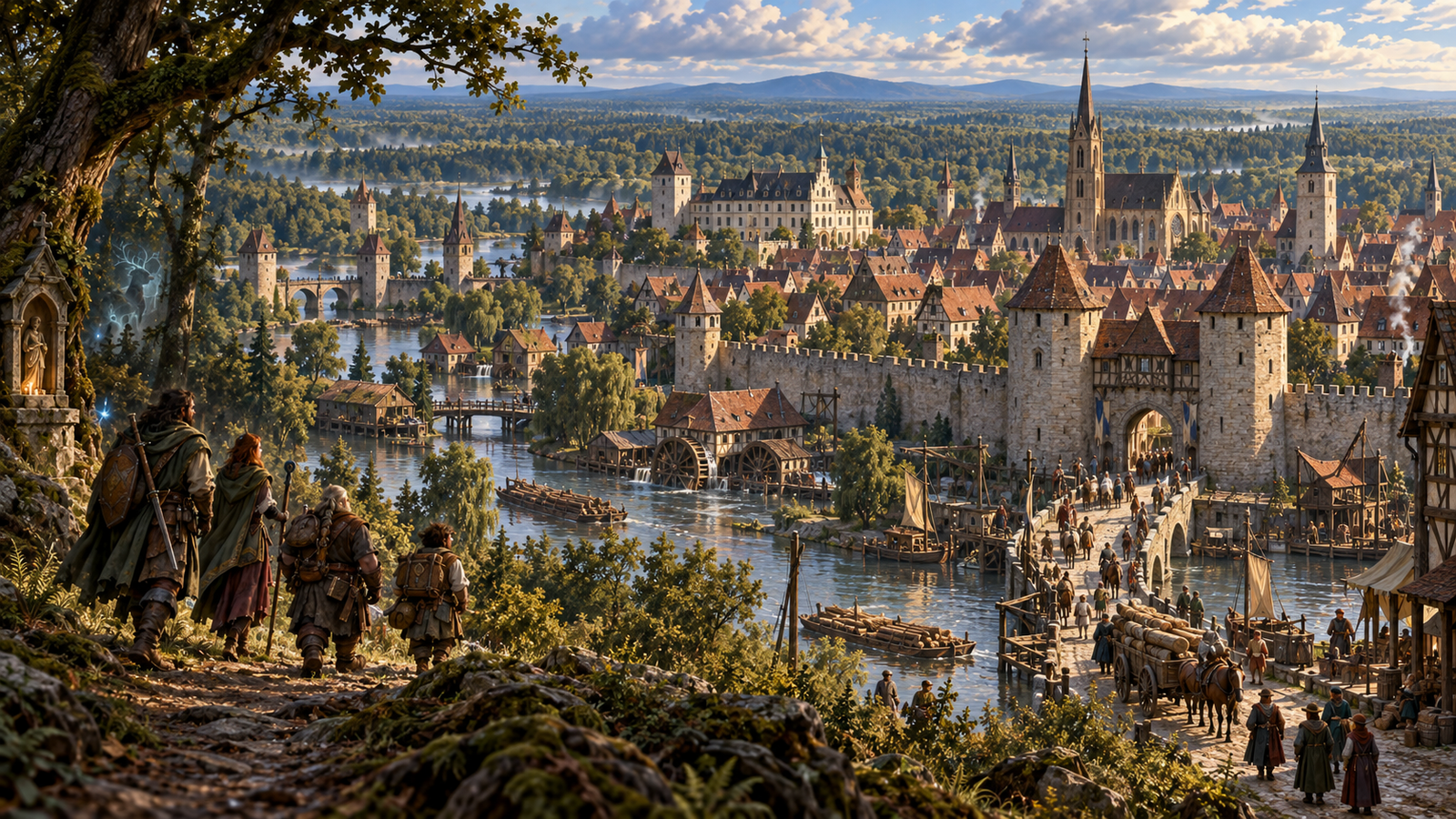
The first thing adventurers notice is not the palace. It is the queue. Timber wagons wait outside a gate while a forester argues with an Imperial clerk, a dwarf smith examines a cracked wheel-rim, two halfling carriers complain about a missing courier, and a manuscript dealer keeps one gloved hand firmly pressed against the locked case beside him.
Beyond the gate lies a compact, busy Imperial city of markets, guild workshops, narrow streets, mills and official buildings. The Moder runs through its working life. Beyond the walls begins the Haguenau Forest: valuable, enormous and only partly obedient to human ideas of ownership.
Haguenau is a place where adventurers can find employment without waiting for a ruler to summon them. Merchants need escorts. Forest guards need trackers. Scribes need stolen pages recovered. Guilds need discreet investigators. Imperial officials need problems solved without starting arguments with the city council. The council needs exactly the same thing in reverse.
And when somebody says that a spirit has moved a boundary stone, the correct first question is not whether spirits exist. It is which boundary, and who loses if the stone stays where it is?
What Is Happening Right Now?
The Seventh Mark
Timber is being felled under warrants carrying a forest mark nobody recognises. Haguenau’s guards say it is Imperial. Imperial foresters say it belongs to the city. Both are wrong.
Yesterday a woodcutter found the same mark cut into a living oak far beyond the authorised felling ground.
Pages Missing From Lauber’s Workshop
Eight leaves have vanished from an expensive manuscript commissioned by a wealthy customer. The illuminations were left behind. Whoever took the pages wanted the words.
Diebold Lauber is offering good money for discreet recovery before his customer learns anything is missing.
Ten Cities, Nine Answers
A Decapolis dispatch arrives carrying what appear to be valid seals from several cities. One member city denies agreeing to the document at all.
If the seal is false, somebody can imitate civic authority. If it is genuine, somebody inside an allied government is lying.
The Chamber Beneath the Palace
Repair work in the old Imperial complex has exposed a blocked doorway. Local memory associates this part of the palace with the era when Imperial treasures were sometimes kept at Haguenau.
The actual Imperial Regalia are long gone. The workers nevertheless refuse to reopen the door.
Places Adventurers Actually Visit
The White Rose Inn
A busy travellers’ inn inside the walls, named for the city arms. Merchants, couriers, guild factors, caravan guards and wandering specialists pass through. The common room is respectable enough for business but noisy enough for discreet conversation.
Come here for: rooms, meals, caravan work, local gossip, guides, replacement hirelings and introductions to people who do not advertise openly.
The Kornmarkt
Grain, bread, carts, animals, household goods and commercial news converge here. Bakers know shortages before councillors do. Carters know which road is unsafe. Merchants know who has stopped paying.
A surviving civic record from the period concerns a bakery in the house called Zum Stier on the Kornmarkt.
Come here for: ordinary equipment, supplies, pack animals, porters, wagons, rumours and people who noticed who bought something unusual.
Diebold Lauber’s Workshop
This is not a lonely scribe’s desk. Lauber directs an organised manuscript business employing several hands: scribes, illustrators and specialists producing books for wealthy urban and aristocratic customers.
Finished works, exemplars, pigments, loose quires and private commissions make the workshop a treasure house for anybody who understands how valuable information can be.
Come here for: copying, translation contacts, manuscript expertise, rare texts, missing books, suspicious handwriting and work involving dangerous documents.
The Imperial Palace
The Staufen complex remains the most potent physical reminder that Haguenau’s importance reaches beyond its walls. Imperial administration now matters more than royal residence, but the palace still carries the weight of centuries.
Come here for: warrants, audiences, sealed records, Imperial commissions, prisoners, legal appeals and mysteries left behind by earlier rulers.
The Forest Gate
Timber wagons, charcoal burners, hunters, foresters and travellers moving towards the northern woods pass through this gate. Notices appear here before rumours reach the inns.
Come here for: forest guides, tracking work, missing travellers, creature bounties, timber disputes, hunting permissions and escort contracts.
The Moder Mills
Wheels turn, grain moves, workers shout over water and cargo changes hands nearby. The mills are useful places to move goods without attracting the attention that accompanies the main market.
River spirits known locally as Brenzele are associated with quieter stretches of water. Bread and honey are still left where mill-workers think an offering is sensible.
Come here for: boatmen, mill workers, hidden cargo, water spirits, missing goods and things recovered from the river that should have stayed submerged.
The Guild Houses
Haguenau’s trades are organised through masters, workshops, apprenticeships, household connections and negotiated privileges. Coin alone does not guarantee immediate access to a specialist.
Come here for: armour repairs, fine metalwork, locksmithing, carts, leatherwork, specialised tools, employment and somebody willing to vouch for you.
The Shrine Court of the Old Ways
Haguenau’s older traditions remain visible throughout the city. Goden and household ritualists maintain shrines and observances connected with Wodan, Donar, Zisa, Nerthus and local powers of forest, water and sky.
Autumn rites associated with Zisa fill streets with oak garlands and painted shields, while smiths still invoke Donar when beginning dangerous work.
Come here for: omens, ritual help, healing contacts, spirit lore, mediation with supernatural beings and warnings nobody in the magistracy wants recorded.
People Who Matter
Antoine von Hornberg
Newly received into the office of Schultheiss, Hornberg is learning which apparently simple disputes conceal generations of precedent.
He listens carefully, asks for documents and dislikes being forced into public decisions before he knows who benefits from them.
Use in play: employer, magistrate, reluctant ally, source of warrants or the man who tells the party that their perfectly valid authority is valid in the wrong jurisdiction.
Diebold Lauber
Lauber knows handwriting, paper, pigments, customers and deadlines. He can recognise many of his workers’ hands immediately and knows when a page does not belong in a book even if the words look convincing.
He is a businessman before he is an adventurer’s sage. Information has a price because producing it has a price.
Use in play: expert on manuscripts, patron for recovery missions, unwilling witness to magical texts and one of the first people likely to understand the significance of mechanically repeated lettering.
Greta Rosen
Greta remembers faces, drinking habits and who unexpectedly paid in foreign coin. She refuses to sell private information about ordinary guests but makes an exception for people who bring danger into her house.
Use in play: safe contact, rumour source, introducer to caravans and a practical measure of whether the characters’ reputation is improving or collapsing.
Ulrich Eisenhand
Ulrich’s household has worked with Haguenau’s craftsmen for years. He makes locks, repairs armour, recognises poor metal immediately and considers most magical security worthless if the hinges can simply be removed.
Use in play: equipment, lock expertise, dwarven trade contacts, engineering problems and somebody who can tell whether a broken door was forced or carefully dismantled.
Elsa Fink
Elsa moves parcels, letters and small valuable goods between Haguenau and nearby settlements. She knows which roads are genuinely dangerous and which stories were invented to keep travellers away.
Use in play: guide, courier, road intelligence, missing-person cases and connections with itinerant and settled halfling families.
Matthes Dorn
Matthes has no patience for the idea that every supernatural creature is either sacred or monstrous. Some are neighbours. Some are predators. Some are both.
Use in play: spirit lore, omen reading, ritual assistance, negotiation with woodland powers and inconvenient reminders that the forest remembers agreements humans have forgotten.
Factions in Haguenau
| Faction | Wants | Has | Weakness |
|---|---|---|---|
| The Civic Magistracy | Protect Haguenau’s privileges, commerce and authority inside the walls. | Officials, records, seals, watchmen, guild support and local legitimacy. | The council contains competing interests and does not always agree what “the city’s interest” means. |
| The Imperial Landvogtei | Keep Imperial authority effective across Lower Alsace and the Decapolis. | Recognised jurisdiction, correspondence, officers, Imperial prestige and regional influence. | Power relies upon charters and negotiated cooperation rather than unlimited command. |
| The Decapolis Delegates | Defend the collective privileges and security of the ten allied Imperial cities. | Ten governments, messengers, seals, militias and political leverage. | The cities remain independent and often disagree about cost, precedence and risk. |
| The Guild Interests | Protect trades, apprenticeship, prices, standards and workshop privilege. | Craftsmen, money, tools, apprentices, warehouses and local information. | Guilds compete with one another and need the magistracy more than they like admitting. |
| Lauber’s Workshop | Produce valuable books, retain skilled workers and protect commissions. | Scribes, illustrators, exemplars, wealthy customers and specialised knowledge. | Books are valuable, portable, fragile and easy to damage deliberately. |
| Mentelin’s Free Cities Press Network | Spread arguments defending Free Imperial City liberties and resistance to unlawful tolls and predatory rule. | Movable type, paper, merchants, scribes, couriers and sympathetic urban contacts. | Secrecy. One captured courier can expose several connections at once. |
| The Forest Guards | Control felling, grazing, hunting, roads and unlawful exploitation. | Local knowledge, authority, markers, patrols and evidence gathered beyond the walls. | Shared civic and Imperial administration creates divided loyalties. |
| The Older Forest Powers | Depends upon the grove, spirit, creature or ancient agreement. | Territory, memory and supernatural influence. | They rarely speak with one voice and are easy for human factions to misrepresent. |
Who Lives Here?
Haguenau is human-majority, but it is not a human-only city. Trade, guild work, administration and the roads through Alsace bring many peoples through its gates.
Dwarves are most visible in metalwork, engineering, assaying and commercial connections to wider mining networks. Halflings appear among settled households, carriers, food trades, markets and travelling kin-networks. Gnomes are uncommon but valued in precision work, mechanisms, pigments, engraving and alchemy. Elves are fewer still, generally travellers, merchants, envoys or specialists connected with their stronger communities in Britain and Scandinavia.
Citizenship, guild standing, household connections, reputation, property and patronage matter more in daily dealings than a neat fantasy division into ancestry districts. Suspicion and prejudice exist, but they are social realities rather than universal mechanical penalties.
What Adventurers Can Buy, Learn and Arrange
| Need | Where to Start | Availability |
|---|---|---|
| Ordinary adventuring equipment | Kornmarkt, guild craftsmen, merchants | Usually straightforward. |
| Armour and weapon repair | Smiths and guild workshops | Routine repairs readily arranged; specialised work requires a master. |
| Guides and trackers | Forest Gate, inns, hunters, foresters | Easy for common roads; harder for dangerous or disputed woodland. |
| Hirelings and caravan guards | White Rose, guild houses, merchants | Available when the work sounds survivable. |
| Healing | Healers, Goden, apothecaries and trained magical practitioners | Ordinary treatment common; powerful magical intervention requires contacts. |
| Alchemical materials | Apothecaries, specialist craftsmen, merchants | Common materials available; rare reagents require time or an introduction. |
| Translation and manuscript work | Lauber’s workshop, clerks, scholars | Excellent by regional standards. |
| Magical detection | Scholars and trained practitioners | Access to effects such as Detect Magic is plausible through the correct contact. |
| Magical identification | Scholars, specialist practitioners, collectors | Identify and equivalent expertise are available but not an automatic shop service. |
| Magical translation | Scholars and specialist spellcasters | Comprehend Languages may be commissioned through learned contacts. |
| Secure magical storage | Wealthy merchants, officials and specialist warders | Important archives and chests may use Arcane Lock or comparable protections. |
| Rare magic items | Brokers, private owners, guild masters, travellers | Not displayed on shelves; finding the owner is usually part of the adventure. |
Magic in Everyday Haguenau
Magic is part of ordinary learned life without turning Haguenau into a magical shopping centre. A locksmith may understand warding. An apothecary may recognise an unnatural illness. A manuscript specialist may detect an enchanted page. A Goden may know which offering a local spirit expects. A forest guide may carry charms learned from a master rather than from a university.
Learned magic travels through masters, schools, private tutors, court scholars, guild traditions, household teaching, ritual lineages and practical experience. There is no single institution licensing every legitimate spellcaster.
This makes specialist magical help obtainable without making it anonymous. The important question is usually not “does this spell exist?” but “who knows somebody willing and able to perform it?”
Dangers In and Around Haguenau
Waldschrate
Ancient tree guardians are associated with particular groves and old growth. They are most dangerous when somebody damages a place under their protection and then assumes that human permission settles the matter.
Unholde
Pale, dangerous beings are reported along neglected forest tracks and places where travellers disappear without signs of ordinary robbery.
Nachtjäger
Spectral hunters belong to the stories told about night travel through the deeper forest. Dismissing those accounts merely because they sound like folklore is a poor survival strategy.
Brenzele
River spirits associated with the Moder are not automatically hostile. Mill-workers and river households leave small offerings because coexistence is easier than proving to a water spirit that a mill charter grants jurisdiction over its pool.
People With Seals
The most dangerous encounter in Haguenau may still be an official with a lawful warrant. Violence against civic or Imperial personnel can turn a local incident into a regional problem very quickly.
Street Talk and Rumours
| d10 | Rumour |
|---|---|
| 1 | A forest guard found a boundary marker twenty paces from where he swears it stood last week. |
| 2 | Somebody is paying apprentices for discarded pieces of Lauber’s paper. |
| 3 | An Imperial clerk has been buying drinks for guild masters who normally refuse to sit at the same table. |
| 4 | A Brenzele returned a drowned man’s purse but kept every coin stamped with the Imperial eagle. |
| 5 | The White Rose has a guest who has paid for the same room under three different names. |
| 6 | A new broadsheet appeared in three taverns before sunrise, and nobody saw who delivered it. |
| 7 | Woodcutters have stopped entering one grove because somebody inside keeps calling them by their childhood names. |
| 8 | One of the city seals in the archive weighs slightly less than it did last month. |
| 9 | A dwarf smith says a lock recovered from the palace was made centuries after the room behind it was supposedly sealed. |
| 10 | A Decapolis courier has been seen twice on the Strasbourg road even though he has been officially missing for four days. |
Adventure Hooks
The Seventh Forester
Timber warrants bear an unknown seventh forest mark. The person using it knows the authorised boundaries better than several official guards.
The Missing Quire
The stolen leaves from Lauber’s manuscript appear one at a time in different parts of the city. Each now carries a single additional sentence.
The Rose and the Eagle
The magistracy and an Imperial officer issue contradictory orders concerning the same wagon. Both documents are genuine.
The Empty Treasury
A sealed palace chamber once associated with Imperial storage is opened. The Regalia are not there—but something omitted from every known inventory is.
No Toll Without Right
Haguenau merchants are arrested after refusing a newly imposed road toll. By morning, anonymous sheets demanding a Decapolis response are circulating.
The Printed Lauber
Dozens of identical pages reproduce a text from Lauber’s workshop. He did not make them. Mentelin’s people deny making them. One sentence appears in no known manuscript.
The Grazing Ban
Officials close part of the forest to livestock. A nearby community refuses because its families claim an older right. Then the animals left inside begin disappearing.
The Sleeping Courier
A Decapolis messenger reaches Haguenau mounted, armed and apparently unharmed, but cannot be awakened. His dispatch case is empty and the lock has not been forced.
The Waldschrat’s Claim
A tree guardian produces an object bearing the names of families with forest rights. Several names also appear in Haguenau’s oldest records.
Ten Seals
A document apparently carrying the assent of all ten Decapolis cities reaches Haguenau. Nine seals are genuine. The tenth belongs to a city that insists it never saw the document.
City, Forest and Roads
The Moder
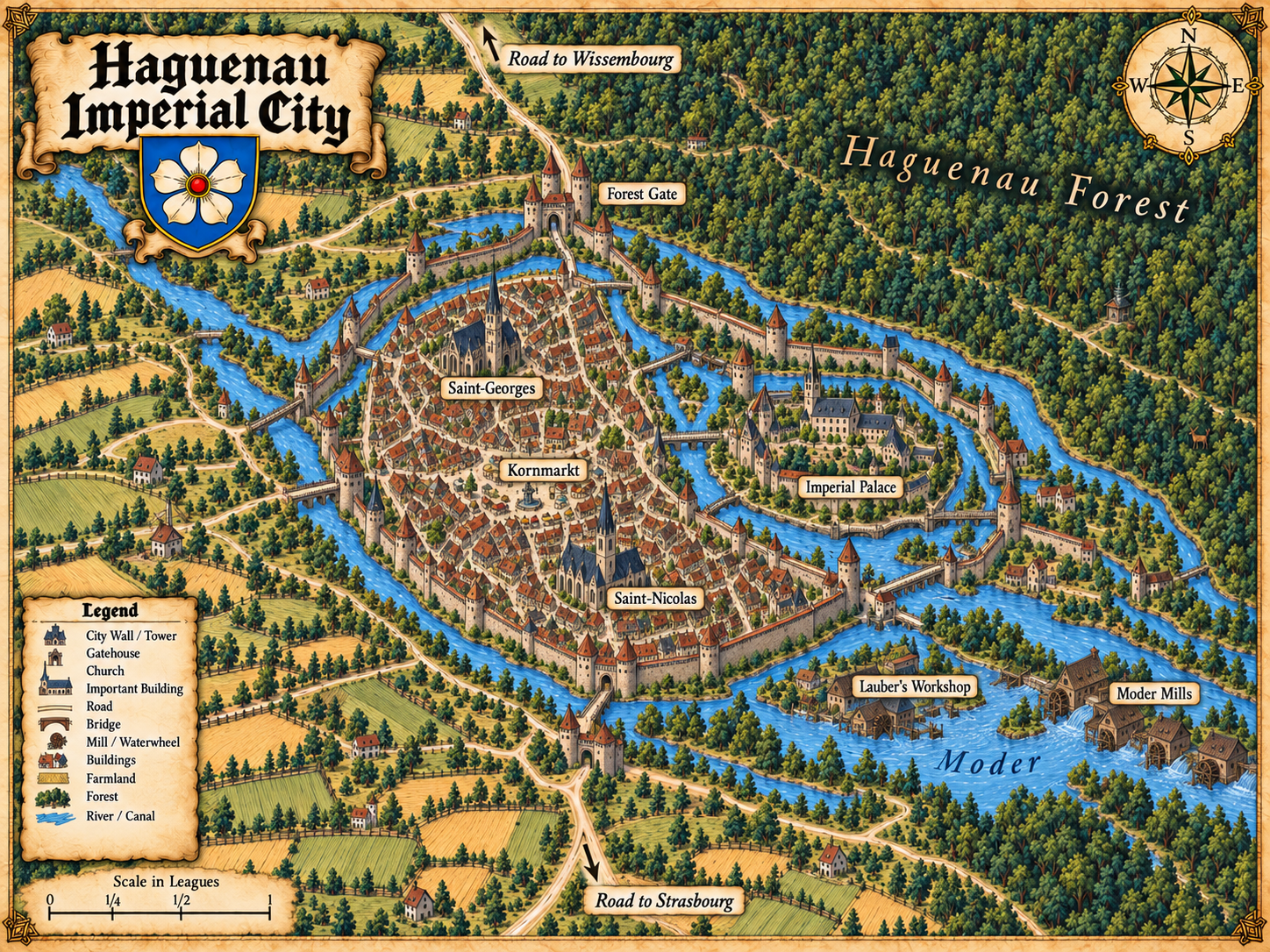
Haguenau grew around a castle established on an island in the Moder. Water therefore shapes the city at its oldest point rather than merely passing beside it. Mills, bridges, working channels and low ground connect the river directly with commerce and travel.
The Great Forest
Haguenau Forest dominates the landscape beyond the city. Timber, hunting, grazing, fuel, forest products and roads make it economically indispensable. It is equally important as a supernatural frontier.
North Towards Wissembourg
Roads north move through settlements and forest towards Wissembourg and the northern reaches of Alsace. Travellers use Haguenau as a natural staging point before entering less controlled stretches of road.
South Towards Strasbourg
The road south connects Haguenau with Strasbourg, the larger Free Imperial City whose merchants, scribes and clandestine printing connections matter greatly to Haguenau.
The Decapolis Roads
Couriers and merchants connect Haguenau with fellow member cities including Sélestat, Obernai and Colmar. Those roads carry political information as readily as cargo.
The Forest Is a Legal Problem
Haguenau’s forest works best in play when it is not treated as an empty wilderness waiting for random encounters.
Emperor Sigismund’s settlement of 1434 confirmed an unusual arrangement: administration and interests in the forest were shared between the city and the Imperial representative. The settlement is recent enough that its practical meaning remains contested by living institutions.
The arrangement creates questions adventurers can actually encounter:
- Who may cut this tree?
- Who may arrest a poacher?
- Whose warrant allows pursuit beyond a boundary?
- Who may close a forest road?
- Who receives money from timber or grazing?
- Who owns something discovered beneath the ground?
- Who negotiates if the claimant is a Waldschrat rather than a human landholder?
The strongest forest adventures therefore put several forms of authority in collision: civic privilege, Imperial law, customary use and supernatural claims.
Manuscripts, Secrets and the Coming Print Revolution
Diebold Lauber’s workshop is one of Haguenau’s strongest distinguishing features. It has been producing illustrated manuscripts for decades and employs multiple scribes and illustrators rather than functioning as the workroom of one isolated copyist.
Some books are produced for stock as well as direct commission. That turns manuscripts into a genuine urban business: customers, exemplars, materials, unfinished work, employees, deadlines and valuable information all pass through the same place.
Lauber is not a printer.
That matters because Johannes Mentelin’s clandestine movable-type work is beginning to create a radically different way of spreading short texts through Strasbourg and contacts among the Free Imperial Cities.
The Mentelin Free Cities Press Network circulates arguments for chartered urban liberty, lawful civic privilege, resistance to unlawful tolls and opposition to rulers who permit mercenary depredation and corruption.
Haguenau is an ideal destination for such material. A sheet circulating here can reach guild masters, Decapolis messengers, Imperial officials, manuscript customers and ordinary craftsmen in the same day.
Why Haguenau Has So Much Authority
The Castle on the Moder
Haguenau grows from the castle established around 1115 by Frederick the One-Eyed on an island in the Moder.
Under Frederick I Barbarossa, the settlement becomes an important Staufen centre. The palace is developed, the town is fortified and the citizens receive major privileges in the charter of 1164.
Those privileges are not decorative history. Medieval charters determine practical questions involving markets, tolls, property, forest use, courts and the relationship between citizens and outside authority.
The Imperial Palace and the Regalia
During the Staufen age, the palace chapel at Haguenau was one of the places in which the Imperial Regalia were kept at various times.
They are not present in Haguenau now. The Regalia were entrusted to Nuremberg in 1424. The old palace nevertheless retains rooms, memories, records and stories associated with the period when Haguenau stood much closer to the physical symbols of Imperial legitimacy.
The Grand Bailiff
From the later thirteenth century Haguenau becomes the seat of the Imperial Grand Bailiff in Alsace. That regional administrative role explains why the city matters beyond its population.
Imperial immediacy does not mean the city is outside the Empire. It means Haguenau answers directly to Imperial structures rather than existing as the ordinary possession of a neighbouring territorial prince.
The Decapolis
Since 1354, Haguenau has been the chief city of the Alsatian alliance normally called the Decapolis.
Its ten cities are Haguenau, Wissembourg, Rosheim, Obernai, Sélestat, Kaysersberg, Colmar, Munster, Turckheim and Mulhouse.
They are allies, not provinces governed from Haguenau. Each keeps its own government, privileges, interests and arguments. Haguenau’s importance comes from its administrative role and association with Imperial authority.
Strasbourg is important to the same regional world but is not one of the ten members.
The New Schultheiss
Antoine von Hornberg is historically documented entering office as Haguenau’s Schultheiss during the campaign present.
That makes him particularly valuable at the table: he is not a name pasted onto a generic council. He is an official beginning a term while the characters are in town, with relationships still being tested and political expectations still being established.
Haguenau in Play
Haguenau is a location rather than a giant stat block. These panels provide enough mechanical guidance to resolve common investigations, social scenes, commerce and civic trouble while keeping the underlying location consistent between systems.
5.5e — Urban and Forest Challenges
| Difficulty | Suggested DC | Example |
|---|---|---|
| Routine | 10 | Find an inn, guild house, market stall, gate, common craftsman or ordinary service. |
| Guarded | 15 | Learn which forester issued a permit, trace a courier’s last stop or gain minor archive access. |
| Difficult | 20 | Detect a sophisticated forged seal, follow a hidden printing contact or navigate a disputed forest claim. |
| Exceptional | 25 | Penetrate a compartmentalised political network or expose a conspiracy involving both civic and Imperial offices. |
Failure
A failed check should rarely end the adventure. Information may instead cost time, coin, a favour, increased Attention or a promise to somebody whose help becomes inconvenient later.
Social Position
Do not apply one universal ancestry modifier. Reputation, clothing, guild membership, citizenship, patronage, occupation and the attitude of the particular NPC matter more.
Pathfinder 1e — Settlement Profile
LN Small City
Government: Council under Imperial oversight
Qualities: Academic, Prosperous, Strategic Location
Danger: +5
Marketplace
Base Value: 5,600 gp
Purchase Limit: 37,500 gp
Spellcasting: 7th level
Minor Items: 4d4
Medium Items: 3d6
Major Items: 1d6
The standard Small City baseline is modified by Prosperous (+30% base value and +50% purchase limit), Strategic Location (+10% base value) and Academic (+1 spellcasting level).
These figures do not mean every qualifying magic item sits in a shop. Rare goods still require the correct broker, craftsman, private owner or specialist contact.
Useful Skills
| Task | Suggested DC | Useful Skills |
|---|---|---|
| Routine local information | 10 | Diplomacy, Knowledge (local), Profession |
| Guarded information | 15 | Diplomacy, Bluff, Sense Motive, Perception |
| Protected document or forest record | 20 | Knowledge (local), Linguistics, Perception, relevant Profession |
| Hidden political network | 25+ | Multiple skills, evidence and contacts |
D&D 3.5e — Settlement Profile
Community Type: Small City
Population: several thousand
GP Limit: 15,000 gp
The GP Limit represents ordinary commercial access rather than a guarantee that a specific object is waiting on a shelf. Imperial property, private collections, specialised commissions and unique magical objects remain outside ordinary market assumptions.
Urban Tasks
| Task | Suggested DC | Useful Skills |
|---|---|---|
| Common local knowledge | 10 | Gather Information, Knowledge (local) |
| Notice suspicious activity | 15 | Spot, Listen, Sense Motive |
| Research seals, records or manuscripts | 15–20 | Search, Decipher Script, Appraise, relevant Profession |
| Penetrate a guarded political network | 20–25+ | Gather Information, Bluff, Diplomacy, Disguise, Hide, Move Silently |
Beyond Haguenau
Historical and Supernatural Context
Haguenau’s playable identity rests on genuine medieval foundations: the castle on the Moder, Staufen patronage, Imperial privilege, the regional Landvogtei, the Decapolis, the great forest and Diebold Lauber’s manuscript workshop.
The world’s established supernatural reality exists alongside that history. Waldschrate, Unholde, Nachtjäger and Brenzele remain part of the established Haguenau material, while Wodan, Donar, Zisa, Nerthus and the Goden belong to the setting’s living Old Ways.
The fantastic population follows the same principle. Dwarves, halflings, gnomes, elves and other peoples live inside the actual political and economic structures of the city rather than being placed in generic fantasy districts.
Myth is real, but frightened witnesses can still be wrong. A missing traveller may have been taken by an Unhold—or robbed by a human who knows everybody will blame the forest.
Sources
Historical Sources
- Ville de Haguenau — Histoire de Haguenau . Foundation around 1115, Staufen development, Imperial administration, Decapolis leadership and the forest settlement of 1434.
- Musée Historique de Haguenau . Medieval civic history, manuscript culture, coinage and Haguenau’s principal surviving historical material.
- Sigilla — Institut de recherche et d’histoire des textes . Haguenau documentary material concerning forest rights, civic administration and contemporary officeholders.
- Europeana / Staatsbibliothek zu Berlin — The Workshop of Diebold Lauber in Hagenau . Lauber’s manuscript workshop, its scribes and illustrators, and its organised production of manuscripts.
- Art Collections of the City of Nuremberg — Transfer of the Imperial Regalia . Transfer of the Imperial Regalia to Nuremberg in 1424.
Rules Sources
- System Reference Document 5.2.1 — D&D 5.5e / 2024-compatible rules terminology.
- Pathfinder RPG GameMastery Guide — settlement size, qualities, marketplace and spellcasting procedures.
- Pathfinder RPG Core Rulebook — magic-item availability procedures.
- Revised System Reference Document / D&D 3.5e — community-size and settlement-market procedures.
Licensing
SRD 5.2.1 / Creative Commons Attribution
This work includes material from the System Reference Document 5.2.1 (“SRD 5.2.1”) by Wizards of the Coast LLC, available at D&D Beyond. The SRD 5.2.1 is licensed under the Creative Commons Attribution 4.0 International License .
Designation of Open Game Content
The mechanical rules material contained in the Pathfinder 1e and D&D 3.5e mechanics panels is designated as Open Game Content and may be Used only under and in terms of the Open Game License version 1.0a reproduced below.
No other portion of this page is designated as Open Game Content. SpiralWorlds setting material, historical discussion, campaign interpretations, NPCs, factions, adventure hooks, rumours, encounter material, maps, artwork, CSS, presentation, image captions and editorial prose are excluded from that designation.
Open Game License v1.0a and Section 15 Notices
OPEN GAME LICENSE Version 1.0a
The following text is the property of Wizards of the Coast, Inc. and is Copyright 2000 Wizards of the Coast, Inc (“Wizards”). All Rights Reserved.
1. Definitions: (a) “Contributors” means the copyright and/or trademark owners who have contributed Open Game Content; (b) “Derivative Material” means copyrighted material including derivative works and translations (including into other computer languages), potation, modification, correction, addition, extension, upgrade, improvement, compilation, abridgment or other form in which an existing work may be recast, transformed or adapted; (c) “Distribute” means to reproduce, license, rent, lease, sell, broadcast, publicly display, transmit or otherwise distribute; (d) “Open Game Content” means the game mechanic and includes the methods, procedures, processes and routines to the extent such content does not embody the Product Identity and is an enhancement over the prior art and any additional content clearly identified as Open Game Content by the Contributor, and means any work covered by this License, including translations and derivative works under copyright law, but specifically excludes Product Identity; (e) “Product Identity” means product and product line names, logos and identifying marks including trade dress; artifacts; creatures characters; stories, storylines, plots, thematic elements, dialogue, incidents, language, artwork, symbols, designs, depictions, likenesses, formats, poses, concepts, themes and graphic, photographic and other visual or audio representations; names and descriptions of characters, spells, enchantments, personalities, teams, personas, likenesses and special abilities; places, locations, environments, creatures, equipment, magical or supernatural abilities or effects, logos, symbols, or graphic designs; and any other trademark or registered trademark clearly identified as Product identity by the owner of the Product Identity, and which specifically excludes the Open Game Content; (f) “Trademark” means the logos, names, mark, sign, motto, designs that are used by a Contributor to identify itself or its products or the associated products contributed to the Open Game License by the Contributor; (g) “Use”, “Used” or “Using” means to use, Distribute, copy, edit, format, modify, translate and otherwise create Derivative Material of Open Game Content; (h) “You” or “Your” means the licensee in terms of this agreement.
2. The License: This License applies to any Open Game Content that contains a notice indicating that the Open Game Content may only be Used under and in terms of this License. You must affix such a notice to any Open Game Content that you Use. No terms may be added to or subtracted from this License except as described by the License itself. No other terms or conditions may be applied to any Open Game Content distributed using this License.
3. Offer and Acceptance: By Using the Open Game Content You indicate Your acceptance of the terms of this License.
4. Grant and Consideration: In consideration for agreeing to use this License, the Contributors grant You a perpetual, worldwide, royalty-free, non-exclusive license with the exact terms of this License to Use, the Open Game Content.
5. Representation of Authority to Contribute: If You are contributing original material as Open Game Content, You represent that Your Contributions are Your original creation and/or You have sufficient rights to grant the rights conveyed by this License.
6. Notice of License Copyright: You must update the COPYRIGHT NOTICE portion of this License to include the exact text of the COPYRIGHT NOTICE of any Open Game Content You are copying, modifying or distributing, and You must add the title, the copyright date, and the copyright holder’s name to the COPYRIGHT NOTICE of any original Open Game Content you Distribute.
7. Use of Product Identity: You agree not to Use any Product Identity, including as an indication as to compatibility, except as expressly licensed in another, independent Agreement with the owner of each element of that Product Identity. You agree not to indicate compatibility or co-adaptability with any Trademark or Registered Trademark in conjunction with a work containing Open Game Content except as expressly licensed in another, independent Agreement with the owner of such Trademark or Registered Trademark. The use of any Product Identity in Open Game Content does not constitute a challenge to the ownership of that Product Identity. The owner of any Product Identity used in Open Game Content shall retain all rights, title and interest in and to that Product Identity.
8. Identification: If you distribute Open Game Content You must clearly indicate which portions of the work that you are distributing are Open Game Content.
9. Updating the License: Wizards or its designated Agents may publish updated versions of this License. You may use any authorized version of this License to copy, modify and distribute any Open Game Content originally distributed under any version of this License.
10. Copy of this License: You MUST include a copy of this License with every copy of the Open Game Content You Distribute.
11. Use of Contributor Credits: You may not market or advertise the Open Game Content using the name of any Contributor unless You have written permission from the Contributor to do so.
12. Inability to Comply: If it is impossible for You to comply with the terms of this License with respect to some or all of the Open Game Content due to statute, judicial order, or governmental regulation then You may not Use any Open Game Material so affected.
13. Termination: This License will terminate automatically if You fail to comply with all terms herein and fail to cure such breach within 30 days of becoming aware of the breach. All sublicenses shall survive the termination of this License.
14. Reformation: If any provision of this License is held to be unenforceable, such provision shall be reformed only to the extent necessary to make it enforceable.
15. COPYRIGHT NOTICE
Open Game License v 1.0a Copyright 2000, Wizards of the Coast, Inc.
System Reference Document. Copyright 2000, Wizards of the Coast, Inc.; Authors Jonathan Tweet, Monte Cook, Skip Williams, based on material by E. Gary Gygax and Dave Arneson.
Pathfinder Roleplaying Game Core Rulebook. © 2009, Paizo Publishing, LLC; Author: Jason Bulmahn, based on material by Jonathan Tweet, Monte Cook, and Skip Williams.
Pathfinder RPG GameMastery Guide. © 2010, Paizo Publishing, LLC; Authors: Cam Banks, Wolfgang Baur, Jason Bulmahn, Jim Butler, Eric Cagle, Graeme Davis, Adam Daigle, Joshua J. Frost, James Jacobs, Kenneth Hite, Steven Kenson, Robin Laws, Tito Leati, Rob McCreary, Hal Maclean, Colin McComb, Jason Nelson, David Noonan, Richard Pett, Rich Redman, Sean K Reynolds, F. Wesley Schneider, Amber Scott, Doug Seacat, Mike Selinker, Lisa Stevens, James L. Sutter, Russ Taylor, Penny Williams, Skip Williams, Teeuwynn Woodruff.
Haguenau — Imperial City at the Edge of the Great Forest. Copyright 2026, SpiralWorlds.
END OF LICENSE
Keep this reference growing
If this page helped with your reading or game, you can support its upkeep or explore the curated books.
Explore the Bookshop — epics, classics and stories behind imagined worlds.