
Sélestat
Sélestat is a prosperous fortified Free Imperial City between the Vosges and the Rhine, governed by its citizens, allied to the ten imperial cities of the Alsatian Decapolis and still marked by the Armagnac invasion of 1444–45.
Its guilds regulate labour and trade, its archives preserve the legal memory of allied cities, and its Latin School is becoming one of the Upper Rhine’s most vigorous centres of scholarship, natural philosophy and disciplined magical study.
Beneath that civic prosperity runs a quieter struggle over knowledge. Ludwig Dringenberg teaches that knowledge should be examined. Heinrich Kramer hunts knowledge used for forbidden ends. Johannes Mentelin has begun reproducing knowledge faster than either scholars or magistrates can comfortably control.

Sélestat Game Statistics
The following profiles describe the same settlement through three rules systems. Sélestat has approximately 5,500 inhabitants in 1454; each edition applies its own community categories and market procedures.
| Edition | Settlement Treatment | Market / Services | Primary Use |
|---|---|---|---|
| D&D 5.5e | City for settlement-service purposes | DM-controlled markets; city-level spellcasting-service access | Factions, access, investigation and civic response |
| Pathfinder 1e | LG Small City | Base Value 5,600 gp; Purchase Limit 37,500 gp; Spellcasting 7th | Settlement modifiers, qualities and magic-item availability |
| D&D 3.5e | Large Town by adult population | GP Limit 3,000 gp; Ready Cash approximately 630,000 gp | Power centres, highest-level locals, guards and militia |
Sélestat — D&D 5.5e Settlement Profile
Defining Traits
- Powerful guild government.
- Decapolis archive and meeting centre.
- Renowned Latin School.
- Academic magical instruction.
- Open canals and specialised craft quarters.
- Strong medieval fortifications.
- Living memory of the 1444–45 Flayer invasion.
- Clandestine movable-type printing network.
- Active inquisitorial investigations.
Current Pressure
A new anonymous broadsheet urges the Free Imperial Cities to seize nearby toll-castles before their lords can act against the Decapolis.
The type resembles Mentelin’s secret work. Mentelin denies printing it. Kramer believes the sheet may conceal a magical cipher. The Magistrat fears that admitting either possibility will provoke a diplomatic crisis.
Entry and Watch
City guards inspect armed companies, valuable cargo, manuscripts and untaxed merchandise.
A credible guild, school, archive or merchant sponsor removes most routine delay. Printing type, anonymous political sheets, dangerous magical books and suspicious ritual materials invite additional scrutiny.
Market
Common equipment, livestock, wagons, armour repair, scribal supplies, tools, alchemical materials and ordinary trade goods are readily available.
Rare or magical objects require a real seller, owner, commission or visiting merchant. There is no universal settlement-wide 2,000 gp magic-item ceiling.
Spellcasting Services
For spellcasting-service availability, treat Sélestat as a city. That permits the full city service table, but it does not mean that every high-level caster is permanently present or willing to work for strangers.
| Spell Level | Availability in Sélestat | Service Cost |
|---|---|---|
| Cantrip | Normally available | 30 gp |
| 1st | Normally available | 50 gp |
| 2nd | Normally available | 200 gp |
| 3rd | Available from specialists | 300 gp |
| 4th–5th | Notable specialists | 2,000 gp |
| 6th–8th | Rare named caster; finding one can become an adventure | 20,000 gp |
| 9th | Extraordinary; never assume immediate availability | 100,000 gp |
Expensive material components are additional. Sélestat is particularly good at locating specialists in language, identification, wards, divination, alchemy and scholarly magic.
Useful Checks
- DC 12 Wisdom (Perception): learn a gate rotation or notice unusual surveillance.
- DC 13 Intelligence (History): recognise a Decapolis precedent, civic privilege or claim left by the Flayer crisis.
- DC 14 Intelligence (Investigation): detect an altered seal, substituted manuscript quire or forged archive reference.
- DC 15 Charisma (Persuasion): obtain supervised access to restricted books or persuade a guild officer to provide sponsorship.
- DC 16 Intelligence (Arcana): interpret advanced magical geometry, warding notation or disputed arcane commentary.
- DC 17 Intelligence (Investigation): distinguish one printer’s type from another through damaged letters, spacing, pressure and repeated imperfections.
Sélestat — Pathfinder 1e
Corruption +1; Crime +1; Economy +3; Law +0; Lore +0; Society +6
Qualities: Academic, Prosperous, Strategic Location
Demographics
Population 5,500: 4,840 humans; 260 halflings; 185 dwarves; 145 elves; 70 other.
Political Forces
- Senior Burgomaster: chairs the Magistrat and receives imperial and allied-city envoys.
- Keeper of the Decapolis Archives: controls access to charters, precedents, seals and correspondence.
- Captain of the Gates: commands the watch, wall patrols, alarms and emergency musters.
- Guild Delegates: regulate apprenticeships, weights, warehouses, market discipline and much of the council vote.
- Ludwig Dringenberg: director of the Latin School and one of the city’s strongest intellectual authorities.
- Heinrich Kramer : a formidable inquisitor whose investigations can draw upon informants, specialists and cooperating officials.
- Johannes Mentelin: a Sélestat-born scribe whose concealed printing network has become a political force.
Marketplace
Base Value: 5,600 gp
Purchase Limit: 37,500 gp
Spellcasting: 7th level
Minor Items: 4d4
Medium Items: 3d6
Major Items: 1d6
A Small City begins with a 4,000 gp Base Value, 25,000 gp Purchase Limit and 6th-level spellcasting. Prosperous adds 30% to Base Value and 50% to Purchase Limit; Strategic Location adds another 10% to Base Value. Academic raises spellcasting by one level.
Defence
Approximately 42 professional guards, officers, gatekeepers and soldiers form the permanent civic security core. Roughly 210 armed citizens can be called out rapidly, while a major emergency brings a much larger guild and household muster.
Use a Watch Captain for senior command and City Guards for routine patrols.
Sélestat — D&D 3.5e Community Profile
| Community Size | Large Town |
|---|---|
| Adult Population | Approximately 4,200 adults within a total population of about 5,500 |
| Community Modifier | +3 |
| GP Limit | 3,000 gp |
| Ready Cash | Approximately 630,000 gp |
| Government | Independent civic council of burgomasters, councillors and guild representatives |
| Authorities | About 42 full-time guards and soldiers; about 210 militia available within hours |
| Defences | Stone enceinte, gate towers, ditch, wall walks, alarms and organised citizen militia |
| Available Services | Inns, stabling, scribes, copyists, scholars, healers, tanners, vintners, armour repair, wagons, alchemical supplies and magical consultation |
Highest-Level Locals
| Class | Highest-Level Local | Class | Highest-Level Local |
|---|---|---|---|
| Adept | 1d6 +3 | Aristocrat | 1d4 +3 |
| Barbarian | 1d4 +3 | Bard | 1d6 +3 |
| Cleric | 1d6 +3 | Commoner | 4d4 +3 |
| Druid | 1d6 +3 | Expert | 3d4 +3 |
| Fighter | 1d8 +3 | Monk | 1d4 +3 |
| Paladin | 1d3 +3 | Ranger | 1d3 +3 |
| Rogue | 1d8 +3 | Sorcerer | 1d4 +3 |
| Warrior | 2d4 +3 | Wizard | 1d4 +3 |
Power Centres
Roll d20 +3 when randomly determining a power centre. The Magistrat is the obvious conventional authority, but guild blocs, the Latin School, Kramer’s inquisitorial network and Mentelin’s clandestine printers can all function as independent campaign power centres.
Market and Authorities
Goods costing more than the 3,000 gp community limit are not routinely available. Characters must locate a specific owner, arrange a commission, await an appropriate merchant or travel to a larger market.
The community has roughly one full-time guard or soldier per 100 adults and one militia member or conscript per 20 adults: about 42 professionals and 210 rapidly available militia.
Reusable SpiralWorlds NPCs
City Guard
Gate inspection, market patrol, arrest, curfew and wall duty.
Guard Officer
Commands patrols, questions armed visitors and executes warrants.
Watch Captain
Coordinates gates, wall alarms, investigations and militia mobilisation.
Successful Merchant
Provides credit, warehousing, guild influence and expensive goods.
Travelling Merchant
Brings cargo, road intelligence, letters and scarce goods from other cities.
Aloof Scholar
A visiting academic, translator, examiner, rival or keeper of difficult knowledge.
Sage
A magical academic able to answer questions whose price is not necessarily money.
Sélestat in 1454
A Free Imperial City
Sélestat owes immediate allegiance to the Emperor rather than to a neighbouring count or territorial prince. Its Magistrat guards that privilege through charters, civic law, taxation, tolls and disciplined negotiation.
Burgomasters preside, but guild masters and established civic households control much of the wealth, labour and voting power that makes municipal government possible.
Imperial immediacy gives Sélestat unusual autonomy. It does not make the city independent of imperial demands, military obligations or the ambitions of neighbouring powers.
The Decapolis
Since 1354 Sélestat has belonged to the league of ten Alsatian imperial cities commonly known as the Decapolis or Décapole. Its central position makes it a regular meeting place and, critically, the keeper of the league archives.
A single document can settle a toll dispute, prove an obligation to send troops, establish ownership, expose a forgery or destroy the claims of an influential family.
The archives therefore make Sélestat politically important well beyond its population.
Between Ill and Rhine
Sélestat stands on the Ill and its channels rather than directly on the Rhine. Roads lead north towards Strasbourg , south towards Colmar and west towards the Vosges.
Wet ground, streams, bridges, mill channels and raised roads shape movement around the city. A force that blocks a bridge or western road can disrupt trade without ever breaching the walls.
Trade and Markets
Sélestat’s commerce is tied to the Ill and the roads crossing central Alsace. Wine, grain, hay, fish, salt, iron, glass and leather move through its gates.
Parchment, ink, writing tools and manuscripts are unusually visible because of the scholarly community. Printing paper, metal type and proof sheets move much more quietly.
Market spaces retain strong occupational identities. A visitor does not merely seek “the market”; fish, wine, livestock, tools and specialist crafts have their own networks of guild control.
The Flayers’ Invasion — Still Living Memory
The Armagnac host that entered Alsace in 1444 contained professional soldiers, foreign contingents and unpaid companies whose plundering earned them the name Écorcheurs — the Flayers.
Sélestat’s walls held while surrounding communities suffered. During the withdrawal in 1445, men from Sélestat and Obernai fought beside local inhabitants against part of the departing host and captured weapons, baggage and artillery.
Only nine years have passed. Veterans still serve in the militia. Families still remember who resisted, who collaborated and who simply did what was necessary to survive.
- Large armed companies must identify their patron and numbers.
- The Magistrat can require mercenaries to camp outside the walls.
- Veterans recognise old badges, captains and battlefield signals.
- Former Flayers, scouts, guides and fences still use regional roads.
- Captured artillery remains both trophy and disputed property.
- Mentelin’s propaganda repeatedly invokes memories of the invasion.
Streets, Gates and Notable Places
Tour des Sorcières — The Niedertor
The old Lower Gate belongs to Sélestat’s earliest medieval fortifications and was later raised into a commanding tower-gate. Its thick masonry and controlled approach make it an effective checkpoint even after the city expanded beyond the first enclosure.
In 1454 its later reputation as the “Witches’ Tower” has not yet accumulated the full prison associations of future centuries. Characters first encounter it as gatehouse, watch post and symbol of civic authority.
Tour Neuve
The New Tower belongs to the expanded medieval enceinte and commands one of the city’s principal approaches. Painted decoration added in 1436 is recent enough that living residents remember its craftsmen, patrons and unveiling.
Mühlthor — The Mill Gate
The Mill Gate controls one of the southern approaches where road, water and working traffic converge. Millers, carters, guards and boatmen make it less ceremonious than the principal gates but no less important to everyday supply.
Closing it during an alarm immediately affects flour, river traffic and access to the channels beyond the walls.
Town Hall and the Magistrat
The civic heart of Sélestat is not a royal court. Burgomasters, councillors, legal officers, guild representatives and clerks meet to administer a city accustomed to governing itself.
Visitors seeking permission to quarter troops, reopen a sealed warehouse, alter a toll, investigate an archive or obtain civic protection eventually encounter the Magistrat’s machinery.
The Latin School of Schlettstadt
Ludwig Dringenberg directs Sélestat’s celebrated Latin School. The institution is academically serious and heavily supported by the city because trained readers, writers, accountants, secretaries, legal thinkers, physicians and natural philosophers are essential to a self-governing imperial city.
The school remains closely connected to the learned world around Great Gothic Works and its book collection, but it is not merely an ecclesiastical possession. Civic patronage, scholarly authority and institutional tradition overlap.
Magic as Academic Knowledge
In SpiralWorlds, magic is demonstrably real. Educated people therefore study much of it within the same intellectual tradition that investigates mathematics, astronomy, medicine, matter and the hidden properties of nature.
Sélestat does not maintain a separate modern-style wizard academy. Arcane study grows naturally from grammar, logic, mathematics, natural philosophy and manuscript scholarship.
Foundation
- Latin grammar
- Rhetoric
- Logic and dialectic
- Arithmetic
- Geometry
- Music
- Astronomy
- Astrology
Natural Philosophy
- Medicine
- Herbal practice
- Minerals and metals
- Natural history
- Alchemy
- Celestial influences
- Occult properties
Arcane Philosophy
- Magical correspondences
- Sympathetic principles
- Arcane notation
- Magical geometry
- Planar influences
- Ward theory
- Spell structures
Advanced Practice
- Protective wards
- Charms
- Identification
- Ritual preparation
- Alchemical work
- Controlled spellcasting
- Manuscript comparison
Not every pupil becomes a professional spellcaster. A physician may understand magical diagnosis without casting battle magic; a legal secretary may recognise warding notation without knowing how to construct the ward.
Common academic workings include Comprehend Languages , Detect Magic , Identify and Arcane Lock .
Necromancy, coercive spirit-binding, hostile conjuration, destructive transformations and deliberately harmful workings are treated much more severely. Access to such texts or practices is licensed, restricted, concealed or prohibited according to the danger involved.
Dringenberg and Kramer
Dringenberg and Heinrich Kramer agree that genuinely dangerous supernatural practices exist. Their argument is over how those practices should be identified.
Dringenberg insists that unusual magic must be investigated rationally before condemnation. Kramer argues that experienced malefactors deliberately shelter forbidden practice behind respectable academic language.
Their dispute has become one of the defining intellectual tensions of Sélestat.
The Great Precinct Library
The 1452 donation associated with Johannes von Westhuss has recently strengthened Sélestat’s learned book collection. These are valuable manuscripts rather than casual circulating books.
Volumes can be chained, catalogued, supervised and copied in place. Masters, senior pupils, learned officials and approved visitors gain access according to reputation, purpose and sponsorship.
Magical books are not forbidden merely because they concern magic. A work on astronomy, natural correspondences or protective geometry can be studied openly. A manual for coercing hostile spirits may be held under several locks.
Kramer maintains his own list of texts he considers too dangerous for ordinary scholarly custody. The librarians do not always agree.
The Great Gothic Works — Still Being Built
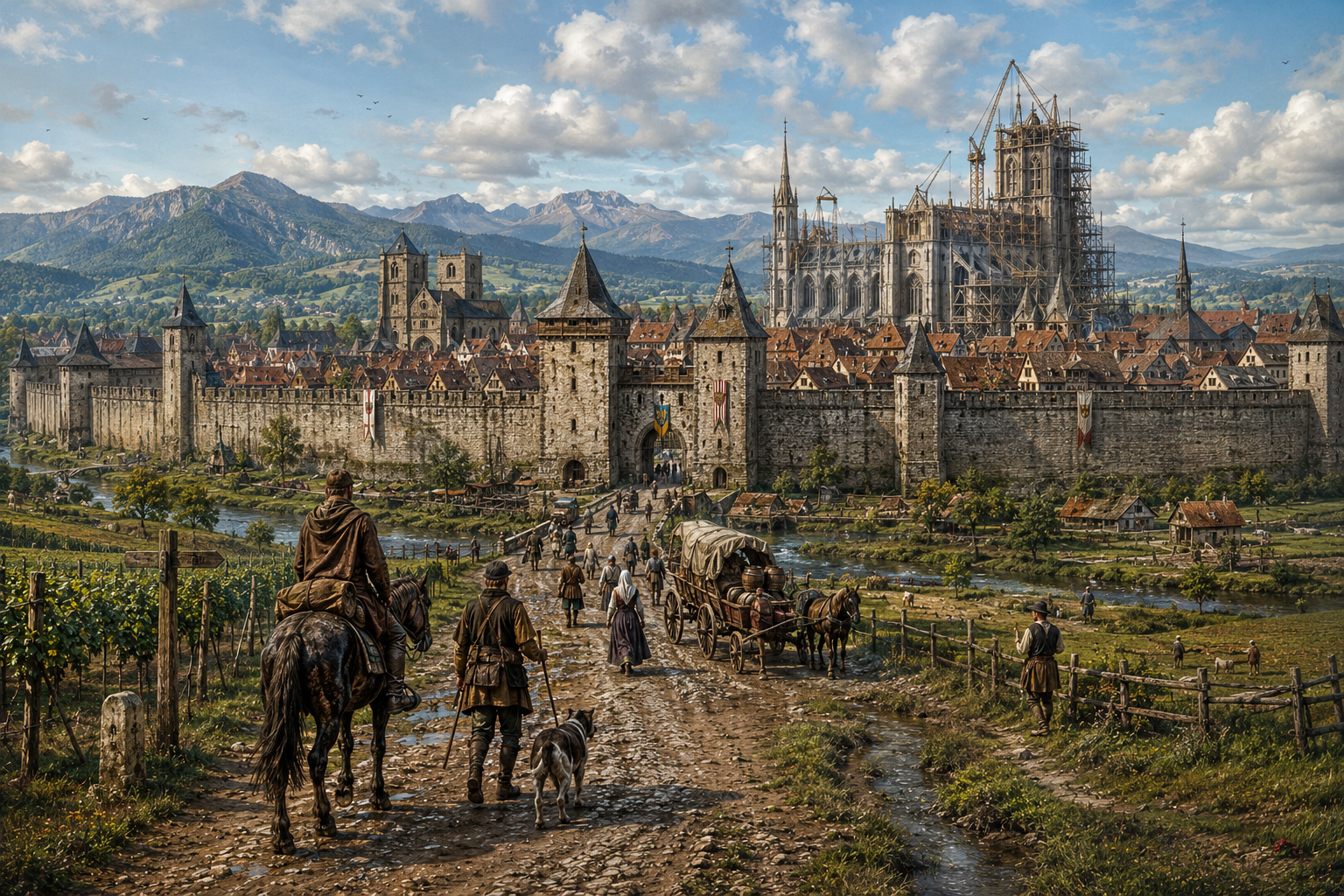
The Great Gothic Works dominate the skyline, but the building seen in 1454 is not the wholly completed monument known to later centuries. The western tower will not be completed until 1490.
Scaffolding, masons’ yards, timber hoists, stonecutters, carpenters and glaziers therefore belong to the everyday scene. Building contracts and guild contributions bind the project directly to civic politics.
The unfinished fabric is excellent adventure terrain: roof walks, temporary stairs, half-built galleries, sealed cavities and wooden scaffolds create routes that disappear once construction ends.
Old Romanesque Precinct
The older Romanesque complex provides a visual counterweight to the unfinished Great Gothic Works. Heavy stonework, twin towers and enclosed spaces make the Old Romanesque Precinct one of the city’s most recognisable landmarks.
Its long memory makes it useful whenever an adventure concerns old property boundaries, buried records, inherited claims or objects whose history predates the present civic order.
Gerberbach — The Tanners’ Canal
The Gerberbach runs openly through the tanning quarter before joining the wider water system. Hides soak beneath working houses and drying lofts while narrow bridges cross foul, busy water.
The canal is simultaneously workplace, drain, evidence trail, transport route and concealed approach. Dye, tanning liquor and ordinary waste can disguise traces of something far more serious.
Ritterhof and the Commandery of Saint John
The early fifteenth-century Ritterhof anchors a secure commandery precinct with accommodation, stables, correspondence and disciplined retainers.
Its enclosed character makes it useful for envoys, couriers, injured travellers and negotiations requiring privacy.
The Franciscan Convent
The Franciscan community has occupied part of Sélestat since the thirteenth century. Its church and conventual buildings are mature parts of the medieval town by 1454.
The precinct supplies enclosed courtyards, guest rooms, stores, quiet chambers and learned contacts away from the noise of the market quarter.
The Decapolis Archives
The alliance archives contain charters, toll agreements, military obligations, legal precedents, sealed decisions and correspondence from the ten cities.
Access is tightly controlled because the wrong document can invalidate a noble claim, force a city to send soldiers, overturn a toll or reveal decades of political deception.
Arcane security is practical rather than theatrical. Important doors and chests can be protected by Arcane Lock , while sensitive documents are divided among independent seals, keys and custodians.
Market Quarter and Guild Houses
Sélestat’s guilds regulate training, employment, market access, quality, weights, warehousing and transport. They are institutions, not background colour.
A character who needs fifty porters, ten wagons, a specialist metalworker or a large stock of alchemical material is dealing with organised interests rather than an anonymous shop.
A hostile guild can deny labour, credit, storage, transport and reliable witnesses without a single member drawing a sword.
Mentelin’s Sélestat Printing Cell
Johannes Mentelin’s principal public life is centred on Strasbourg. His experimental printing work is not.
Inside Sélestat, trusted merchants and craftsmen maintain a concealed cell where paper, type, woodblocks, proofs and finished broadsheets can be stored, corrected and redistributed. A small press can produce short runs when transporting material from Strasbourg is too risky.
The operation hides behind respectable scribal and commercial work. Type can travel in tool chests; political sheets can disappear among wine invoices, manuscript gatherings and merchant correspondence.
Mentelin’s Broadsheets
- The Ten Stand Together: no Free Imperial City can defend its liberties alone.
- Remember the Flayers: rulers who unleash unpaid soldiers upon civilians are unfit to claim obedience.
- No Toll Without Right: unlawful road, bridge and river dues are attacks upon chartered civic liberty.
- The Free Wall: the fortified imperial city protects craftsmen, merchants and households against arbitrary coercion.
- Ten Seals, One Answer: an attack upon one member’s lawful privileges demands a collective response from the Decapolis.
The most effective sheets use short arguments, memorable slogans and simple woodcuts because many copies are read aloud in workshops, taverns and guild halls rather than privately.
Mentelin does not sign them. Some sheets are made to resemble manuscript copies or are attributed to another city so that a political idea appears to have arisen independently in several places at once.
People and Factions
Ludwig Dringenberg
Dringenberg is energetic, demanding and politically useful. He wants pupils who can reason, write, calculate, investigate and advise cities rather than merely repeat memorised authorities.
He can recognise a manuscript tradition, expose a corrupt translation, interpret an unusual magical diagram or embarrass councillors into protecting a threatened scholar.
His greatest concern is preserving the distinction between investigation and accusation.
Heinrich Kramer — Inquisitor
Kramer is one of Sélestat’s most formidable sons: an experienced inquisitor and witch-hunter operating at the height of his powers.
He can call upon informants, investigators, correspondents, magical specialists and cooperative officials. He is accustomed to interrogating witnesses, examining supernatural evidence and following cases across jurisdictional boundaries.
Kramer does not classify all magic as criminal. Astronomy, alchemy, healing arts, wards and disciplined natural magic can belong to legitimate learning.
His attention falls upon curses, hostile spirit-binding, necromancy, magical murder, coercive transformations and pacts with malign powers.
That distinction does not make him gentle. Kramer believes malefactors use respectable scholarly terminology precisely because it protects them from ordinary suspicion.
Johannes Mentelin — The Secret Printer
Johannes Mentelin is publicly known as an accomplished calligrapher, scribe and man of letters associated with Strasbourg.
Behind that respectable identity he is already operating an experimental movable-type printing network.
Mentelin understands the political meaning of the invention. A charter copied by hand reaches a council chamber. A printed argument can reach hundreds of craftsmen, militia captains, merchants and tavern patrons before a government understands that it is circulating.
His politics are fiercely urban rather than generally revolutionary: chartered liberties, mutual defence, civic government, resistance to unlawful tolls and hostility to rulers who permit mercenary devastation.
Bucer and Rhenanus
Martin Bucer and Beatus Rhenanus are already prominent among Sélestat’s learned circles in 1454.
Bucer is a formidable disputant whose arguments move rapidly through schools, guild halls and taverns. Rhenanus is a collector and textual scholar whose influence is measured in manuscripts, correspondents and access to knowledge.
Both strengthen Sélestat’s reputation as an intellectual centre whose learned culture is beginning to reach far beyond the walls of the Latin School.
The Magistrat
The city council is a coalition rather than a single personality. Burgomasters, legal officers, wealthy households and guild delegates rarely agree on everything.
Some councillors quietly approve of Mentelin’s broadsheets. Others fear anonymous propaganda will destroy the diplomacy on which the Decapolis depends.
The same division applies to Kramer: some see him as necessary protection against genuine supernatural threats, while others fear that an investigation can destabilise the city faster than the crime itself.
The Guilds
Vintners, tanners, smiths, cloth workers, bakers, carriers and merchants regulate training and access to work.
Guild halls are also perfect places for political literature to circulate. One sheet read aloud after supper can reach dozens of households by morning.
Kramer’s Informants
Kramer’s network is not a uniform organisation. It includes frightened witnesses, ambitious officials, repentant occultists, professional investigators and ordinary citizens who have seen things they cannot explain.
Some are reliable. Others bring grudges, superstition or deliberate lies. Kramer’s effectiveness comes from comparing reports across many cases rather than trusting every accusation.
Mentelin’s Printers
The printing network includes metalworkers who can reproduce type, scribes who prepare copy, merchants who move paper, carriers who conceal bundles and trusted readers who distribute broadsheets.
Most members know only a small part of the network. Discovering one cache or workshop does not automatically reveal every printer, commissioner or distributor.
The Flayers’ Remnants
The 1444–45 host has dispersed, but former soldiers, deserters, scouts, guides, fences and camp followers remain scattered across the region.
Some now serve respectable employers. Others are precisely the kind of armed men Mentelin’s sheets warn the Free Imperial Cities never to trust again.
Nonhuman Households
Sélestat remains overwhelmingly human, but its position on important roads and its prosperous trades make nonhuman households entirely ordinary within the city.
| People | Population | Typical Presence in Sélestat |
|---|---|---|
| Humans | 4,840 | Most civic households, guilds, labourers, merchants, scholars and militia. |
| Halflings | 260 | Market gardeners, innkeepers, carriers, traders and settled families with itinerant kin. |
| Dwarves | 185 | Metalworkers, armourers, miners’ agents, factors and households connected to Vosges trade. |
| Elves | 145 | Scholars, envoys, merchants and specialist craftspeople, often connected to Britain or Scandinavia. |
| Other | 70 | Smaller peoples, specialists, travellers and long-term foreign households. |
Residence follows household, property, guild and occupation more naturally than ancestry alone. Sélestat does not divide neatly into fantasy racial quarters.
The Struggle for Knowledge
Dringenberg
Knowledge should be investigated.
The Latin School represents disciplined inquiry. Strange magic, suspicious texts and unexplained phenomena should be examined before conclusions are reached.
Kramer
Dangerous knowledge must be controlled.
Kramer accepts legitimate scholarship but believes malicious practitioners deliberately exploit the protections afforded to respectable learning.
Mentelin
Knowledge should circulate.
Mentelin’s press can multiply an argument beyond the control of library, guild, council, scholar or inquisitor.
Why This Matters
The conflict does not divide neatly into hero and villain.
Dringenberg’s scholars can protect dangerous material in the name of inquiry. Kramer can expose genuine horrors while destroying innocent reputations. Mentelin can spread vital warnings — or lies faster than anyone can correct them.
Adventures in Sélestat work best when characters must decide not only what is true, but who should be allowed to know it and who has the right to act upon it.
Running Sélestat at the Table
Use Documents as Weapons
- A charter can open a gate or establish an obligation.
- A forged seal can provoke a military mobilisation.
- An authentic document can still be interpreted dishonestly.
- A missing page can matter more than a missing sword.
- A printed copy can reach hundreds before the original is suppressed.
- Restricted books require trust, service or sponsorship.
Make the City Responsive
- Gate scrutiny rises after reports of raiders or forged documents.
- Guilds retaliate through labour, credit and access.
- The Latin School spreads arguments rapidly.
- Printed propaganda moves faster still.
- Bells bring organised civic response to violence.
- Kramer’s agents may already know what happened yesterday.
Use the Flayers as Relationships
- Veterans remember badges, captains, routes and signals.
- Villagers may hate the Flayers or have traded with them to survive.
- Former collaborators fear surviving records.
- Captured artillery has monetary and symbolic value.
- Mercenary service alone is not proof of criminality.
- A veteran can be hero to one household and murderer to another.
Use the Latin School as an Institution
- Admission requires literacy, aptitude, patronage or payment.
- Not every pupil studies practical spellcasting.
- Senior scholars can examine supernatural evidence.
- Laboratories have rules because magical accidents are real.
- Dangerous texts require supervised access.
- Scholarly rivals produce competing interpretations.
Use Kramer as Pressure
- He arrives with evidence rather than random accusation.
- His presence causes witnesses and officials to panic.
- He can obtain evidence others cannot easily reach.
- He expects cooperation when genuine supernatural crime is found.
- His conclusions can threaten innocent scholars as well as real villains.
Use Mentelin as Escalation
- A private argument becomes public overnight.
- A local dispute becomes a Decapolis dispute.
- A forged broadsheet can manufacture political consensus.
- Destroying one sheet cannot suppress hundreds.
- Finding the printer is not the same as finding the commissioner.
Languages
Alsatian Alemannic dominates homes, streets and workshops. German is important in civic and imperial business. Latin serves scholarship, legal records and long-distance learned correspondence. French is heard among western merchants, mercenaries and envoys.
There is no universal Common tongue.
Encounter Rhythm
A strong Sélestat adventure often begins at a controlled gate, moves through a guild, market or scholarly institution, introduces a disputed document or supernatural problem, and then reveals the faction that profits if the truth is believed — or suppressed.
Violence inside the walls has consequences. Bells ring, gates close, guilds shut doors, witnesses appear and organised civic forces respond. Sélestat is a community capable of acting collectively.
Sélestat Adventure Hooks
The Tenth Seal
A Decapolis charter bears an additional impression no archive keeper recognises. The seal appears genuine, and the city named in the altered clause has already begun assembling troops.
The Open Niedertor
The Lower Gate unlocks itself before dawn. A gargoyle among the stonework has watched the same cloaked carrier leave on three consecutive nights.
The carrier is transporting printed sheets.
The Missing Quire
Eight leaves disappear from a supervised manuscript. Dringenberg believes the thief wanted an encoded magical diagram; three guild masters insist the missing text proves their oldest privileges.
The Red Water
The Gerberbach runs red after midnight. Tanners blame dye, the watch suspects murder, and Kramer’s investigators find traces of ritual alchemy in the residue.
Kramer’s Inquiry
Kramer arrives with sealed authority, several witnesses and a list of apparently unrelated magical incidents: a wasting curse, a speaking corpse, livestock born without shadows and a scholar who vanished after buying a prohibited manuscript.
He believes all four cases lead to the same hidden circle operating inside Sélestat.
The Eleventh Broadsheet
Ten anonymous sheets defending the liberties of the Decapolis have circulated quietly through Alsace.
The eleventh calls upon Sélestat, Strasbourg and their allies to seize nearby castles, abolish disputed tolls and arm the guilds before the princes can respond.
The type is unmistakably Mentelin’s.
Mentelin swears he never printed it.
Remember the Flayers
Hundreds of copies of Mentelin’s most inflammatory anti-mercenary sheet appear in taverns across central Alsace on the same morning.
A legitimate mercenary company travelling under lawful contract is approaching Sélestat.
The militia is already gathering at the gates.
The Flayer’s Warrant
A scarred mercenary captain camps outside the western gate and produces a royal warrant demanding the return of a bombard captured during the Lièpvre fighting.
The seal appears genuine. The gun is now a civic trophy, and Mentelin’s supporters have begun printing handbills demanding that it never be surrendered.
The Warded Examination
During a manuscript exercise a pupil copies a symbol that is not visible in the original.
Doors seal under Arcane Lock , and a hidden commentary begins answering questions in fresh ink.
Kramer believes the manuscript is communicating with an external intelligence. Dringenberg refuses to destroy it until the phenomenon is understood.
The Mason’s Hollow
Stonecutters working high on unfinished Great Gothic Works discover a sealed cavity containing an old charter and a set of metal printing punches that should not exist.
Mentelin claims never to have seen them.
No Toll Without Right
A neighbouring lord arrests three Sélestat merchants for refusing a disputed road toll. Within two days Mentelin’s broadsheet describing the affair appears throughout the Decapolis.
The account is mostly accurate.
The paragraph claiming the prisoners were tortured is not.
The Moving Type
Workers at a secret press insist that pieces of type rearrange themselves after midnight, adding sentences to political sheets.
Mentelin suspects sabotage. Kramer suspects a bound intelligence.
The added sentences predict events that have not yet happened.
The Guild Without Men
An entire transport guild refuses work without explanation. Grain carts accumulate outside the walls, prices rise and no carrier will cross one particular bridge after sunset.
The Magistrat suspects industrial pressure. Kramer believes the guild has been threatened. Mentelin’s printers want to publish the story before either side understands it.
The False Inquisitorial Order
Printed notices bearing Kramer’s seal order citizens to surrender all privately owned magical manuscripts within three days.
Kramer immediately declares the notices forgeries.
Several frightened households have already complied — and the collection wagons have disappeared.
Related SpiralWorlds Resources
Historical and Campaign Foundations
Historical Foundations
- Ville de Sélestat — 13 Centuries of History : imperial-city development, Decapolis membership, civic growth, guild life and the Latin School.
- Ville de Sélestat — Great Gothic Works Church : construction chronology and completion of the western tower in 1490.
- Bibliothèque Humaniste de Sélestat : the Latin School, manuscript culture and the historic collections.
- Archaeology of Sélestat’s Medieval Fortifications : the medieval enclosure, Niedertor and development of the defensive circuit.
- Lièpvre Municipal History : the 1444–45 Armagnac incursions and local fighting during the withdrawal through the valley.
- The late-medieval population is represented as approximately 5,500 inhabitants, within the commonly cited range of roughly 5,000–6,000 at the end of the Middle Ages.
Campaign Foundations
- Magic is a genuine field of learned natural and arcane philosophy. Latin schools, universities, civic scholars, courts, guild masters and private teachers can all transmit different branches of magical knowledge.
- Heinrich Kramer is already operating in his inquisitorial prime in 1454, with established authority, agents, informants and substantial experience investigating forbidden supernatural practices.
- Johannes Mentelin is already secretly developing movable-type printing. His network produces anonymous political material supporting the autonomy and mutual defence of the Free Imperial Cities.
- Mentelin’s propaganda condemns unlawful tolls, predatory territorial power, mercenary devastation and failures of collective defence, with the memory of the Armagnac Flayers providing its strongest recurring argument.
Rules Sources
- D&D Beyond — 2024 Equipment : spellcasting-service availability and prices.
- Archives of Nethys — Settlements in Play : Pathfinder 1e settlement type, modifiers, marketplace, available-item rolls and spellcasting.
- Archives of Nethys — Settlement Qualities : Academic, Prosperous and Strategic Location.
- D&D 3.5e community size, GP Limit, ready-cash formula, highest-level-local rolls and authority ratios follow the Dungeon Master’s Guide community-generation rules.
Artwork
- Sélestat in 1454: SpiralWorlds original campaign illustration showing the fortified city, its approaches, Old Romanesque Precinct and Great Gothic Works under construction.
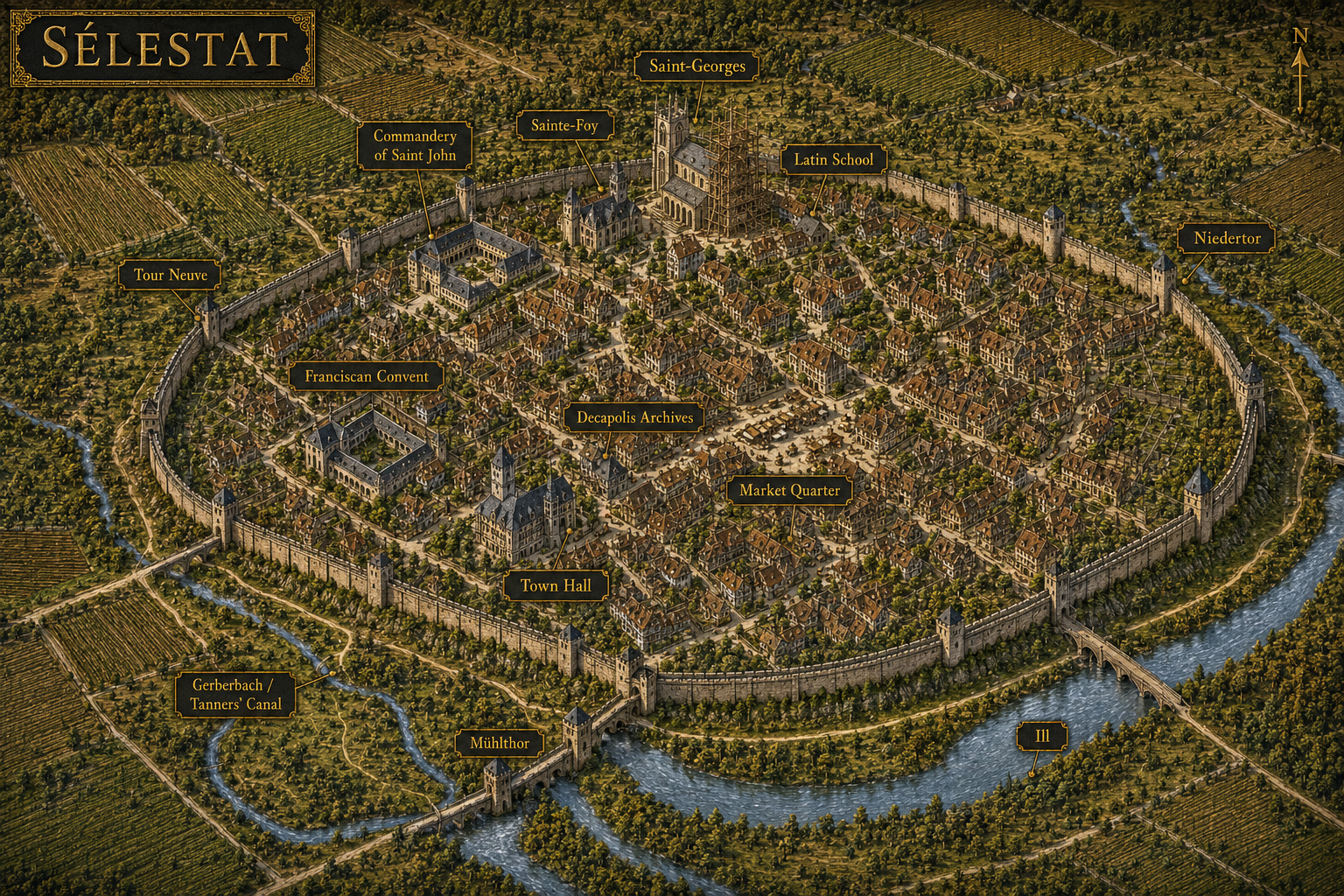
- Historical Town Map: SpiralWorlds campaign reconstruction using the medieval enclosure, surviving gates, major institutions, Gerberbach, Decapolis Archives and the River Ill.
- Traditional Arms: SpiralWorlds rendering of Sélestat’s traditional crowned red lion rampant on a silver field.
Keep this reference growing
If this page helped with your reading or game, you can support its upkeep or explore the curated books.
Explore the Bookshop — epics, classics and stories behind imagined worlds.