
Obernai — Free Imperial City of Walls and Wine
Obernai at a Glance
Where surviving medieval totals are uncertain, population figures are SpiralWorlds campaign estimates.

What Is Happening Right Now?
Oberehnheim to its inhabitants, Obernai is a small, wealthy fortress republic whose freedom rests on walls, wine and guild solidarity — with the ancient Vosges beginning almost as soon as the vineyards end.
The city commands roads, vineyards, dependent villages and woodland on the western edge of the Alsatian plain. Its citizens answer directly to the Imperial framework rather than to a neighbouring territorial lord, but independence is something they have to defend every day with charters, money, armed citizens and stone.
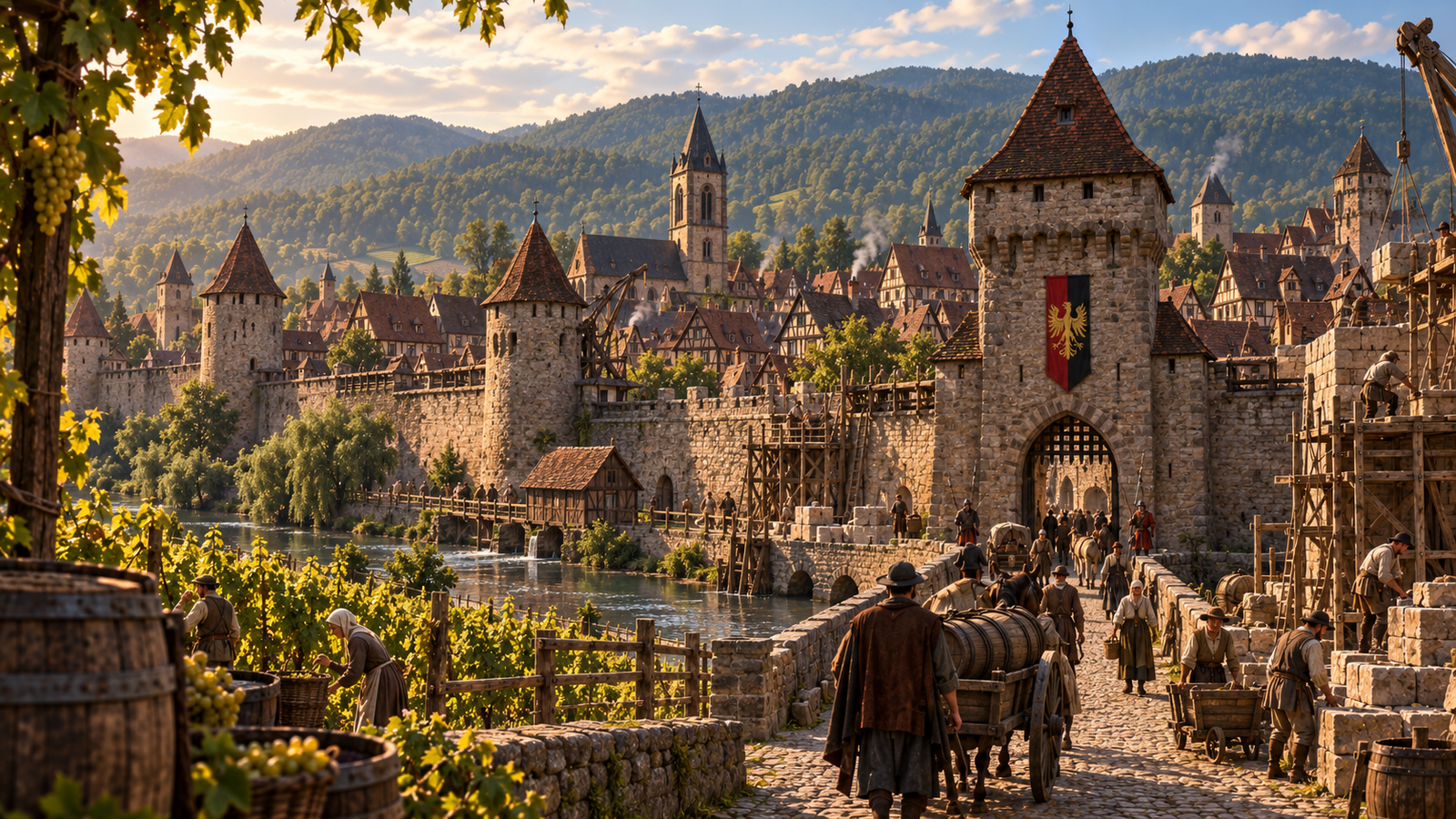
Right now that stone is being rebuilt. Masons crowd the walls, carts bring timber and dressed blocks through the gates, guild masters argue over labour and taxes, and watch officers still remember what foreign troops did to neighbouring towns a decade ago.
“Oberehnheim keeps its freedom behind stone, seals and barrels of wine.”
The Wall Works
A major rebuilding programme is consuming stone, timber, iron, carts and labour. Dressed stone is disappearing from guarded worksites, the accounts do not balance, and someone is quietly insisting that the wrong section of wall receives priority.
The Guilds Want a Say
The corporations provide craftsmen, money and armed citizens whenever the city is threatened. Several guild leaders increasingly expect political influence in return, while old noble households see their position continuing to weaken.
Something Is Moving Through the Forest
Merchants using the roads beneath Kagenfels report armed riders stopping wagons and searching them carefully. They are not behaving like ordinary robbers. They appear to be looking for one particular object.
The Old Boundary Has Been Disturbed
A carved stone taken from the hills has been reused in the new masonry. Since then, travellers in the forest have begun reaching places they did not intend to find, while the Ehn behaves strangely around one section of the defences.
Places Adventurers Will Visit
The Market Place
Wine merchants, guild representatives, carriers, innkeepers, craftsmen and officials all cross paths here. It is the easiest place to buy ordinary supplies, gather rumours, find employment or hear a civic proclamation.
The Laube
A centre of civic judgement and public business. Petitions, fines, trade disputes and arguments over jurisdiction can become adventures before anybody draws a weapon.
The Wall Works
Scaffolding, stone yards, guarded stores and half-open sections of fortification create a maze of restricted areas. Masons know which towers are sound, which are dangerous and which have spaces nobody remembers building.
The Gates and Ditches
Every road enters through controlled defensive ground. Guards inspect suspicious carts and armed companies, while the Ehn and its channels feed ditches and mills around the walls.
Selhof
A distinct defended area with inherited judicial and landholding importance. Arguments about who may judge whom often become arguments about who really controls the city.
The Road into the Obernai Forest
Vineyards give way quickly to woodland, castles, disputed rights and old sacred ground. Civic authority becomes less certain with every mile west.
Kagenfels
A rebuilt castle deep in the forest with a history of siege and artillery. Its position makes it an ideal base for armed pressure on travellers and city interests.
Birkenfels
Another forest castle surrounded by disputed woodland claims. The dangers here are as likely to begin with a boundary marker or charter as with an ambush.
People Who Matter
Jakob Rebstock — Senior Burgomaster
A wealthy, disciplined civic politician who believes the city survived the Armagnac crisis because it was prepared. He wants the walls completed even if that means unpopular new levies.
What he can offer: civic authority, access to records, watch cooperation and legal protection.
Problem: one section of the restoration budget cannot be reconciled with the treasury books.
Greta Fassbinder — Cooper Guild Speaker
A formidable representative of households whose barrels make the wine economy possible. She supports civic independence but refuses to let “emergency” become a permanent excuse for unpaid labour.
What she can offer: guild introductions, craftsmen, gossip and commercial leverage.
Problem: several master coopers are threatening to delay a civic contract until old debts are settled.
Matthias Steinmetz — Master of the Wall Works
A mason trusted with the most difficult repairs. He knows which towers only look sound and where new construction has exposed forgotten spaces.
What he can offer: access to restricted worksites, engineers, labour crews and hidden parts of the walls.
Problem: dressed stone intended for a gate repair is disappearing faster than his ledgers can explain.
Lienhard Kessler — Captain of the Gates
A veteran of the Armagnac crisis who distrusts unexplained carts, armed companies and anyone who treats the gates as a mere inconvenience.
What he can offer: gate records, guards, searches and information about who entered or left the city.
Weakness: his determination never to repeat the old crisis makes him vulnerable to manipulated military intelligence.
Anna von Ehenheim — Noble Householder
An educated member of an old local family whose relatives once enjoyed greater civic authority. She accepts that guild power is permanent but will not quietly watch the noble interest disappear.
What she can offer: letters of introduction, noble contacts and information the Magistrat cannot easily obtain.
Asset: correspondence with neighbouring lords that the city sometimes needs more than it wants to admit.
Peter Wolf — Bernardswiller Elder
A vintner and spokesman skilled at turning every civic demand into a question about the exact wording of old obligations.
What he can offer: rural guides, vineyard contacts, local labour and knowledge of roads beyond the walls.
Goal: stop a new military levy from becoming a precedent for permanent control over village labour.
Running Obernai Tonight
Prepare Six Things
- First impression: stone carts queue beside a gate while masons shout measurements from scaffolding overhead.
- Immediate problem: somebody is stealing dressed stone from the fortification works.
- Three active people: Jakob Rebstock wants quiet; Matthias Steinmetz wants the theft exposed; Peter Wolf wants proof Bernardswiller labour is not being blamed unfairly.
- Two useful places: the wall worksite and the Market Place.
- One organised move: the watch begins searching incoming carts and temporarily closes a secondary gate.
- Escalation: a repaired section fails, proving either sabotage or catastrophic incompetence.
Obernai Game Statistics
| Edition | Settlement Treatment | Market / Services | Primary Use |
|---|---|---|---|
| D&D 5.5e | Town with unusually strong civic and defensive institutions | Routine goods common; specialist and magical services depend on named providers | Investigation, factions, access, law and civic response |
| Pathfinder 1e | LN Large Town | Base Value 2,800 gp; Purchase Limit 15,000 gp; Spellcasting 5th | Settlement modifiers, marketplace and organised civic power |
| D&D 3.5e | Large Town by adult population | GP Limit 3,000 gp; Ready Cash approximately 390,000 gp | Power centres, markets, guards and militia |
Factions in Obernai
The Magistrat
Wants: defensible walls, stable revenue and preservation of Imperial privileges.
Fear: a military emergency exposing that the city has spent too little — or spent badly.
Method: law, taxation, contracts, diplomacy and control of civic office.
The Corporations
Want: political influence proportionate to the labour and wealth they provide.
Fear: emergency levies becoming permanent burdens.
Method: coordinated votes, control of skilled labour, credit, apprenticeship and reputation.
The Old Noble Interest
Wants: to preserve property, prestige and remaining routes into civic power.
Fear: becoming wealthy residents with no meaningful political voice.
Method: family alliances, outside patrons, landholding and legal precedent.
The Wall Interest
Wants: money, labour and authority directed toward fortification.
Fear: another invasion before repairs are complete.
Method: security warnings, work orders, requisitions and inspection.
Bernardswiller’s Elders
Want: predictable obligations and respect for inherited local custom.
Fear: Obernai using military emergency to absorb still more local authority.
Method: petitions, delay, collective bargaining and knowledge of the countryside.
The Decapolis Connection
Wants: mutual defence without letting one ally dominate the league.
Fear: isolated cities being defeated or coerced one by one.
Method: envoys, letters, common guarantees, military cooperation and political pressure.
The City of Walls
The Double Enceinte
The old city is enclosed by two concentric defensive walls. Historical descriptions give the inner enceinte a circuit of roughly 1,400 metres and the outer one roughly 1,532 metres. Towers, aligned gates, drawbridges, portcullises and guardhouses turn every approach into controlled military ground.
The Ehn and associated watercourses help shape the northern and north-eastern defences. Ditches can be flooded, roads funnel travellers toward gates, and anyone trying to move carts or troops around the city must reckon with water as well as stone.
The Walls Are Being Restored
The rebuilding is the city’s strongest immediate pressure. It consumes stone, timber, iron, carts, labour and money, creating opportunities for honest craftsmen and corrupt contractors alike.
Every proposed repair also raises a political question: who pays, which gate matters most, whose labour can be demanded and whose property can be disturbed in the name of defence?
The Faubourg and Selhof
Obernai is not protected by one simple ring. The suburb has its own developing enclosure, while the Selhof area forms another distinct defended space connected to the wider system.
The old city is the strongest core. The faubourg contains workshops, households and traffic that cannot all fit behind the oldest walls. Selhof carries inherited judicial and landholding importance. In an alarm, residents do not all stand behind the same gate or answer to the same immediate officer.
Gunpowder Changes the Question
Obernai’s medieval walls remain formidable against raiders and feudal violence, but artillery is changing what fortification means. Nearby Kagenfels has already experienced siege cannon, proving that gunpowder artillery is not a hypothetical threat in the region.
Some councillors want damaged stone restored exactly as it was. Others argue for thicker earthworks, changed approaches and positions able to accommodate firearms. Every choice has a price.
The Armagnac Wound
A decade ago Armagnac forces — remembered locally as destructive foreign soldiery and Flayers — devastated parts of Alsace. Obernai escaped occupation and held its outer territory while nearby Rosheim and Niedernai suffered directly.
Survival did not make the crisis harmless. Refugees, ruined farms, interrupted roads, military spending and the knowledge of what happened to neighbouring communities remain within living memory. Men who stood at the gates then are still on the watch now.
For some councillors the lesson is simple: spend whatever is necessary on the walls. For merchants the lesson is that trade routes and alliances matter as much as stone. For guild families already burdened by taxes and military duties, invoking the Flayers can sound suspiciously like an excuse for every new levy.
Government, Law and Civic Power
A Free Imperial City
Obernai belongs directly within the Imperial political framework rather than being governed as the ordinary possession of a neighbouring prince. Its freedom is practical rather than abstract. The city keeps courts, raises money, regulates markets, maintains walls, negotiates with neighbours and defends privileges recorded in charters and confirmed by successive rulers.
Emperor Frederick III is the emperor. His authority matters when Obernai needs confirmation of a privilege, judgement between rival claims or Imperial legitimacy against a stronger neighbour, but the everyday government of Oberehnheim remains overwhelmingly local.
The Magistrat
The Magistrat is the practical centre of civic rule. Burgomasters and councillors deal with taxation, markets, public works, defence, diplomacy and municipal ordinances. Obernai is neither a modern democracy nor a town personally ruled by one noble household; power belongs to an organised civic elite whose legitimacy rests on office, property, corporation membership and Imperial privilege.
The Nine Corporations
Obernai has nine corporations. Their leaders have participated in important civic decisions since at least the fourteenth century.
They are not merely trade associations. They organise labour, apprenticeship, reputation and economic access. When the city needs money, guards, carts or skilled craftsmen, it negotiates with the same institutions whose masters expect a voice in government.
Noble participation has been diminishing for generations, while guild-led civic authority continues to strengthen.
The Schultheiss and the Courts
The old office of Schultheiss survives, but its power has narrowed. Its role is now principally associated with presiding over the court rather than governing the whole city.
Obernai also possesses strong privileges over where its citizens can be called to judgement. Jurisdiction matters. A merchant may admit the debt but deny the foreign court. A noble may insist that Selhof has the proper venue. A burgess may demand the Laube. An arrest made in the wrong place can become a political dispute even when everybody agrees a crime occurred.
Law at the Table
- Weapons may be declared or peace-bound at the gate.
- Guild privilege matters when selling specialist work.
- Weights, measures and wine transactions fall under civic scrutiny.
- Foreign warrants do not automatically overrule Obernai’s jurisdiction.
- Wall work can justify temporary requisition, road closure and inspection.
- Forging a civic or Decapolis seal is a direct attack on political authority.
- Supernatural evidence is evidence only after the court decides how it can be proved.
The Decapolis
Since 1354 Obernai has belonged to the league of ten Alsatian Imperial cities generally known as the Decapolis. The alliance provides mutual assistance and political weight in a region crowded with competing territorial rights.
The Decapolis is not one state. Obernai still guards its own treasury, laws, territory and civic interests. An allied city may help against an outside threat while arguing fiercely over tolls, roads, legal precedents or the cost of common defence.
Nearby Decapolis partners include Rosheim, Sélestat, Haguenau and Colmar. Nearby Strasbourg is a major independent Free Imperial City and regional partner, but is not a member of the Decapolis.
Wine, Markets and Work
Vineyards
Obernai lies where the Vosges foothills meet the Alsatian plain, ideal country for vines. Wine shapes land values, seasonal labour, barrels, transport, credit, taverns, taxation and disputes over roads and storage.
A failed harvest hurts coopers and carriers as well as growers. A blocked road affects prices inside the walls. A merchant accused of diluting or mislabelling wine may face both guild sanctions and civic law.
The Market Place
Obernai’s weekly market has operated since the early fourteenth century. The medieval market zone concentrates civic buildings, inns and corporation meeting places. A visitor looking for “the market” is really entering overlapping networks of vintners, butchers, bakers, tailors, coopers, merchants, carriers and officials.
Work Created by the Walls
The fortification programme increases demand for:
- masons and stonecutters;
- carpenters and sawyers;
- ironwork, hinges, chains and gate fittings;
- wagons, draught animals and carters;
- ditch clearance and water management;
- food and drink for labour crews;
- surveying and engineering;
- guards to protect stores and worksites.
The wall project is an entire miniature economy — and therefore a perfect place for theft, bribery, political patronage and sabotage.
People, Languages and Everyday Magic
The ordinary language of Oberehnheim is the local Alsatian Alemannic/German vernacular. Latin appears in learned, diplomatic and legal settings. French is encountered through western merchants, travellers and political contact but is not the normal street language.
There is no universal spoken Common.
The city is human-majority but not human-only. Halfling households appear among carriers, inns, agriculture and market work. Dwarves are present in metalworking, stone, engineering, assaying and wider guild connections. Gnomes are uncommon but valued in precision craft and mechanisms. Elves are more likely to be travellers, merchants or specialists than a large settled local population.
Magic is familiar enough that guards, merchants and craftsmen know it can affect ordinary problems. Apothecaries and learned practitioners may be consulted for unusual illnesses or substances; wealthy patrons hire specialists when they can afford them; old protective marks appear on buildings and boundaries; and unexplained effects are investigated rather than automatically dismissed.
There is no single public shop where every magical service or object can be purchased. Finding serious magical help means finding the right practitioner, patron or specialist.
The Territory Beyond the Walls
Bernardswiller
Bernardswiller began as a distinct Imperial village with its own territory and administration. Obernai acquired it in 1349, together with its people, rights and customs. Its inhabitants consequently became citizens of the Free City while continuing to live in their own community.
That relationship is more than a century old, but political memory does not disappear merely because an agreement is old. Bernardswiller supplies land, labour and access to a valuable hinterland, while families there can still remember that their community once governed itself more directly.
A tax, militia demand, forest dispute or road requisition can become a question of identity as quickly as one of money.
The Obernai Forest
The wooded high ground west of the city supplies timber, grazing, hunting, charcoal and strategic depth. It is also full of rights that overlap badly: Imperial ground, city interests, castle claims and neighbouring communities.
The forest is not empty wilderness. A traveller can cross from civic territory into a lord’s claimed woodland without seeing a clear boundary until somebody demands a toll, challenges a timber cart or produces an ancient charter.
Kagenfels
Kagenfels stands deep in the Obernai forest on Imperial ground. It has endured repeated sieges, including fighting involving artillery, and burned before being substantially rebuilt.
The castle is associated with Anton von Hohenstein, whose father Heinrich died in 1451 after undertaking major reconstruction. Its position, military history and control of forest routes make Kagenfels a credible source of coercion, seizure and private violence against travellers.
Birkenfels
Birkenfels is another castle entangled with Obernai’s forest. Archaeology indicates intensive fifteenth-century occupation and rebuilding, while the Beger family presses claims concerning surrounding woodland.
That makes Birkenfels useful for campaigns centred on boundaries rather than sieges: disputed trees, hidden markers, arrested foresters, competing charters and the question of who possesses the right to enforce an old grant.
The Sacred and Supernatural Landscape
The Vosges above Obernai have been sacred ground far longer than the city’s walls have existed. Old sanctuaries, inherited estates, wells, forest clearings and ancient stonework preserve claims that municipal government cannot simply erase.
The great ancient wall on the mountain — the structure later widely known as the Heidenmauer or Pagan Wall — belongs to a landscape already old when Oberehnheim became a city. Scholars disagree about its builders and purpose. Spirits do not necessarily share their uncertainty.
Supernatural Claim: The Old Boundary
Local warding customs treat some stones, watercourses and forest boundaries as more than property markers. Certain lines are believed to separate civic land from territories claimed by older powers.
The belief becomes dangerous when wall contractors quarry an ancient stone because it is conveniently shaped. Removing it may solve a structural problem inside Oberehnheim while reopening a much older one outside it.
The Ehn
The Ehn is simultaneously water supply, mill power, landscape feature and part of the defensive system. It is also a natural focus for river spirits and inherited supernatural agreements.
Most inhabitants do not expect a spirit to appear every time somebody clears a ditch. They do know that unexplained drownings, changes in flow and repeated mechanical failures are not automatically dismissed as superstition.
Rumours in Obernai
| d10 | Rumour | Truth |
|---|---|---|
| 1 | The city is rebuilding the wrong wall because one councillor owns land behind the section receiving priority. | Partly true. |
| 2 | Stone from an old mountain boundary has been used in a gate tower. | True. |
| 3 | Armagnac scouts have returned to Alsace. | False, but somebody wants the rumour believed. |
| 4 | A Bernardswiller vintner possesses a charter proving Obernai has exceeded its rights. | The document is real; what it proves is disputed. |
| 5 | A mason working after sunset heard knocking from inside a sealed section of wall. | True. |
| 6 | Anton von Hohenstein has begun stopping travellers near Kagenfels. | Unconfirmed, but entirely plausible. |
| 7 | One corporation can prove the Magistrat has charged for the same timber twice. | True. |
| 8 | The Ehn refuses to flow correctly around one repaired ditch. | True, but nobody agrees whether the cause is engineering or supernatural. |
| 9 | A noble household is financing opposition to the guilds. | True, though not for the reason most citizens assume. |
| 10 | A Decapolis courier carrying sealed military correspondence never reached Sélestat. | True. |
Adventure Hooks
1. The Missing Wall
Trigger: dressed stone disappears from a guarded construction yard.
The theft is too regular to be ordinary pilfering. Somebody has duplicated a work order and is moving stone through the gate legally. Following the paperwork reveals that the material is rebuilding a private fortified property outside the city.
2. The Stone That Marked a Boundary
Trigger: workers cut an ancient carved stone into a gate repair.
Nothing happens inside the city. Instead, paths in the forest begin returning travellers to the wrong side of an old boundary. Replacing the stone requires discovering where it originally stood and who — or what — still recognises it.
3. Two Copies of the Same Charter
Trigger: Obernai and Bernardswiller produce conflicting copies of an old agreement.
Both documents are genuinely old. One has been subtly altered, but the alteration itself may also be centuries old. The question is no longer simply which parchment is authentic, but which version generations of people have actually lived under.
4. The Kagenfels Rider
Trigger: a wounded merchant reaches Obernai after armed men stop his convoy in the forest.
The attackers did not take his cargo. They searched every wagon for one sealed case and left as soon as they failed to find it. The missing case is already inside Obernai.
5. The Dry Ditch
Trigger: a defensive ditch that should take water from the Ehn remains inexplicably dry.
Engineers blame a collapsed channel. A water-worker claims the river is being diverted deliberately. By night, wet footprints appear on the stonework despite the empty ditch.
6. The Armagnac Chest
Trigger: wall repairs expose a sealed cavity dating from the old emergency.
Inside are weapons, coin, correspondence and a list of citizens accused of preparing to betray the city. Several families now prominent in civic life appear on it. Nobody agrees whether the list records real treason, wartime paranoia or a political purge that never happened.
7. The Corporation Refuses the Muster
Trigger: one guild refuses to provide the armed citizens demanded for a drill.
The guild does not oppose defence. It claims the Magistrat has repeatedly called out its members while granting favoured households exemptions. If guards attempt arrests, a constitutional dispute can become a street confrontation.
8. The Lost Decapolis Packet
Trigger: a courier from Obernai fails to arrive in Sélestat.
The packet contains nothing spectacular — only correspondence concerning wall expenditure and mutual defence. Unfortunately, one paragraph reveals exactly which Obernai gate the Magistrat considers least secure.
Roads Beyond Obernai
Toward Strasbourg
North-east lies Strasbourg, far larger, richer and more influential. News, merchants, specialists, diplomatic correspondence and printed material increasingly move through that network.
Go there for: major trade, printing, diplomacy and wider Imperial politics.
Toward Sélestat
South lies Sélestat, another Decapolis city with strong guild institutions, important records and growing scholarly significance.
Go there for: archives, scholarship, Decapolis records and political correspondence.
Into the Vosges
Westward the ground rises into vineyards, woodland, old sacred sites and castle country. The change from civic road to forest claim can happen quickly.
Go there for: disputed boundaries, castles, old roads, spirits and supernatural archaeology.
Toward Bernardswiller
The dependent village lies close enough that its politics are Obernai politics. Vineyard work, forest rights, military demands and old communal privileges all cross the boundary.
Go there for: rural disputes, civic obligations, wine and contested local rights.
Historical & Mythic Context
The settlement is called Oberehnheim in the campaign present. “Obernai” is retained in the H1, URL and modern search terminology so readers can identify the real place.
The name Ehenheim is documented in the eighth century, while the Oberehnheim form appears in the thirteenth century to distinguish the settlement from Niederehnheim. Its development as an Imperial town belongs to the Hohenstaufen period around the mid-thirteenth century.
The double enceinte, civic taxation and justice, markets, Decapolis membership, nine corporations, narrowing of the Schultheiss’s role, Armagnac crisis, Bernardswiller relationship and restoration of the fortifications beginning in 1454 are based on historical evidence.
The political movement visible in the campaign present continued: in 1459 a new municipal constitution excluded nobles from the civic political structure.
Kagenfels remained associated with Anton von Hohenstein, whose later career confirms that the castle could become a base for coercion and private violence. Surviving fortification evidence also records later adaptation to increasingly effective weapons, reinforcing the military pressures already visible in the rebuilding programme.
The approximately 3,400 permanent residents, campaign NPCs, nonhuman demographic breakdown, old-boundary supernatural claim and individual adventure situations are SpiralWorlds campaign material.
The city’s later Renaissance monuments are deliberately not projected backward into the campaign present. The famous later town-hall remodelling, grain hall, Six-Bucket Well and other post-medieval features do not define Obernai’s skyline here.
Related SpiralWorlds Entries
Sources, Attribution and Licensing
Historical References
- Ville d’Obernai — Histoire et Patrimoine — Ehenheim/Oberehnheim, Hohenstaufen development, city rights, fortifications, markets and Decapolis membership.
- Ministère de la Culture — Fortifications d’Obernai — chronology of the first and second enclosures and restoration of the fortifications from 1454.
- Dictionnaire Historique des Institutions de l’Alsace — Obernai — municipal organisation, corporations, noble participation, Schultheiss, jurisdictions and Armagnac crisis.
- Ville d’Obernai — Les Remparts — double enceinte, wall lengths, towers, gates, defensive water and fifteenth-century extensions.
- Mairie de Bernardswiller — Histoire — Bernardswiller’s earlier Imperial status and acquisition by Obernai in 1349.
- Kagenfels — Historical Survey — Imperial site, sieges, artillery evidence, rebuilding and Anton von Hohenstein after 1451.
- Association pour la Conservation du Patrimoine Obernois — Château de Birkenfels — fifteenth-century rebuilding, occupation and disputes concerning the surrounding forest.
Rules References
- System Reference Document 5.2.1 — current d20 tests, ability checks and compatible 5.5e mechanics.
- Archives of Nethys — Settlements in Play — Pathfinder settlement size, qualities, marketplace, modifiers and spellcasting from the Pathfinder RPG GameMastery Guide.
- Dungeons & Dragons Dungeon Master’s Guide v.3.5, Chapter 5 — community-scale reference used by the 3.5e profile.
- SpiralWorlds Settlements — site-wide settlement framework and edition-handling standard.
Artwork
Obernai hero illustration, SpiralWorlds, 2026. The scene is a campaign reconstruction intended to communicate Obernai’s fortified city, vineyards, working gates and wall restoration; it is not a literal surviving map or architectural elevation.
Painted heraldic interpretation of the traditional arms of Obernai, SpiralWorlds, 2026.
SRD 5.2.1 Attribution
This work includes material from the System Reference Document 5.2.1 (“SRD 5.2.1”) by Wizards of the Coast LLC, available at D&D Beyond . The SRD 5.2.1 is licensed under the Creative Commons Attribution 4.0 International License .
Legacy Open Game Content
Mechanical rules material inside the Pathfinder 1e and D&D 3.5e mechanics panels is designated as Open Game Content and may be Used only under and in terms of the Open Game License version 1.0a reproduced below.
No other portion of this page is designated as Open Game Content. Artwork, design, CSS, presentation, historical discussion, adventure material, setting material, NPCs, examples and SpiralWorlds editorial prose are excluded from that designation.
Open Game License v1.0a + applicable Section 15 notices
OPEN GAME LICENSE Version 1.0a
The following text is the property of Wizards of the Coast, Inc. and is Copyright 2000 Wizards of the Coast, Inc (“Wizards”). All Rights Reserved.
1. Definitions: (a) “Contributors” means the copyright and/or trademark owners who have contributed Open Game Content; (b) “Derivative Material” means copyrighted material including derivative works and translations (including into other computer languages), potation, modification, correction, addition, extension, upgrade, improvement, compilation, abridgment or other form in which an existing work may be recast, transformed or adapted; (c) “Distribute” means to reproduce, license, rent, lease, sell, broadcast, publicly display, transmit or otherwise distribute; (d) “Open Game Content” means the game mechanic and includes the methods, procedures, processes and routines to the extent such content does not embody the Product Identity and is an enhancement over the prior art and any additional content clearly identified as Open Game Content by the Contributor, and means any work covered by this License, including translations and derivative works under copyright law, but specifically excludes Product Identity; (e) “Product Identity” means product and product line names, logos and identifying marks including trade dress; artifacts; creatures characters; stories, storylines, plots, thematic elements, dialogue, incidents, language, artwork, symbols, designs, depictions, likenesses, formats, poses, concepts, themes and graphic, photographic and other visual or audio representations; names and descriptions of characters, spells, enchantments, personalities, teams, personas, likenesses and special abilities; places, locations, environments, creatures, equipment, magical or supernatural abilities or effects, logos, symbols, or graphic designs; and any other trademark or registered trademark clearly identified as Product identity by the owner of the Product Identity, and which specifically excludes the Open Game Content; (f) “Trademark” means the logos, names, mark, sign, motto, designs that are used by a Contributor to identify itself or its products or the associated products contributed to the Open Game License by the Contributor; (g) “Use”, “Used” or “Using” means to use, Distribute, copy, edit, format, modify, translate and otherwise create Derivative Material of Open Game Content; (h) “You” or “Your” means the licensee in terms of this agreement.
2. The License: This License applies to any Open Game Content that contains a notice indicating that the Open Game Content may only be Used under and in terms of this License. You must affix such a notice to any Open Game Content that you Use. No terms may be added to or subtracted from this License except as described by the License itself. No other terms or conditions may be applied to any Open Game Content distributed using this License.
3. Offer and Acceptance: By Using the Open Game Content You indicate Your acceptance of the terms of this License.
4. Grant and Consideration: In consideration for agreeing to use this License, the Contributors grant You a perpetual, worldwide, royalty-free, non-exclusive license with the exact terms of this License to Use, the Open Game Content.
5. Representation of Authority to Contribute: If You are contributing original material as Open Game Content, You represent that Your Contributions are Your original creation and/or You have sufficient rights to grant the rights conveyed by this License.
6. Notice of License Copyright: You must update the COPYRIGHT NOTICE portion of this License to include the exact text of the COPYRIGHT NOTICE of any Open Game Content You are copying, modifying or distributing, and You must add the title, the copyright date, and the copyright holder’s name to the COPYRIGHT NOTICE of any original Open Game Content you Distribute.
7. Use of Product Identity: You agree not to Use any Product Identity, including as an indication as to compatibility, except as expressly licensed in another, independent Agreement with the owner of each element of that Product Identity.
You agree not to indicate compatibility or co-adaptability with any Trademark or Registered Trademark in conjunction with a work containing Open Game Content except as expressly licensed in another, independent Agreement with the owner of such Trademark or Registered Trademark. The use of any Product Identity in Open Game Content does not constitute a challenge to the ownership of that Product Identity.
The owner of any Product Identity used in Open Game Content shall retain all rights, title and interest in and to that Product Identity.
8. Identification: If you distribute Open Game Content You must clearly indicate which portions of the work that you are distributing are Open Game Content.
9. Updating the License: Wizards or its designated Agents may publish updated versions of this License. You may use any authorized version of this License to copy, modify and distribute any Open Game Content originally distributed under any version of this License.
10. Copy of this License: You MUST include a copy of this License with every copy of the Open Game Content You Distribute.
11. Use of Contributor Credits: You may not market or advertise the Open Game Content using the name of any Contributor unless You have written permission from the Contributor to do so.
12. Inability to Comply: If it is impossible for You to comply with any of the terms of this License with respect to some or all of the Open Game Content due to statute, judicial order, or governmental regulation then You may not Use any Open Game Material so affected.
13. Termination: This License will terminate automatically if You fail to comply with all terms herein and fail to cure such breach within 30 days of becoming aware of the breach. All sublicenses shall survive the termination of this License.
14. Reformation: If any provision of this License is held to be unenforceable, such provision shall be reformed only to the extent necessary to make it enforceable.
15. COPYRIGHT NOTICE
Open Game License v 1.0a Copyright 2000, Wizards of the Coast, Inc.
System Reference Document. Copyright 2000, Wizards of the Coast, Inc.; Authors Jonathan Tweet, Monte Cook, Skip Williams, based on material by E. Gary Gygax and Dave Arneson.
Pathfinder Roleplaying Game Core Rulebook. © 2009, Paizo Publishing, LLC; Author: Jason Bulmahn, based on material by Jonathan Tweet, Monte Cook, and Skip Williams.
Pathfinder RPG GameMastery Guide. © 2010, Paizo Publishing, LLC; Authors: Cam Banks, Wolfgang Baur, Jason Bulmahn, Jim Butler, Eric Cagle, Graeme Davis, Adam Daigle, Joshua J. Frost, James Jacobs, Kenneth Hite, Steven Kenson, Robin Laws, Tito Leati, Rob McCreary, Hal Maclean, Colin McComb, Jason Nelson, David Noonan, Richard Pett, Rich Redman, Sean K Reynolds, F. Wesley Schneider, Amber Scott, Doug Seacat, Mike Selinker, Lisa Stevens, James L. Sutter, Russ Taylor, Penny Williams, Skip Williams, Teeuwynn Woodruff.
END OF LICENSE
Keep this reference growing
If this page helped with your reading or game, you can support its upkeep or explore the curated books.
Explore the Bookshop — epics, classics and stories behind imagined worlds.