
The Sword and the Sorcerer (1982)
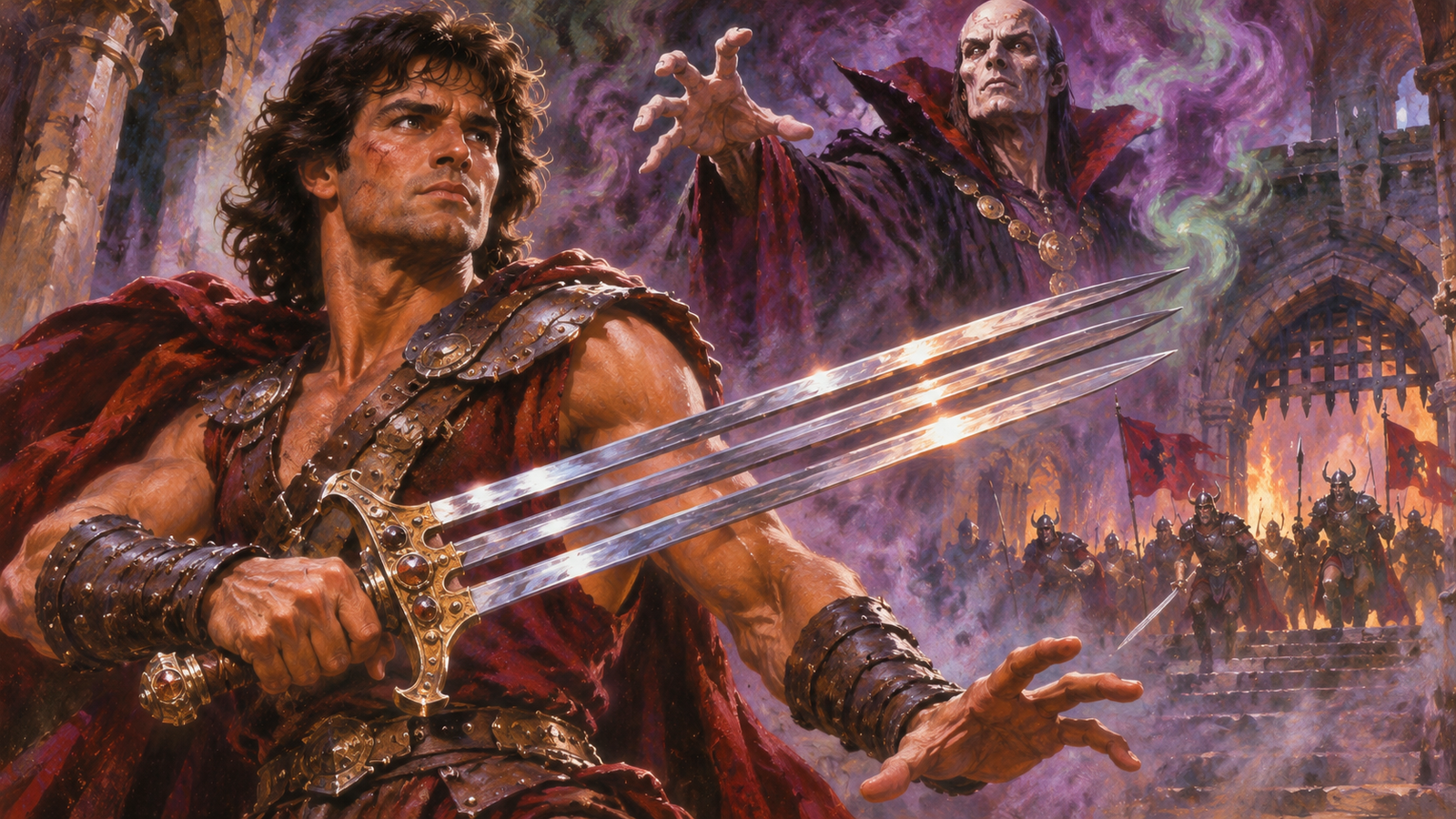
A fallen kingdom, a mercenary with a remarkable sword and a sorcerer whose alliances cannot be trusted.
Albert Pyun’s The Sword and the Sorcerer (1982) is a boisterous, rough-edged example of early-1980s sword-and-sorcery cinema. It brings together a dispossessed prince, a brutal conqueror, conspirators and an ancient magician in a world that has little interest in genteel heroics. The film’s energy comes from ambushes, reversals and the charisma of a protagonist more comfortable with danger than courtly virtue.
At a Glance
| Film | The Sword and the Sorcerer (1982) |
|---|---|
| Director | Albert Pyun |
| Screenplay | Albert Pyun, Tom Karnowski and John V. Stuckmeyer |
| Principal cast | Lee Horsley, Kathleen Beller, Simon MacCorkindale, Richard Lynch and Richard Moll |
| Genre | Sword-and-sorcery; dark fantasy adventure |
| Signature weapon | Talon’s unusual three-bladed sword |
| Runtime | Approximately 99 minutes |
| Audience | Mature viewers; bloody battles and threatening imagery |

Why This Film Matters
This film is valuable less as a model of subtle writing than as an example of how pulp fantasy can make a complicated political struggle instantly playable. A throne has been taken, rival claimants still have supporters, soldiers serve questionable masters and a summoned sorcerer cannot be assumed to remain loyal to the person who called him. Almost every character enters the story with a reason to betray someone else.
The Story — Without Major Spoilers
The ruthless Titus Cromwell employs a powerful sorcerer, Xusia, in his campaign to conquer a kingdom. The alliance of military force and destructive magic changes the fate of the royal family. Years later Talon, a mercenary carrying an extraordinary sword, becomes involved with a movement to challenge Cromwell’s control. His past gives the conflict a significance beyond payment for a dangerous job.
Princess Alana and Prince Mikah become important to the resistance, while the ruler’s allies and rivals attempt to profit from every shift in fortune. The plot races through imprisonment, escape, deception and battle, rarely leaving long intervals for the audience to question the logistics.
Characters and Performances
Talon (Lee Horsley) is a roguish fighter whose confidence conceals the burdens of a lost inheritance. His weapon is spectacular, but his greatest advantages are audacity and willingness to improvise. Alana (Kathleen Beller) represents the resistance to Cromwell’s regime and has a direct stake in the kingdom’s future. Mikah (Simon MacCorkindale) provides another face of threatened legitimacy.
Cromwell (Richard Lynch) is a domineering ruler whose willingness to deal with forbidden power reveals his inability to trust ordinary loyalty. Xusia (Richard Moll) is more than the hired magical weapon Cromwell imagines; his own existence and ambitions make him a separate threat.
The World on Screen
Fortresses, underground passages, halls and lawless roads form a familiar pulp-fantasy landscape. The settings are not studied portraits of a particular historical society. Instead, their job is to create immediate situations for action: guards who can be deceived, doors that can be breached, rival factions who may be persuaded and dangers concealed beneath a seemingly secure royal court.
Talon’s triple-bladed sword is a memorable piece of fantasy excess. Two of its blades can be fired as projectiles, leaving the central blade to fight with. It is not an example of realistic arms design, nor a standard game glaive or ordinary sword. Its unusual functions signal Talon’s identity and create sudden reversals in combat. An original campaign equivalent would be a unique magical weapon whose ranged blades, recovery and limitations are clearly defined for the chosen rules edition, rather than simply a conventional sword with a larger damage number.
Behind the Camera
The Sword and the Sorcerer marked Albert Pyun’s feature-directing debut. The production combined a modestly scaled fantasy world with elaborate stunts, violent combat and magical effects. Its practical constructions and costumes place it firmly in the early-1980s wave of cinema that tried to bring paperback fantasy’s spectacle to the screen. The hurried pacing and sometimes awkward editing are evident, but so is the commitment to action.
Themes and Critical Assessment
The film is driven by questions of loyalty, inheritance and the consequences of relying upon power without trust. It is not a nuanced discussion of political rule; the characters are broadly drawn, and several relationships are arranged to propel a chase or betrayal. Its tone can shift sharply between humour, cruelty and triumph.
What works: Lee Horsley’s lively central performance, a strong premise for competing conspiracies, an entertaining magical antagonist and unapologetically extravagant action. What works less well: thin character development, uneven storytelling and violence that sometimes overwhelms the stakes. The film is better approached as energetic exploitation-era fantasy than as a polished epic.
Related Films
For another dark fantasy centred on a kingdom’s bargain with destructive power, see Dragonslayer (1981). For a warrior navigating a world of cults and competing rulers, explore Conan the Barbarian (1982). The Fantasy Films collection offers more from this sword-and-sorcery period.
Ideas for the Table
A throne stolen with a sorcerer’s assistance makes an excellent campaign beginning. The conqueror is now afraid of the magician, the magician demands a reward that threatens the kingdom, and the old dynasty has scattered allies whose loyalties have changed over time. The player characters can choose whom to support, exploit the divisions or seek an alternative to restoring a possibly undeserving royal family.
Give the party a mercenary’s freedom to negotiate rather than requiring them to fight for the rightful heir. They might rescue prisoners, expose the tyrant’s secret bargain, break the magician’s hold or bargain for protection of innocent settlements. The world should remember both who was rescued and who was abandoned. Find original adversaries and allies in the Bestiary and NPC archive.
The sorcerer’s price. A conquering warlord’s summoned ally demands a reward that was never agreed in public. Competing agents offer the party different accounts of the bargain; discovering its true wording could free prisoners or endanger an entire town.
Three blades, one wielder. A famous mercenary carries a weapon able to launch two enchanted blades. After one is lost during a rescue, several rivals seek it for different reasons. The party can return it, expose a forgery or investigate who commissioned the weapon.
A claimant worth testing. A rebel princess needs help rescuing her brother. Supporting them might replace one violent ruler with another: the characters can gather testimony about the siblings’ plans, negotiate protections for villages or back a third faction.
Sources and Credits
- American Film Institute Catalog — The Sword and the Sorcerer (production history, cast and credits).
- BBFC — The Sword and the Sorcerer (runtime, rating and content details).
Film characters and promotional art remain the property of their respective rights holders. This original review and the campaign material are independent commentary.
Keep this reference growing
If this page helped with your reading or game, you can support its upkeep or explore the curated books.
Explore the Bookshop — epics, classics and stories behind imagined worlds.