
Cythnigot
Abyssal Fungal Parasite
Qlippoth · Void-Born Fiend · Corpse-Inhabiting Fungal Parasite
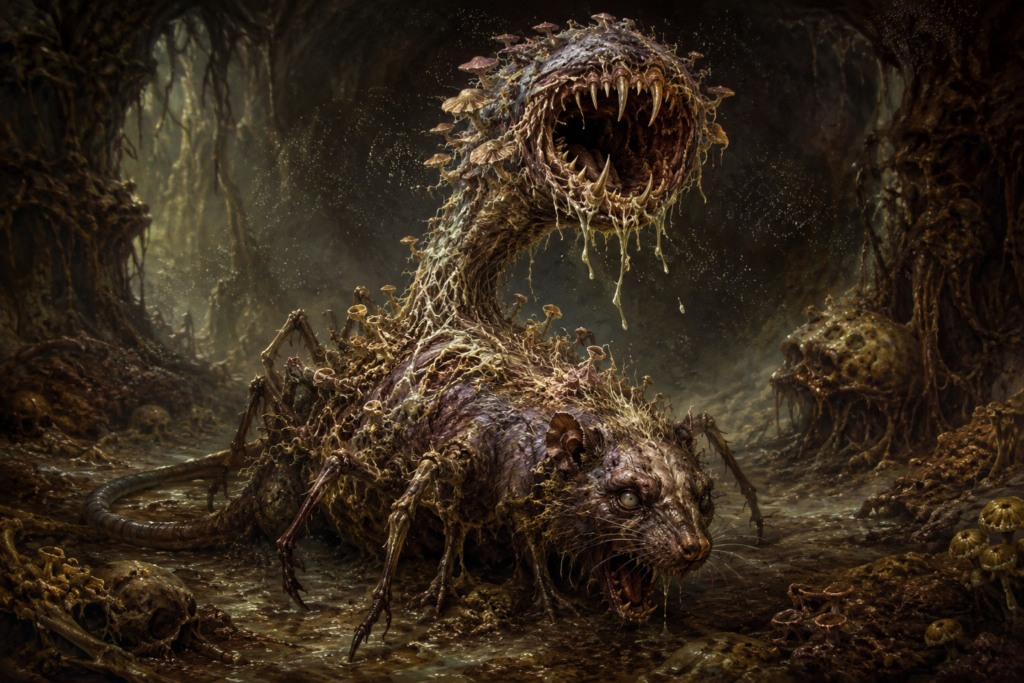
A cythnigot is one of the smallest known qlippoth: a foul fungal parasite that grows within the corpse of a small animal, reshapes that dead body into an unnatural mobile husk, and attacks through a fibrous stalk ending in a powerful set of fanged jaws.
Game Statistics
The Pathfinder 1e Cythnigot is the mechanical foundation for this entry. The D&D 5.5e / 2024 and D&D 3.5e versions translate that same creature rather than replacing it with a substantially different fungal monster.
Cythnigot
Tiny Fiend (Qlippoth), Chaotic Evil
Armor Class 14 (Natural Armor)
Hit Points 28 (8d4 + 8)
Speed 40 ft., Fly 60 ft.
| STR | DEX | CON | INT | WIS | CHA |
|---|---|---|---|---|---|
| 12 (+1) | 14 (+2) | 12 (+1) | 11 (+0) | 8 (−1) | 7 (−2) |
Saving Throws Dex +4
Skills Perception +1, Stealth +6
Damage Resistances Acid, Fire, Lightning; Bludgeoning, Piercing, and Slashing from attacks not made with Cold Iron or a weapon specifically treated as Lawful for overcoming resistance
Damage Immunities Cold, Poison
Condition Immunities Charmed, Frightened, Poisoned
Senses Darkvision 60 ft., Passive Perception 11
Languages Abyssal; telepathy only with a creature the Cythnigot is touching
Challenge 2 (450 XP)
Proficiency Bonus +2
Traits
Magic Awareness. The Cythnigot knows when it is within 30 feet of an active spell, magic item, or other magical effect that isn’t behind Total Cover. This sense does not automatically identify the effect.
Law Sense. If the campaign uses alignment, the Cythnigot senses the presence of Lawful supernatural auras within 30 feet. It knows the location of such an aura if it can perceive its source, but this sense does not reveal the creature’s identity, powers or intentions.
Actions
Stalk Bite. Melee Attack Roll: +4, reach 5 ft., one target. Hit: 8 (2d6 + 1) Piercing damage. If the target is a creature, it must succeed on a DC 11 Constitution saving throw or become Spore-Bound.
Horrific Appearance. The Cythnigot deliberately exposes the full impossibility of its corpse-borne form. Each living creature other than a Qlippoth within 10 feet that can see the Cythnigot must make a DC 11 Wisdom saving throw. On a failed save, the creature has the Poisoned condition until the end of the Cythnigot’s next turn. After a creature makes this saving throw, whether it succeeds or fails, it is immune to the Horrific Appearance of all Cythnigots for 24 hours.
Spore-Bound. A Spore-Bound creature has its Speed halved, can’t take the Dash action, and has Disadvantage on Dexterity saving throws as pallid, hair-like fungal fibres coil around its limbs. On its turn, the creature can take an action to repeat the DC 11 Constitution saving throw, ending the infestation on a success. Multiple Cythnigot infestations do not stack. A Plant creature has Disadvantage on saving throws against this effect. The spores count as a supernatural disease.
Warp Wood (1/Day). Magic Action. The Cythnigot warps one nonmagical wooden object of Large size or smaller that it can see within 60 feet. A door can be forced open or jammed shut, a wooden ranged weapon can be rendered unusable, and another wooden object can be twisted out of its intended shape. If the object is being worn or carried, its bearer can make a DC 11 Dexterity saving throw, preventing the effect on a success. The deformation is instantaneous and remains until repaired.
Soften Earth and Stone (1/Day). Magic Action. The Cythnigot chooses a 20-foot square of natural, unworked earth or stone it can see within 60 feet. Dry earth becomes loose and unstable, wet ground becomes thick mud, and natural stone becomes soft clay. Mud and loose earth in the area are Difficult Terrain. A creature standing in mud when the effect occurs must succeed on a DC 11 Dexterity saving throw or have Speed 0 until the beginning of its next turn. Worked or magically reinforced stone is unaffected. The change is instantaneous.
Qlippoth Communion (1/Week). Magic Action. The Cythnigot contacts a distant qlippoth intelligence and asks up to six questions that can be answered briefly. The responding intelligence answers according to its own knowledge and interests and is not omniscient.
5.5e Familiar Conversion
There is no direct 2024 equivalent of the Pathfinder Improved Familiar procedure used by the original Cythnigot. If the GM permits a Cythnigot familiar through a special qlippoth-binding rite, a spellcaster bonded to one is immune to the Horrific Appearance of all Cythnigots and has Advantage on saving throws against the Horrific Appearance of other Qlippoth.
Cythnigot
CR 2 · XP 600 · CE Tiny outsider (chaotic, evil, extraplanar, qlippoth)
Init +1; Senses darkvision 60 ft., detect law, detect magic; Perception +5
Languages Abyssal; telepathy (touch)
Defense
AC 14, touch 13, flat-footed 13 (+1 Dex, +1 natural, +2 size)
hp 16 (3d10)
Fort +1, Ref +6, Will +2
DR 5/cold iron or lawful; Immune cold, poison, mind-affecting effects; Resist acid 10, electricity 10, fire 10
Offense
Speed 40 ft., fly 60 ft. (good)
Melee bite +6 (1d6+1 plus spores)
Space 2½ ft.; Reach 0 ft.
Special Attacks horrific appearance (10 ft., DC 9), spores
Spell-Like Abilities (CL 6th; concentration +4)
- Constant— detect law, detect magic, fly
- 1/day— soften earth and stone, warp wood
- 1/week— commune (six questions)
Statistics
Str 12, Dex 12, Con 11, Int 11, Wis 8, Cha 7
Base Atk +3; CMB +2; CMD 13 (21 vs. trip)
Feats Lightning Reflexes , Weapon Finesse
Skills Acrobatics +7 (+11 jump) , Fly +15 , Knowledge (nature) +6 , Knowledge (planes) +6 , Perception +5 , Stealth +15
Ecology
Environment any (Abyss)
Organization solitary or bloom (2–12)
Treasure standard
Special Abilities
Horrific Appearance (Su). As a standard action, the Cythnigot can fully present its unnatural form to assault the senses of living creatures within 10 feet. Affected creatures that can see the Cythnigot must attempt a DC 9 Will save. On a failed save, the creature is sickened for 1 round. Once a creature makes a saving throw against a particular Cythnigot’s horrific appearance, whether successful or not, that creature is immune to the Horrific Appearance of all Cythnigots for 24 hours. This is a mind-affecting gaze attack.
A spellcaster that has a Cythnigot as a familiar is immune to the Horrific Appearance of all Cythnigots and gains a +4 bonus on saving throws against the Horrific Appearance of any other Qlippoth.
Spores (Su). Any creature bitten by a Cythnigot must succeed on a DC 11 Fortitude save or become infested by its otherworldly spores. Twitching spikes and pallid, hair-like fungal fibres erupt from the bite and coil around the target’s limbs. The affected creature is entangled.
In a later round, an affected creature can use a standard action to attempt another DC 11 Fortitude save. Success tears the tendrils free and ends the entangled condition. Multiple Cythnigot bites do not stack. Plant creatures take a −4 penalty on saving throws against this effect. The spores are a disease effect. The save DC is Constitution-based.
Improved Familiar
A chaotic evil spellcaster of caster level 7th or higher who has the Improved Familiar feat can gain a Cythnigot as a familiar. The spellcaster must already possess a Tiny animal familiar. Infusing that familiar with Cythnigot spores transforms it into the new Cythnigot familiar.
A mature Cythnigot is about 20 inches long and weighs approximately 10 pounds.
Cythnigot
Tiny Outsider (Chaotic, Evil, Extraplanar, Qlippoth)
Hit Dice 3d8 (13 hp)
Initiative +1
Speed 40 ft. (8 squares), fly 60 ft. (good)
Armor Class 14 (+2 size, +1 Dex, +1 natural), touch 13, flat-footed 13
Base Attack/Grapple +3/−4
Attack Bite +6 melee (1d6+1 plus spores)
Full Attack Bite +6 melee (1d6+1 plus spores)
Space/Reach 2½ ft./0 ft.
Special Attacks Horrific appearance, spores, spell-like abilities
Special Qualities Darkvision 60 ft.; damage reduction 5/cold iron or lawful; immunity to cold, poison and mind-affecting effects; resistance to acid 10, electricity 10 and fire 10; telepathy (touch)
Saves Fort +3, Ref +6, Will +2
Abilities Str 12, Dex 12, Con 11, Int 11, Wis 8, Cha 7
Skills Balance +5 , Hide +15 , Jump +11 , Knowledge (nature) +6 , Knowledge (the planes) +6 , Listen +5 , Move Silently +7 , Spot +5 , Tumble +7
Feats Lightning Reflexes , Weapon Finesse
Environment Any Abyssal region
Organization Solitary or bloom (2–12)
Challenge Rating 2
Treasure Standard
Alignment Always Chaotic Evil
Advancement —
Level Adjustment —
Combat
A Cythnigot uses flight, concealment and its small size to approach from an awkward direction. It attempts to expose enemies to its horrific form before delivering a bite and allowing its spores to hinder pursuit.
Horrific Appearance (Su). As a standard action, the Cythnigot can present its full unnatural form to all living creatures within 10 feet that can see it. Affected creatures must make a DC 9 Will save. On a failed save, the creature becomes sickened for 1 round. Once a creature makes this saving throw against a particular Cythnigot, whether successful or not, it is immune to the Horrific Appearance of all Cythnigots for 24 hours. This is a mind-affecting gaze attack.
A spellcaster possessing a Cythnigot familiar is immune to the Horrific Appearance of all Cythnigots and receives a +4 bonus on saving throws against the Horrific Appearance of other Qlippoth.
Spores (Su). A creature bitten by the Cythnigot must succeed on a DC 11 Fortitude save or become infested with otherworldly fungal growths and entangled.
In a later round, an affected creature can spend a standard action to attempt another DC 11 Fortitude save. Success tears the tendrils free and ends the entangled condition. Multiple infestations do not stack. Plant creatures take a −4 penalty on saving throws against the spores. This is a disease effect. The save DC is Constitution-based.
Spell-Like Abilities
Caster level 6th.
- Constant— detect law, detect magic, fly
- 1/day— soften earth and stone, warp wood
- 1/week— commune (six questions)
Improved Familiar
As a SpiralWorlds D&D 3.5e back-conversion, a chaotic evil spellcaster of caster level 7th or higher who has the Improved Familiar feat may transform an existing Tiny animal familiar into a Cythnigot through a qlippoth spore-binding rite.
A spellcaster with such a familiar is immune to the Horrific Appearance of Cythnigots and gains a +4 bonus on saving throws against the Horrific Appearance of other Qlippoth.
Appearance
A cythnigot without a host resembles little more than a foul-smelling puffball the size of a human fist. Once established within a corpse, the parasite radically rearranges the dead animal’s anatomy.
A rat may develop additional insect-like legs and an altered face. A cat might lose its normal limbs and become an elongated, serpentine carcass. Other small animals can be changed just as violently. The host’s original species therefore provides only a rough guide to the shape of the mature creature.
Every cythnigot shares one unmistakable feature: a long stalk of fibrous fungal matter rising from the corpse and terminating in a surprisingly strong pair of fanged jaws. This stalk-mouth is the parasite’s primary natural weapon.
Qlippoth Nature
The cythnigot belongs to the qlippoth, the primordial outsider lineage whose history reaches beyond the ordered universe into the Void Between Universes.
Cythnigots are now encountered chiefly in the remote depths of the Abyss, where surviving qlippoth populations endured after the rise of demonkind. This does not make the cythnigot a demon. Qlippoth are an older and fundamentally separate lineage, and their ancient relationship with demonkind is one of hostility rather than natural allegiance.
In SpiralWorlds chronology the qlippoth are not ordinary natives created by the Abyss. Their lineage entered creation from beyond the ordered cosmos and became deeply associated with the Abyss during the immense conflicts of the earliest ages.
Demonkind arose later and eventually displaced the older qlippoth from much of the plane. Surviving qlippoth withdrew into regions so deep and hostile that even many demons avoid them. Cythnigots persist among those scattered populations and can also reach other planes through summoning, planar breaches and familiar-binding rites.
The qlippoth do not form one universal kingdom, empire or fungal dominion. Individual creatures can be commanded, cultivated, summoned or enslaved by greater beings, but a cythnigot should not automatically be treated as the servant of a particular qlippoth lord.
Behaviour
Cythnigots are parasites and opportunistic predators rather than builders of conventional settlements. Their small size, powerful flight and ability to hide within the altered shape of a dead animal make them effective infiltrators and ambush creatures.
A cythnigot attempts to approach from an unexpected direction, deliberately display its revolting form, and then bite a vulnerable target. The bite implants otherworldly spores that erupt as pallid, hair-like fibres and coil around the victim’s limbs.
Several cythnigots may gather in a bloom of two to twelve. Their spore infestations do not become progressively stronger merely because the same creature is bitten repeatedly, so a bloom benefits from spreading its attacks across several opponents.
A wounded cythnigot may flee, hide or use terrain to delay pursuit, but it possesses no inherent regeneration ability. Likewise, it does not produce combat clouds of poisonous spores unless a particular variant explicitly gains such an ability.
Habitat
Abyssal Depths
Cythnigots survive in remote Abyssal territories where qlippoth still endure. Caverns, corpse-fields, fungal wildernesses and regions rich in dead organic matter provide concealment and suitable material for their parasitic existence.
Material Plane
A cythnigot may arrive through planar summoning, an escaped familiar bond, a damaged gate or another breach between worlds. Crypts, cellars, mines, ruins, refuse pits, plague grounds and battlefield margins offer plentiful concealment once it arrives.
The Cythnigot on Earth in 1454
In the campaign present, the most dangerous infestations begin in places where the disappearance or movement of small dead animals attracts little notice. Rats, cats, birds and similar creatures provide compact corpses that can be concealed beneath buildings, within walls, in abandoned mines or among the waste of crowded settlements.
A cythnigot does not need a major Abyssal invasion to reach Earth. A single occultist can deliberately create one as a familiar under older magical traditions, and such a creature may survive its master’s death or escape control.
Consequently, one cythnigot proves only that something unnatural has occurred. A whole bloom is more serious, but even several creatures do not automatically prove that a demon army or qlippoth host is approaching.
Signs of a Cythnigot
- Small animal corpses disappearing from places where they were left.
- Dead vermin discovered in locations they could not have reached naturally.
- Tracks with the wrong number or arrangement of limbs for the apparent animal.
- Pale fibrous matter caught on timber, stone, clothing or broken masonry.
- Carcasses with rearranged limbs, altered faces or grossly distorted proportions.
- A strong fungal or carrion smell with no obvious living source.
- Bite wounds from which pale hair-like fibres begin rapidly growing.
Combat Tactics
Horrific Display
A cythnigot’s Horrific Appearance is deliberate rather than a permanently active aura. The creature reveals the full unnatural configuration of its host body when enemies are close enough for the display to matter, then takes advantage of their revulsion.
Ambush
A cythnigot is much more effective when it can exploit vertical space. Its powerful flight allows it to approach from rafters, cave ceilings, ruined upper floors and other directions that ground-bound opponents may overlook.
Debilitation
The creature’s bite is dangerous because of the infestation that follows. It gains more by hindering an opponent and moving away than by remaining adjacent to a stronger melee combatant.
Bloom Tactics
A bloom should distribute its bites among several enemies whenever possible. Because multiple spore infestations do not stack on one target, concentrating every attack on a single already-infested opponent wastes much of the group’s special ability.
Environmental Manipulation
Warp Wood and Soften Earth and Stone allow the creature to interfere with doors, barricades, floors, tunnels, natural passages and escape routes. These powers support the Cythnigot’s mobility and evasion rather than functioning as direct-damage attacks.
Cythnigot Familiars
Cythnigots have an unusual route onto the Material Plane because older magical systems permit sufficiently powerful chaotic evil spellcasters to create them as familiars.
The process begins with a Tiny animal already serving as the spellcaster’s familiar. Qlippoth spores infest and transform that animal, replacing the living familiar with the Cythnigot form.
The Pathfinder procedure requires the Improved Familiar feat and a sufficiently powerful caster. The mechanical requirements are preserved in the Pathfinder tab above and translated separately for the other supported systems.
This provides a useful explanation for isolated Earth encounters. A Cythnigot discovered in a cellar, ruined tower or abandoned laboratory may be the surviving familiar of a dead or missing spellcaster rather than evidence of a functioning Abyssal gate.
Using Cythnigots in a Campaign
The Dead Rat Walks
Poisoned vermin vanish from a merchant’s granary. One is later seen moving through the rafters despite having been killed several days earlier.
The Abandoned Familiar
A dead occultist’s familiar survives the destruction of its master and hides among the animal corpses in the surrounding quarter.
Bloom Beneath the Battlefield
Scavengers discover several altered carcasses beneath a collapsed field chapel. A whole bloom has remained concealed among the remains.
The Warped Cellar Door
A cellar door repeatedly twists in its frame despite being repaired. The creature inside is using Warp Wood to keep investigators away from its hiding place.
Historical & Mythic Context
The Cythnigot has obvious parallels with parasitic fungi that grow from animal hosts, but in SpiralWorlds this resemblance does not explain the creature away. The parasite is genuinely supernatural, intelligent enough to employ tactics and capable of planar magic far beyond any mundane fungus.
In 1454, people encountering a corpse that moves after death may interpret it through local ideas of witchcraft, plague, possession, necromancy, monstrous vermin or corrupt magic. Experienced monster-hunters distinguish a Cythnigot by the deliberate movement of the corpse, the deformation of its body, the characteristic fungal stalk-mouth and the pallid fibres produced by its bite.
Burning a dead host can destroy evidence and may prevent ordinary contamination of the site, but the Cythnigot is not merely a mundane mould. Hunters must still locate and destroy the actual fiend.
Connections
Explore: Qlippoth · The Abyss · Detect Law · Fly · Warp Wood · Soften Earth and Stone · Commune · Improved Familiar · Lightning Reflexes · Weapon Finesse
Rules Sources & Licensing
Pathfinder 1e: The Pathfinder Cythnigot statistics, qlippoth traits and core abilities derive from Pathfinder Roleplaying Game Bestiary 2.
D&D 5.5e / 2024: The modern stat block is a SpiralWorlds conversion of the Pathfinder creature. It is not presented as an official Wizards of the Coast Cythnigot stat block.
D&D 3.5e: The 3.5e version is a SpiralWorlds backwards conversion preserving the Pathfinder creature’s core statistics and abilities while translating Pathfinder-specific skills and rules into D&D 3.5e equivalents.
Open Game Content: Pathfinder-derived rules material is used under the Open Game License v1.0a.
Section 15: Pathfinder Roleplaying Game Bestiary 2, © 2010, Paizo Publishing, LLC; Authors Wolfgang Baur, Jason Bulmahn, Adam Daigle, Graeme Davis, Crystal Frasier, Joshua J. Frost, Tim Hitchcock, Brandon Hodge, James Jacobs, Steve Kenson, Hal MacLean, Martin Mason, Rob McCreary, Erik Mona, Jason Nelson, Patrick Renie, Sean K Reynolds, F. Wesley Schneider, Owen K.C. Stephens, James L. Sutter, Russ Taylor, and Greg A. Vaughan, based on material by Jonathan Tweet, Monte Cook, and Skip Williams.
Keep this reference growing
If this page helped with your reading or game, you can support its upkeep or explore the curated books.
Explore the Bookshop — epics, classics and stories behind imagined worlds.