
Bunyip — The Haunter of the Billabongs
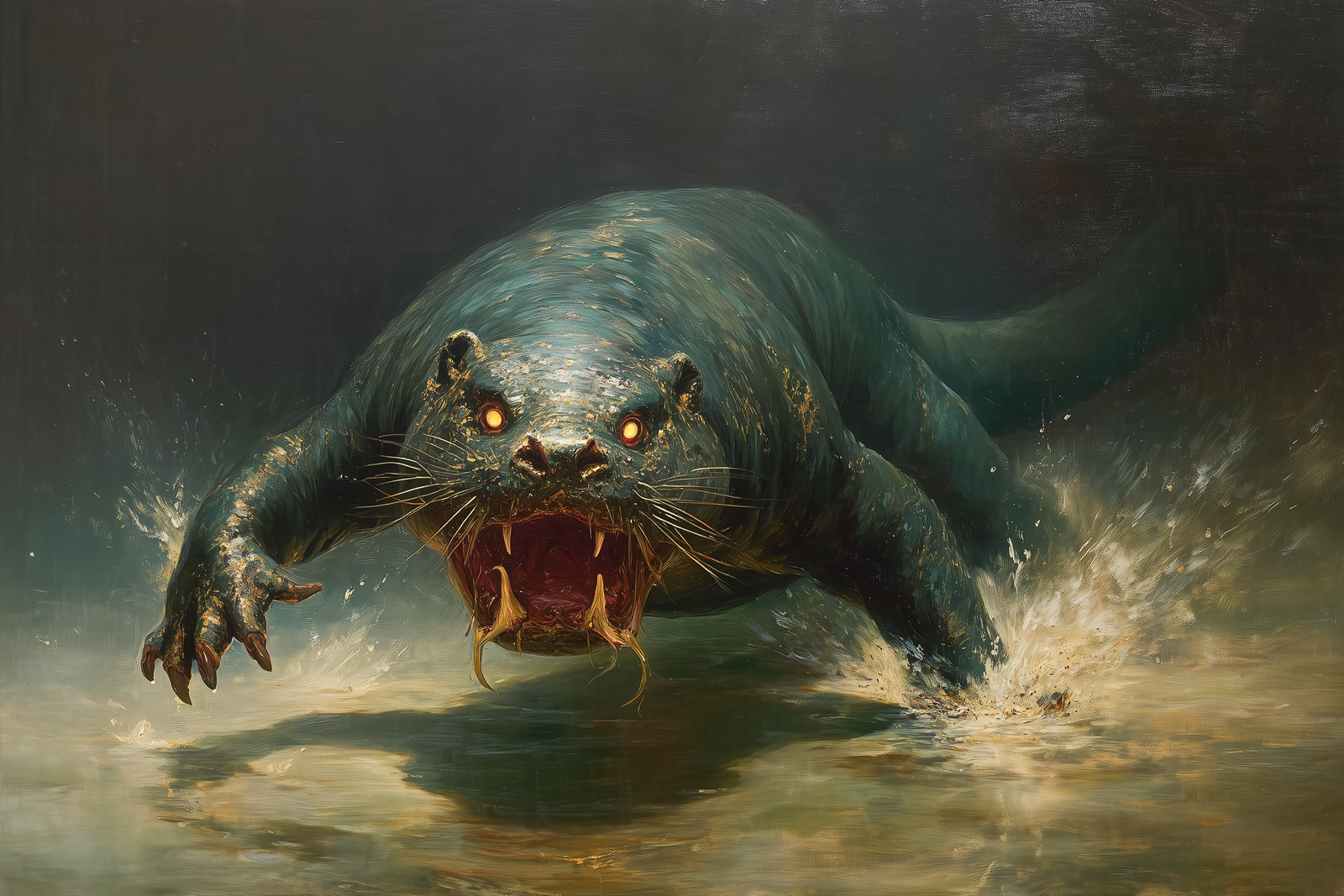
A waterhole falls silent at dusk. Reeds bend against the current, fresh drag marks disappear beneath the surface, and a low cry carries over the pool.
Bunyip traditions belong to particular Australian water places and First Nations communities, and their descriptions differ. The amphibious predator in the rules below is one fantasy-game interpretation, not a single accepted account of Aboriginal tradition.
At the Table
- Sign: Crushed reeds, a disturbed bank, drag marks beneath the water and no birds feeding at its edge.
- Want: An undisturbed feeding pool; it drives intruders away rather than seeking a fight to the death.
- Avoid fighting: Follow the dry bank, find an upstream crossing or lure it away from the ford.
- In a fight: Ambush the first wader, seize prey if the edition permits, then retreat to deeper water when injured.
Monster statistics · Run the encounter · Folklore and sources
Bunyip Monster Statistics — Four Editions
Select an edition to see its rules. These are separate interpretations, with Pathfinder 1e credited to its publisher and D&D 3.5e marked as an original conversion.
Bunyip — D&D 2024
Large Monstrosity, Chaotic Neutral
D&D 2024 adaptation: Original, unofficial game statistics created for this page. The 2014, Pathfinder 1e and D&D 3.5e tabs use separate mechanics.
Armor Class: 16 (natural armor)
Hit Points: 145 (fixed homebrew hit points)
Speed: 40 ft., swim 60 ft.
| STR | DEX | CON | INT | WIS | CHA |
|---|---|---|---|---|---|
| 20 (+5) | 14 (+2) | 20 (+5) | 6 (−2) | 14 (+2) | 8 (−1) |
Saving Throws: Str +8, Con +8, Wis +5
Skills: Perception +5, Stealth +5
Damage Resistances: Bludgeoning, Piercing, and Slashing from Nonmagical Attacks
Damage Immunities: Cold
Condition Immunities: Charmed, Frightened
Senses: Darkvision 60 ft., Tremorsense 30 ft., Passive Perception 15
Languages: —
Challenge: 8 (3,900 XP); Proficiency Bonus: +3
Traits
Amphibious. The bunyip can breathe air and water.
Swamp Camouflage. While in swamp, marsh, or murky water terrain, the bunyip has advantage on Dexterity (Stealth) checks and can attempt to hide even when lightly obscured.
Haunting Call (Recharge 5–6). As an action, the bunyip emits a mournful wail. Each creature of its choice within 120 feet that can hear it must succeed on a DC 16 Wisdom saving throw or have the Frightened condition until the end of the bunyip’s next turn. Creatures that succeed are immune to this bunyip’s Haunting Call for 24 hours.
Minor Water Magic (1/Short or Long Rest). The bunyip casts Fog Cloud as a Magic action, centred on itself, following the spell’s normal concentration and duration rules. Its spellcasting ability is Constitution.
Actions
Multiattack. The bunyip makes two attacks: one with its bite and one with its claws.
Bite. Melee Attack Roll: +8, reach 5 ft., one target. Hit: 16 (2d10 + 5) Piercing damage. If the target is Large or smaller, it is Grappled (escape DC 16). Until the grapple ends, the bunyip cannot grapple another creature with its bite.
Claw. Melee Attack Roll: +8, reach 10 ft., one target. Hit: 12 (2d6 + 5) Slashing damage.
Tail Slam. Strength Saving Throw: DC 16, each creature in a 10-foot-long, 5-foot-wide line originating from the bunyip. Failure: 14 (2d8 + 5) Bludgeoning damage and the creature has the Prone condition. Success: Half damage, and the creature does not fall Prone.
Drag Prey (Recharge 6). The bunyip moves up to half its current movement speed (up to 20 feet on land or 30 feet while swimming), taking one creature grappled by its Bite with it. The creature remains grappled during the move. Being submerged does not cause instant drowning: apply the normal breath-holding and suffocation rules, and allow the creature to attempt to escape the grapple normally.
Reactions
Snap Defense. When a creature within 5 feet hits the bunyip with a melee attack, the bunyip can use its reaction to make one Claw attack against that creature.
Legendary Actions
The bunyip can take 2 legendary actions, choosing from the options below. Only one legendary action can be used at a time and only at the end of another creature’s turn. The bunyip regains spent legendary actions at the start of its turn.
- Lunge. The bunyip moves up to its speed toward a creature and makes a claw attack.
- Haunting Whimper (Costs 2 Actions). The bunyip emits a brief, eerie cry. All creatures within 30 ft. must succeed on a DC 16 Wisdom saving throw or be frightened until the end of their next turn.
Tactics
Bunyips prefer ambush tactics, hiding in murky water until prey approaches. They strike with bite and claw, then follow up with tail slams to disrupt groups. In multi-creature encounters, the bunyip uses fog cloud and Haunting Call to scatter opponents, drag isolated targets into water, and exploit terrain for advantage. It avoids prolonged fights on dry land, preferring to lure foes into swamps or rivers where its swimming speed and grapple abilities dominate.
Bunyip — D&D 2014
Bunyip (2014 original conversion)
Huge monstrosity, unaligned
Armor Class 15 (natural armor)
Hit Points 147 (14d12 + 56)
Speed 20 ft., swim 50 ft.
| STR | DEX | CON | INT | WIS | CHA |
| 22 (+6) | 12 (+1) | 18 (+4) | 3 (–4) | 14 (+2) | 8 (–1) |
Saving Throws Dex +4, Wis +5
Skills Athletics +9, Perception +8, Stealth +4
Senses darkvision 60 ft., passive Perception 18
Languages —
Challenge 8 (3,900 XP)
Amphibious. The bunyip can breathe air and water.
Waterborne Ambush. The bunyip has advantage on Dexterity (Stealth) checks while submerged in murky water.
Water Sense. The bunyip has advantage on Wisdom (Perception) checks relying on sound while its head is at least partially submerged.
Dread Call (Recharge 5–6). As a bonus action, the bunyip bellows across the water. Each creature of its choice within 90 feet that can hear it must succeed on a DC 15 Wisdom saving throw or become frightened for 1 minute. A creature can repeat the saving throw at the end of each of its turns, ending the effect on itself on a success. If a creature’s saving throw is successful or the effect ends for it, the creature is immune to the bunyip’s Dread Call for the next 24 hours.
Actions — Multiattack. The bunyip makes one bite and two body slam attacks.
Bite. Melee Weapon Attack: +9 to hit, reach 10 ft., one target. Hit: 22 (3d10 + 6) piercing damage. A Large or smaller creature hit is grappled (escape DC 17); the bunyip cannot bite another target while maintaining this grapple.
Body Slam. Melee Weapon Attack: +9 to hit, reach 10 ft., one target. Hit: 15 (2d8 + 6) bludgeoning damage.
View this edition’s artwork
Bunyip — Pathfinder 1e
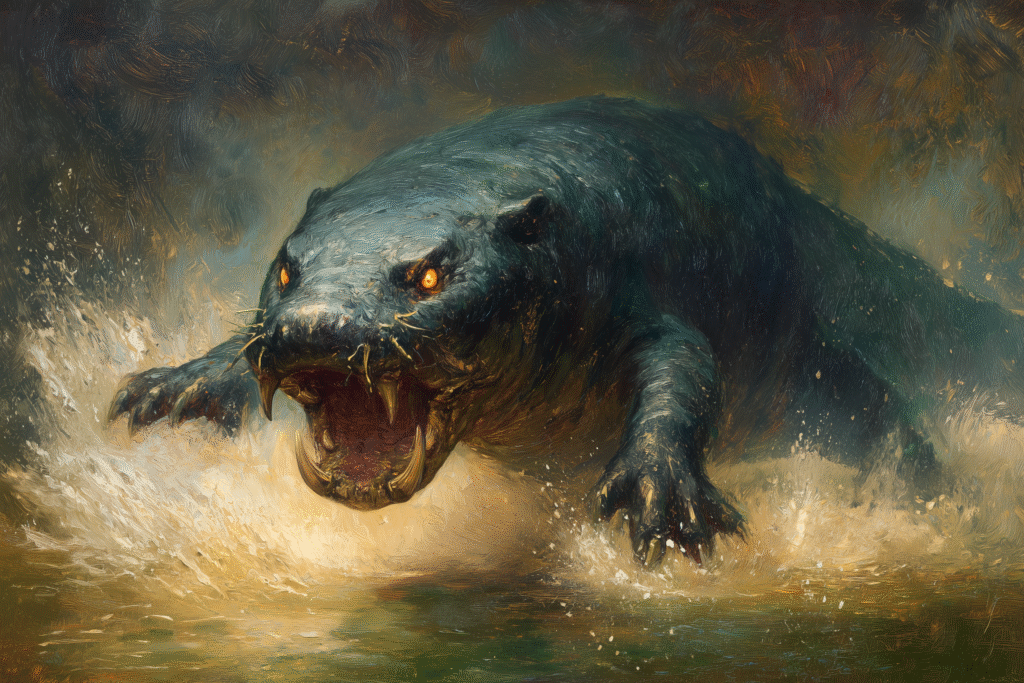
A disturbing combination of shark and seal, this brown-furred creature has a wide mouth filled with razor-sharp teeth.
This Pathfinder 1e creature is a territorial aquatic predator. It hunts near banks and shallow crossings, using the water as cover. Its seal-like head, toothy jaws and aggressive behaviour describe this game adaptation, not one agreed traditional bunyip.
For an encounter, the Pathfinder bunyip usually stays near a reliable feeding ground. It becomes especially dangerous when blood enters the water, triggering its blood rage. Adventurers who keep back from the bank may avoid a fight; anyone wounded while swimming faces a much greater risk.
The Pathfinder source describes a broadly adaptable aquatic monster, including marine habitats. That game ecology is separate from the Australian water-place traditions discussed above. In the campaign, use a specific Australian pool or river reach unless the GM intentionally introduces an imported creature elsewhere.
Bunyip CR 3
XP 800
N Medium magical beast (aquatic)
Init +3; Senses darkvision 60 ft., low-light vision, keen scent 180 ft.; Perception +8
Defence
AC 15, touch 13, flat-footed 12 (+3 Dex, +2 natural)
hp 32 (5d10+5)
Fort +5, Ref +7, Will +1
Offence
Speed 10 ft., swim 50 ft.
Melee bite +7 (1d8+1/19–20 plus bleed)
Special Attacks bleed (1d6), blood rage, roar
Statistics
Str 13, Dex 16, Con 13, Int 2, Wis 11, Cha 7
Base Atk +5; CMB +6; CMD 19
Feats Improved Critical (bite)B, Skill Focus (Perception), Skill Focus (Stealth), Weapon Focus (bite)
Skills Escape Artist +5, Perception +8, Stealth +10, Swim +9; Racial Modifiers +8 Swim
SQ amphibious
Special Abilities
Blood Rage (Ex)
A bunyip’s blood rage ability activates whenever it detects blood in the water using its keen scent, but otherwise functions as the universal monster rule of the same name.
Roar (Su)
A bunyip’s roar is supernaturally loud and horrifying. When a bunyip roars (a standard action the creature can perform at will), all hearing creatures with 4 or fewer HD within a 100-foot spread must succeed on a DC 13 Will save or become panicked for 2d4 rounds. Whether or not the save is successful, creatures in the area are immune to the roar of that bunyip for 24 hours. This is a sonic, mind-affecting fear effect. The save DC is Constitution-based.
Ecology
Environment any aquatic
Organization solitary or pair
Treasure none
Appearance in this Pathfinder game version: a seal-like head, powerful forequarters, broad fins and a long tail. Its jaws and silhouette are design choices for this particular stat block. Accounts of bunyips differ across communities and periods; these features should not be presented as the anatomy of every bunyip tradition.
Section 15: Copyright Notice
Pathfinder Roleplaying Game Bestiary 2, © 2010, Paizo Publishing, LLC; Authors Wolfgang Baur, Jason Bulmahn, Adam Daigle, Graeme Davis, Crystal Frasier, Joshua J. Frost, Tim Hitchcock, Brandon Hodge, James Jacobs, Steve Kenson, Hal MacLean, Martin Mason, Rob McCreary, Erik Mona, Jason Nelson, Patrick Renie, Sean K Reynolds, F. Wesley Schneider, Owen K.C. Stephens, James L. Sutter, Russ Taylor, and Greg A. Vaughan, based on material by Jonathan Tweet, Monte Cook, and Skip Williams.
View this edition’s artwork

Bunyip — D&D 3.5e
Medium Magical Beast (Aquatic)
Hit Dice: 5d10+5 (32 hp)
Initiative: +3
Speed: 10 ft. (2 squares), swim 50 ft.
Armor Class: 15 (+3 Dex, +2 natural), touch 13, flat-footed 12
Base Attack/Grapple: +5/+7
Attack: Bite +7 melee (1d8+2)
Full Attack: Bite +7 melee (1d8+2)
Space/Reach: 5 ft./5 ft.
Special Attacks: Frightful roar
Special Qualities: Amphibious, darkvision 60 ft., low-light vision
Saves: Fort +5, Ref +7, Will +1
Abilities: Str 15, Dex 16, Con 13, Int 2, Wis 11, Cha 7
Skills: Listen +6, Spot +6, Swim +10
Feats: Alertness, Endurance
Environment: Temperate freshwater rivers and wetlands
Organization: Solitary
Challenge Rating: 3 (provisional homebrew estimate; playtest before use)
Treasure: None
Alignment: Always neutral
Advancement: 6–10 HD (Medium); 11–15 HD (Large)
Level Adjustment: —
Combat: This adaptation ambushes prey from shallow water and retreats when badly wounded. Frightful Roar (Su): As a standard action, the bunyip bellows. Hearing creatures with 4 or fewer Hit Dice within 100 feet must make a DC 13 Will save or become panicked for 2d4 rounds. A creature that saves or suffers the effect is immune to this bunyip’s roar for 24 hours. This is a sonic, mind-affecting fear effect; the DC is Constitution-based. Amphibious (Ex): It can breathe air and water. It has a +8 racial bonus on Swim checks, can take 10 on Swim checks even when threatened, and can use the run action while swimming in a straight line. This D&D 3.5e conversion is original, unofficial game material; its CR is an estimate, not a published official statistic.
Appearance and Recognition
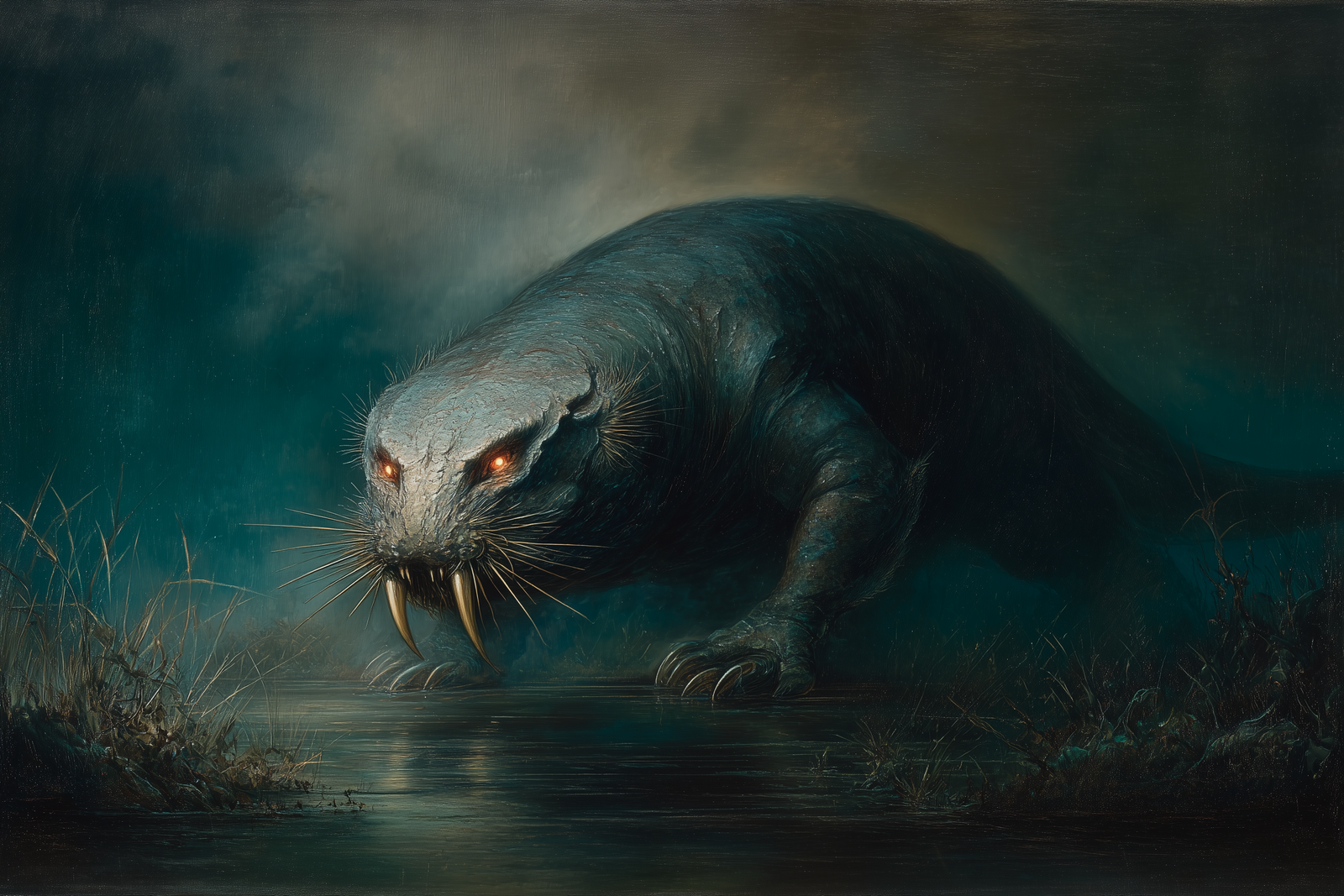
This bunyip has a broad, mud-dark back, projecting tusks, flippered forelimbs and a long tail. Only its eyes and part of its back break the surface. Its approach may be betrayed by reeds bending against the current, a low call or a sudden silence among the waterbirds.
Behaviour
The bunyip waits beneath overhanging banks and floating reeds, watching animals approach the water. Travellers who stay on a distant path usually pass unchallenged; those who wade into its feeding pool provoke an attack. Drought makes it bolder by crowding prey into fewer waterholes. Once wounded, it sinks into the deeper channel rather than chasing enemies across dry ground.
Habitat
Campaign range: bunyips inhabit selected Australian billabongs, marshes and slow river pools. Floods can connect feeding pools and carry one creature along a river system; a bunyip found beyond Australia should have a specific cause in the campaign, not appear wherever the map shows wet ground.
If Violence Starts
The bunyip lunges from a submerged bank at the first creature within reach. In the fifth-edition versions its bite can seize a victim; it then uses the water to separate that victim from companions. Its bellow may drive others back from the bank. In Pathfinder 1e and D&D 3.5e, follow the printed abilities rather than adding a free grapple. It retreats once it can no longer hold the pool.
What It Wants
Encounter clue: A waterhole that was safe yesterday now has crushed reeds on its far bank, fresh drag marks beneath the surface and no birds feeding at the edge. The bunyip can be avoided by taking a longer route, waiting for daylight or drawing it away from the crossing with noise. A submerged snag provides cover for the creature but can also trap it if the party blocks the channel.
The bunyip wants to feed undisturbed and keep rivals away from its pool. A party that backs away from the shore may end the confrontation without killing it; a group forced to cross the channel must find another approach or contend with the creature on its own ground.
Using the Bunyip in Play
Before initiative: Mark the safe bank, the submerged snag, the depth of the channel and one dry retreat route on the encounter map. Show the disturbed reeds before anyone must decide whether to cross. The creature defends the pool rather than chasing travellers across the floodplain. Use the CR and mechanics for the edition actually being played: the Pathfinder 1e and D&D 3.5e versions are far less dangerous than the CR 8 fifth-edition versions.
Adventure Hooks
The drowned ford: A wagon carrying medicine cannot reach a riverside settlement before evening. The crossing is watched by a bunyip, but a fallen tree upstream could form a slower, safer bridge. The players must choose whether to risk the ford, build the crossing or return too late with the medicine.
The new channel: Drainage works have connected an old billabong to grazing land. A herder has vanished at the water’s edge. Closing the channel may isolate the creature again but will flood a neighbour’s fields. The problem can be solved by negotiation and earthworks without hunting the animal.
After the Encounter
There is no assumed treasure inside the creature. The real reward is a safe crossing, a recovered load, or knowledge of which waterholes to avoid. If the bunyip survives, it may return when the channel floods again; mark that change on the GM’s map rather than treating the defeated encounter as a permanent regional solution.
Bunyip Traditions and Later Reports
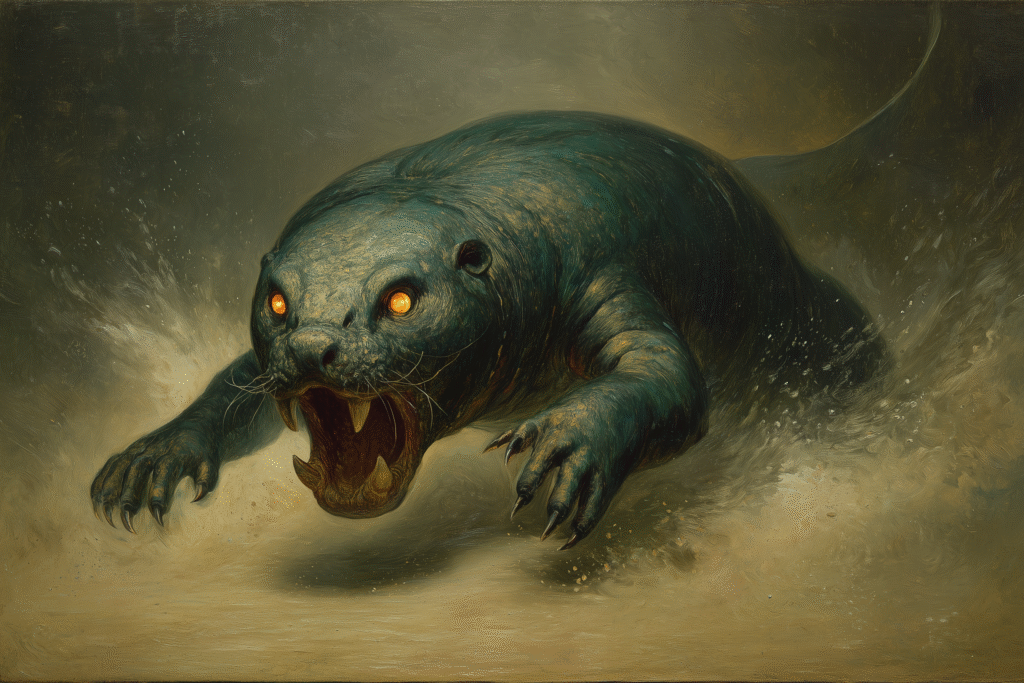
Bunyip accounts belong to particular Australian places and communities. The English spelling was popularised through colonial writing, which often treated accounts from different people as descriptions of the same animal. They were not. Among Ngarrindjeri stories from the lower Murray and lakes, Mulyawonk is a named water being with its own traditions; it should not be treated as a second name for every bunyip. Bunjil, a Victorian creator figure, is not the bunyip. For nearby bestiary entries, visit the Oceania Bestiary.
The colonial press gave the bunyip considerable attention during the 1840s. An alleged skull displayed at the Australian Museum in 1847 attracted notice, but it did not establish a zoological species. The Challicum bunyip, recorded in Victoria in the nineteenth century, became another much-retold image. Accounts disagree about the creature’s appearance, and no single anatomical reconstruction can settle them. See the Australian Museum’s historical research.
Seals venturing inland, booming bittern calls and memories of extinct megafauna are among the proposed natural explanations. They remain hypotheses, not demonstrated origins for any one community’s tradition. Diprotodon was a real extinct marsupial; its existence is not evidence that the bunyip was a surviving diprotodont. For more on the historical and cultural record, consult The Oxford Companion to Australian Folklore and research on Ngarrindjeri accounts.
Further rules reading: EN World: Epic Monsters — Bunyip presents a separately published 5e interpretation. The 2014-compatible game statistics above are not presented as that source’s official rules.
Watch: Water-Place Stories and Bunyip History
Wutiyeti: Bunyip from Ackle Bend — This Place (ABC and First Languages Australia, about four minutes). Uncle Ron Marks and Hunter King discuss the Wimmera River’s Wergaia place names and the bunyip story associated with Wutiyeti. Watch on Indigenous Community Television.
Bunyip: Australia’s Mysterious Amphibian Monster — Monstrum (PBS, 7 minutes 29 seconds). A compact look at differing accounts, nineteenth-century reports and the effects of European colonisation on how the stories were recorded. Watch on PBS.
Sources, Editions and Licensing
The 2024 and 2014 stat blocks are unofficial fantasy-game interpretations. The Pathfinder 1e block draws on the Open Game Content of Pathfinder Roleplaying Game Bestiary 2; the D&D 3.5e conversion uses legacy d20 rules. The setting notes and illustrations are separate from those rules. For the underlying game material, consult Paizo’s licence guidance, the Pathfinder reference licence, and D&D SRD 5.2.1.
Open Game License v1.0a and notices
Open Game Content identification: game mechanics derived from OGL rules in the Pathfinder 1e and D&D 3.5e tabs only. Original folklore summaries, original prose, campaign placements, art, images and page design are excluded. D&D SRD 5.2.1 material is separately licensed under Creative Commons Attribution 4.0; its attribution appears below.
Read the full Open Game License v1.0a on this site; see also the Pathfinder reference document’s legal notices.
Copyright notice: Open Game License v1.0a © 2000 Wizards of the Coast, Inc.; System Reference Document © 2000 Wizards of the Coast, Inc., authors Jonathan Tweet, Monte Cook and Skip Williams, based on material by E. Gary Gygax and Dave Arneson.
Pathfinder source: Pathfinder Roleplaying Game Bestiary 2 © 2010 Paizo Publishing, LLC. Authors credited within the Pathfinder tab above.
Creative Commons: This work includes game terminology and material from the System Reference Document 5.2.1 by Wizards of the Coast LLC, available at D&D Beyond, licensed under CC BY 4.0. The SRD and trademark names remain the property of their respective owners.
OPEN GAME LICENSE Version 1.0a
The following text is the property of Wizards of the Coast, Inc. and is Copyright 2000 Wizards of the Coast, Inc (“Wizards”). All Rights Reserved.
1. Definitions: (a) “Contributors” means the copyright and/or trademark owners who have contributed Open Game Content; (b) “Derivative Material” means copyrighted material including derivative works and translations (including into other computer languages), potation, modification, correction, addition, extension, upgrade, improvement, compilation, abridgment or other form in which an existing work may be recast, transformed or adapted; (c) “Distribute” means to reproduce, license, rent, lease, sell, broadcast, publicly display, transmit or otherwise distribute; (d) “Open Game Content” means the game mechanic and includes the methods, procedures, processes and routines to the extent such content does not embody the Product Identity and is an enhancement over the prior art and any additional content clearly identified as Open Game Content by the Contributor, and means any work covered by this License, including translations and derivative works under copyright law, but specifically excludes Product Identity; (e) “Product Identity” means product and product line names, logos and identifying marks including trade dress; artifacts; creatures characters; stories, storylines, plots, thematic elements, dialogue, incidents, language, artwork, symbols, designs, depictions, likenesses, formats, poses, concepts, themes and graphic, photographic and other visual or audio representations; names and descriptions of characters, spells, enchantments, personalities, teams, personas, likenesses and special abilities; places, locations, environments, creatures, equipment, magical or supernatural abilities or effects, logos, symbols, or graphic designs; and any other trademark or registered trademark clearly identified as Product identity by the owner of the Product Identity, and which specifically excludes the Open Game Content; (f) “Trademark” means the logos, names, mark, sign, motto, designs that are used by a Contributor to identify itself or its products or the associated products contributed to the Open Game License by the Contributor; (g) “Use”, “Used” or “Using” means to use, Distribute, copy, edit, format, modify, translate and otherwise create Derivative Material of Open Game Content; (h) “You” or “Your” means the licensee in terms of this agreement.
2. The License: This License applies to any Open Game Content that contains a notice indicating that the Open Game Content may only be Used under and in terms of this License. You must affix such a notice to any Open Game Content that you Use. No terms may be added to or subtracted from this License except as described by the License itself. No other terms or conditions may be applied to any Open Game Content distributed using this License.
3. Offer and Acceptance: By Using the Open Game Content You indicate Your acceptance of the terms of this License.
4. Grant and Consideration: In consideration for agreeing to use this License, the Contributors grant You a perpetual, worldwide, royalty-free, non-exclusive license with the exact terms of this License to Use, the Open Game Content.
5. Representation of Authority to Contribute: If You are contributing original material as Open Game Content, You represent that Your Contributions are Your original creation and/or You have sufficient rights to grant the rights conveyed by this License.
6. Notice of License Copyright: You must update the COPYRIGHT NOTICE portion of this License to include the exact text of the COPYRIGHT NOTICE of any Open Game Content You are copying, modifying or distributing, and You must add the title, the copyright date, and the copyright holder’s name to the COPYRIGHT NOTICE of any original Open Game Content you Distribute.
7. Use of Product Identity: You agree not to Use any Product Identity, including as an indication as to compatibility, except as expressly licensed in another, independent Agreement with the owner of each element of that Product Identity.
You agree not to indicate compatibility or co-adaptability with any Trademark or Registered Trademark in conjunction with a work containing Open Game Content except as expressly licensed in another, independent Agreement with the owner of such Trademark or Registered Trademark. The use of any Product Identity in Open Game Content does not constitute a challenge to the ownership of that Product Identity.
The owner of any Product Identity used in Open Game Content shall retain all rights, title and interest in and to that Product Identity.
8. Identification: If you distribute Open Game Content You must clearly indicate which portions of the work that you are distributing are Open Game Content.
9. Updating the License: Wizards or its designated Agents may publish updated versions of this License. You may use any authorized version of this License to copy, modify and distribute any Open Game Content originally distributed under any version of this License.
10. Copy of this License: You MUST include a copy of this License with every copy of the Open Game Content You Distribute.
11. Use of Contributor Credits: You may not market or advertise the Open Game Content using the name of any Contributor unless You have written permission from the Contributor to do so.
12. Inability to Comply: If it is impossible for You to comply with the terms of this License with respect to some or all of the Open Game Content due to statute, judicial order, or governmental regulation then You may not Use any Open Game Material so affected.
13. Termination: This License will terminate automatically if You fail to comply with all terms herein and fail to cure such breach within 30 days of becoming aware of the breach. All sublicenses shall survive the termination of this License.
14. Reformation: If any provision of this License is held to be unenforceable, such provision shall be reformed only to the extent necessary to make it enforceable.
15. COPYRIGHT NOTICE
Open Game License v 1.0a Copyright 2000, Wizards of the Coast, Inc.
System Reference Document. Copyright 2000, Wizards of the Coast, Inc.; Authors Jonathan Tweet, Monte Cook, Skip Williams, based on material by E. Gary Gygax and Dave Arneson.
Pathfinder Roleplaying Game Reference Document. © 2011, Paizo Publishing, LLC; Author: Paizo Publishing, LLC.
Pathfinder Roleplaying Game Core Rulebook. © 2009, Paizo Publishing, LLC; Author: Jason Bulmahn, based on material by Jonathan Tweet, Monte Cook, and Skip Williams.
Pathfinder Roleplaying Game Bestiary. © 2009, Paizo Publishing, LLC; Author: Jason Bulmahn, based on material by Jonathan Tweet, Monte Cook, and Skip Williams.
Pathfinder Roleplaying Game Bestiary 2. © 2010, Paizo Publishing, LLC; Authors Wolfgang Baur, Jason Bulmahn, Adam Daigle, Graeme Davis, Crystal Frasier, Joshua J. Frost, Tim Hitchcock, Brandon Hodge, James Jacobs, Steve Kenson, Hal MacLean, Martin Mason, Rob McCreary, Erik Mona, Jason Nelson, Patrick Renie, Sean K Reynolds, F. Wesley Schneider, Owen K.C. Stephens, James L. Sutter, Russ Taylor, and Greg A. Vaughan, based on material by Jonathan Tweet, Monte Cook, and Skip Williams.
Bunyip, original homebrew 3.5e conversion. © 2026 SpiralWorlds.
END OF LICENSE
Keep this reference growing
If this page helped with your reading or game, you can support its upkeep or explore the curated books.
Explore the Bookshop — epics, classics and stories behind imagined worlds.