
Epigaulus — Horned Gopher of the Old Earth
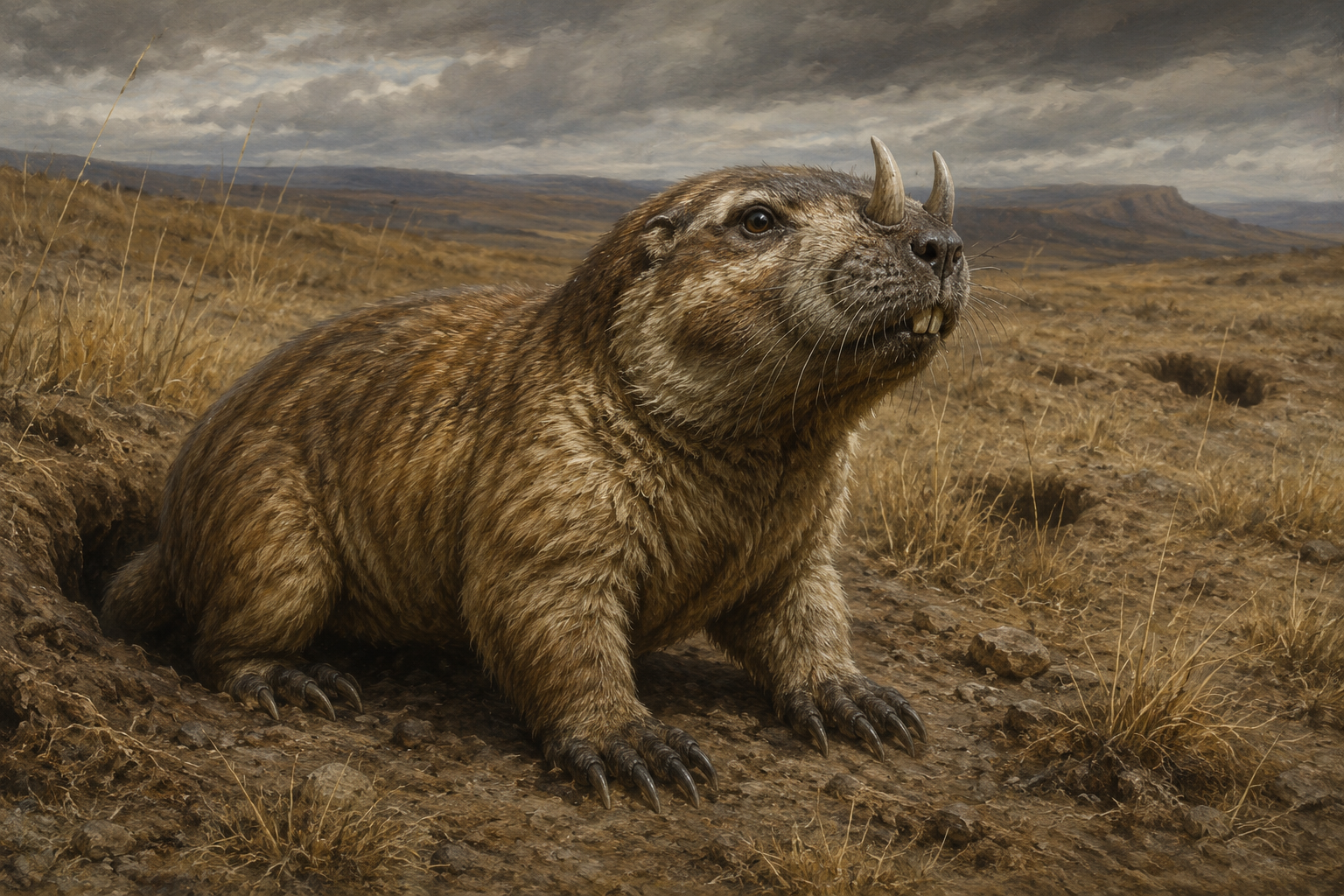
Epigaulus is a squat, horned burrowing rodent of the Old Earth, little more than a foot long but powerfully built for digging. Colonies undermine grasslands with shallow runs and concealed chambers, while sentries defend burrow mouths with abrupt upward strikes of their paired nasal horns.
Most flee underground at the first alarm. An Epigaulus fights only when cornered, when young are threatened, or when a predator reaches into an occupied burrow.
- Size
- Tiny; about 1 ft. (30 cm) long
- Type
- Animal / Beast
- Temperament
- Wary, defensive and burrow-bound
- Diet
- Grasses, roots, shoots, seeds and low scrub
- Habitat
- Prairie, badlands, dry scrub and loose-earth grasslands
- Range
- North American interior and Hollow Earth refuges
Epigaulus Game Statistics
Epigaulus — D&D 5.5e / 2024
Tiny Beast, Unaligned
AC 12
Initiative +1 (11)
HP 4 (1d4 + 2)
Speed 20 ft., Burrow 10 ft.
PB +2
Skills Perception +3, Stealth +3
Senses Passive Perception 13
Languages —
CR 0 (XP 10; PB +2)
Traits
Burrower. The Epigaulus can burrow through loose earth and ordinary soil but not solid rock. Its normal tunnels are large enough for Tiny creatures; larger creatures require excavation rather than simply following it underground.
Actions
Nasal Horn. Melee Attack Roll: +2, reach 5 ft. Hit: 1 Piercing damage.
Reactions
Defensive Horn-Flick. Trigger: A creature within 5 feet misses the Epigaulus with a melee attack while the Epigaulus is within 5 feet of one of its burrow entrances. Response: The Epigaulus makes one Nasal Horn attack against that creature and may then move up to 5 feet into the burrow without provoking an Opportunity Attack.
Epigaulus Burrow Field — 5.5e Environmental Hazard
An active colony turns apparently ordinary grassland into a network of shallow runs, hidden roofed tunnels and narrow openings. The animals are not laying traps; the hazard is simply what their colony does to the ground.
Spotting the Field. A creature examining the area can identify the burrow field with a successful DC 12 Wisdom (Perception or Survival) check. Obvious mounds, whistles or visible Epigauli remove the need for the check.
Crossing Safely. A creature that knows the field is present can cross safely by treating the area as Difficult Terrain.
Hidden Burrow. The first time on a turn that a Medium or larger ground creature moves more than 10 feet through an unrecognised burrow field without treating it as Difficult Terrain, it must make a DC 12 Dexterity saving throw. On a failure, its movement ends and it has the Prone condition. Large or larger creatures make this save with Disadvantage.
Mounted Crossing. A mount makes the Hidden Burrow saving throw rather than its rider. On a failure, the mount’s Speed becomes 0 until the end of the current turn. If the save fails by 5 or more, the mount also has the Prone condition and the rider must succeed on a DC 12 Dexterity saving throw or fall Prone in an unoccupied space within 5 feet of the mount.
Alarm Whistles. Once a creature disturbs the field, Epigauli within roughly 120 feet become aware of the direction of the disturbance and usually retreat toward deeper tunnels rather than fighting.
Epigaulus — Pathfinder 1e
CR 1/4 XP 100
N Tiny animal
Init +1; Senses low-light vision, scent; Perception +5
Defense
AC 14, touch 13, flat-footed 13 (+1 Dex, +1 natural, +2 size)
hp 5 (1d8+1)
Offense
Speed 20 ft., burrow 10 ft.
Melee gore +3 (1d3−1)
Space 2-1/2 ft.; Reach 0 ft.
Special Attacks defensive horn-flick
Statistics
Str 8, Dex 13, Con 12, Int 2, Wis 12, Cha 5
Skills Perception +5, Stealth +9
Racial Modifiers +4 Stealth in dry grass, scrub, badlands or loose earth
Ecology
Environment temperate or warm plains, badlands, scrublands, Hollow Earth grasslands
Organization solitary, pair, watch-post (3–6), or colony (8–40)
Treasure none
Special Abilities
Defensive Horn-Flick (Ex). Once per round, when a creature within 5 feet misses the Epigaulus with a melee attack while the Epigaulus is adjacent to a burrow entrance, it may make one gore attack as an immediate action. For this attack only, treat its reach as 5 feet. After the attack it may move 5 feet into its burrow without provoking attacks of opportunity.
Epigaulus Burrow Field — Pathfinder 1e Environmental Hazard
Detection. A DC 12 Perception or Survival check identifies the field before a creature enters it. Once detected, Medium or larger ground creatures treat the area as difficult terrain. Tiny and Small creatures may move normally unless the GM decides a particular section has collapsed or been churned up.
Unseen Burrow Roofs. A Medium or larger creature that crosses an undetected field at more than half speed must attempt a DC 12 Reflex save the first time each round it moves through the hazard. Failure ends its movement and leaves it prone. Large or larger creatures take a −2 penalty on this save.
Running and Charging. Once the field is recognised as difficult terrain, creatures cannot run or charge through it under the normal Pathfinder movement rules.
Mounted Crossing. The mount makes the Reflex save. On a failure, its movement ends. If it fails by 5 or more, the mount also falls prone and the rider must succeed on a DC 12 Ride check or fall prone in an adjacent square.
Alarm Whistles. Disturbing the field alerts the colony. Epigauli that can hear the warning normally withdraw underground; the whistles are not a supernatural alarm and do not reveal intruders to unrelated creatures.
Epigaulus — D&D 3.5e
Tiny Animal, Neutral
Hit Dice 1d8+1 (5 hp)
Initiative +1
Speed 20 ft., burrow 10 ft.
Armor Class 14 (+2 size, +1 Dex, +1 natural), touch 13, flat-footed 13
Base Attack/Grapple +0/−9
Attack Gore +3 melee (1d3−1)
Full Attack Gore +3 melee (1d3−1)
Space/Reach 2-1/2 ft./0 ft.
Special Attacks Defensive horn-flick
Special Qualities Low-light vision, scent
Saves Fort +3, Ref +3, Will +1
Abilities Str 8, Dex 13, Con 12, Int 2, Wis 12, Cha 5
Skills Hide +13 in native terrain, Listen +3, Spot +3
Environment temperate or warm plains and badlands
Organization solitary, pair, or colony (3–18)
Challenge Rating 1/4
Treasure none
Alignment always neutral
Special Ability
Defensive Horn-Flick (Ex). Once per round, when a creature within 5 feet misses the Epigaulus with a melee attack while the animal is adjacent to a burrow entrance, the Epigaulus may make an attack of opportunity with its gore. For this attack only, treat its reach as 5 feet. After the attack it may immediately move 5 feet into an adjacent burrow without provoking an attack of opportunity.
Epigaulus Burrow Field — D&D 3.5e Environmental Hazard
Detection. A DC 12 Spot or Survival check identifies the burrow field before entry. Once recognised, Medium or larger ground creatures treat it as difficult terrain.
Unseen Burrow Roofs. A Medium or larger creature crossing an undetected field at more than half speed must make a DC 12 Reflex save the first time each round it moves through the hazard. Failure ends its movement and knocks it prone. Large or larger creatures take a −2 penalty on the save.
Running and Charging. Once the terrain is recognised, the normal 3.5e difficult-terrain rules prevent running or charging across it.
Mounted Crossing. The mount makes the Reflex save. On a failure, its movement ends. If the mount fails by 5 or more, it falls prone and its rider must succeed on a DC 12 Ride check or fall prone in an adjacent square.
Alarm Whistles. Once disturbed, the colony passes warning calls from burrow to burrow and withdraws underground unless fire, flooding, excavation or another threat blocks retreat.
Description
An Epigaulus has a broad, blunt head, small eyes, short legs and heavy digging forelimbs. A matched pair of horns rises from the nose. The horns are short, stout and forward-set rather than antler-like, giving the animal a distinctive wedge-shaped profile.
Adults are usually about 1 foot (30 cm) long and weigh only a few pounds. Their dense bodies, powerful shoulders and low stance make them look heavier than they are.
Combat
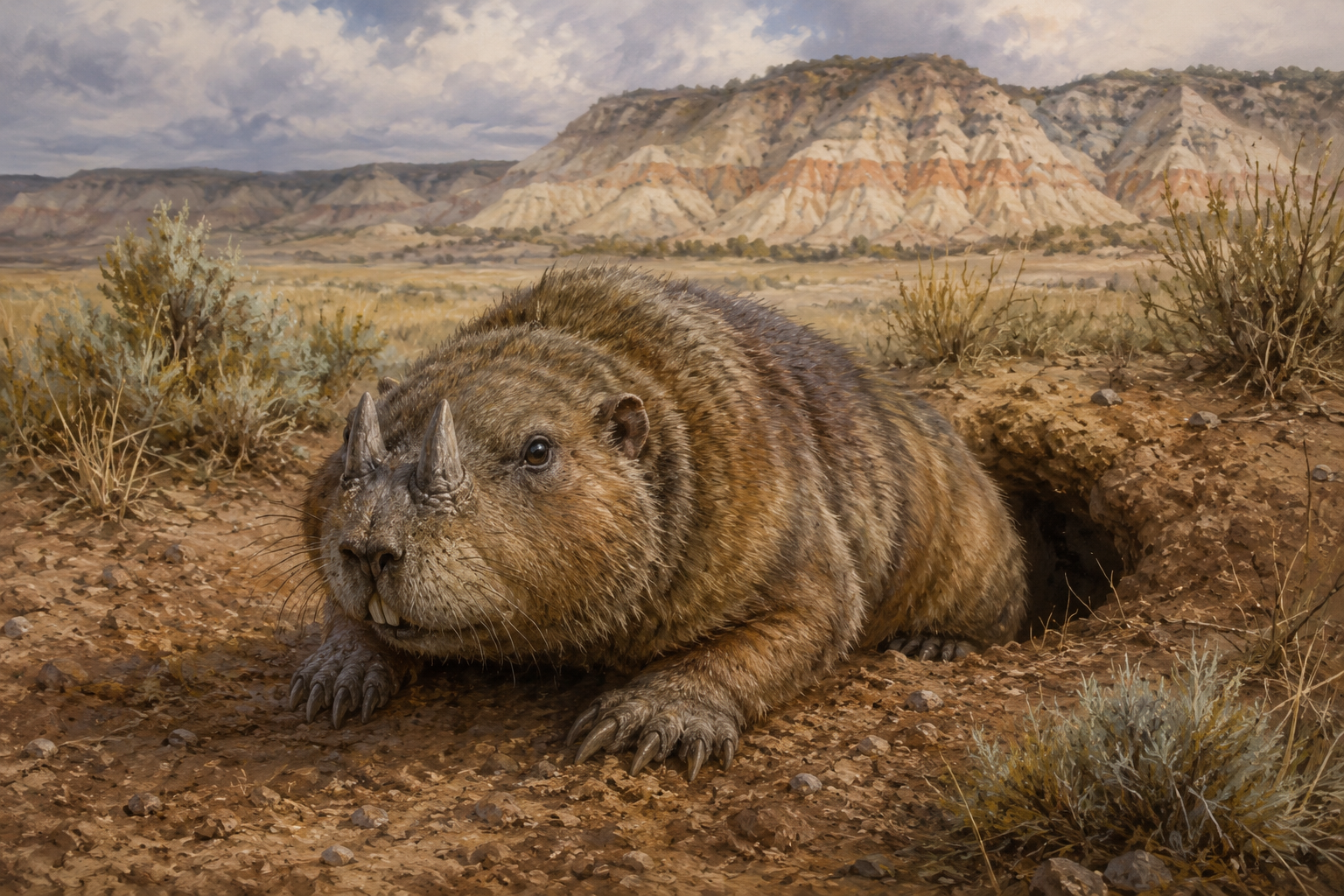
Epigauli avoid open combat. A threatened animal backs toward the nearest burrow entrance, gives a sharp whistle and keeps its horned head toward the attacker. If a predator lunges, it snaps its head upward and retreats underground immediately afterward.
A colony rarely swarms an intruder. Its real defence is the ground itself: broken turf, concealed tunnel roofs and narrow entrances that make a careless charge or mounted crossing dangerous.
Habitat and Ecology
Epigauli live in dry grasslands, badlands, scrub and loose-earth plains. Surface populations are strongest in North America, while older and more stable colonies survive in Hollow Earth grasslands.
They feed on grasses, roots, shoots, seeds and low scrub. Abandoned tunnels shelter insects, snakes and small mammals, while foxes, owls and other predators hunt along colony edges.
Burrows and Colonies
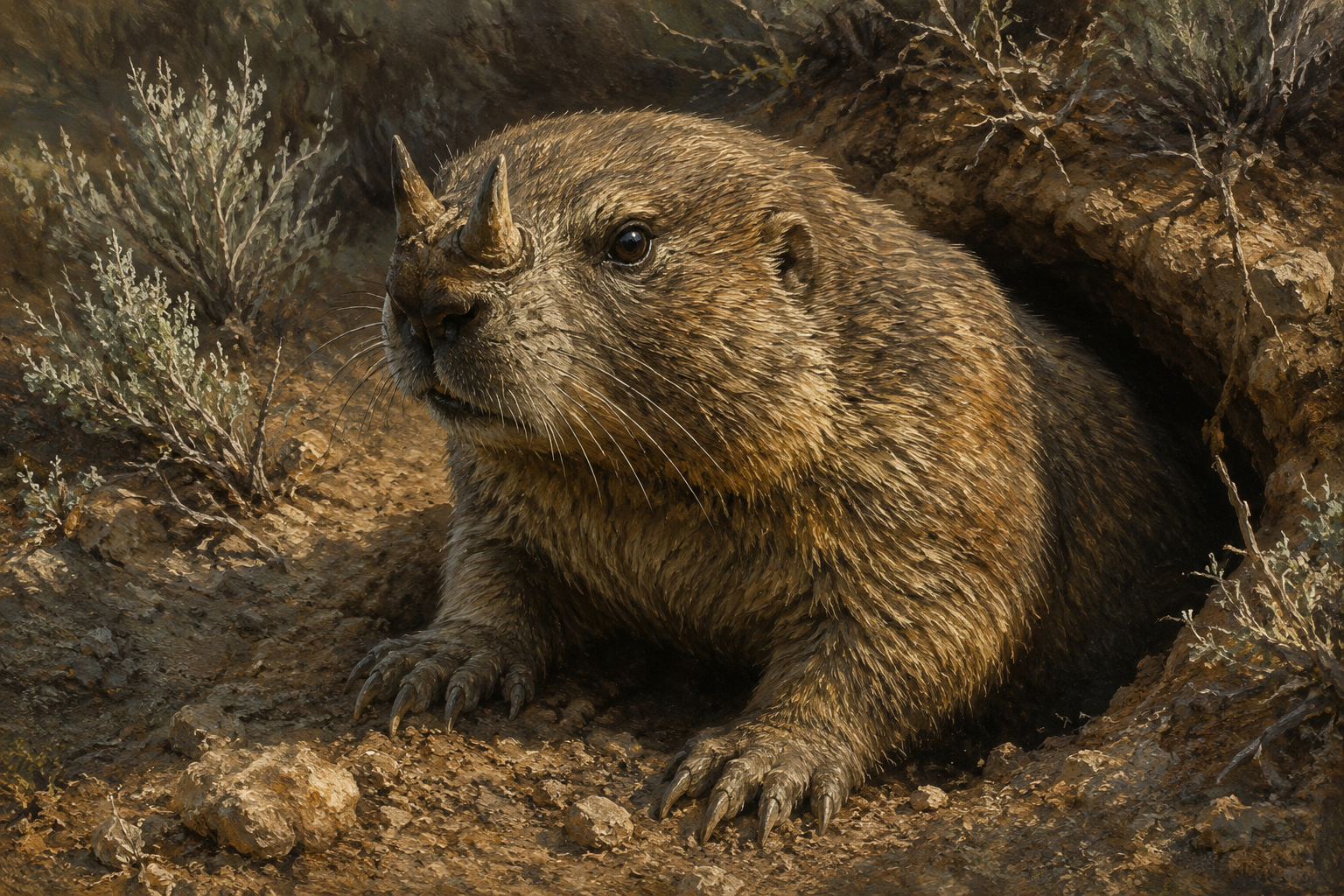
A colony is usually visible only as low mounds, clipped vegetation and scattered openings. Beneath the surface lies a network of feeding runs, sleeping chambers and escape tunnels. Sentries whistle when they detect danger, and nearby animals vanish underground within moments.
Active colonies can turn apparently safe ground into a serious obstacle for horses, carts and running travellers. The environmental rules in each edition tab represent this burrow field.
Epigaulus in 1454
Rare colonies survive in isolated prehistoric refuges, especially across the North American interior and in Hollow Earth. Their presence often marks a wider pocket of Old Earth life: exposed fossil beds, surviving prehistoric plants, unusual predators or hidden passages into deeper refuges.
Adventure Hooks
The Grass That Watches
Travellers enter an apparently empty meadow. Horned heads rise above the grass, a line of warning whistles passes across the slope, and the first horse puts a hoof through a hidden run.
The Exposed Bed
Heavy rain drives a colony into a pale sediment layer filled with fossil bone and shell. Fresh mounds now contain teeth, horn cores and fragments from an older age, drawing scholars, relic hunters and something that has been waiting deeper down.
The Burrowed Mound
A burial mound is slowly collapsing because an Epigaulus colony has tunnelled into its sides. Beads, old bronze, finger bones and carved stones appear around the entrances. The animals are not the threat; they are exposing what the mound was built to contain.
Treasure and Remains
Epigauli carry no treasure, but intact remains are valuable to natural philosophers, collectors and apothecaries.
- Nasal horns: 5 sp–2 gp each; 3–5 gp for a clean matched pair.
- Complete skull: 10–25 gp.
- Claws: 2–8 sp for a cleaned set.
- Hide: 1–4 gp.
- Living specimen: 10–30 gp where a buyer specifically wants one.
Video
Related SpiralWorlds
Animals — the broader SpiralWorlds animal bestiary.
North American Bestiary — creatures associated with the Epigaulus’s strongest surface range.
Lost World / Hollow Earth Bestiary — other creatures surviving in old-earth refuges.
North America — campaign geography for its main surface populations.
Hollow Earth — the principal deep refuge for stable prehistoric populations.
Sources and Natural History
The fossil animal historically called Epigaulus is now generally placed in Ceratogaulus. Its size, burrowing build and paired nasal horns inform the creature presented here.
- Smithsonian National Museum of Natural History — Epigaulus hatcheri / Ceratogaulus hatcheri
- Hopkins, “The evolution of fossoriality and the adaptive role of horns in the Mylagaulidae”
Rules and Licensing
D&D 5.5e / 2024
This work includes material from the System Reference Document 5.2.1 (“SRD 5.2.1”) by Wizards of the Coast LLC, available from D&D Beyond. The SRD 5.2.1 is licensed under the Creative Commons Attribution 4.0 International License.
Pathfinder 1e and D&D 3.5e
The Pathfinder 1e and D&D 3.5e rules are SpiralWorlds adaptations using Open Game Content under the Open Game License Version 1.0a.
Open Game License Version 1.0a
OPEN GAME LICENSE Version 1.0a
The following text is the property of Wizards of the Coast, Inc. and is Copyright 2000 Wizards of the Coast, Inc (“Wizards”). All Rights Reserved.
1. Definitions: (a) “Contributors” means the copyright and/or trademark owners who have contributed Open Game Content; (b) “Derivative Material” means copyrighted material including derivative works and translations (including into other computer languages), potation, modification, correction, addition, extension, upgrade, improvement, compilation, abridgment or other form in which an existing work may be recast, transformed or adapted; (c) “Distribute” means to reproduce, license, rent, lease, sell, broadcast, publicly display, transmit or otherwise distribute; (d) “Open Game Content” means the game mechanic and includes the methods, procedures, processes and routines to the extent such content does not embody the Product Identity and is an enhancement over the prior art and any additional content clearly identified as Open Game Content by the Contributor, and means any work covered by this License, including translations and derivative works under copyright law, but specifically excludes Product Identity. (e) “Product Identity” means product and product line names, logos and identifying marks including trade dress; artifacts; creatures characters; stories, storylines, plots, thematic elements, dialogue, incidents, language, artwork, symbols, designs, depictions, likenesses, formats, poses, concepts, themes and graphic, photographic and other visual or audio representations; names and descriptions of characters, spells, enchantments, personalities, teams, personas, likenesses and special abilities; places, locations, environments, creatures, equipment, magical or supernatural abilities or effects, logos, symbols, or graphic designs; and any other trademark or registered trademark clearly identified as Product identity by the owner of the Product Identity, and which specifically excludes Open Game Content; (f) “Trademark” means the logos, names, mark, sign, motto, designs that are used by a Contributor to identify itself or its products or the associated products contributed to the Open Game License by the Contributor; (g) “Use”, “Used” or “Using” means to use, Distribute, copy, edit, format, modify, translate and otherwise create Derivative Material of Open Game Content; (h) “You” or “Your” means the licensee in terms of this agreement.
2. The License: This License applies to any Open Game Content that contains a notice indicating that the Open Game Content may only be Used under and in terms of this License. You must affix such a notice to any Open Game Content that you Use. No terms may be added to or subtracted from this License except as described by the License itself. No other terms or conditions may be applied to any Open Game Content distributed using this License.
3. Offer and Acceptance: By Using the Open Game Content You indicate Your acceptance of the terms of this License.
4. Grant and Consideration: In consideration for agreeing to use this License, the Contributors grant You a perpetual, worldwide, royalty-free, non-exclusive license with the exact terms of this License to Use, the Open Game Content.
5. Representation of Authority to Contribute: If You are contributing original material as Open Game Content, You represent that Your Contributions are Your original creation and/or You have sufficient rights to grant the rights conveyed by this License.
6. Notice of License Copyright: You must update the COPYRIGHT NOTICE portion of this License to include the exact text of the COPYRIGHT NOTICE of any Open Game Content You are copying, modifying or distributing, and You must add the title, the copyright date, and the copyright holder’s name to the COPYRIGHT NOTICE of any original Open Game Content you Distribute.
7. Use of Product Identity: You agree not to Use any Product Identity, including as an indication as to compatibility, except as expressly licensed in another, independent Agreement with the owner of each element of that Product Identity. You agree not to indicate compatibility or co-adaptability with any Trademark or Registered Trademark in conjunction with a work containing Open Game Content except as expressly licensed in another, independent Agreement with the owner of such Trademark or Registered Trademark. The use of any Product Identity in Open Game Content does not constitute a challenge to the ownership of that Product Identity. The owner of any Product Identity used in Open Game Content shall retain all rights, title and interest in and to that Product Identity.
8. Identification: If you distribute Open Game Content You must clearly indicate which portions of the work that you are distributing are Open Game Content.
9. Updating the License: Wizards or its designated Agents may publish updated versions of this License. You may use any authorized version of this License to copy, modify and distribute any Open Game Content originally distributed under any version of this License.
10. Copy of this License: You MUST include a copy of this License with every copy of the Open Game Content You Distribute.
11. Use of Contributor Credits: You may not market or advertise the Open Game Content using the name of any Contributor unless You have written permission from the Contributor to do so.
12. Inability to Comply: If it is impossible for You to comply with any of the terms of this License with respect to some or all of the Open Game Content due to statute, judicial order, or governmental regulation then You may not Use any Open Game Material so affected.
13. Termination: This License will terminate automatically if You fail to comply with all terms herein and fail to cure such breach within 30 days of becoming aware of the breach. All sublicenses shall survive the termination of this License.
14. Reformation: If any provision of this License is held to be unenforceable, such provision shall be reformed only to the extent necessary to make it enforceable.
15. COPYRIGHT NOTICE
Open Game License v 1.0a Copyright 2000, Wizards of the Coast, Inc.
System Reference Document Copyright 2000–2003, Wizards of the Coast, Inc.; Authors Jonathan Tweet, Monte Cook, Skip Williams, Rich Baker, Andy Collins, David Noonan, Rich Redman, Bruce R. Cordell, Chris Sims, James Wyatt, based on original material by E. Gary Gygax and Dave Arneson.
Pathfinder Roleplaying Game Core Rulebook Copyright 2009, Paizo Publishing, LLC; Author: Jason Bulmahn, based on material by Jonathan Tweet, Monte Cook, and Skip Williams.
Pathfinder Roleplaying Game Bestiary 5 © 2015, Paizo Inc.; Authors: Dennis Baker, Jesse Benner, John Bennett, Logan Bonner, Creighton Broadhurst, Robert Brookes, Benjamin Bruck, Jason Bulmahn, Adam Daigle, Thurston Hillman, Eric Hindley, Joe Homes, James Jacobs, Amanda Hamon Kunz, Ben McFarland, Jason Nelson, Thom Phillips, Stephen Radney-MacFarland, Alistair Rigg, Alex Riggs, David N. Ross, Wes Schneider, David Schwartz, Mark Seifter, Mike Shel, James L. Sutter, and Linda Zayas-Palmer.
Gegenees D&D 3.5e rules adaptation. Copyright 2026 SpiralWorlds.
Keep this reference growing
If this page helped with your reading or game, you can support its upkeep or explore the curated books.
Explore the Bookshop — epics, classics and stories behind imagined worlds.