
The Lands of The Great Horde
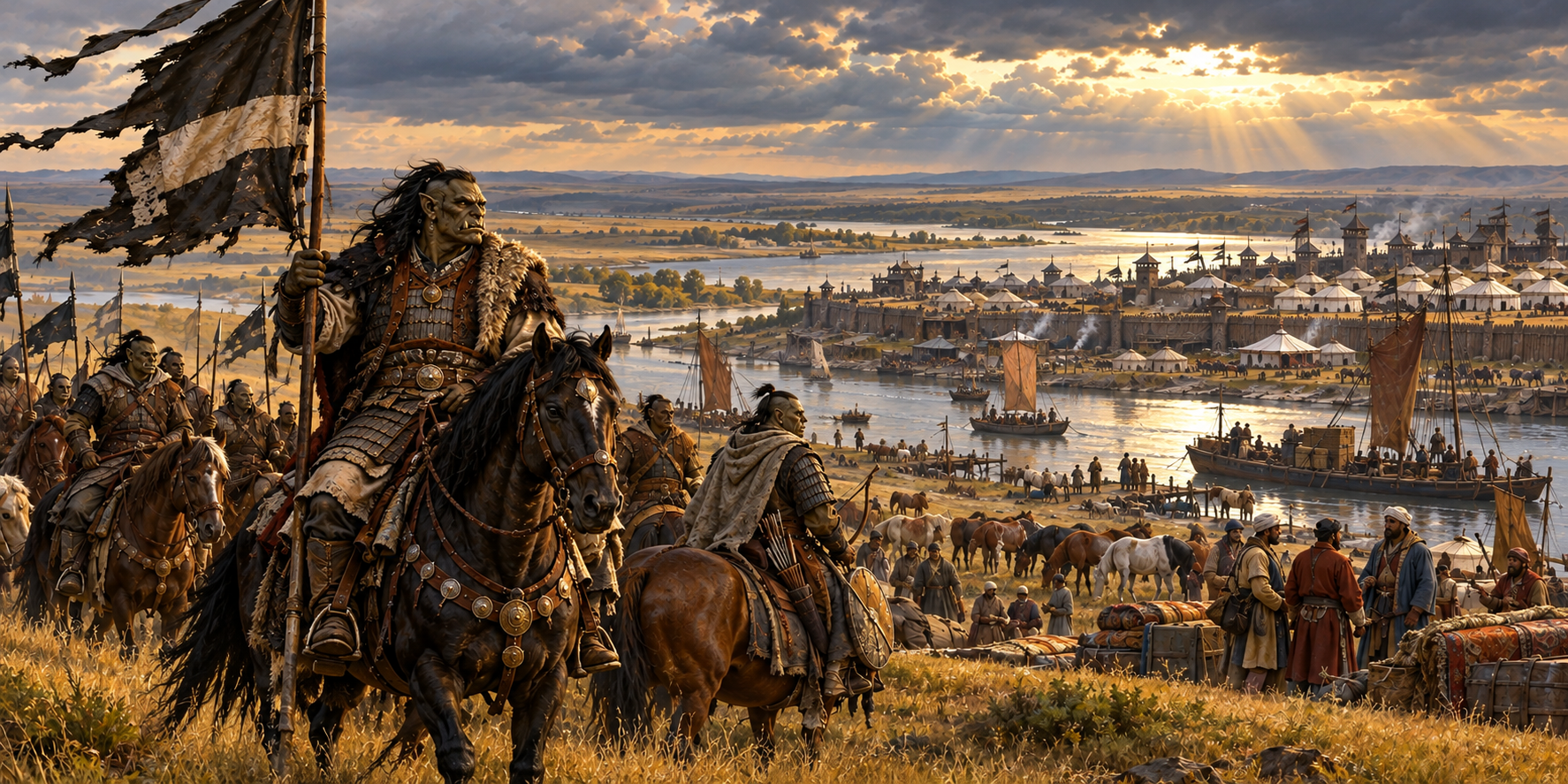
Lower Volga · Sarai · Krusk Ash-Standard · Caspian Steppe · Rival Standards
Great Horde at a Glance
| Campaign Present | 1454 CE |
|---|---|
| Realm | Western steppe khanate within the fractured inheritance of Mhurak’s Great Muster, not a fifth co-equal orc successor empire |
| Ruler | Krusk Ash-Standard, orc khan claiming the Horde’s central inheritance |
| Seat of Power | Sarai on the lower Volga, alongside the khan’s moving court and seasonal camps |
| Government | Khan, military household, clan Scar-Chiefs, tribute officials and seasonal councils |
| Lands | Lower Volga, northern Caspian grasslands, Don–Volga approaches and disputed western pasture routes |
| Neighbours | Kazan, Crimea, Nogai clans and the Rus lands |
| Claim over Crimea | Krusk Ash-Standard invokes the old Great Muster to demand tribute and an oath of fealty; the independent Crimean khan Hacı Giray refuses. Crimea is claimed, not controlled. |
| Peoples | Orc ruling families, half-orcs, human river and steppe populations and other subject communities |
| Languages | Orc, regional Turkic and Rus tongues; interpreters at major markets |
| Beliefs | First-Scar seers, clan ancestors, sacred standards and varied local customs |
| Trade | Livestock, horses, river tolls, grain, fish, hides, metal goods and caravan traffic |
| Threats | Rival khans, tribute raids, blood-feuds, dangerous crossings and winter exposure |
Before sunrise the drums sound beyond Sarai’s river gates. Ash-grey orc sentries in iron-rimmed helmets watch the Volga from timber towers. On the shore, caravan brokers haggle beside grain boats while riders lead their remounts through the reed smoke. Black standards rise above the khan’s camp, each marked with scars, tusks or broken weapons taken in war. Krusk Ash-Standard commands this formidable host; he cannot command every clan’s loyalty without proving his strength.
The Great Horde holds a contested western inheritance of Mhurak Stone-Blood’s Great Muster. Krusk Ash-Standard receives envoys beneath a smoke-dark banner, demands tribute from the Rus and speaks of gathering the divided standards again. His authority reaches far beyond the riders who stand before him, but the Scar-Chiefs still count their own warriors and remember their own blood-debts. Any chief can promise obedience in Sarai and ride home intending to do otherwise.
Far from the war standards, families mend felt tents, keep the herds, tend children, dry fish, forge iron and bargain with river merchants. Orc households dominate the mounted war-hosts, yet human, half-orc and other communities keep Sarai and the ferries alive. Steppe herders depend on pasture and wells; townsfolk depend on boats and grain. The khan’s summons can empty a camp of riders, but it cannot feed their families or repair a broken winter road.
Timur’s armies left ruined stations and frightened memories along the old conquest roads. Clan feuds widened the wounds. Now Muscovy resists the Horde’s demands, Kazan guards its upriver rights and Crimean messengers ride west with offers that may conceal threats. The drums at Sarai still call warriors together; whether the chiefs answer them is another matter.
Entering the Great Horde
- At the river gate: a black-standard guard asks whose protection the travellers carry.
- In Sarai: traders, orc clan households and subject communities share streets but answer to different patrons.
- Beyond the road: pasture rights, hungry worgs and uncertain wells matter as much as enemy riders.
- At the khan’s court: gifts, witnessed promises and knowledge of clan rivalries open more doors than threats.
Life Beneath the Ash Standard
The first things heard in an orc camp are not always battle cries. Hammer blows ring from armourers’ shelters, children quarrel beside the cooking fires and herd-keepers shout over the horses. The heavy smell of tallow, damp felt, hot iron and boiled meat carries between the tents. Above it all stand the standards: clan names made visible in cloth, bone and captured steel.
Scars, Names and Standards
An earned name speaks more loudly than a birth name. A warrior might become Iron-Tusk after holding a broken gate or Broken-Chain after escaping captivity. Old scars can be badges of pride or reminders of failure; neither is explained to a stranger lightly. Clan banners bear marks of beasts, wounds and victories. The Black-Tusk, Split-Shield and Night-Worg names are known across the imperial inheritance, but a banner’s presence does not mean the whole clan has joined Krusk.
Warriors, Families and Smiths
Mounted orcs wear felt beneath mail and battered lamellar, with pieces of enemy armour hammered into their own. Their wealth is visible in remounts, heavy iron, polished tusk jewellery, fine cloth taken in trade and the number of dependants their household can sustain. Forge-keepers, cooks, fletchers, herders and boat crews are essential to a war-host. A Scar-Chief who brings fighters but no fodder may find himself unwelcome before the next winter.
The Night Watch
Many old-blood orcs see well in darkness and dislike the glare of noon. Scouts blacken their brows against the sun and favour dusk, mist and moonless approaches. Orc patrols ride horses and use remounts on long journeys; worg allies can guard a dangerous perimeter. The few Gore-Riders whose dire boars can shatter a close formation are prized for assaults, not routine travel across the open plain.
Hospitality and the Broken Oath
A guest who is welcomed beneath a witnessed standard may share food even with a feared enemy. A guest who steals, draws steel without cause or mocks the household’s dead can lose that protection. Scar-Law rests on witnessed words, obligation, blood-debt and the chief’s ability to enforce judgement. A wronged family may accept compensation or demand a harsher settlement; a wise envoy learns the custom before making an offer.
What Is Happening Right Now?
Krusk Calls for a Reckoning
Krusk has demanded an accounting of tribute collected along the northern roads. A convoy carrying sealed tallies has vanished between a guarded river station and Sarai. Two Scar-Chiefs blame one another, and neither wishes to surrender the surviving witnesses. The khan will reward whoever restores the records; he will also want to know who has read them.
The Night-Worg Pact Falls Silent
Worg allies once guarding a northern pasture have abandoned their night stations. At dawn, their tracks circle the tent of a missing Standard-Bearer and lead away without signs of a struggle. A Night-Worg elder blames an oath broken by the riders, but refuses to name the offender before Krusk’s seers. Until the breach is settled, caravans cross that country unguarded.
Kazan Refuses to Be Spoken For
Envoys from Myev Stone-Eye’s Kazan arrive with their own terms for the middle Volga. Krusk’s advisers hear defiance where the envoys speak of shared river trade. Meanwhile Azgar’s hobgoblin soldiers gather behind their own red banner, hoping both orc courts will exhaust themselves. The guests at Sarai must decide which promises can outlast the next campaign season.
Pasture Rights Become a War
Riders associated with the influential Nogai Fanglord Holg Long-Ride have moved herds across ground two clans each claim by ancestral oath. Wells have been fouled, perhaps deliberately, and both sides blame the other. Scouts gather while herders and families flee towards the river.
Crimea Watches the Western Roads
Ovak Black-Boar’s orc war-camp on Crimea’s northern roads seeks advantage from the Horde’s divided westward alliances. Krusk Ash-Standard has demanded that Hacı Giray acknowledge the Great Horde’s inherited supremacy and send tribute to Sarai; the Crimean khan refuses. Caravans from the Black Sea report rival levies, missing escorts and competing promises of protection. Crimea is independent, not under Krusk’s control and not an Ottoman or hobgoblin vassal. Ovak must decide whether to enforce Krusk’s claim or bargain with the Giray court.
Places Adventurers Can Actually Reach
Sarai — The Lower-Volga Court
The old capital is a place of courts, ruined districts, storehouses, caravan yards and armed compounds. Not every quarter is equally inhabited, and the greatest power often lies in the khan’s camp beyond the streets. A traveller needs a sponsor before entering a chief’s audience. A trusted interpreter is often worth more than a bodyguard.
The Volga Ferries and Toll Forts
Control of a ferry means control of troops, trade and news. Timber forts and earthen posts watch the busiest banks. Ferry captains know which seals are likely to be accepted tomorrow, but may refuse to cross after sunset or in dangerous water. Hostages sometimes guarantee a caravan’s safe-conduct.
The Khan’s Moving Camp
Krusk’s mobile court gathers tents, remounts, armourers, guarded wagons, petitioners and warriors beneath a forest of standards. Its position changes with season and circumstance. A stranger seeking an audience must first negotiate with watch riders, gift-takers and suspicious chiefs whose rivalries can turn a petition into a trial.
The Don–Volga Approaches
Tracks and portages between the rivers draw carriers, guides and spies. Pack animals haul cargo past scarce wells; rival escorts sell promises of safety. The corridor matters to merchants moving between inland river routes and the western steppe. There is no single perfectly safe road.
The Caspian Delta
The Volga breaks into channels, reeds and treacherous shallows before meeting the Caspian Sea. Fishers, reed-cutters, pilots and toll collectors know passages strangers do not. Floods change the channels. A concealed landing may shelter smugglers, fugitive captives or an envoy who cannot travel openly.
The Border Pastures
Clan grazing grounds are territories of wells, graves, seasonal camps and ancient oaths, not neat boundaries drawn on a map. Some chiefs answer Krusk, some bargain with Nogai riders, and others misuse the khan’s name. A promise of safe passage must be renewed whenever the standard changes.
People Adventurers May Actually Meet
Krusk Ash-Standard — The Khan Who Counts Standards
Krusk wears conquest as a claim rather than a memory. At his audiences he lets boasting chiefs exhaust themselves, then asks which warriors, remounts and stores they will actually bring when called. He listens closely to interpreters and messengers because an empire can be lost through false promises as easily as a lost battle. He respects courage that can be proved and despises public humiliation; to be contradicted before his Scar-Chiefs is to invite a contest of authority.
Meeting the khan: a recognised patron and a useful gift secure the first hearing. He might grant an adventuring company an iron-marked safe-conduct in return for returning lost standards, rescuing his envoy or exposing a broken oath. He may honour that promise precisely while permitting his chiefs to interpret it narrowly. The danger is not simply his temper, but the chiefs watching for any sign that he can be defied.
The Scar-Chiefs. Clan rulers command warriors, herds and ancestral loyalties. Each seeks advantage over rivals without showing weakness before Krusk. A chief may observe hospitality scrupulously but punish an insult to the clan standard severely.
Sarai’s caravan brokers and river pilots. Human, orc and half-orc intermediaries keep traffic moving when courts disagree. They know which roads are open, whose word still carries authority and who vanished after crossing the wrong warlord.
First-Scar seers and standard-keepers. Some preserve the old rites of Mhurak’s war-hosts; others answer to particular clans. A witness to an oath can be more politically dangerous than the warrior swearing it.
Envoys from neighbouring khanates. Messengers of Myev Stone-Eye, Ovak Black-Boar and Holg Long-Ride sit in the outer camp, each watching where the others are seated at Krusk’s feasts. A low place at the table can insult a chief as surely as a drawn sword. Some couriers carry genuine authority; others hope their lord will honour the deal after it is made.
Factions, Faith and Authority
The Ash-Standard Household
Krusk’s household commands guards, messengers, tribute clerks and the warriors closest to his banner. His decisions travel through people rather than a uniform administration. Letters can be forged, messengers detained and orders disputed before they reach the outer clans.
Clan Hosts and Competing Standards
Scar-Law recognises witnessed bargains, blood-debts and obligations to protect guests, but it does not prevent vendettas. Clan cavalry travels with remounts and knows the wells by inherited agreement. Rare Gore-Riders on dire boars serve as prestigious shock troops around particular households; they are not the ordinary mounts of open-steppe armies.
Subject Towns and Independent Traders
The river economy cannot survive on raids alone. Town elders, ferrymen, armourers, fishers and merchants bargain for workable tolls, protected storage and safety from competing warbands. The khan’s authority is most visible in the markets; its failure is measured there first.
Rites and Sacred Obligations
Orc clans remember the First Scar through ancestral recitations, honoured standards and seers. Subject peoples follow local customs of their own. No single priesthood governs every settlement. An oath sworn before recognised witnesses may protect a traveller more effectively than an unfamiliar charm.
Trade, Services and the Law
Goods: horses, livestock, hides, felt, salt, fish, grain, metal goods, furs and cargo carried between river markets and distant caravan routes. Captives also pass through coercive trading networks, offering morally difficult choices for travellers who oppose such practices.
Services: interpreters, guides, remounts, ferries, winter shelter, farriers, wagon repairs, guarded storage and introductions to households that can issue safe-conduct.
Law: a stranger’s best defence is a known patron, a witnessed agreement and an honest inventory of goods. Theft from the khan, insulting a standard or breaking hospitality under oath may provoke fines, confiscation, hostage-taking or blood-feud. Enforcement differs between clans and river courts.
Dangers and Encounters
A patrol of orc riders first looks for a standard, a reason for travelling and the whereabouts of missing horses. A suspicious chief may demand hostages or a witnessed oath before drawing a sword. Worgs scent the approach of strangers after dark, while the sound of a distant war drum can warn of a clan muster long before the riders appear.
| Place | Encounter | Complication |
|---|---|---|
| Volga landing | Two warbands demand the same toll | Both have convincing warrants |
| Open pasture | Night riders pursue a missing herd | They mistake the party’s animals for stolen stock |
| Sarai forge-yard | A Scar-Champion demands a public challenge | The challenger’s younger kin begs for a nonlethal settlement |
| Delta reeds | A barge runs aground with desperate passengers | Its pilot conceals a protected route |
| Abandoned station | Worg tracks circle a cold watch fire | The pack may have an intelligent ally willing to bargain |
| Winter road | Herders are trapped without fuel | Helping them could violate another clan’s pasture taboo |
The worst journeys bind one trouble to another: a feud closes a well just as a sand-laden wind rises, a ferry goes missing while armed riders search the bank, or a thaw breaks the road when the remount herd is already hungry. Each danger forces travellers to choose whose hospitality they will trust.
Adventure Hooks
The Split-Shield Blood Debt
A Split-Shield rider dies after accusing a visiting champion of cowardice. Her kin demand a witnessed reckoning before the next muster, but the supposed killer was guarding a First-Scar shrine when she fell. The party must uncover the true cause, negotiate a settlement or choose a champion before two allied war-hosts turn on each other. The wrong accusation may be a trap set for Krusk himself.
Twelve Riders at Dusk
A small escort of Gore-Riders has disappeared beyond a winter well. Their rare mounts left unmistakable tracks, but the riders abandoned their weapons. The truth involves a broken oath and a captive who knows why a rival chief wants the escort blamed for murder.
The River That Changed Sides
Spring flooding cuts off a settlement while two chiefs dispute its grain stores. Saving the residents wins local allies but angers whichever ruler claims the ferry. A pilot says there is another channel, if someone can deal with what shelters at its mouth.
News from Kazan
An envoy bearing Myev Stone-Eye’s proposal for a neutral market has vanished. Her rivals accuse Krusk of arresting the messenger; Krusk denies receiving the envoy. Recovering the missing letter could prevent a border war—or show that a supposedly neutral merchant began it.
Travel and Regional Guidance
The Volga: barges move bulky goods, but current, season, shoals, pilots and tolls determine progress. The next landing’s garrison matters more than any promise made far upstream.
The grasslands: riders rely on water, pasture, remounts and accurate knowledge of seasonal camps. Guides identify wells and the clans that claim them rather than promising a continuous safe road.
Winter: frozen crossings may open just as boat travel closes. Storms, exposed ground and difficulty feeding animals can turn a short route fatal. Weather should affect decisions about supplies and shelter.
Diplomacy: a recognised standard or safe-conduct can prevent bloodshed, but may have no force in a camp loyal to a rival chief. Travellers employed by Krusk should expect repeated challenges.
The Horde’s Older History
Mhurak Stone-Blood’s conquests bound distant lands beneath the Great Muster. The western Horde grew wealthy and feared through cavalry, tribute, commerce and the great river crossings, yet repeated successions shattered unified rule. The campaigns of the human conqueror Timur and later civil wars damaged cities, armies and trading networks. Strong local rulers rose in Crimea, Kazan and among the Nogai clans.
Krusk now preserves the lower Volga inheritance and struggles to keep regional chiefs under one command. The older Horde’s vast reach from the Urals towards the Danube is a memory of former imperial strength, not a map of territory firmly controlled in 1454. Muscovy continues to contest obligations, while separate khanates pursue their own claims.
In Sarai, the elders still argue whether Krusk will gather the standards or see them scattered further. Young warriors speak of recovering abandoned forts; merchants ask only for a year when the next caravan can ride unmolested. Neither hope is yet secure.
Map and River Approaches
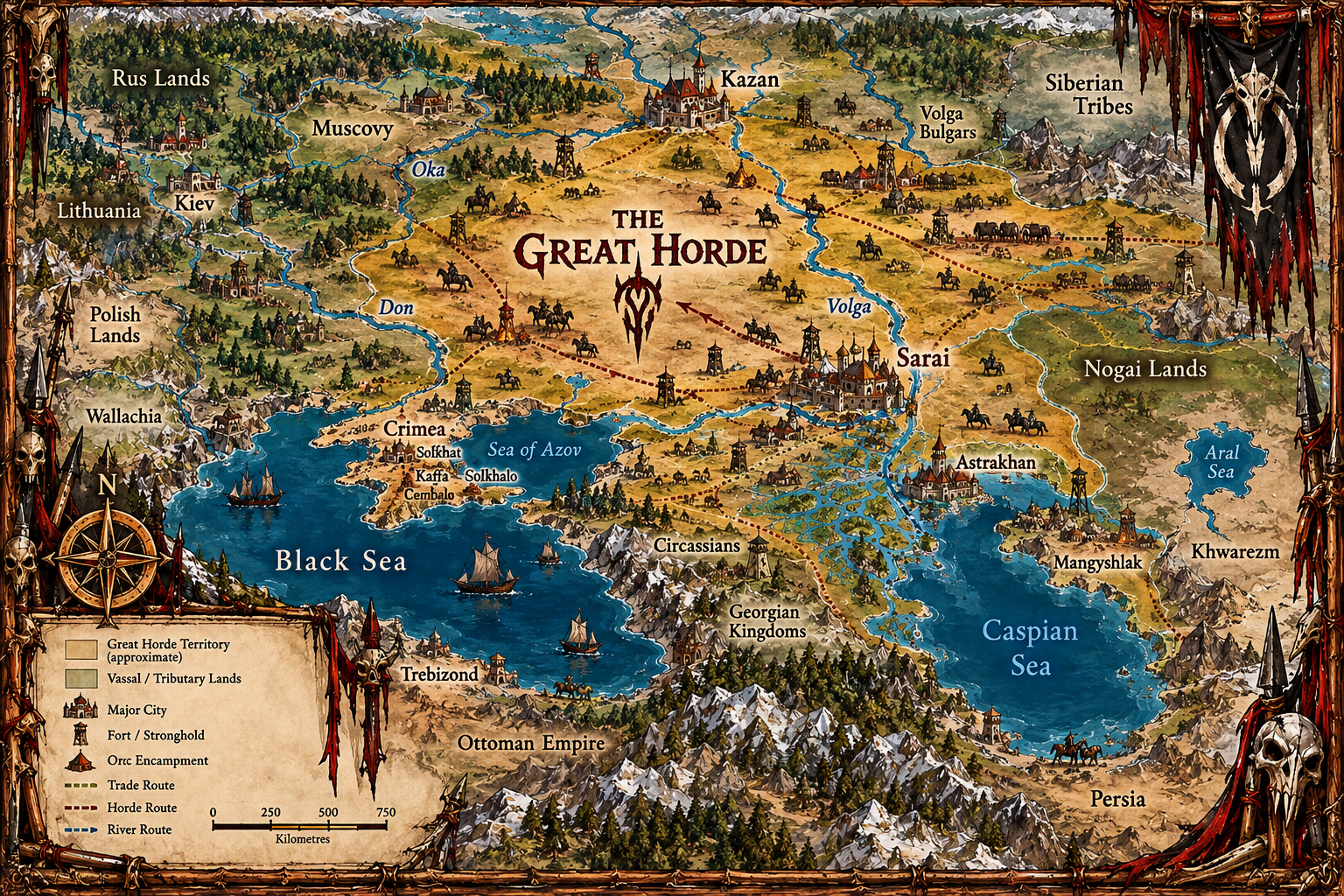
The realm’s main axis is the lower Volga, which flows south into the Caspian delta. Sarai lies on its lower course. Kazan is farther upstream on the middle Volga; the Don approaches from the west, and Nogai pastures spread eastwards. The boundaries between steppe khanates are zones of shifting allegiance and seasonal movement, not modern straight-line frontiers.
Travellers reckon the route by water and pasture: Sarai to the lower delta, upstream towards Kazan, west across the Don approaches or east into Nogai grazing country. The apparent borders on many foreign maps conceal overlapping tribute rights and seasonal claims. A captain who promises safe passage through one khan’s territory may be wrong by the next well.
Explore the Neighbouring Realms
Historical Background and Sources
Historical and campaign reference. The historical Great Horde emerged from the fragmentation of the Golden Horde, centred on the lower Volga and Sarai. Its actual rulers and populations were not orcs. Krusk Ash-Standard, Mhurak’s Great Muster, Scar-Chiefs and Gore-Riders belong to the campaign setting. The four paramount orc successor hosts remain the Eastern Fang Host, Ash-Standard Host, Red Fang Reach and Black Anvil Realm; the Great Horde is a regional khanate among their contested inheritances, not another co-equal empire. Real fifteenth-century steppe borders were fluid. The Great Stand on the Ugra River occurred in 1480 and the historical Great Horde fell in 1502; neither event has yet happened in the campaign present.
For historical context consult Encyclopaedia Britannica — Golden Horde and Great Horde — historical overview and bibliography. The campaign’s political structure follows the Empire of the Orcs and the neighbouring regional entries.
Keep this reference growing
If this page helped with your reading or game, you can support its upkeep or explore the curated books.
Explore the Bookshop — epics, classics and stories behind imagined worlds.