
Republic of Venice — The Serene Sea Power
At a Glance
| Region | Adriatic lagoon and mainland possessions in northeastern Italy |
|---|---|
| Capital | Venice |
| Ruler | Doge Francesco Foscari, elected by the republic’s ruling order |
| Government | Merchant republic with a Great Council and Council of Ten |
| Currency | Ducat and lira |
| Rivals | Milan on land; Genoa at sea |
| Character | Lawful Neutral in its public institutions; individuals range from generous rescuers to ruthless profiteers |
| Reach | Lagoon capital, Venetian mainland and strategic islands and ports of the eastern Mediterranean |
| Campaign tone | Sea voyages, rival captains, secret cargoes, recent peace and desperate choices |

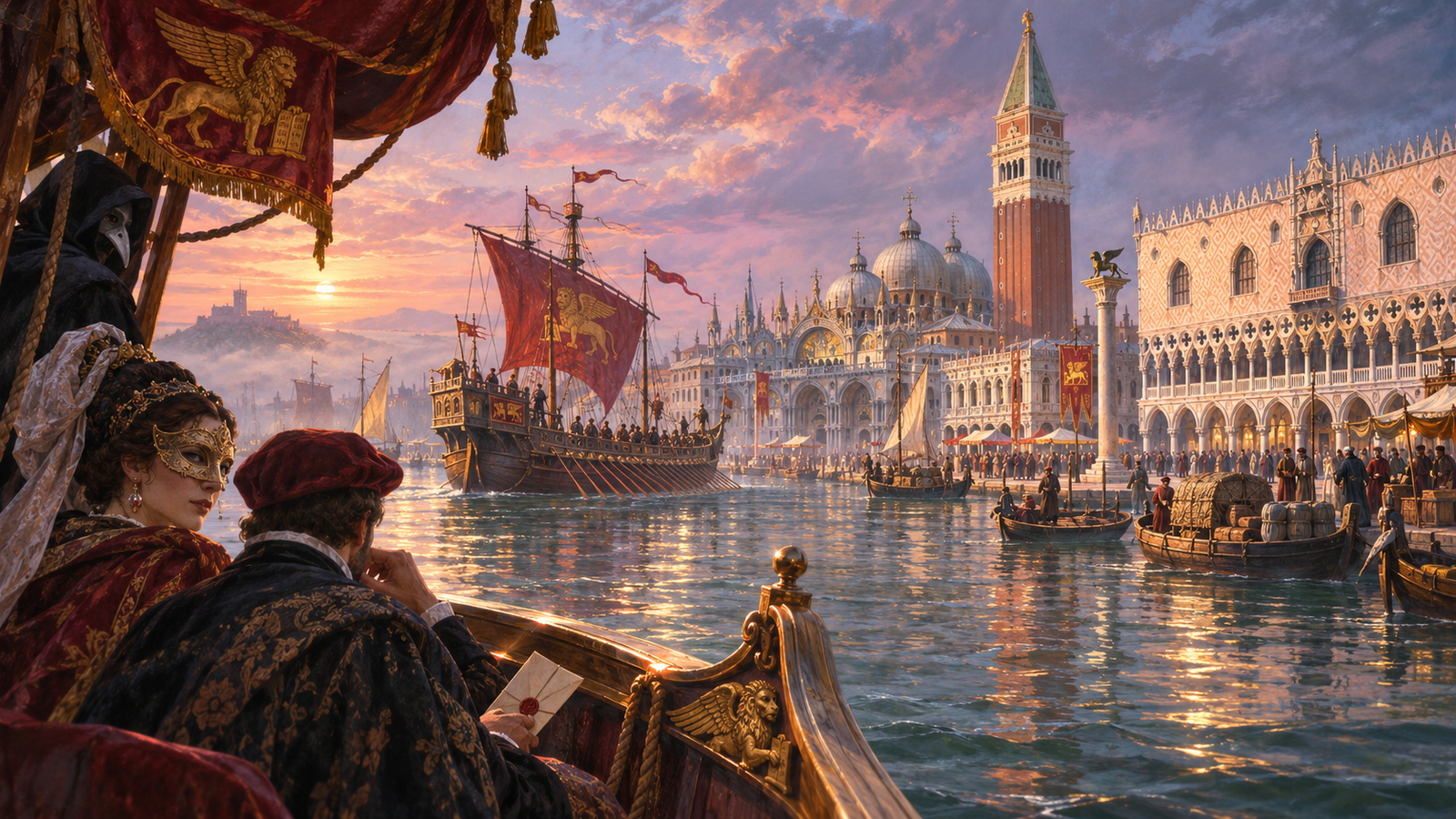
Venice looks tranquil when seen from a boat at dawn. Inside the lagoon capital, a delayed cargo can ruin a merchant house, a frightened pilot can strand a fleet, and a message from the east can turn a celebrated voyage into a desperate rescue. Doge Francesco Foscari stands between the sea trade that pays for everything and the mainland war he has just helped contain.
A galley reaches the lagoon flying the lion of Saint Mark, but its crew refuse to berth. The captain says her hold contains survivors from an eastern port. The customs clerk claims the ship carries stolen war plans. A woman on the foredeck offers the characters a sealed letter: deliver it to a missing sailor’s daughter before the harbour bell rings, and she will tell them why two ships have been following her since dawn.
What Is Happening Right Now?
There are three urgent stories in the republic. They can intersect in one session or become a whole maritime campaign. None is settled until the characters act.
Peace on the mainland
The Peace of Lodi fixes a frontier with Milan for now. Captains, displaced claimants and creditors have not forgotten the campaigns. A border tower can make a treaty feel distant.
Trade across two seas
Venetian ships and factors reach the Adriatic, eastern Mediterranean and lands linked to the great overland routes. Salt, grain, silk and information all have different escorts and different enemies.
The rival republic
Genoa competes for cargo, contacts and harbours. Both sides know a merchant vessel can carry an envoy or a spy without changing its flag.
Letters from fallen Constantinople
The Ninefold Dominion’s seizure of Constantinople has broken old assurances. Venetian families are looking for missing merchants and relatives, while captains fear that a familiar seal may now be used by an enemy. A rescued witness might know whether an eastern ship carries refugees, an infiltrator or both.
Places and People
This page covers the whole republic. For a street-level arrival and districts of its capital, continue to Venice — Capital of the Serene Republic; for the university, farms and mainland roads, visit Padua.
Great Council and Doge’s court
Foscari presides, but patrician votes and committee findings decide how far a decree travels. The Council of Ten investigates threats to the state behind guarded doors.
Rialto markets
Bankers, brokers and shipowners price cargo before it reaches a warehouse. A rumour from Crete or Genoa can change credit in an afternoon.
Arsenal and lagoon channels
Shipwrights and sailors make Venice’s power tangible. Pilots know which channels remain passable at low tide and which watchers have been paid to overlook a boat.
Artists and travellers
Marco Polo’s journeys remain a model for ambitious merchants. Patrician chroniclers, glassworkers, musicians, mapmakers and visiting scholars move through the republic’s circles of conversation and patronage; reputations travel by boat as quickly as cargo.
People Who Can Change the Voyage
Doge Francesco Foscari: an experienced ruler who wants the new peace to last without allowing Venice’s sea possessions to become helpless. He values solutions that protect ships and keep rivals uncertain. A convincing captain may get his attention; a reckless hero may be handed a dangerous mission instead.
Bartolomeo Colleoni: a formidable contracted commander, watching the roads after the settlement with Milan. He wants his men paid, equipped and ready, and will judge the party by what they accomplish rather than their titles.
Nicoleta Ziani (fictional contact): a lagoon pilot whose brother has disappeared while guiding an unfamiliar black-sailed ship. She knows shallow channels that larger crews ignore and will rescue a stranger who proves they care about her brother.
Teodoro Greco (fictional contact): an eastern merchant newly arrived with letters from relatives trapped beyond Venetian reach. He knows which messages are forged, but will lie about a smuggled passenger if the characters threaten to surrender her.
Lucia Trevisan (fictional contact): a widow financing repairs to a merchantman at Rialto. Her creditors want the ship sold; she needs it launched before a rival reveals what it carried on its last voyage. A party that helps her gains passage and a powerful enemy.
Services, Equipment and Magic
Obtain a berth, exchange coin and hire a lagoon pilot before committing a ship to narrow channels. Factors arrange letters of credit and warehouse space; shipwrights repair hulls; captains hire guards for a mainland road or passage at sea. Use Ship’s Passage for travel choices and costs, and the galley entry when an oared warship becomes part of the adventure.
At the Rialto: obtain changing currency, hire messengers, buy ship provisions, commission translation and find merchants willing to take a discreet passenger. A trusted introduction buys opportunities; it does not guarantee loyalty.
At the Arsenal: skilled carpenters, rope makers, sailmakers and armourers repair practical damage. A merchant cannot simply buy a war galley from a stall; gain the trust of a master shipwright for access to specialist materials and repairs.
Occult services: warded cargo seals, navigational charms and exorcisms can be commissioned from individuals with demonstrable gifts, not every shopkeeper or scholar. A claimed protective charm should be tested; many are merely decorative. A whispering bell hauled from the lagoon may require a genuine spellcaster, a diver, or a bargain with something beneath the mud.
Across the republic: mercenaries, healers, interpreters, couriers and guides are easier to hire in ports and university towns than at a deserted frontier tower. In Candia (Crete), local loyalties and older sacred places matter more than the promises of a stranger bearing the lion’s seal.
Dangers, Rumours and Adventure Hooks
- The missing manifest: a vessel unloads two more chests than its register allows. A Milanese envoy and a Genoese factor both claim them. One chest contains a living witness who has no wish to be found.
- The island that was empty: an informant disappears on a lagoon boat. Pilot Nicoleta swears she saw him step ashore; that island is now under water. At low tide, a stone stair opens and the missing man’s lantern still burns below.
- The frontier gun: a Venetian fort receives artillery marked as Milanese property. Returning it would expose the broker who sold it. Colleoni’s soldiers offer to escort the party, but an unpaid gunner may be selling information.
- Salt and silk: false weights ruin Lucia Trevisan’s merchant house just as creditors move to seize a ship carrying a dangerous relic. Rescue her cargo, abandon it, or learn why the relic calls to anyone who touches seawater.
- The last eastern letter: Teodoro’s letter carries three different handwritings, one belonging to a man thought dead at Constantinople. A Ninefold agent wants the paper destroyed; a refugee offers to lead the party to its author.
- The drowned bell: fishermen hear a bell ring from the silt every sunset, and each night another mooring rope is found cut. An ordinary diver can reach the bell, but the creature guarding it knows the name of an important Venetian patron.
If nobody intervenes: the ship sails before the missing witness can speak, Nicoleta’s brother remains lost, and the sealed letter is sold to the highest bidder. If the characters take sides, Venice reacts: a saved captain offers passage, a ruined merchant seeks revenge, and an exposed traitor changes the security of every later voyage.
Travel, Geography and Consequences
The lagoon and the capital: enter the city by boat through marked or known channels; shallows, fog, tides and local pilots decide whether a vessel arrives safely. The city’s dockside scenes belong in the Venice capital guide.
The mainland: Padua offers scholars and inland contacts. Roads continue through fortified Venetian possessions toward the Duchy of Milan, with captains and households still unsettled after the peace. For the larger patchwork of states use the Italy guide.
The maritime routes: galleys and merchant ships link Venice to ports along the Adriatic, islands such as Crete (Candia), and eastern trading stations. Each port has its own local people, traditions and dangers; the lion’s banner does not make a journey safe.
Rivals and contacts: the Republic of Genoa offers competitors, informants and possible allies. Experienced captains change employers; no treaty stops a smuggler, pirate or grieving relative from acting on a personal grievance.
Local expectations: pilots, shipping brokers, household patrons and paid crews matter more to most visitors than inaccessible council chambers. The republic can reward a successful expedition with work, protection or a favourable berth, but a broken promise follows a traveller from port to port.
Running the Lagoon Crossing
Use the following challenge when the party needs to reach a vessel before it sails with the missing witness. The four presentations are self-contained alternatives.
D&D 2024 — Fogbound Channel
Situation. A merchant vessel begins to leave at dusk. Fog conceals a shallow channel; the party has one chance to intercept it without alerting the pursuing craft.
Checks. DC 13 Wisdom (Survival) to identify a safe channel or DC 13 Wisdom (Perception) to follow a distant bell; a character proficient with Water Vehicles may instead make an appropriate DC 13 Dexterity check using that proficiency. Two successes before two failures achieve a clean approach. Each character describes how they help before rolling.
Success. The party reaches the merchantman unseen and can question the witness. Failure. The pursuing boat spots them; the witness’s keeper has time to move her, but she remains recoverable. A skilled pilot’s guidance grants Advantage to one relevant check.
D&D 2014 — Fogbound Channel
Situation. A merchant vessel begins to leave at dusk. Fog conceals a shallow channel; the party must intercept it before a pursuing craft finds them.
Checks. DC 13 Wisdom (Survival) to plot the channel, or DC 13 Wisdom (Perception) to keep the ship’s bell in range. A character proficient with water vehicles may use a DC 13 Dexterity check with the relevant proficiency instead. Gain two successes before two failures; explain each approach to the channel.
Success. The group reaches the merchantman unseen. Failure. Their boat is spotted and the witness is moved below deck; the party may still board or negotiate. A trusted lagoon pilot provides advantage on one relevant check.
Pathfinder 1e — Fogbound Channel
Situation. A merchant vessel leaves at dusk while a rival boat crosses fog-bound shallows. The characters must reach it unseen.
Checks. DC 15 Profession (sailor) to pilot safely or DC 15 Survival to keep a landmark bearing; DC 15 Perception reveals a warning bell or reef marker. The party needs two successful checks before two failures. Suitable magic, informed scouting and accurate charts may alter the circumstances at the GM’s discretion.
Success. The merchantman can be approached without alerting the rival boat. Failure. The rival gains an intercepting position and the witness is moved; the scene continues with boarding, negotiation or pursuit. A local pilot can attempt the primary Profession check on the party’s behalf.
D&D 3.5e — Fogbound Channel
Situation. A merchant vessel is leaving at dusk, and fog hides a shallow route between the islands. A rival craft is closing in.
Checks. DC 15 Profession (sailor) to guide the boat or DC 15 Survival to maintain direction; DC 15 Spot can find a channel marker before it disappears in the mist. Gain two successes before two failures, using different approaches or a credible change in circumstances for each attempt.
Success. The party intercepts the merchantman unseen. Failure. The pursuers notice the approach and the witness is taken below deck, creating a new obstacle rather than an unavoidable defeat. A local pilot may make the primary Profession check instead of the adventurers.
History and Sources
Venice grew from its lagoon settlements into a trading republic with a mainland state and overseas strongholds. Francesco Foscari’s long rule extended the republic’s interests and helped sustain costly wars with Milan. The Peace of Lodi in April 1454 recognised a settlement in Lombardy, including Venice’s holdings around Brescia and Bergamo and the disputed position of Crema. The peace is recent enough that commanders and their creditors remain alert for another campaign.
The republic’s sea connections reach beyond the Adriatic to Dalmatian ports, Corfu, Crete and positions farther east. Not all Greek islands are direct Venetian possessions, and local societies are never interchangeable with the merchant houses of the lagoon. The fall of Constantinople is a fresh rupture: in this world the Ninefold Dominion holds the city, disrupting Venice’s older web of contacts without determining what every eastern ruler must do next.
Historical references: UNESCO — Venice and its Lagoon; Treccani — Francesco Foscari; Treccani — the Venetian mainland; Treccani — Venice and Italian politics. The named fictional contacts, supernatural mysteries and crossing challenges above are original game material, not historical claims. The painted lion of Saint Mark is an artistic rendering of Venice’s civic emblem, not a new coat of arms.
Keep this reference growing
If this page helped with your reading or game, you can support its upkeep or explore the curated books.
Explore the Bookshop — epics, classics and stories behind imagined worlds.