
Padua — University City of the Venetian Mainland
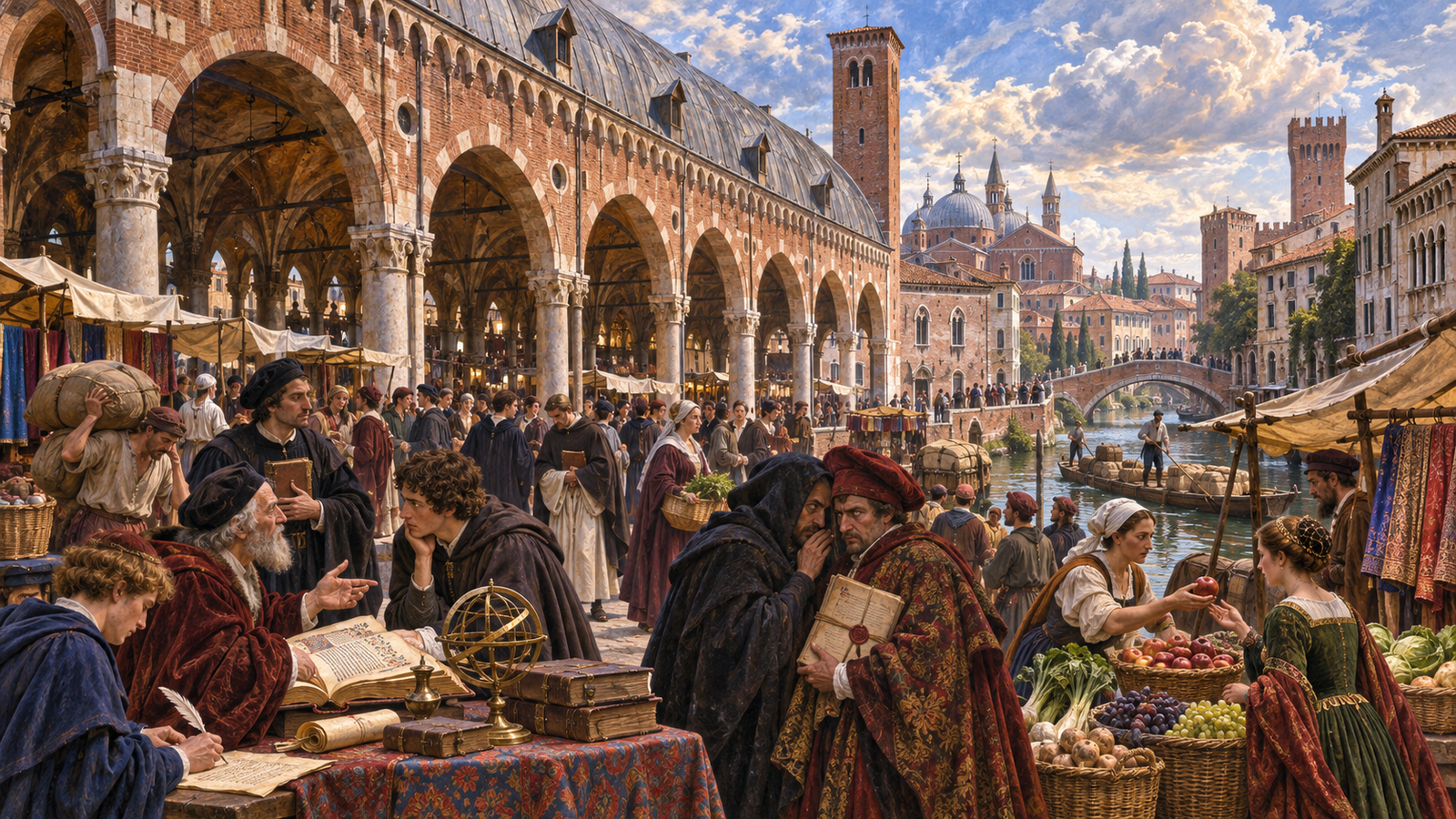
Venetian Mainland · University and Markets · 1454 CE
At a Glance
| Setting | Padua, northeastern Italy, on the Venetian mainland |
|---|---|
| Allegiance | Republic of Venice, which conquered Padua in 1405 |
| Government | Venetian-appointed podestà for civil matters and a captain for military affairs |
| Population | Probably around 20,000; mid-fifteenth-century estimates remain uncertain |
| Character | University town, markets, canals, craft workshops and rival political loyalties |
| Notable places | Palazzo della Ragione, Piazza delle Erbe, Piazza dei Frutti, university schools and medieval walls |
| Campaign themes | Disputed manuscripts, Venetian agents, university rivalries and hidden river routes |
| Campaign present | 1454 CE |

A locked manuscript chest bursts open beneath the market arcades. Three men claim the scattered pages, the porter denies knowing who hired him, and a student begins gathering the leaves before anyone can read them. Above, the great hall holds the city’s courts; beyond the market, Padua’s bridges and canals offer a hundred routes of escape.
What Is Happening Right Now?
The Peace of Lodi has brought Venice and Milan to terms in 1454. That makes the roads safer for some merchants, but peace does not settle every old grudge. The Carraresi family ruled Padua until Venice’s siege and conquest in 1405. Some households still honour the dynasty; others remember the damage of its last war. Venetian officials are determined that the city will not become a rallying point for an exiled claimant.
The university is both Padua’s greatest distinction and its sharpest source of quarrels. Venice wants subjects to study here and seeks renowned teachers, yet the 1450s are a period of difficulty for the university’s prestige and attendance. Professors compete for patrons and pupils; students choose sides in arguments that began as disputes over texts and end as accusations of dishonesty. The difference between a genuine discovery and a very clever forgery can decide a family’s fortune.
One professor has gone missing after announcing that an ancient medical manuscript proves his respected rival wrong. The bookseller who handled it claims the manuscript was stolen. A Venetian officer fears the quarrel conceals political messages. A frightened apprentice insists the missing man walked to the river with a traveller from Milan.
Places to Explore
Palazzo della Ragione — The Great Hall
The vast upper hall stands over busy market arcades. Courts sit within; below, porters and merchants wait beside shops, produce stalls and bags of grain. Its astrological paintings, restored following an earlier fire, attract visitors who study the motions of the heavens. A disputed witness can be overheard by half a marketplace before reaching the chamber where judgement is made. A faded corner of the hall’s painted calendar may be more important to an investigator than a magistrate’s lengthy speech.
Piazza delle Erbe and Piazza dei Frutti
The adjoining squares are the city’s daily stomach. Farmers arrive from the countryside with vegetables and fruit, carriers unload grain, and craftspeople offer cloth, tools and domestic wares. A market porter can tell a visitor which scholar has received a suspicious delivery, while a spice seller might know who is buying ingredients in quantities beyond an apothecary’s needs. A chase through the markets means overturned carts, blocked arcades and a crowd that demands explanations.
The University Schools
Founded in 1222, the University of Padua remains a collection of teaching spaces and scholarly communities, not yet a single grand college complex. Jurists argue from manuscripts and precedents; physicians debate the body and inherited medical authorities; scholars of arts investigate philosophy, language, mathematics and the stars. Student associations exert influence over teaching and reputation. A professor may offer knowledge freely to a promising pupil and refuse the same explanation to a wealthy stranger who arrives with armed guards.
River Landings and the Piovego
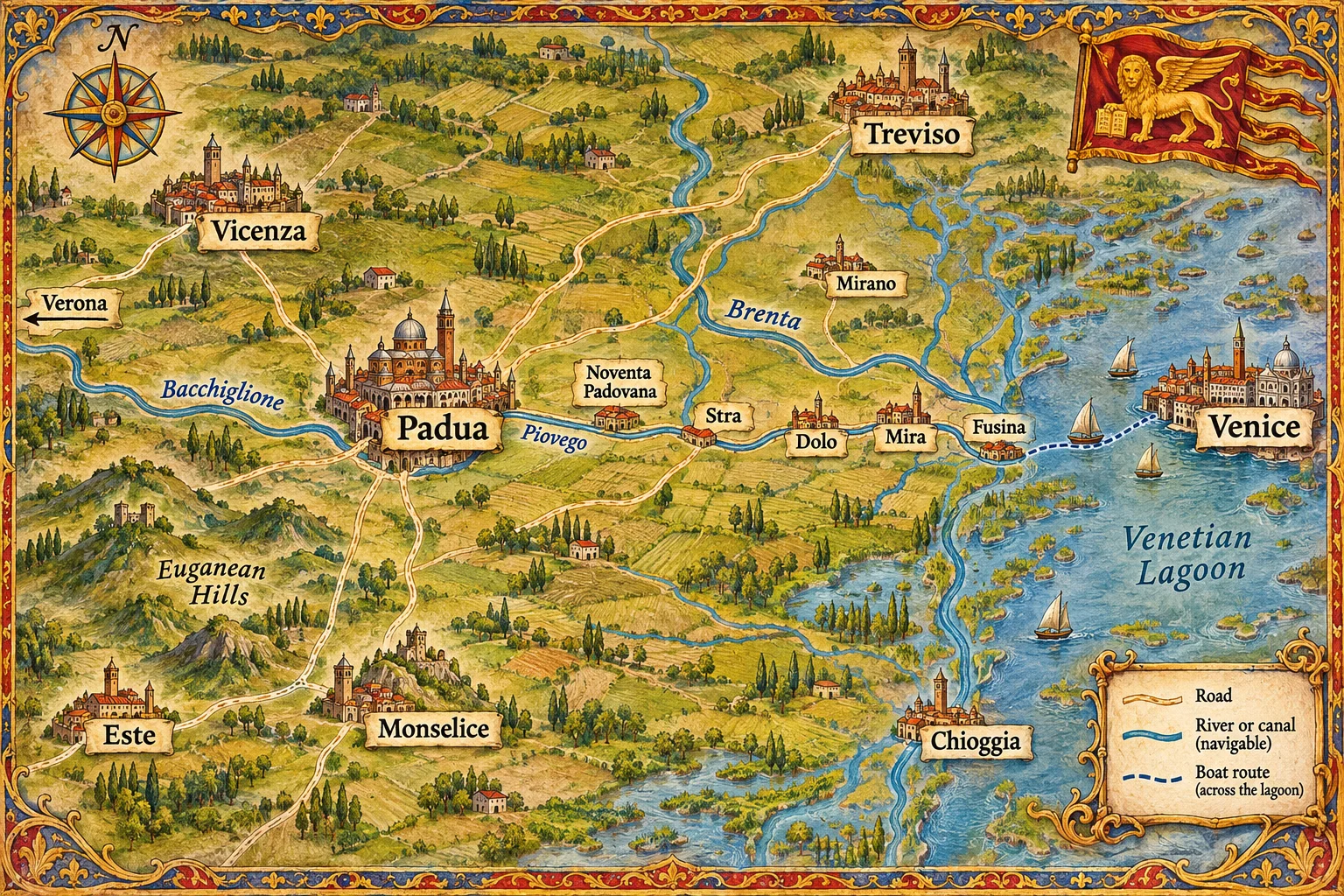
Padua’s rivers and canals are working routes, not decorations. The Bacchiglione supplies the city and its mills, and the Piovego canal connects with the Brenta system toward the Venetian lagoon. Barges carry produce, timber, craft goods and travellers. A river pilot knows which passage is shallow and which landing is privately watched. A boat can make a quiet departure at dawn, although every river household notices a stranger who refuses to name his cargo.
Medieval Walls and the Old Strongholds
Older walls and gates survive from the city’s communal and Carraresi centuries. These defences are not the great artillery-resistant Venetian ramparts of a later age. A watch captain remembers the costly siege that ended independence. In the old noble houses, servants and household stewards still know which rooms were concealed, sealed or abandoned when the rulers fell. A disgraced family might guard a hidden record out of loyalty, fear or simple pride.
People and Factions
The podestà, appointed from Venice’s ruling patriciate, directs civil government and justice. He values stability, but strict obedience can make him slow to recognise a wrongful accusation. The captain commands the city’s military affairs and cannot allow academic rivalry to become armed factional fighting. Both answer to Venetian authority rather than ruling Padua as princes.
University masters need paying pupils, supporters and access to books. Some defend their students at great personal cost; others trade scholarship for patronage. Boatmen, millers and market families feed the town and supply much of its practical intelligence. Carraresi sympathisers include harmless mourners of a lost court, wealthy former dependants and a smaller number prepared to conspire. Do not mistake every nostalgic Paduan for a rebel or every Venetian officer for a tyrant.
Lucetta dei Molini, a local grain merchant, is a fictional contact who keeps her word and knows which barges make private voyages. Tommaso Vettor, a fictional junior Venetian officer, wants evidence before arrests but has orders to stop rumours of rebellion. Marta da Este, a fictional bookbinder, can recognise a replacement page by its ink and stitching. Each has a reason to help the party, and a reason to withhold something until trust is earned.
Authority in Padua tends towards orderly obedience, while the university prizes argument and independent judgement. Neither position alone makes a person virtuous. The lawful magistrate who protects a witness may be a stronger ally than the charming scholar who steals the witness’s testimony to win a dispute.
Markets, Shelter and Useful Services
Padua offers inns, stables, carts, barge passage, physicians, apothecaries, scribes, parchment, bookbinding and the services of professional interpreters. Scholars can identify scripts, weigh medical claims and examine inscriptions; they may also demand an introduction or ask to keep a puzzling document overnight. Boatmen can arrange movement towards Venice, and market traders know how to send goods across the countryside without advertising their owner.
Visitors seeking a particular master should ask where he teaches rather than expecting every lesson to take place in one university hall. Personal recommendations matter, especially for rare books and private healing. An honest artisan can be a better guide than a famous patron who has never walked along the working quays.
Magic and Learning
Some learned healers employ genuine curative or protective magic; others rely on medicine, herbs, calculation or impressive but empty claims. Diviners and students of celestial motion compete to explain unusual signs. Enchanted objects receive careful scrutiny because a costly fake can ruin the reputation of anyone who recommended it. Access to rare magic depends on trust, skill and personal obligations, not on a public list of spells for sale.
One mystery focuses on a restored astrological figure in the Palazzo della Ragione. A visiting scholar maintains that it carries the wrong emblem. An old drawing in a private household seems to support him, but the drawing is written on parchment that belongs to a more recent manuscript. Uncovering who changed which image may expose a forgery—or a deliberate attempt to preserve knowledge that powerful people wanted erased.
Dangers and Adventure Hooks
- The Missing Master. A lecturer vanishes before presenting an important medical text. His students demand a search; an officer believes he has defected to a Milanese patron. An apprentice has the only surviving copy of the disputed page but does not know how valuable it is.
- The Altered Star. An unknown hand has changed a detail in the great hall’s painted heavens. The grandson of an old restorer receives threatening notes, and two book dealers bid for the same sketch. The clue leads to a sealed chamber in a former Carraresi household.
- The Last Prisoner of the War. A veteran returns after years away to claim an inheritance. His evidence is real, but his witness is a suspected conspirator. A quiet settlement could restore the family’s livelihood; a careless arrest could turn a grievance into another rebellion.
Travel and Wider Geography
Roads east and the waterways of the Piovego and Brenta lead towards Venice and the Adriatic. Westward roads cross the plain through Vicenza towards Verona; southward lie the Euganean Hills and the lands around Este; other routes lead towards Treviso and the Alpine corridors. The pace of a barge depends on the current, its crew and its cargo, while roads become difficult after heavy rain.
Padua is a mainland possession of the Republic of Venice. The Italy guide describes its neighbours, and Milan remains important to the politics of the new peace. Travellers with a legitimate purpose usually have more to fear from theft, a false guide or an unreliable bridge than from a grand political plot.
Deeper History
Padua’s Roman past, medieval commune, influential artistic patrons and renowned university long predate Venetian conquest. The Carraresi ruled the city until 1405, when a severe siege and the Republic’s victory ended the dynasty’s independence. Venice placed its own civil and military rectors in Padua while local councils and families retained influence over daily affairs.
The university was founded in 1222 and had distinct communities of law scholars and students of arts and medicine. Venetian support sustained its reputation, though it experienced a difficult period in the 1450s before a later revival. The great hall, its restored celestial paintings, older city walls and working medieval canals already belong to this world. The named local contacts and specific mysteries above are fictional adventures placed in a historically grounded setting.
Historical Sources and Image Credit
University of Padua: the fifteenth century · Italian State Archives: Podestà of Padua · Padua civic history, medieval hall and walls · Historical study of the siege of 1405. Civic arms are the site’s existing Padua image.
Keep this reference growing
If this page helped with your reading or game, you can support its upkeep or explore the curated books.
Explore the Bookshop — epics, classics and stories behind imagined worlds.