
Vienna — City of the Danube and the Habsburgs
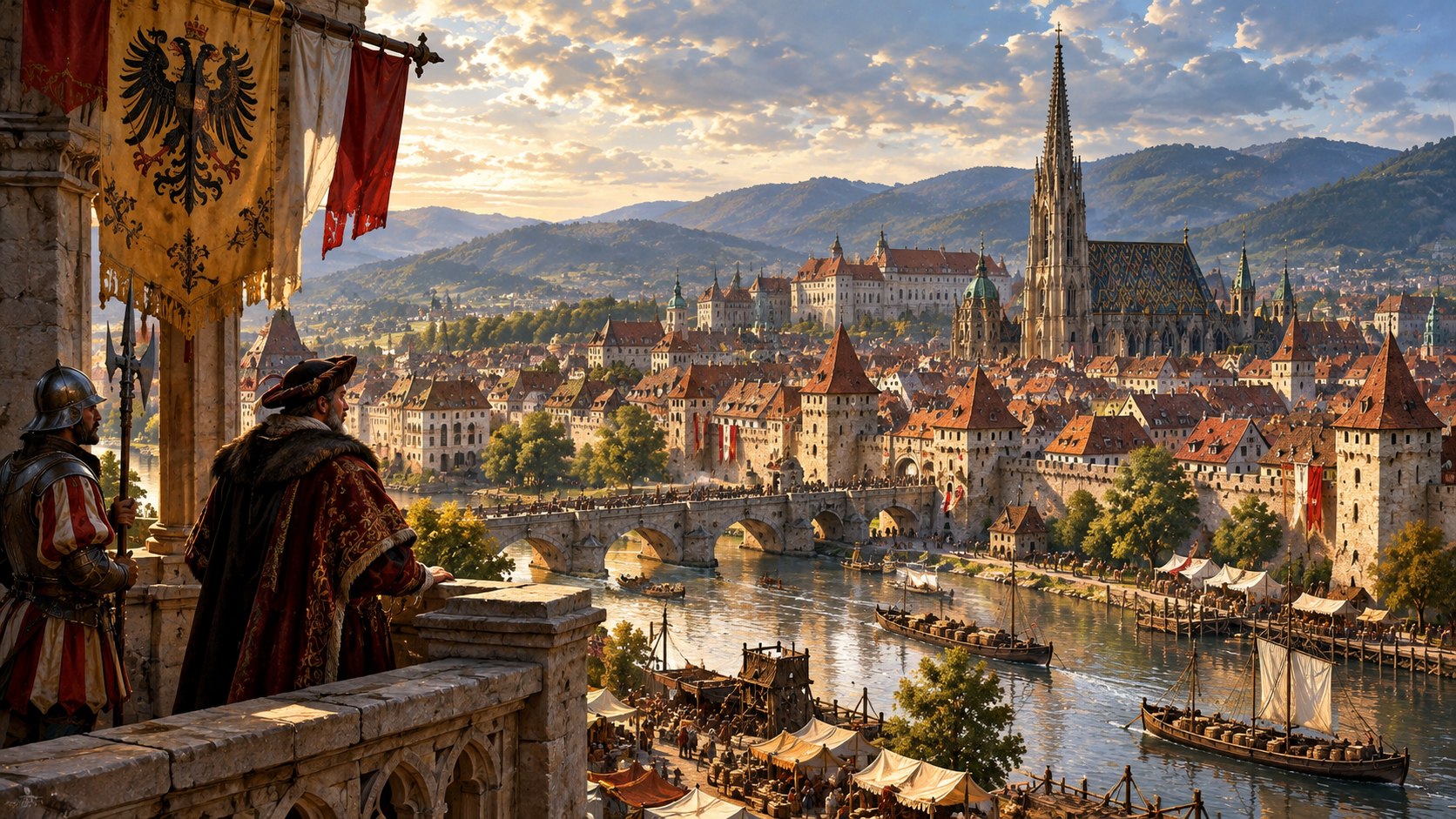
Walled Habsburg city • Danube commerce • Contested charters and courts
At a Glance
| Realm | Archduchy of Austria, a state of the Holy Roman Empire |
|---|---|
| Settlement | Major walled city and ducal centre |
| Population | Approximately 20,000–25,000 residents, including the communities beyond the walls |
| Dynastic ruler | Ladislaus the Posthumous |
| Mayor | Oswald Reicholf, with the council |
| Imperial influence | Emperor Frederick III |
| Languages | German dialects, Hungarian, Czech, Latin and merchants’ tongues |
| Trade | Danube tolls, wine, grain, textiles, salt and metalwork |
| Character | Guild privileges, scholars, guarded politics and river commerce |
| Dangers | Intrigue, contraband, false seals and court factionalism |
At the meeting of the Danube roads and the waterways leading east, Vienna watches the passage of people, coin and secrets. Barges push towards guarded landing places; porters quarrel over weights; messengers carry contradictory orders from rival courts. Inside the walls, a narrow lane can lead from a busy market to a guild hall or an audience chamber where a seal is worth more than a sword.
This is a city of privileges, not the capital of the entire Holy Roman Empire. The young Ladislaus holds the Austrian inheritance, but burghers, noble houses, guild masters and the estates protect rights of their own. A character with the wrong patron can be detained before a blade is ever drawn.
What Is Happening Right Now?
The young duke’s authority is contested. Ladislaus has emerged from Frederick III’s guardianship, but powerful advisers now argue over offices, charters and access to his household. A routine garrison appointment could draw three incompatible claims of lawful authority.
The emperor’s agents are active. Frederick III, crowned emperor in 1452, still has allies, debts and ambitions in the Austrian lands. Serving the emperor, the duke and Vienna’s council are not the same obligation.
The river brings secrets. Customs officers are investigating discrepancies in the freight records. A missing ledger, a forged seal or an unidentified prisoner aboard a barge could lead from the landings to the Hofburg and beyond.
Places Adventurers May Visit
The Hofburg — Fortress and Court
The ducal residence is still a medieval fortress of towers, gates, walled yards and private chambers, not the enormous palace of later centuries. Officers guard the approach to Ladislaus’s household; servants know when a messenger is lying. A lost charter here can ruin a noble family.
The Great Spire and Its Quarter
A mighty Gothic tower rises over narrow lanes, stonecutters’ yards and civic ceremonies. Nearby sacred halls, local shrines and household rites honour the many powers of the city. The spire guides travellers through fog even when the streets beneath it are confusing.
Hoher Markt and the Guild Streets
Weights and measures are checked in the market. Goldsmiths, cloth sellers, wine merchants and metalworkers protect their crafts and privileges. A counterfeit seal or stolen guild die is more than a petty theft.
The Duke’s College and Scholars’ Houses
Vienna’s university was founded in 1365. Near the Stubentor, university rooms, book dealers and lodgings host scholars of law, medicine and philosophy, along with students of arcane traditions. A disputed manuscript may have a legal owner, a magical guardian and several ambitious buyers.
Gates, Quays and Watch Posts
The Kärntner Tor, Stubentor and other gates control busy roads. City guards question strangers with weapons or unusual cargo. River pilots, customs clerks and ferrymen watch the landings and know who arrived before dawn.
Werd and the Riverside Workshops
Beyond the inner waterways stand timber yards, warehouses and craftspeople’s dwellings. The established dwarven community works in workshops and counting houses along these riverside routes. This is not yet the later, built-up borough known as Leopoldstadt.
People and Powers
Ladislaus the Posthumous
The young Habsburg ruler is the centre of competing expectations. His claims in Austria, Hungary and Bohemia command respect but not automatic obedience. The characters can reach him only through guarded corridors, letters of introduction or extraordinary events.
Mayor Oswald Reicholf
Vienna’s civic mayor for this year defends municipal rights, revenues and public order. He is not the ruler of the duchy. An adventurer carrying a convincing freight ledger may gain his attention faster than one offering grand threats.
Emperor Frederick III
The emperor’s agents can offer patronage or dangerous obligations. Frederick III retains influence, but his imperial dignity does not make Vienna his uncontested personal capital.
The Council, Guilds and River Companies
Merchant houses finance barges and armed escorts; guild wardens defend charters; university masters claim scholarly protections. Dwarven workshops compete and cooperate with human artisans. None is wholly united, and each offers possible patrons or enemies.
Magic, Markets and Services
Supplies, lodging, farriers, skilled metalworkers, merchants, notaries and river pilots can be found here. Access to expensive goods depends on references as much as coin. Customs officers may demand proof of ownership, an inspection fee or a charter before releasing a valuable cargo.
Enchanted items pass through trusted artisans, private collectors, specialist merchants and patrons rather than standing openly in every marketplace. A major commission may require rare materials and months of labour. University scholars can research a cryptic inscription or lost document, but the price may be access to what the characters discover.
Learned healers, herbalists and temple practitioners serve different communities. Households maintain their own divine and ancestral traditions; Vienna has no single compulsory universal faith. Using magic against a citizen without permission can bring the watch, however well-intentioned the caster believes the spell to be.
Peoples, Languages and Customs
German dialects dominate the everyday speech of Vienna. Merchants from Bohemia, Hungary, the Alpine lands and Italy bring other languages and trading practices. Dwarven families are established among metalworkers, freight agents and counting houses on the riverside; halfling travellers and smaller numbers of elves and gnomes appear through trade, scholarship or patronage. Their communities should be treated as people with homes and obligations, not scenery.
Guild feasts, ancestor observances, river offerings, household altars and shrines to different gods coexist with formal civic rites. Contracts and oaths are taken seriously; a traveller should find out whose witness is expected before binding themselves to an agreement.
Dangers and Adventure Hooks
The Counterfeit Seal
Clue. Two authentic-looking warrants order opposite things at a city gate. Complication. One messenger is protected by an important courtier. Choice. Denounce the forgery publicly and risk a riot, or seek proof quietly before the magistrates close the gates.
The Missing River Ledger
Clue. A customs clerk disappears after recording a barge that supposedly unloaded nothing. Trail. Its papers belong to a respectable merchant house; its hold contained a chained stone coffer. Stakes. Delay allows the vessel to pass east beyond the council’s reach.
Blue Fire Beneath Werd
Clue. A dwarven forge burns blue after midnight, and a nearby cellar cracks open. Complication. Rival guild officers accuse one another of sabotage. Choice. Save the quarter, secure the chamber or protect the person who opened it.
The Scholar’s Manuscript
Clue. A university master vanishes, leaving notes describing a meeting that has not happened yet. Complication. Two court factions want the book for opposing purposes. Stakes. The next ducal audience is only days away.
Three Oaths at the Hofburg
Clue. A messenger carries three sealed letters for three rivals. Problem. All contain truthful information that makes the other letters dangerous. Consequence. The watch receives instructions to arrest the courier unless the characters reach a trusted patron first.
Travel, Law and Practical Matters
| Subject | What Travellers Should Know |
|---|---|
| Danube passage | Heavy cargo moves by barge under river pilots and toll collectors. Upstream passage needs more labour and time. |
| Westward roads | Roads toward the Bavarian duchies carry merchants, couriers and escorts. Letters of passage matter. |
| Eastern routes | Boats and roads connect with Hungary and Buda. Border politics can complicate permits. |
| Northward roads | Routes toward Bohemia and Prague cross jurisdictions with different loyalties. |
| City gates | Armed strangers, unusual beasts and valuable cargo may be inspected, especially after dark. |
| Money and lodging | Markets and inns serve travellers, but reputable houses may require references. Weights and coinage are checked. |
| Beyond the walls | Vineyards, gardens, mills, riverside dwellings and roads offer cover, but the council’s watch still has influence. |
Deeper History
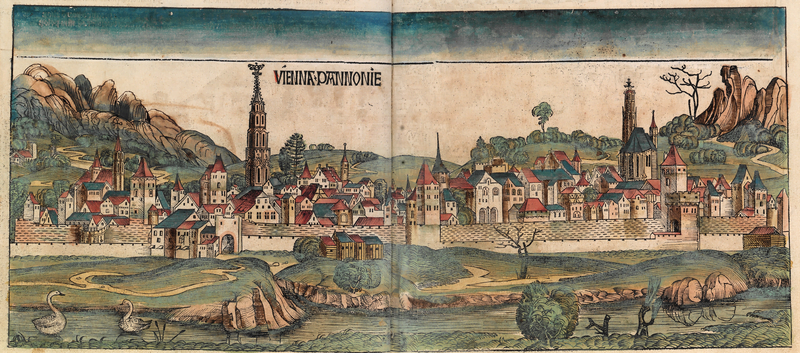
Vienna’s wealth long predates the current succession disputes. Medieval walls protect a city enriched by Danube traffic, merchants’ privileges and the right to require passing traders to offer goods for sale locally. Guilds, magistrates and noble households have a long habit of defending their rights, even against a strong dynasty.
The Habsburgs took possession of Austria in the thirteenth century. The university, founded in 1365, later made learning and legal knowledge additional sources of urban influence. Ladislaus was born in 1440, after his father’s death. Frederick III acted as guardian until pressure from the Austrian estates compelled him to surrender the boy in 1452. Vienna now feels the political consequences of his release.
Within the walled city, workshops and counting houses press against great halls and towered fortifications. Wine cellars and toll ledgers matter as much as courtly splendour; merchants and magistrates defend their privileges against any prince who demands too much.
Map of Medieval Vienna
Illustrated City Map
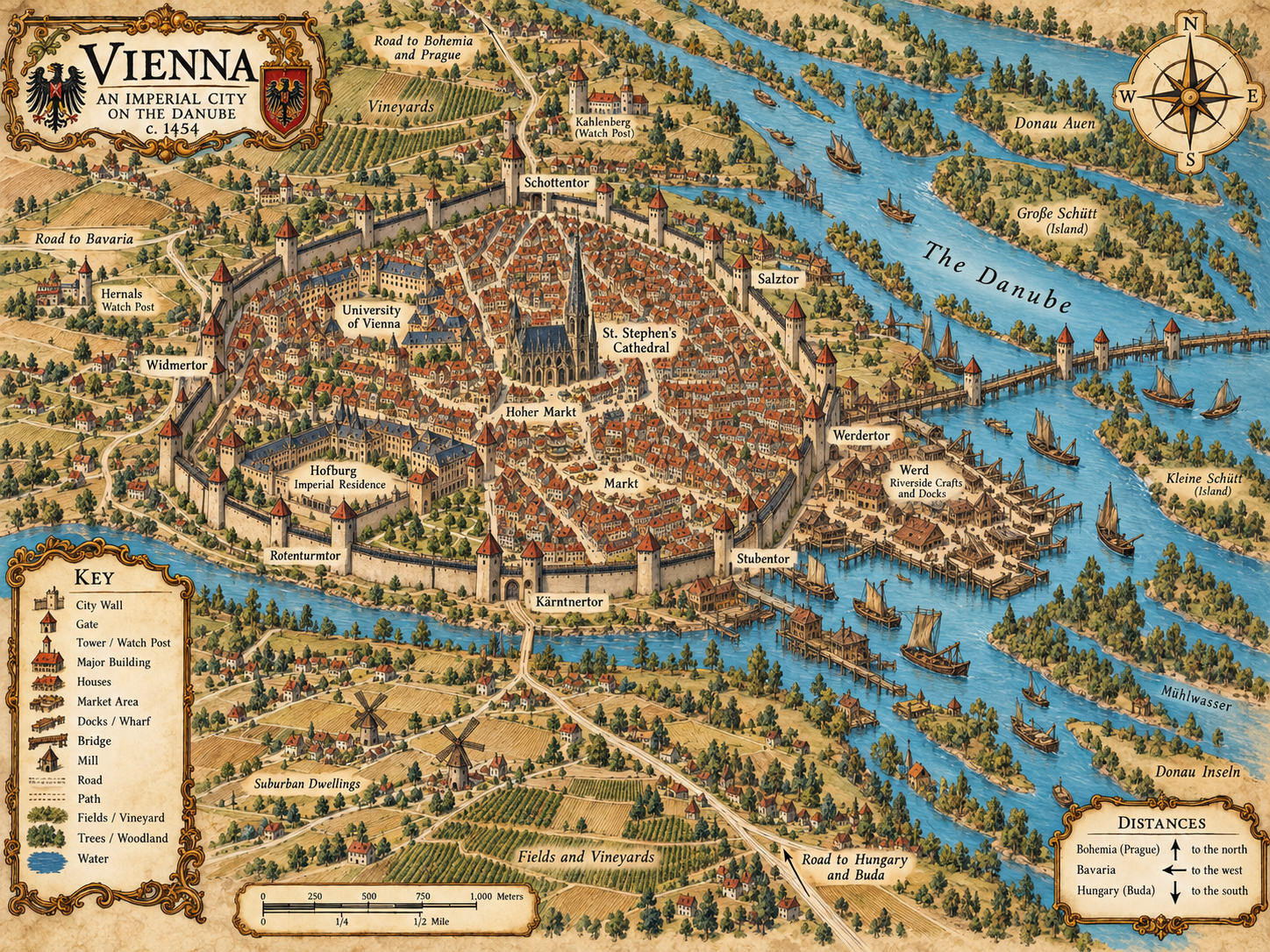
The fortified heart of Vienna is approached through guarded gates, crowded streets and busy river landings.
The walls and gates organise arrivals and pursuit. The Hofburg serves political intrigue, the river landings smuggling and reconnaissance, the market guild disputes, and the riverside workshops investigations outside the walls. The city’s later Ringstraße and modern district plan do not exist here.
Historical Sources and Image Credits
- City of Vienna — medieval walls, trading privileges and the Danube.
- The World of the Habsburgs — Ladislaus, Frederick III and the contest over guardianship.
- The medieval Hofburg — early palace and fortress layout.
- University of Vienna — its foundation and medieval college.
- Wien Museum, Albertinian Plan — historical city plan, CC0.
- Historical city woodcut: Nuremberg Chronicle (1493); original site artwork preserved alongside the city’s history.
Vienna’s troubles come from disputed oaths, trade and dynastic rivalry; no invading army now stands before its walls.
Keep this reference growing
If this page helped with your reading or game, you can support its upkeep or explore the curated books.
Explore the Bookshop — epics, classics and stories behind imagined worlds.