
Tweedledum and Tweedledee — The Mirror Twins
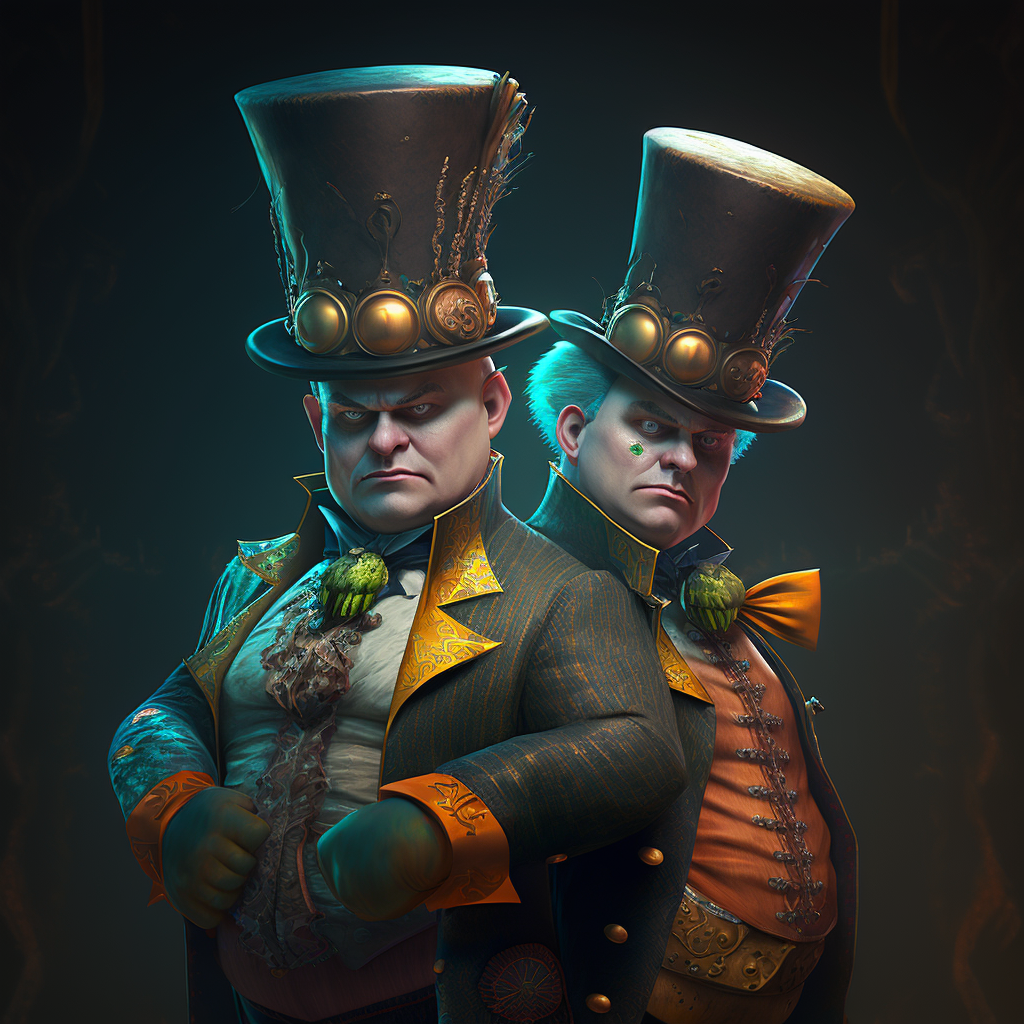
Tweedledum and Tweedledee are not travellers from a future century. They belong to a part of the Otherworld where stories arrive before books do. The twins step through mirrored water, polished metal, dream corridors and doors that open onto the wrong side of a room.
They turn argument into geography. Two contradictory directions may both lead to the same place. A ritual dispute can become binding law. A question asked badly may receive two perfectly accurate answers that solve nothing.
At a Glance
- Names: Tweedledum and Tweedledee
- Species: Fey
- Home: A Looking-Glass region of the Otherworld
- Role: Guides, riddlers, ritual combatants and living contradictions
- Alignment: Chaotic Neutral
- Campaign status: Active whenever the correct boundary is crossed
- Campaign use: Otherworld guides, comic obstacles, puzzle NPCs, strange allies or guardians of a threshold
Game Statistics
5.5e / 2024
Use the following statistics for each twin.
Tweedledum / Tweedledee
Medium Fey, Chaotic Neutral
Armor Class 15
Hit Points 52 (8d8 + 16)
Speed 30 ft.
| STR | DEX | CON | INT | WIS | CHA |
|---|---|---|---|---|---|
| 14 (+2) | 14 (+2) | 14 (+2) | 13 (+1) | 14 (+2) | 17 (+3) |
Saving Throws Wis +4, Cha +5
Skills Deception +5, Performance +5, Persuasion +5, Insight +4
Languages Common, Sylvan
Challenge 3 (700 XP; PB +2) each
Traits
Paired Logic. While the twins are within 30 feet of each other, both have Advantage on Wisdom saving throws and cannot be magically compelled to attack one another.
Contradictory Truth. When a creature asks a direct question, each twin can answer with a different statement. Both may be literally true. A creature that succeeds on a DC 14 Insight check can identify what assumption makes the answers compatible.
Story Boundary. The twins can recognise portals, dream-roads and Otherworld thresholds within 60 feet even when those boundaries are invisible.
Actions
Quarterstaff. Melee Attack Roll: +4, reach 5 ft. Hit: 6 (1d8 + 2) Bludgeoning damage.
Ritual Challenge (Recharge 5–6). One creature within 30 feet must make a DC 13 Wisdom saving throw or be compelled to answer a challenge, riddle or stated rule before willingly moving more than 30 feet away. The effect ends after 1 minute or when the creature fulfils the challenge in good faith.
Reaction
No, the Other Way. When a creature within 30 feet makes an Investigation or Survival check, one twin can impose Disadvantage unless the creature first states exactly what it is trying to find.
Tweedledum and Tweedledee — 5e / 2014
Two separate Medium fey, chaotic neutral
Armor Class 15 each; Hit Points 52 (8d8 + 16) each; Speed 30 ft.; Challenge 2 (450 XP) each; proficiency bonus +2. If both are present, calculate encounter difficulty for two combatants.
STR 14 (+2), DEX 14 (+2), CON 14 (+2), INT 13 (+1), WIS 14 (+2), CHA 17 (+3).
Saving Throws Wis +4, Cha +5; Skills Deception +5, Performance +5, Persuasion +5, Insight +4; Senses passive Perception 12; Languages Common, Sylvan.
Traits
Paired Logic. While within 30 feet of one another, the twins have advantage on Wisdom saving throws and cannot be magically compelled to attack one another.
Contradictory Truth. Each twin may offer a different literally accurate answer to the same question. A DC 14 Wisdom (Insight) check recognises a shared assumption that makes the answers compatible, if evidence supports it.
Story Boundary. A twin senses an Otherworld doorway within 60 feet, but this sense does not identify its destination, danger or means of opening it.
Actions
Quarterstaff. Melee Weapon Attack: +4 to hit, reach 5 ft., one target. Hit: 6 (1d8 + 2) bludgeoning damage.
Ritual Challenge (Recharge 5–6). One creature within 30 feet that understands the twin must make a DC 13 Wisdom saving throw or be charmed until the end of its next turn. While charmed this way, it cannot willingly move more than 30 feet away without answering a simple riddle or challenge. The effect ends early if either twin harms it.
Reaction
No, the Other Way. When a creature within 30 feet makes an Intelligence (Investigation) or Wisdom (Survival) check, one twin may impose disadvantage on the check unless the creature states a specific goal. The creature must be able to hear and understand the twin.
Original 2014 rules conversion for two distinct fey characters. Existing edition panels and their Otherworld adventure hooks remain unchanged.
Pathfinder 1e
Tweedledum and Tweedledee CR 4 each; fey expert 4/brawler 2; CN Medium fey. AC 18; hp 44 each.
Skills Bluff +12, Perform (comedy) +12, Sense Motive +11, Knowledge (planes) +10. Special teamwork benefits while adjacent or within 30 ft., detect portals, confusion-like riddle effect 1/day.
D&D 3.5e
Tweedledum and Tweedledee CR 4 each; fey expert 4/fighter 2. AC 17; hp 38 each. Feats Combat Expertise, Improved Trip, teamwork-themed feat. Skills Bluff +11, Knowledge (the planes) +10, Perform +11, Sense Motive +10.
What Are the Twins Doing Right Now?
A mirror-road has opened beneath a flooded lane outside London, and the twins are standing on the other side arguing about whether travellers entering from England are arriving or leaving.
They know the road eventually reaches the same strange region now touching the household guarded by Mary Poppins, but they refuse to explain the route until someone settles a dispute about which twin spoke first.
Meeting Tweedledum and Tweedledee
The twins treat strangers as participants in a game already underway. They may ask for a ruling, announce a rule nobody heard, or insist the party has broken a promise made in a dream.
The useful trick is to take their words literally without assuming they use ordinary logic.
Encounters
- The twins stand on opposite sides of the same doorway and insist both are guarding the entrance.
- A bridge across an Otherworld stream exists only while the party continues an argument the twins began.
- One twin gives the correct route while the other gives the correct warning; neither will say which is which.
- A ritual challenge looks like a comic quarrel until the surrounding landscape begins obeying its rules.
- The twins recognise an object carried by the party from an encounter that has not happened yet.
Appearance and Manner
The twins resemble one another closely but are not perfectly identical. They wear matching, slightly exaggerated late-medieval clothing in reversed patterns, as though each were the reflection of the other. Their expressions shift rapidly between solemn ritual and childish delight.
Personality
Argumentative, theatrical and literal-minded, the twins are not malicious. They simply inhabit a place where rules have physical consequences and find mortal assumptions endlessly funny.
Relationships
Each other: inseparable rivals who define themselves through disagreement.
Mary Poppins: the twins treat her with unusual caution, suggesting previous encounters she declines to explain.
Otherworld travellers: temporary referees, audiences, opponents or witnesses.
Equipment
- Matching quarterstaves
- Small rattles, counters and game pieces whose rules change by scene
- Reversed maps that make sense only when viewed in a mirror
- Tokens marking promises, challenges and debts of courtesy
Running the Twins at the Table
Keep their riddles playable. Every contradiction should have a discoverable assumption behind it, and their rules should be strange but consistent once stated. The humour comes from logic pushed sideways, not from withholding information arbitrarily.
Adventure Hooks
- The Flooded Mirror: the twins know which reflection leads home, but only one is willing to answer.
- The Battle Before Breakfast: they insist a ritual duel must occur before negotiations can begin.
- Tomorrow’s Introduction: the twins greet the party by name and complain about something the adventurers have not done yet.
- The Reversed Map: a route through the Otherworld is correct only when every instruction is read as its opposite.
- Mary’s Warning: Mary Poppins tells the party not to accept gifts from either twin unless both agree on what was given.
Connected Places and Realms
Mythical and Historical Context
Tweedledum and Tweedledee appear as characters in Lewis Carroll’s Through the Looking-Glass (1871), inspired by an older nursery rhyme. They are literary and folkloric characters rather than documented people of 1454. Within this campaign, the twins are independent fey inhabitants of mirror paths and story-bound territories; their logical disputes are clues, not automatic mind control. Read the original Through the Looking-Glass for the literary origin. Their playable encounter mechanics and linked Otherworld locations are original.
Literary Inspiration
Tweedledum and Tweedledee come from Lewis Carroll’s Looking-Glass stories. This version treats them as timeless Otherworld figures whose story can intersect the campaign without requiring mortal chronology to match their publication history.
Rules Notes
The game statistics, riddle mechanics and campaign relationships are original adaptations for the stated rules editions.
Sources and Adaptation
Adapted from the public-domain nursery-rhyme tradition and Lewis Carroll’s public-domain Through the Looking-Glass. The campaign version develops the twins independently of later copyrighted visual and screen interpretations.
Keep this reference growing
If this page helped with your reading or game, you can support its upkeep or explore the curated books.
Explore the Bookshop — epics, classics and stories behind imagined worlds.