
Nessus — The Deepest Rift
Nessus is the deepest Perdition and the seat of infernal sovereignty: a shattered realm of immense ravines, dead stone and guarded depths dominated by Malsheem, the Citadel of Hell, from which Asmodeus rules the Nine Perditions.
The Ninth Perdition
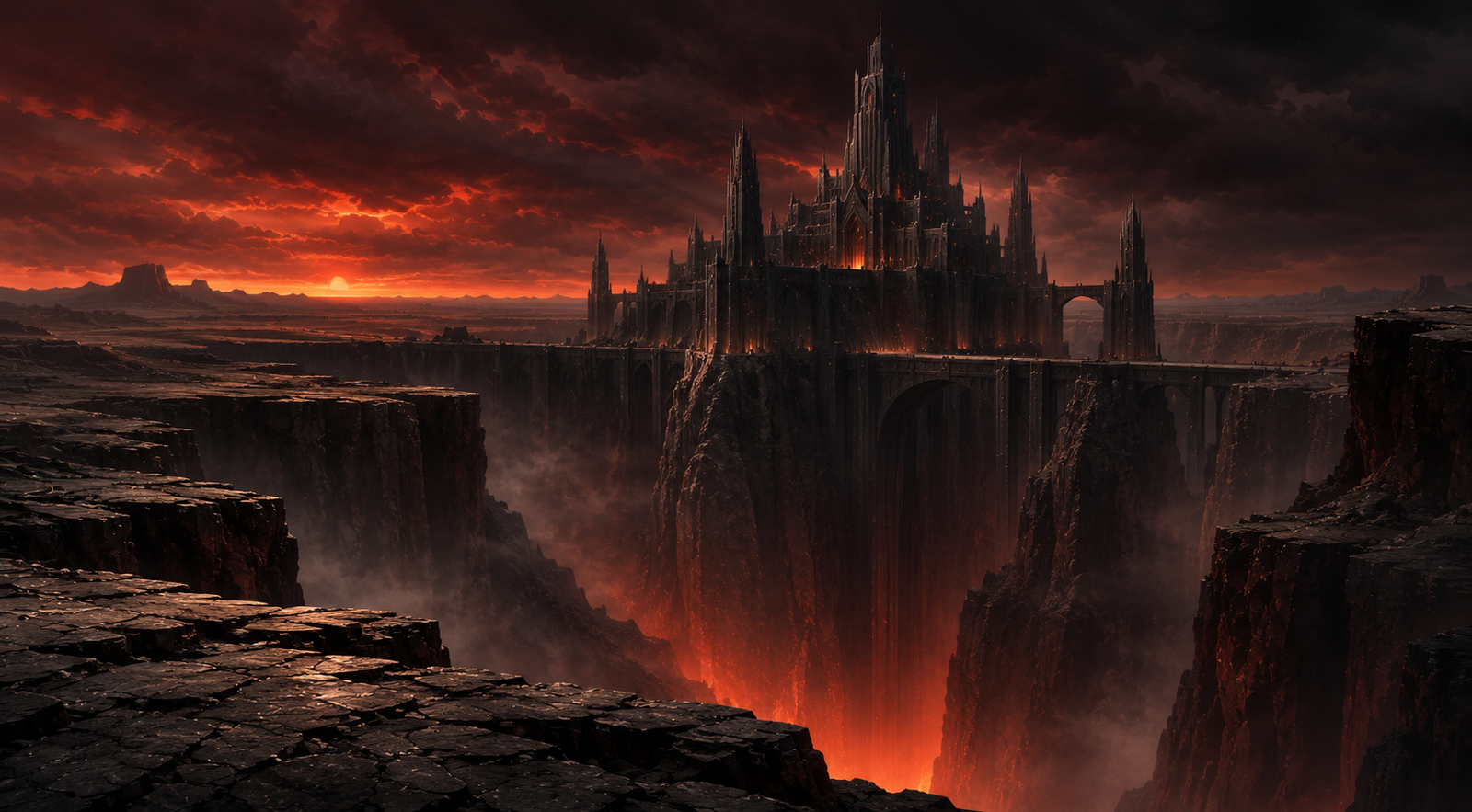
Nessus is a shattered plain divided by pits, ravines, canyons and trenches of extraordinary depth.
Some descend thousands of miles through undifferentiated dead stone. Many appear natural, while others look as though they were cut or blasted into the landscape by forces of immense power.
The ground between the rifts can appear almost empty, but this is not wilderness beyond the reach of Hell. Nessus surrounds the seat of Asmodeus, and important routes through the broken land are watched, defended or controlled.
The most politically important rift lies immediately below the boundary with Cania . Malsheem rises from this immense trench, making the final descent through Hell an approach toward the fortress of its supreme ruler.
Rumours speak of a hidden tributary of the River Styx somewhere in the depths of the Ninth. Existing accounts themselves are uncertain, so its course and even its existence remain disputed.
Nessus is dangerous because of its geography, inhabitants, fortifications and political importance. It does not impose a blanket alignment change, universally modify magic or automatically transform those who enter.
The Great Rifts
Immense fissures divide the plain and make direct movement difficult without bridges, flight, magic or recognised crossings.
The Dead Plain
Bleak expanses of rock stretch between the chasms, broken by guarded approaches and infernal works.
The Guarded Deep
Reaching the Ninth does not grant freedom of movement through territory surrounding Malsheem and the forbidden depths below.
Asmodeus and the Government of Hell
Asmodeus
Lord of the Ninth · Overlord of HellAsmodeus is the recognised Lord of Nessus and the supreme ruler of Hell.
The Lords of the other eight Perditions possess immense authority within their own territories, but those lordships exist within the wider infernal order over which Asmodeus presides.
From Malsheem he deals with the highest matters of infernal rule: the conduct of the Lords, appointments, central institutions, major disputes and affairs affecting Hell as a whole.
Nessus is therefore both Asmodeus’ personal Perdition and the territory surrounding the seat from which the wider infernal state is governed.
Lord of Nessus
Asmodeus directly rules the Ninth in addition to his wider authority over Hell.
Overlord of Hell
The other Lords are great territorial rulers, but none is a sovereign equal standing outside the authority of the Ninth.
Malsheem
The Citadel of Hell is the place most closely associated with the public rule and court of Asmodeus.
Malsheem
Malsheem rises from the colossal rift immediately below the Cania–Nessus boundary.
The existing Nessus account describes it as the greatest fortress in the Outer Planes. Whatever comparisons outsiders might make, its importance within Hell is beyond dispute: Malsheem is the seat of Asmodeus and the stronghold from which he rules the plane.
Its court receives beings important enough to deal directly with the central authority of Hell. Dukes, archdevils, representatives of the Lords and high infernal officials may appear there when their business demands the attention of Nessus.
Access is correspondingly restricted. The fact that the main descent from Cania emerges near Malsheem does not mean that a traveller can simply walk into the presence of Asmodeus.
The deeper caverns and lower chambers associated with the fortress are even more tightly controlled. Some paths are forbidden to nearly every power in Hell without the direct permission of Asmodeus.
The Citadel of Hell
Malsheem combines the physical security expected of Hell’s greatest stronghold with the political weight of the court it protects.
The Seat of Asmodeus
Asmodeus receives his court and conducts the highest business of the Nine from Malsheem.
The Lower Paths
Some of the caverns and chambers within the deeper stronghold are restricted even to Hell’s greatest nobles.
The Pit of Darkness
The deepest rift of Nessus contains the Pit of Darkness, a place also called in infernal traditions the Serpent’s Coil and the Endless Chasm of Fire.
The Pit must remain distinct from Malsheem. Malsheem is the visible citadel and seat of government. The Pit belongs to the much older mysteries surrounding the origin and hidden nature of Hell’s ruler.
Even among the greatest devils, knowledge of the deepest reaches of Nessus is restricted. The region is not an ordinary destination or another public district of the Ninth.
The Pit also stands at the centre of later political history. The decisive confrontation of the Dies Irae occurred at the foot of Malsheem near the Pit of Darkness.
What Lies Below
Most inhabitants of Hell know Asmodeus through the ruler who sits in Malsheem.
The oldest traditions of the Pit describe something far deeper and less readily understood. Such knowledge is guarded even within Hell and should not be treated as common information available to every traveller.
The Court of Nessus
The court around Malsheem contains some of the highest-ranking and most dangerous servants of the infernal state.
Not every devil who conducts business in Nessus lives there permanently. The Ninth is nevertheless the point at which the personal servants of Asmodeus, visiting dignitaries and the central institutions of Hell converge.
Aesmadeva — Alastor
Aesmadeva is the first and greatest of the pit fiends, the personal bodyguard of Asmodeus and one of the few beings trusted with the deepest secrets of the Ninth.
He leads the Ashmadia , the nine executioners of Hell.
Martinet
Martinet is the Constable of Nessus and the Voice of Asmodeus.
He handles important infernal business, speaks with the authority of his master and serves as one of the chief intermediaries between Malsheem and the wider hierarchy.
Nessian Pit Fiends
Nessian pit fiends are specialised infernal champions associated directly with the deepest Perdition and Asmodeus.
They guard forbidden approaches and are among the few servants permitted to move through some of Malsheem’s most restricted depths.
The Ashmadia
Nine in number including Aesmadeva, the Ashmadia act as executioners and direct instruments of Asmodeus against enemies judged worthy of their attention.
The Dark Ministry
Asmodeus allows the Dark Ministry to meet in Nessus four times each year.
These meetings bring senior infernal officers into the political sphere of Malsheem without requiring that every Minister permanently reside in the Ninth.
Lords, Dukes and Envoys
The court of Asmodeus can receive Lords of the Nine, Dukes, archdevils and their representatives when affairs rise to the level of central infernal government.
Nessian Pit Fiends
The Nessian pit fiends are one of the signature populations of the Ninth.
They are larger and more formidable than ordinary pit fiends and are closely associated with Asmodeus, Nessus and the forbidden regions of Malsheem.
Their standing is unusual. Although other infernal rulers may call upon Nessian pit fiends in war or matters of exceptional importance, their deepest loyalty is to Asmodeus.
In the lowest protected regions of the Ninth they serve as guards, enforcers and defenders of places into which even high-ranking devils cannot pass freely.
Infernal traditions connect their origin to Nessus itself and to the ancient power concealed within the Pit of Darkness. Whatever outsiders believe about those traditions, the Nessian pit fiends are unquestionably creatures of the Ninth and servants of its ruler.
Guardians
They protect restricted passages, caverns and approaches associated with the deepest reaches of Malsheem.
Enforcers
Their power allows them to act as direct instruments of central infernal authority when ordinary troops are insufficient.
Symbols of Favour
The presence of Nessian pit fiends in another Lord’s service represents access to forces whose ultimate source remains the Ninth.
Souls in Nessus
Nessus does not automatically receive the most evil mortals, the proudest rulers, the greatest tyrants or any other universal category of the dead.
A soul reaches Hell through an appropriate cosmological destination, recognised infernal claim, contract, allegiance, binding or supernatural circumstance.
Souls present in Nessus may be directly claimed by powerful infernal authorities, attached to service within the Ninth, held for information or political value, or confined under a specific infernal judgement.
Some souls are of far greater value as witnesses, bargaining pieces, servants or sources of information than as anonymous labour.
There is no universal Nessian punishment and no automatic transformation into a devil merely because a soul remains within the Ninth.
Travel Through Nessus
Nessus is the final stage of the recognised descent through the Nine Perditions.
The principal approach from Cania emerges near the immense rift from which Malsheem rises.
From there, geography and politics become inseparable. Ravines divide the terrain while infernal authority controls the approaches that matter most.
Travellers may require recognised permission, escort or specific infernal business to move toward protected regions. Some of the deepest paths of Malsheem remain prohibited even to powerful members of the infernal peerage without direct authority from Asmodeus.
There is no Tenth Perdition below Nessus.
The descent ends here, in the domain of the ruler whose authority extends upward through every Perdition above.
Nessus in Infernal History
Hell formed during Eon VII, long before the mature infernal state emerged.
By Eon XVI, territorial lordships, courts, ranks and organised offices had developed across the Perditions.
Nessus later became the decisive ground upon which Asmodeus reasserted his supremacy over the competing powers of Hell.
During the Dies Irae , the rival Lords were drawn into battle at the foot of Malsheem near the Pit of Darkness.
Martinet and Geryon played crucial roles in bringing the competing Lords into the confrontation. At the critical moment, Geryon revealed his loyalty to Asmodeus and sounded his horn.
The Lords were stripped of their powers and defeated by their own great generals. Most were later restored to office, but the political order changed dramatically.
Moloch was removed and replaced by Lilith . Geryon himself was cast out and Leviathan restored to the Fifth.
Loyal pit-fiend generals, including figures such as Bael , rose into the highest ranks of the postwar infernal order, while the first Dark Ministers emerged from Asmodeus’ victorious supporters.
Nessus therefore became not merely the place where Asmodeus ruled, but the battlefield upon which the present structure of Hell was enforced.
In the current order, Asmodeus remains Lord of the Ninth and Overlord of Hell, while Malsheem remains the seat from which his authority is exercised.
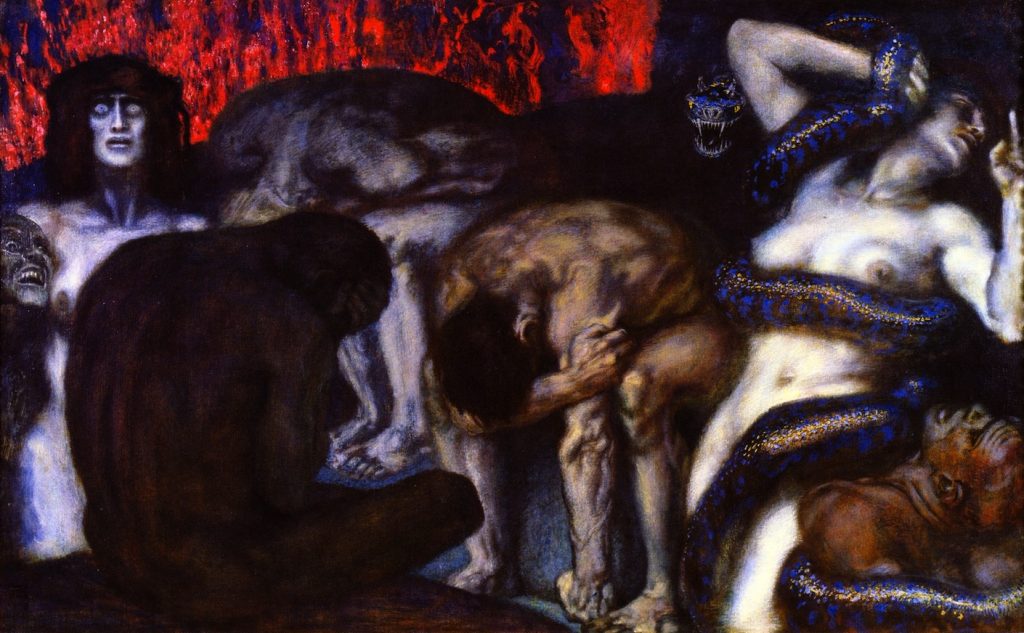
A Mortal Vision of the Infernal Deep
Historical visions of infernal darkness and monumental suffering provide a useful mortal visual parallel for Nessus without serving as literal maps of the Ninth.
Nessus Beyond SpiralWorlds
These videos are retained as external gaming reference and atmosphere. Their rulers, locations, history and cosmology may differ from SpiralWorlds and do not define this setting’s canon.
Exploring Nessus
External gaming lore concerning the traditional ninth Hell, retained for comparison rather than as SpiralWorlds canon.
Nessus — Ninth Circle Ambience
External fantasy ambience inspired by the traditional deepest Hell, retained for tabletop atmosphere rather than canonical description.