
Magic · Illusion · Stealth and Counter-Surveillance
Cloak of Silence
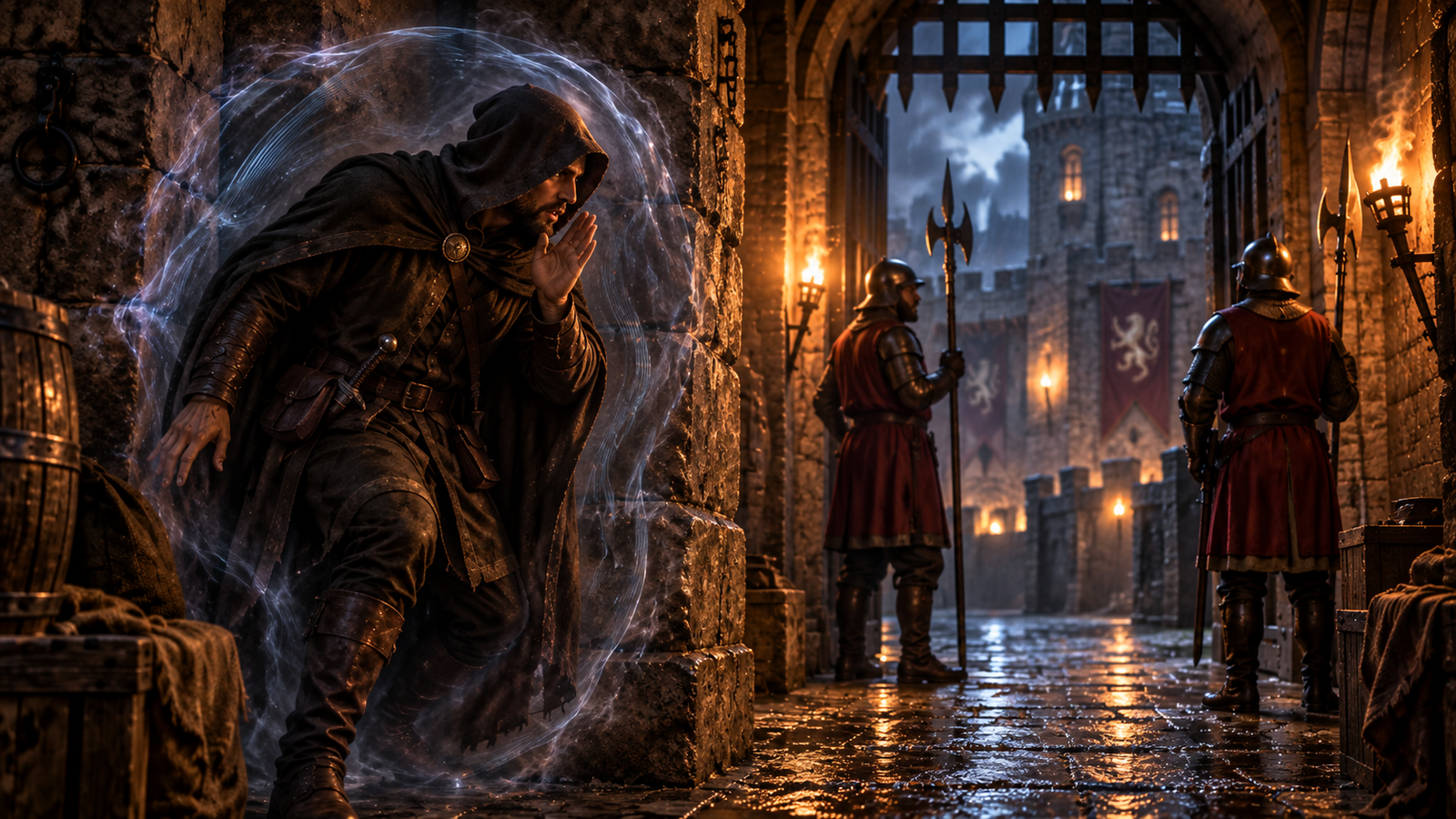
The Cloak of Silence spell wraps one creature in a narrow moving boundary that keeps ordinary sound from escaping. Unlike Silence , the protected creature still has enough audible space around its body to speak, whisper and form verbal spell components inside the cloak.
Rules
Game Statistics
Choose the ruleset in use. Each panel is a complete standalone version of the spell.
Cloak of Silence — 5.5e / 2024
Level 2 Illusion — Bard , Cleric
- Casting Time
- Action
- Range
- 30 feet
- Components
- V, S
- Duration
- Concentration, up to 10 minutes
- Target
- One creature you can see within range
- Saving Throw
- Wisdom negates if the target is unwilling
Effect
A sound-dampening shell extends about 1 foot from the target and moves with it. Sounds created wholly inside the shell do not pass beyond its boundary, and ordinary sound from outside does not pass through the shell. Sounds can still exist inside the enclosed space.
The target can speak, whisper and cast spells that have Verbal components. A spell, command, performance or other effect that requires a creature outside the shell to hear the target cannot affect that creature unless the effect itself carries the communication magically rather than relying on ordinary sound.
The target has Advantage on Dexterity (Stealth) checks when sound could reveal its position . Message can still carry a whispered communication because its magic delivers the words directly to the chosen target.
This does not make the target invisible, conceal tracks, suppress scent or prevent observers from noticing movement, opened doors, displaced objects or other visual evidence.
Weapons drawn, armour shifted and objects handled wholly inside the shell make no sound audible outside it. If the target is grappling another creature, that creature is treated as being inside the shell for as long as the grapple lasts.
The spell does not grant immunity or Resistance to Thunder damage unless another rule specifically says that the effect depends on audible sound crossing the shell.
Cloak of Silence — D&D 5e / 2014
2nd-level Illusion — Bard , Cleric
- Casting Time
- 1 action
- Range
- 30 feet
- Components
- V, S
- Duration
- Concentration, up to 10 minutes
- Target
- One creature you can see within range
- Saving Throw
- Wisdom negates if the target is unwilling
Effect
A moving field of magical sound-dampening surrounds the target to a distance of about 1 foot. Sound created wholly inside that space cannot be heard outside it, and ordinary sound from outside the field cannot be heard within it.
The target can still speak, whisper and provide verbal components for spells because sound continues to exist inside the field. A spell, command, performance or other effect that requires a creature outside the cloak to hear the target cannot affect that creature through the boundary.
The target has advantage on Dexterity (Stealth) checks made when avoiding detection depends on remaining unheard . The spell gives no benefit against sight, tracks, scent or other non-auditory means of detection.
Drawing a weapon, shifting armour or manipulating an object wholly inside the cloak creates no sound audible beyond the field. If the target grapples another creature, the grappled creature is considered inside the cloak while the grapple continues.
Message is a specific exception. Although Message is normally blocked by magical silence, Cloak of Silence preserves the original spell’s interaction and allows a whispered Message to pass magically between the caster and its target.
The cloak does not make the target deafened and does not grant immunity to thunder damage. Those properties belong to Silence , not to Cloak of Silence.
Cloak of Silence — Pathfinder 1e
School Illusion (glamer); Level Bard 2 , Cleric 2 , God’s Eye 2
- Casting Time
- 1 standard action
- Components
- V, S
- Range
- Close (25 ft. + 5 ft./2 levels)
- Target
- You or one creature weighing no more than 100 lb./level
- Duration
- 1 minute/level (D)
- Saving Throw
- Will negates
- Spell Resistance
- Yes
Description
A narrow field surrounds the target and moves with it. The target can speak and cast spells with verbal components inside the field, but ordinary sound made within the cloak cannot be heard outside it. A listener can hear the target normally if the listener’s ear enters the enclosed space.
The target gains a +10 competence bonus on Stealth checks made to avoid being heard . If the same Stealth check also determines whether the target is seen, apply this bonus only against observers whose detection depends on hearing; the spell does not make the target harder to see.
The field extends approximately 1 foot from the target. Anything within that area makes no apparent sound outside it. Drawing a weapon, handling gear or moving armour within the cloak therefore makes no audible noise beyond the field. If the target grapples another creature, that creature is considered inside the field for the duration of the grapple.
The target can cast spells with verbal components, but an audible or language-dependent effect cannot influence a creature outside the field if that creature must hear the target for the effect to work. Message can still function because the spell magically carries the whispered communication to its targets.
Audible bardic performances cannot benefit creatures outside the field. A bard can still use Countersong for itself, but creatures beyond the cloak cannot hear that performance and receive no benefit from it.
Cloak of Silence — D&D 3.5e
Illusion (Glamer) — Level Bard 2 , Cleric 2 , God’s Eye 2
- Casting Time
- 1 standard action
- Components
- V, S
- Range
- Close (25 ft. + 5 ft./2 levels)
- Target
- You or one creature weighing no more than 100 lb./level
- Duration
- 1 minute/level (D)
- Saving Throw
- Will negates
- Spell Resistance
- Yes
Description
The spell surrounds one target with a moving sound-dampening field similar to Silence , except that a few inches of audible space remain between the creature and the field. The target can therefore speak and provide verbal spell components, but ordinary sound does not escape the cloak.
- The target gains a +10 competence bonus on Move Silently checks.
- The field extends approximately 1 foot from the target. Anything within this area makes no apparent sound outside it. Drawing a weapon produces no audible noise. A creature grappled by the target is treated as being inside the field for the duration of the grapple.
- The target can cast spells with verbal components. Effects that require an outside creature to hear the caster cannot function through the field. Shout , Suggestion and Command are examples when their effect depends on audible speech reaching the subject. Message functions normally because it carries the whisper magically.
- The target cannot use Bardic Music to benefit creatures outside the field. Countersong can still protect the bard, but listeners beyond the cloak cannot hear it and gain no benefit.
This presentation updates the original 2003 casting-time terminology from “1 action” to the D&D 3.5e term “1 standard action” while preserving the spell’s level, components, range, target limit, duration, saving throw, spell resistance and sound-control effects.
Practical use
How Cloak of Silence Works at the Table
Move without broadcasting every step
The spell is strongest when the problem is sound rather than sight. Boots on stone, armour links, drawn steel, whispered instructions and the scrape of a latch can disappear from an observer’s hearing while remaining visible if someone is looking in the right direction.
Keep verbal spellcasting possible
The central advantage over Silence is that the target still has audible space inside the cloak. A spellcaster can form verbal components even though those ordinary sounds do not escape.
Use it offensively when silence matters
An unwilling guard, herald, witness or alarm-raiser can be targeted if the selected ruleset allows the spell to take hold. The magic does not paralyse them; it simply prevents ordinary sound from carrying beyond the field.
Remember what it does not hide
Doors still move. Torches still shift. Footprints remain. A watcher can still see the target. Animals can still react to scent. Cloak of Silence solves an acoustic problem, not every problem of infiltration.
Interactions
Sound, Speech and Other Magic
Silence removes sound from a much larger area and prevents verbal spellcasting inside that area. Cloak of Silence instead preserves a small pocket of usable sound around one moving target while stopping ordinary sound from crossing the boundary.
Message is the classic companion spell because it turns a whisper into magically delivered communication. By contrast, Command , Suggestion , audible performances and similar effects may fail when their rules require the listener to hear speech that the cloak prevents from reaching them.
The cloak should not be treated as invisibility, universal anti-sonic armour or automatic immunity to Thunder damage. Resolve only the sound-blocking effects stated in the selected rules panel.
Earth
Cloak of Silence in 1454
In 1454, this is the sort of spell taught quietly rather than publicly displayed. Court agents, thieves, investigators, messengers, city-watch specialists and guild enforcers value it because it suppresses the noises that betray movement through stone corridors, timber stairways, gatehouses, workshops and crowded streets.
Castles and city gates
A single guarded archway can be more dangerous than an open battlefield. A caster uses the cloak to mute boots, buckles, scabbards and whispered coordination while timing movement between patrols.
Workshops and presses
Secret work often fails because wood, metal and machinery carry sound. A cloak around the right worker can hide a brief action, a lock being handled or quiet instructions without making the entire room unnaturally silent.
Courts and councils
The same spell that aids infiltration can suppress an unwanted speech or alarm. Because the target remains physically free, using the spell coercively can become evidence of magical interference rather than an ordinary restraint.
Learned natural philosophy
Scholars describe the effect as a bounded glamer acting on the transmission of sound: vibration remains possible inside the inner space, but the enchanted boundary prevents ordinary sound from propagating across it.
Historical and mythic context
Silence, Secrecy and Sound-Dampening Materials
Harpocrates became a Greco-Roman figure associated with silence and secrecy, commonly shown with a finger to the lips. That later interpretation of the gesture provides a strong mythic parallel for a spell built around controlled quiet rather than absence or invisibility.
Textiles also provide a useful real-world analogue. Acoustic research on historic tapestries shows that hung woven material can absorb sound and reduce reverberation. Cloak of Silence takes that physical idea into fantasy: not a heavy wall-hanging that softens a room, but a mobile magical boundary that prevents sound from carrying beyond one person.
Related magic
Useful SpiralWorlds Links
- Silence — a larger-area spell that suppresses sound completely.
- Message — whispered communication carried by magic.
- Shout — an example of projected sonic magic.
- Command — spoken compulsion whose delivery can be disrupted by silence.
- Suggestion — magical influence expressed through speech.
- Illusion — the wider school of sensory and perceptual magic.
Rules questions
Cloak of Silence FAQ
Can the target cast spells with verbal components?
Yes. That is the defining difference between Cloak of Silence and a normal area of Silence . The target has audible space inside the cloak, so verbal components can be formed there.
Can creatures outside the cloak hear the target speaking?
No. Ordinary sound generated inside the field does not cross its boundary. A listener who physically brings the relevant hearing organ inside the enclosed space can hear sounds made there.
Does Cloak of Silence make the target invisible?
No. It suppresses sound, not sight. Observers can still see the target, notice moving objects, find tracks and use other non-auditory evidence.
Can the spell be cast on an unwilling creature?
Yes where the selected rules panel provides a saving throw. A successful save prevents the spell from taking hold.
Does the spell stop Thunder or sonic damage?
Not automatically. Use only the protection explicitly granted by the selected rules panel or by the particular effect being resolved. The spell is not blanket immunity to sound-themed damage.
What happens when the target grapples someone?
The original spell specifically draws a grappled creature into the sound-dampening area for the duration of the grapple. Each rules panel preserves that interaction in its own terminology.
Rules authority and licensing
Sources and Licensing
- Original spell: Crime & Punishment , © 2003 Trident, Inc. d/b/a Atlas Games; author Keith Baker. Atlas Games identifies the book as an OGL supplement for Third Edition fantasy roleplaying.
- 5.5e / 2024 rules framework: System Reference Document 5.2.1 , including the current rules for Verbal spell components, Silence and Message. The Cloak of Silence rules in that panel are a SpiralWorlds conversion of the original spell.
- D&D 5e / 2014 rules framework: SRD 5.1 — Silence and SRD 5.1 — Message . The Cloak of Silence rules in this panel are a SpiralWorlds conversion preserving the original spell’s moving personal field, verbal spellcasting and specific Message interaction.
- Pathfinder 1e rules framework: Pathfinder Roleplaying Game rules for Stealth, bardic performance and Spell Resistance, checked against Archives of Nethys . The Cloak of Silence rules in that panel are a SpiralWorlds conversion of the original spell.
- D&D 3.5e: the original Third Edition spell has been expressed using D&D 3.5e action terminology while preserving its defining mechanics.
Open Game Content notice: Cloak of Silence from Crime and Punishment, © 2003, Atlas Games; Author Keith Baker, based on original material by Keith Baker. The original Open Game Content is used under the Open Game License version 1.0a. SpiralWorlds-original prose, presentation, examples, setting material and edition conversions are separate adaptations.
SRD 5.2.1 attribution: This work includes material from the System Reference Document 5.2.1 (“SRD 5.2.1”) by Wizards of the Coast LLC, available at D&D Beyond. The SRD 5.2.1 is licensed under the Creative Commons Attribution 4.0 International License.
SRD 5.1 attribution: The D&D 5e / 2014 conversion uses rules terminology and mechanics from the System Reference Document 5.1.