
Nosferatu — The Plague-Bearing Vampire
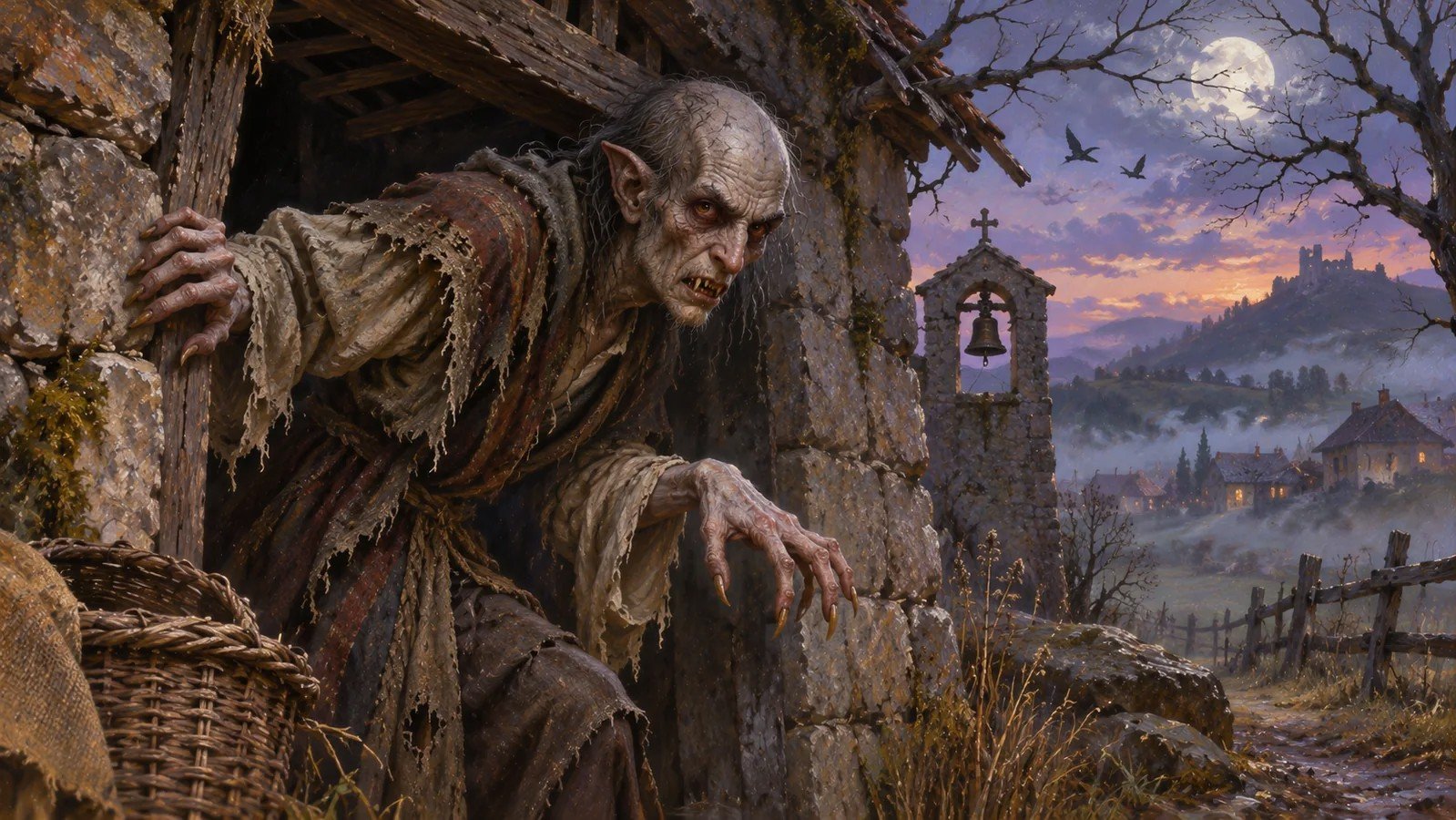
Someone has opened the sealed crypt beneath the chapel. At dawn the dead gravedigger is found outside the gate, his lips stained with earth and his throat marked by two narrow punctures. The village has stopped ringing its bell after sunset; tonight the creature waits beneath it.
At a Glance
| Detail | Description |
|---|---|
| Creature | Nosferatu — a corpse-like, plague-bearing strain of vampire |
| Size and type | Medium Undead |
| Temperament | Usually Neutral Evil; hungry, possessive and fiercely territorial |
| Typical haunts | Undercrofts, abandoned chapels, river ports and sealed burial roads |
| In the world | Most often found along the Carpathian and Danubian routes; elsewhere only where the strain is deliberately carried |
| Encounter rating | D&D 2024 CR 7 · D&D 2014 CR 7 · Pathfinder 1e CR 7 (original plague-bearer; Bestiary 4 exemplar CR 10) · D&D 3.5e CR 7 |
| What makes it different | Cadaverous body, daytime vulnerability, disease-tainted blood and the stealth of a thing accustomed to locked doors |
| Known individual | Count Orlok is a named and unusually powerful member of this strain, not the definition of every nosferatu. |
Game Statistics
D&D 2024
Medium Undead, usually Neutral Evil. AC 17; Initiative +4 (14); HP 112 (15d8 + 45); Speed 30 ft., Climb 30 ft.
| Ability | Score | Modifier | Save |
|---|---|---|---|
| STR | 16 | +3 | +3 |
| DEX | 18 | +4 | +7 |
| CON | 16 | +3 | +3 |
| INT | 14 | +2 | +2 |
| WIS | 14 | +2 | +5 |
| CHA | 16 | +3 | +6 |
Skills Deception +6, Perception +5, Stealth +10. Resistances Necrotic. Immunities Poison damage; Poisoned condition. Senses Darkvision 120 ft., Passive Perception 15. Languages Common and two languages known in life. CR 7 (2,900 XP; PB +3).
Traits
Predator’s Finesse. The nosferatu uses Dexterity instead of Strength for the attack and damage rolls of its claws and bite.
No Spawn. Its Bite and Grave Fever cannot create a Nosferatu, a vampire or Vampire Spawn. A victim who dies of the disease remains dead unless another, independent power intervenes.
Regeneration. The nosferatu regains 10 Hit Points at the start of its turn if it has at least 1 Hit Point and is not in sunlight. This trait does not function on its turn if it took Radiant damage since the end of its previous turn.
Hated Sun. The nosferatu takes 20 Radiant damage when it starts its turn in direct sunlight. While in direct sunlight, it has Disadvantage on attack rolls and ability checks.
Actions
Multiattack. The nosferatu makes two Claw attacks. It can replace one Claw with a Bite against a creature it has Grappled.
Claw. Melee Attack Roll: +7, reach 5 ft., one creature. Hit: 8 (1d8 + 4) Slashing damage; if the target is Medium or smaller, it has the Grappled condition (escape DC 14). The nosferatu can Grapple only one creature this way at a time.
Bite. Melee Attack Roll: +7, reach 5 ft., one willing, Incapacitated or Grappled creature. Hit: 7 (1d6 + 4) Piercing damage plus 7 (2d6) Necrotic damage. The target’s Hit Point maximum decreases by the Necrotic damage taken until it finishes a Long Rest; the nosferatu regains Hit Points equal to that Necrotic damage, up to its maximum.
Grave Fever (Recharge 5–6). The nosferatu exhales a reeking 15-foot cone. Each living creature in the area makes a DC 14 Constitution saving throw, taking 14 (4d6) Necrotic damage on a failed save or half as much on a successful one. On a failure, the creature is also Poisoned until the end of its next turn.
Bonus Actions
Slither into Cover. The nosferatu takes the Hide action while in Dim Light, Darkness or behind substantial cover.
D&D 2014
Medium undead, neutral evil. Armor Class 17; Hit Points 112 (15d8 + 45); Speed 30 ft., climb 30 ft.
| STR | DEX | CON | INT | WIS | CHA |
|---|---|---|---|---|---|
| 16 (+3) | 18 (+4) | 16 (+3) | 14 (+2) | 14 (+2) | 16 (+3) |
Saving Throws Dex +7, Wis +5, Cha +6. Skills Deception +6, Perception +5, Stealth +10. Damage Resistances necrotic. Damage Immunities poison. Condition Immunities poisoned. Senses darkvision 120 ft., passive Perception 15. Languages Common and two from life. Challenge 7 (2,900 XP).
Predator’s Finesse. The nosferatu uses Dexterity for the attack and damage rolls of its natural weapons.
No Spawn. Its bite and Grave Fever cannot create a nosferatu, vampire or vampire spawn. The dead do not rise from this infection.
Regeneration. The nosferatu regains 10 hit points at the start of its turn if it has at least 1 hit point, is not in sunlight and has not taken radiant damage since its preceding turn.
Sunlight Hypersensitivity. The nosferatu takes 20 radiant damage when it starts its turn in sunlight and has disadvantage on attack rolls and ability checks there.
Actions
Multiattack. The nosferatu makes two claw attacks, replacing one with a bite if it has a creature grappled.
Claw. Melee Weapon Attack: +7 to hit, reach 5 ft., one target. Hit: 8 (1d8 + 4) slashing damage, and a Medium or smaller target is grappled (escape DC 14). Only one creature can be grappled by the nosferatu at a time.
Bite. Melee Weapon Attack: +7 to hit, reach 5 ft., one willing creature or a creature grappled by the nosferatu or incapacitated. Hit: 7 (1d6 + 4) piercing plus 7 (2d6) necrotic damage. The target’s hit point maximum falls by the necrotic damage until it finishes a long rest. The nosferatu heals by that amount, up to its maximum hit points.
Grave Fever (Recharge 5–6). Each living creature in a 15-foot cone makes a DC 14 Constitution saving throw, taking 14 (4d6) necrotic damage on failure or half on success. A creature that fails is poisoned until the end of its next turn.
Bonus Actions
Slither into Cover. The nosferatu can take the Hide action when in dim light, darkness or substantial cover.
Pathfinder 1e
Nosferatu Plague-Bearer CR 7 (original variant); XP 3,200. NE Medium undead; Init +6; Senses darkvision 60 ft.; Perception +19.
Defense
AC 19, touch 12, flat-footed 17 (+2 Dex, +7 natural); hp 90 (12d8 + 36); Fort +4, Ref +6, Will +10; Defensive Abilities undead traits; DR 5/silver; Weaknesses sunlight.
Offense
Speed 30 ft., climb 20 ft.; Melee slam +14 (1d8+6 plus grab), bite +13 (1d6+4 plus 2d6 negative energy; grappled target only); Space 5 ft.; Reach 5 ft.; Special Attacks blood drain, grave fever.
Statistics
Str 18, Dex 14, Con —, Int 12, Wis 14, Cha 16. Base Atk +9; CMB +13 (+17 to grapple with grab); CMD 25. Feats Alertness, Blind-Fight, Combat Reflexes, Improved Initiative, Power Attack, Weapon Focus (slam). Skills Bluff +18, Climb +27, Intimidate +18, Perception +19, Stealth +17 (60 ranks total; includes +8 racial Climb and +2 Alertness on Perception). Languages Common and two known in life.
Special Abilities
Blood Drain (Su). On a successful bite against a creature it is grappling, the nosferatu deals 1d4 Constitution damage instead of the listed negative energy damage; it gains 5 temporary hit points, maximum 15, lasting 1 hour. It cannot deal both effects on the same bite.
Grave Fever (Su). Injury; bite; Fortitude DC 19; onset 1 day; frequency 1/day; effect 1d3 Constitution damage; cure 2 consecutive saves. The disease is magical, and magical disease removal cures it. DC is Charisma-based.
No Spawn (Ex). This Nosferatu cannot create new Nosferatu, vampires or vampire spawn through Blood Drain, Grave Fever or any other inherent power.
Fast Healing (Su). Fast healing 5, suppressed while in direct sunlight or until the end of the following turn after taking positive energy damage.
Sunlight (Ex). Direct sunlight deals 2d6 damage at the start of each turn and suppresses fast healing and the creature’s supernatural attacks for as long as the exposure lasts.
Ecology
Environment temperate settlements, burial tunnels and castle undercrofts; Organization solitary or plague court (one nosferatu with 2–6 living retainers); Treasure standard.
D&D 3.5e
Nosferatu — Medium Undead; usually Neutral Evil; Challenge Rating 7 (original game adaptation).
| Statistic | Value |
|---|---|
| Hit Dice | 12d12 (78 hp) |
| Initiative | +6 |
| Speed | 30 ft. (6 squares), climb 20 ft. |
| Armor Class | 19 (+2 Dex, +7 natural); touch 12; flat-footed 17 |
| Base Attack/Grapple | +6/+10 |
| Attack | Slam +11 melee (1d8+6 plus improved grab) |
| Full Attack | One slam +11 melee (1d8+6); bite +10 only against a grappled foe |
| Space/Reach | 5 ft./5 ft. |
| Special Attacks | Improved grab, blood drain, grave fever |
| Special Qualities | Damage reduction 5/silver, darkvision 60 ft., fast healing 5, sunlight aversion, undead traits |
| Saves | Fort +4, Ref +6, Will +10 |
| Abilities | Str 18, Dex 14, Con —, Int 12, Wis 14, Cha 16 |
| Skills | Bluff +18, Hide +17, Listen +19, Move Silently +17, Spot +19 (75 skill points including +2 Alertness) |
| Feats | Alertness, Blind-Fight, Combat Reflexes, Improved Initiative, Weapon Focus (slam) |
| Environment | Temperate towns and crypts |
| Organization | Solitary or plague court |
| Treasure | Standard |
Special Abilities
Improved Grab (Ex). If the nosferatu hits a Medium or smaller opponent with its slam, it can attempt to start a grapple as a free action without provoking an attack of opportunity.
Blood Drain (Ex). A successful grapple check made while pinning a living creature drains 1d4 points of Constitution. The nosferatu gains 5 temporary hit points per successful drain, to a maximum of 15 temporary hit points that expire after 1 hour.
Grave Fever (Su). Injury, bite; Fortitude DC 19 negates infection (10 + half of 12 HD + Charisma modifier 3). Incubation 1 day; 1d3 Constitution damage daily; two consecutive successful saves end the disease. This illness does not create undead.
No Spawn (Ex). The Nosferatu cannot create another Nosferatu or vampire spawn through its bite, Blood Drain or disease.
Fast Healing (Ex). The nosferatu regains 5 hit points at the start of its turn while it has at least 1 hit point and is not in sunlight. Exposure to positive energy suspends this healing for the following turn.
Sunlight Aversion (Ex). In direct sunlight the nosferatu takes 2d6 damage at the start of its turn and cannot use its supernatural grave-fever ability. There is no automatic mist escape or unavoidable resurrection.
What Is Happening Right Now?
The trading village of Vârful Rece has blocked the river quay. Three coffins came ashore in a merchant’s grain barge. Two were empty; the third still smells of fresh mud. Each night a new household is found with doors barred from the inside and the fire cold in its hearth.
The watch captain thinks the bodies are victims of fever and has ordered their burial outside the walls. The priest knows the marks on the necks do not match any natural sickness, but several councillors profit from keeping the trade road open. The nosferatu wants the last coffin carried into the old bell tower, where sunlight cannot reach its stone bed.
Adventurers may close the quay, expose the merchant who imported the coffin, or guard the bell tower until sunrise. Every choice has a cost: hungry villagers need grain, while the creature needs only one unguarded cellar to escape.
An Unmistakable Hunger
A nosferatu does not resemble the polished nobles who hide a vampire’s nature behind courtly manners. The flesh shrinks around the skull; the nails lengthen into curved hooks; clothing hangs from a body that no longer warms itself. When it speaks, its voice is quiet and practical. It asks for keys, passage, blood and the location of the nearest graveyard.
It is not mindless. It bargains with a sexton who fears for his family, arranges the purchase of a derelict house and keeps a ledger of those who break promises. Its power is strongest in places where frightened people conceal the first death. A village may have endured its influence for years without knowing who first invited it to stay.
Unlike vampire spawn, a Nosferatu is an independent predator. It has lost the power to create others of its kind or to raise vampire spawn. Its grave-fever weakens the living, but the sick remain mortal; the blood-drinker must be hunted, not its victims.
How It Hunts — and How to Stop It
- Before the attack. It watches windows and chimney smoke. It steals a house key, bribes a gravedigger or sends an exhausted servant to ask for shelter.
- In the fight. It begins near cover, seizes one exposed target and feeds before withdrawing into a narrow passage. It will not waste its strength grappling several armoured opponents at once.
- Sunlight and sanctified power. Direct daylight and radiant or positive energy disrupt its recovery. A daylight spell may produce bright light without being actual sunlight in a given rules edition; use the panel’s stated exposure rule rather than automatically treating the spell as the sun.
- Under the earth. Walling up a crypt is not enough if the creature can climb between the stones. The party must identify and guard every exit before the next sunrise.
- Protect the infected. Restorative magic can treat the damage of its blood-fever; a separate disease cure may still be required where the rules specify one.
A generic nosferatu has no universal lair actions or regional effects. Exceptional named lords can acquire powers over a particular castle or province. The plague around Count Orlok is the consequence of that individual’s history, influence and servants—not an aura automatically emitted by every member of the strain.
Three Doors After Sunset
The Locked Mill. The miller has found fresh grain stacked beside a coffin in a sealed cellar. He begs the party not to report the find because the town is short of flour. At midnight someone begins turning the mill wheel from the inside.
Crossing the River. A ferryman has been paid to transport a chest bound in chain. The river patrol offers a reward to stop him, but the coffin contains a living fever patient as well as a folded grave-cloth belonging to the nosferatu. The wrong accusation may kill the only witness.
The Silent Bell. A bereaved noble has the chapel bell removed, claiming its sound upsets his household. In fact, the bell tower now shelters the nosferatu. The noble’s servants must decide whether to betray their master or risk a second family death.
Bloodlines, Lords and Borderlands
In the eastern marches, a nosferatu is not the only dead thing that crosses the threshold. The vrykolakas has its own burial tradition, and the greater vampire may preserve courtly habits the nosferatu has long abandoned. Those distinctions determine which witnesses, burial customs and bargains a local ruler trusts.
Vlad Dracula is a named vampire prince pursuing his own political ambitions. Orlok is a different named vampire. Neither should replace this general species entry or be reduced to its standard statistics.
Sources and Licensing
The cadaverous vampire and plague-ship motif draw on Nosferatu: A Symphony of Horror (1922), directed by F. W. Murnau, and its relationship to Bram Stoker’s Dracula (1897). The name nosferatu was popularised in nineteenth-century Western writing and is not presented here as an established medieval Romanian word or a single authentic historical species. Traditional Romanian revenant terms and beliefs are not interchangeable with this later literary and cinematic figure.
The four playable profiles, grave-fever disease, traits, encounters and setting interpretation above are original game adaptations, not official published monster statistics. The Pathfinder 1e CR 7 plague-bearer is a separate original variant; the published Nosferatu template and CR 10 exemplar from Bestiary 4 include their own swarm escape, domination, telekinesis and vampire weaknesses, and do not gain grave-fever by default. See the British Film Institute account of the 1922 film for the cinematic background. Painting: original commissioned artwork of a village-haunting undead creature.
Game licence. The Pathfinder 1e plague-bearer is an original creature variant constructed with Pathfinder rules; the published Nosferatu template and creature example are separately identified above. Open Game Content is used under OGL v1.0a with the full licence and Section 15 below. The independent D&D builds are not presented as official Nosferatu stat blocks.
Full Open Game License 1.0a and Section 15 notices
OPEN GAME LICENSE Version 1.0a
The following text is the property of Wizards of the Coast, Inc. and is Copyright 2000 Wizards of the Coast, Inc (“Wizards”). All Rights Reserved.
1. Definitions: (a)”Contributors” means the copyright and/or trademark owners who have contributed Open Game Content; (b)”Derivative Material” means copyrighted material including derivative works and translations (including into other computer languages), potation, modification, correction, addition, extension, upgrade, improvement, compilation, abridgment or other form in which an existing work may be recast, transformed or adapted; (c) “Distribute” means to reproduce, license, rent, lease, sell, broadcast, publicly display, transmit or otherwise distribute; (d)”Open Game Content” means the game mechanic and includes the methods, procedures, processes and routines to the extent such content does not embody the Product Identity and is an enhancement over the prior art and any additional content clearly identified as Open Game Content by the Contributor, and means any work covered by this License, including translations and derivative works under copyright law, but specifically excludes Product Identity. (e) “Product Identity” means product and product line names, logos and identifying marks including trade dress; artifacts; creatures characters; stories, storylines, plots, thematic elements, dialogue, incidents, language, artwork, symbols, designs, depictions, likenesses, formats, poses, concepts, themes and graphic, photographic and other visual or audio representations; names and descriptions of characters, spells, enchantments, personalities, teams, personas, likenesses and special abilities; places, locations, environments, creatures, equipment, magical or supernatural abilities or effects, logos, symbols, or graphic designs; and any other trademark or registered trademark clearly identified as Product identity by the owner of the Product Identity, and which specifically excludes the Open Game Content; (f) “Trademark” means the logos, names, mark, sign, motto, designs that are used by a Contributor to identify itself or its products or the associated products contributed to the Open Game License by the Contributor (g) “Use”, “Used” or “Using” means to use, Distribute, copy, edit, format, modify, translate and otherwise create Derivative Material of Open Game Content. (h) “You” or “Your” means the licensee in terms of this agreement.
2. The License: This License applies to any Open Game Content that contains a notice indicating that the Open Game Content may only be Used under and in terms of this License. You must affix such a notice to any Open Game Content that you Use. No terms may be added to or subtracted from this License except as described by the License itself. No other terms or conditions may be applied to any Open Game Content distributed using this License.
3. Offer and Acceptance: By Using the Open Game Content You indicate Your acceptance of the terms of this License.
4. Grant and Consideration: In consideration for agreeing to use this License, the Contributors grant You a perpetual, worldwide, royalty-free, non-exclusive license with the exact terms of this License to Use, the Open Game Content.
5. Representation of Authority to Contribute: If You are contributing original material as Open Game Content, You represent that Your Contributions are Your original creation and/or You have sufficient rights to grant the rights conveyed by this License.
6. Notice of License Copyright: You must update the COPYRIGHT NOTICE portion of this License to include the exact text of the COPYRIGHT NOTICE of any Open Game Content You are copying, modifying or distributing, and You must add the title, the copyright date, and the copyright holder’s name to the COPYRIGHT NOTICE of any original Open Game Content you Distribute.
7. Use of Product Identity: You agree not to Use any Product Identity, including as an indication as to compatibility, except as expressly licensed in another, independent Agreement with the owner of each element of that Product Identity. You agree not to indicate compatibility or co-adaptability with any Trademark or Registered Trademark in conjunction with a work containing Open Game Content except as expressly licensed in another, independent Agreement with the owner of such Trademark or Registered Trademark. The use of any Product Identity in Open Game Content does not constitute a challenge to the ownership of that Product Identity. The owner of any Product Identity used in Open Game Content shall retain all rights, title and interest in and to that Product Identity.
8. Identification: If you distribute Open Game Content You must clearly indicate which portions of the work that you are distributing are Open Game Content.
9. Updating the License: Wizards or its designated Agents may publish updated versions of this License. You may use any authorized version of this License to copy, modify and distribute any Open Game Content originally distributed under any version of this License.
10. Copy of this License: You MUST include a copy of this License with every copy of the Open Game Content You Distribute.
11. Use of Contributor Credits: You may not market or advertise the Open Game Content using the name of any Contributor unless You have written permission from the Contributor to do so.
12. Inability to Comply: If it is impossible for You to comply with any of the terms of this License with respect to some or all of the Open Game Content due to statute, judicial order, or governmental regulation then You may not Use any Open Game Material so affected.
13. Termination: This License will terminate automatically if You fail to comply with all terms herein and fail to cure such breach within 30 days of becoming aware of the breach. All sublicenses shall survive the termination of this License.
14. Reformation: If any provision of this License is held to be unenforceable, such provision shall be reformed only to the extent necessary to make it enforceable.
15. COPYRIGHT NOTICE
Open Game License v 1.0a Copyright 2000, Wizards of the Coast, Inc.
System Reference Document Copyright 2000–2003, Wizards of the Coast, Inc.; Authors Jonathan Tweet, Monte Cook, Skip Williams, Rich Baker, Andy Collins, David Noonan, Rich Redman, Bruce R. Cordell, John D. Rateliff, Thomas Reid and James Wyatt, based on original material by E. Gary Gygax and Dave Arneson.
Pathfinder Roleplaying Game Core Rulebook Copyright 2009, Paizo Publishing, LLC; Author Jason Bulmahn, based on material by Jonathan Tweet, Monte Cook and Skip Williams.
Pathfinder Roleplaying Game Bestiary 4 Copyright 2013, Paizo Publishing, LLC; Authors Dennis Baker, Jesse Benner, Savannah Broadway, Ross Byers, Adam Daigle, Tim Hitchcock, Tracy Hurley, James Jacobs, Matt James, Rob McCreary, Jason Nelson, Tom Phillips, Stephen Radney-MacFarland, Sean K Reynolds, F. Wesley Schneider, Tork Shaw and Russ Taylor.
Keep this reference growing
If this page helped with your reading or game, you can support its upkeep or explore the curated books.
Explore the Bookshop — epics, classics and stories behind imagined worlds.