
Spell, Daylight spell, “Apollo’s Revealing Radiance”
Daylight spell, “Apollo’s Revealing Radiance”
A spell of brilliant radiance that drives back darkness; the 2024 version creates sunlight, while older versions create magical light.
Overview
The Daylight spell is one of the most reliable answers to darkness in the world. It does not create a small lantern-glow or decorative shimmer; it turns an object into a powerful source of magical radiance, bright enough to reveal chambers, expose ambushes, weaken creatures that suffer in bright light, and challenge spells of darkness.
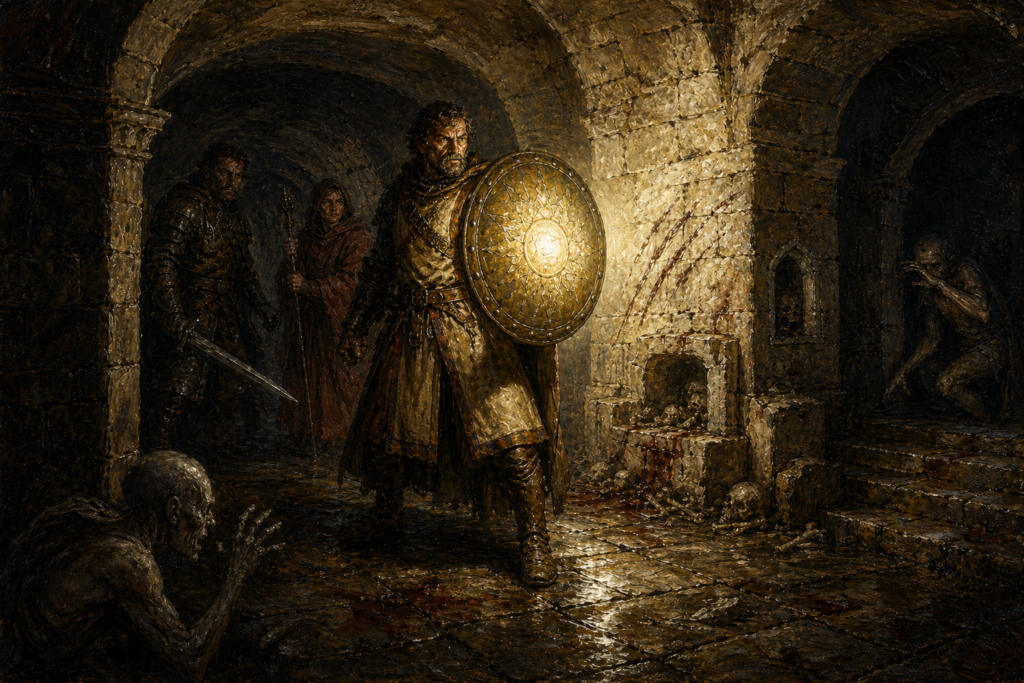
A priest may cast it on a holy symbol before entering a tomb. A paladin may raise it on a shield as a battle-standard. A druid may place it on a river stone and roll it into a root-choked barrow. A wizard may touch a coin and throw it into a blackened vault before anyone crosses the threshold. Watch-captains, mine overseers, temple wardens, caravan masters, and battlefield commanders all value the spell because it makes darkness answerable.
Sunlight depends on the edition. The 5.5e / 2024 version creates sunlight and activates a creature’s sunlight vulnerabilities as written. The 5e / 2014, Pathfinder 1e and D&D 3.5e versions create magical light without counting as sunlight for those vulnerabilities.
Effect
You touch an object and cause it to shed powerful magical light. The object shines with bright light in a 60-foot radius and dim light for an additional 60 feet.
The spell’s light moves with the object. A creature may carry the object, raise it, hide it, throw it, hang it from a staff, tie it to a banner, fix it to a shield, or place it in a room. If the object is completely covered by an opaque or lightproof covering, the illumination is blocked until the covering is removed.
The Daylight spell can counter, suppress, or dispel magical darkness depending on the rules system being used. In older OGL / Pathfinder-compatible play, it specifically counters or dispels darkness spells of equal or lower level, such as darkness.
Daylight spell 5.5e / 2024
Daylight spell Pathfinder / 3.5e
Daylight spell 3.0
Daylight spell 5.5e / 2024
3rd-Level Evocation
Casting Time: Action
Range: 60 feet
Components: V, S
Duration: 1 hour
Available To: Cleric, Druid, Paladin, Ranger, Sorcerer
For the duration, sunlight spreads from a point within range, filling a 60-foot-radius Sphere with Bright Light and shedding Dim Light for another 60 feet.
Alternatively, you can cast the spell on an object that isn’t being worn or carried. The sunlight then fills a 60-foot Emanation from that object. An opaque covering blocks the light while it covers the object.
If the spell’s area overlaps Darkness created by a spell of level 3 or lower, that other spell is dispelled.
Alternative Spell Name: Apollo’s Revealing Radiance
Daylight spell Pathfinder / 3.5e
Evocation [Light]
Level: Bard 3, Cleric 3, Druid 3, Paladin 3, Sorcerer/Wizard 3
Components: V, S
Casting Time: 1 standard action
Range: Touch
Target: Object touched
Duration: 10 minutes/level (D)
Saving Throw: None
Spell Resistance: No
The object touched sheds light as bright as full daylight in a 60-foot radius, and dim light for an additional 60 feet beyond that.
Creatures that take penalties in bright light also take those penalties while within the radius of this magical light. Despite the spell’s name, Daylight is not the equivalent of true daylight for creatures that are damaged, destroyed, or otherwise specifically affected by actual sunlight.
If Daylight is cast on a small object that is then placed inside or beneath a lightproof covering, the spell’s effects are blocked until the covering is removed.
Daylight brought into an area of magical darkness, or magical darkness brought into an area of Daylight, is temporarily negated in the overlapping area. In that overlap, the otherwise prevailing light conditions apply.
Daylight counters or dispels any darkness spell of equal or lower level, such as darkness.
Daylight spell 3.0
This material is Open Game Content, and is licensed for public use under the terms of the Open Game License v1.0a.
The object touched sheds light as bright as full daylight in a 60-foot radius, and dim light for an additional 60 feet beyond that.
Evocation [Light]
Level Bard 3, Cleric 3, Druid 3, Paladin 3, Sorcerer/Wizard 3
Components V, S
Casting Time 1 standard action
Range Touch
Target Object touched
Duration 10 min./level (D)
Saving Throw None
Spell Resistance No
Creatures that take penalties in bright light also take them while within the radius of this magical light. Despite its name, this spell is not the equivalent of daylight for the purposes of creatures that are damaged or destroyed by bright light.
If daylight is cast on a small object that is then placed inside or under a light- proof covering, the spell’s effects are blocked until the covering is removed
Daylight brought into an area of magical darkness (or vice versa) is temporarily negated, so that the otherwise prevailing light conditions exist in the overlapping areas of effect.
Daylight counters or dispels any darkness spell of equal or lower level, such as darkness.
Why The Daylight Spell Is Useful in the World
The Daylight spell is a tool of movement, command, rescue, judgment, and battlefield control. It allows people to move through dangerous places without relying on torches, lanterns, oil, or fragile mundane light. It reveals broken floors, hidden doors, blood trails, murder holes, alcoves, crawling things, and enemies that depend on darkness to control the fight.
In settlements, temples and city watches may use the Daylight spell during plague inspections, mine rescues, night trials, sewer searches, exorcisms, searches for missing children, or ceremonial processions. In war, it can turn a shield, standard, or spear-tip into a visible point of rallying light. In tombs and underworld roads, it may be the difference between a disciplined advance and a blind massacre.
A light-bearing object can be covered, stolen or thrown away from its bearer. Intelligent enemies may target the bearer or block the light. In 5.5e / 2024, Daylight is sunlight: apply each creature’s sunlight traits. In the older editions, its magical light does not activate vulnerabilities that specifically require sunlight.
Best Uses
Use the Daylight spell when people need to:
Reveal a large dark chamber before entering it.
Counter or challenge magical darkness.
Expose enemies relying on concealment, ambush, or fear.
Protect a group travelling at night.
Mark a rallying point in battle.
Illuminate mines, caves, ruins, tombs, sewers, undercrofts, or underworld passages.
Force light-sensitive creatures to fight under worse conditions.
Create a visible signal during a rescue, siege, pursuit, or retreat.
Tactics
The best target for the Daylight spell is rarely a random item. The chosen object should serve the scene.
- A shield: Turns the front-line defender into the centre of the light radius.
- A staff or spear: Lets the light rise above the group, reducing shadows cast by bodies and walls.
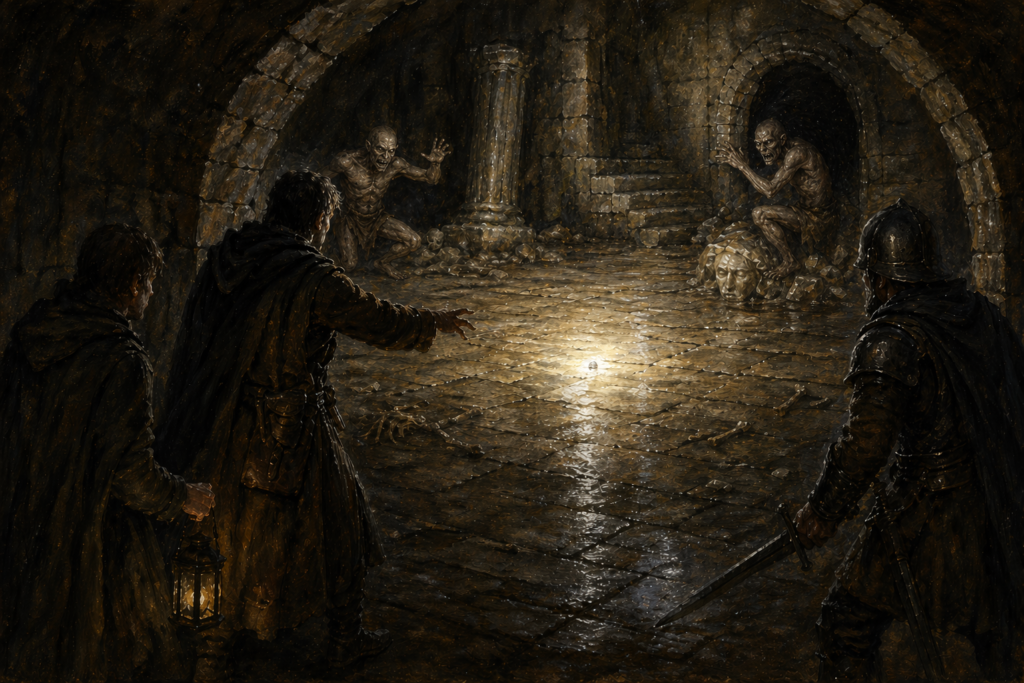
- A coin or stone: Can be thrown into a room before anyone enters.
- A holy symbol: Gives the spell ritual force and visible authority.
- An arrow or crossbow bolt: Allows the light to be placed at range.
- A banner or standard: Makes the spell useful in battlefield scenes, night marches, temple processions, and city emergencies.
Do not forget that enemies can react. A clever opponent may cover the object with a cloak, knock it into water, steal it with magic, drag it beyond a doorway, or lure the bearer away from it.
DM Notes
The Daylight spell works best when light matters. Let it change the mood of a tomb, mine, sewer, cave, ruin, undercroft, night road, or battlefield. Let creatures recoil, retreat, hiss, scatter, or become visible. Let the people present feel the difference between creeping forward by torchlight and advancing behind a 120-foot-wide field of magical radiance.
Use the chosen edition’s sunlight rules. In 5.5e / 2024, Daylight creates sunlight; resolve vampires and other affected creatures using their own sunlight traits. In 5e / 2014, Pathfinder 1e and D&D 3.5e, it creates magical light and does not itself activate vulnerabilities requiring sunlight.
For older OGL / Pathfinder-style play, remember the spell’s direct relationship with magical darkness. It can counter or dispel darkness effects of equal or lower level, making it a strong answer to darkness-based encounter design without making every light spell irrelevant.
Good Combinations
- Faerie Fire: Daylight reveals the area; Faerie Fire marks the enemy.
- See Invisibility: Broad light plus supernatural detection makes ambushes harder to maintain.
- Magic Weapon: A glowing weapon becomes both a combat tool and a visible rallying point.
- Shield of Faith: A paladin or cleric bearing the light can become a protected centre of the formation.
- Wall of Force: Daylight can expose enemies trapped, divided, or contained by battlefield control.
- Dispel Magic: Useful when darkness effects are too strong, layered, or unusually worded for Daylight alone.
Using This Spell in Play
The Daylight spell should feel practical, forceful, and meaningful. It is not just a convenience spell; it changes who controls the scene. Darkness-based creatures lose some of their advantage. Hidden spaces become readable. Fear gives way to formation, movement, and decision.
For stronger play, make the light source physically present. A glowing shield in a crypt is more memorable than a vague statement that an area is lit. A shining coin hurled across a blood-slick floor creates a tactical moment. A staff crowned with white radiance becomes a visual anchor for everyone present.
Spellcasting Culture and Worldbuilding Hooks
Temples may use Daylight to cleanse defiled halls, examine plague houses, judge oaths, or lead processions through dangerous streets.
Druids may cast it on standing stones, polished bones, river rocks, or ancient branches during rites that deny the power of hidden things.
Paladins may carry Daylight-bearing shields into night battles as a declaration that no enemy may rule the dark unchallenged. Cast the spell on the shield before it is worn or carried when the chosen edition requires an unattended object.
In cities, magistrates, treasure houses, and watch-captains may value the spell as much as priests and war-mages do. A single Daylight-bearing object can turn a cellar search, riot response, murder investigation, monster hunt, or mine rescue into a controlled operation.
Keep this reference growing
If this page helped with your reading or game, you can support its upkeep or explore the curated books.
Explore the Bookshop — epics, classics and stories behind imagined worlds.