
Iberian Pantheons — Gods of the Peninsula
At a Glance
| Region | The Iberian Peninsula: Castile, León, Aragon, Catalonia, Valencia, Navarre, Portugal and Granada |
|---|---|
| Divine traditions | Iberian, Celtiberian, Lusitanian, north-western Hispano-Celtic, Basque and southern coastal cults |
| Famous powers | Ataecina, Endovelicus, Bandua, Reue, Nabia, Neton, Betatun; Mari and Sugaar in Basque tradition |
| Shared pantheon? | No. Religious identities, priesthoods, sanctuaries and divine genealogies vary across peoples and kingdoms |
| Other influences | Phoenician and Punic maritime worship; Greek and Roman cults in particular towns; foreign faiths brought by travellers |
| Political pressure | Royal temple patronage, rival noble houses, independent mountain shrines, Inquisition of Flame and Iron and Rome’s Sacred College |
| Campaign present | 1454 CE |
A young courier rides into a mountain village with two seals: one from the new king of Castile, the other from the Inquisition. Both demand that a carved stone be removed from the river sanctuary. The keeper of the spring will yield it to neither. Her family has honoured Nabia for generations, and the river has begun running black since the royal surveyors arrived.
Across Iberia, the gods are as numerous and independent as the peoples who worship them. A healing sanctuary in Lusitania has its own custodians and obligations. A Celtiberian hill-community honours a local guardian whose name means nothing in a coastal city. A valley of Navarre remembers Mari in storms and caves. On the Mediterranean shore, merchants offer gifts before sailing to deities known from both Iberian and Punic traditions. No one speaks for them all.
What Is Happening Right Now?
Ataecina’s dead are restless. A burial-ground keeper near the western frontier refuses an inquisitorial order to close a sanctuary. She claims that grave-goods taken by officials have broken a compact with the goddess. The next corpse arrives carrying a stranger’s seal.
A temple’s claim is questioned. Two kingdoms recognise conflicting rights over a hill shrine used by merchants, soldiers and travellers. One sends a judge from Rome’s Sacred College; the other refuses to recognise that court at all. The god of the place has not answered either delegation.
The mountain has spoken. A Navarrese army postpones its march when a burning light crosses the pass and an oracle of Mari pronounces its commander an oath-breaker. His rival calls the pronouncement a fraud and hires witnesses to disprove it.
The Gods of Lusitania and the Western Lands
In what is now Portugal and the western reaches of Castile and León, gods known by distinct names stand behind springs, settlements, hillforts, graves and sworn promises. Their names survive in ancient dedications. Their full mythologies do not. The cults remain living forces in the campaign present, with differing customs even between neighbouring communities.
| Divine power | Sanctuary and character | At the table |
|---|---|---|
| Ataecina / Ataegina | A goddess associated in scholarship with the earth, vegetation and the dead; honoured especially in western Iberian territory | An inherited burial oath is broken, and seasonal renewal falters around the shrine |
| Endovelicus / Endovellicus | A renowned local god with a sanctuary at São Miguel da Mota; healing, protection and oracular sleep belong to his later interpretation | A wounded traveller receives a dream that contradicts a physician’s diagnosis |
| Bandua | An extensively attested indigenous god with local epithets, often interpreted in relation to the protection of communities | A village claims an ancient defence oath that would prevent its lord from removing the watch |
| Nabia | A widely attested western and north-western goddess; inscriptions occur near springs, heights, settlements and forts | A shrine keeper can reconcile two river communities, but refuses payment in seized land |
| Reue | An important Lusitanian name known from dedications, with scholarly debate over the god’s precise powers | Two priestly houses disagree over what a vow to Reue actually obliges |
| Trebaruna | An indigenous deity attested in Lusitanian religious material; exact attributes remain debated | A boundary altar is moved, and an old settlement agreement loses its protection |
| Arentius and Arentia | Attested divine names of western Iberia; relationships between the two should not be presumed from similar names alone | Two shrines make rival claims about a shared ceremonial procession |
Worship in practice: A village may guard one sacred spring without maintaining a formal priesthood. A greater sanctuary can command stewards, interpreters of dreams, armed attendants and properties donated by worshippers. An official from Lisbon may offer gifts to Endovelicus, while a lord in Castile refuses to recognise the same sanctuary’s immunity from arrest.
Celtiberian Gods and the Interior
The highlands and inland towns have their own sacred traditions. Worship is tied to communities and landscapes rather than a single celestial royal family. Scholars have argued over how to identify the gods represented in ancient Celtiberian material; the campaign’s living shrines may know details that history has lost, but those details should be treated as local tradition rather than universal fact.
Lugus: A Celtic divine name that belongs to wider western European traditions and is relevant to discussions of Iberian Celtic religion; do not assume every Celtiberian shrine honours him, or that his precise sphere is identical in every region. Traders, artisans and envoys may seek his favour where such a cult is recognised.
The Matres: Mother figures and protective female powers are part of the wider Celtic and Roman-period religious landscape. In a Celtiberian village, such worship may centre on a household, local spring or community rather than a continent-wide order of goddesses.
Epona: Epona is a well-established Celtic goddess of horses and their keepers, with a wider cult that can reach travellers and frontier communities. She is a regional or visiting power, not evidence that all Iberian peoples share one horse-centred pantheon.
Hill and boundary gods: Many local divine titles do not resolve into familiar named deities. A stone at a pass, a public oath taken at a well or a hidden spring may be the principal religious centre of a whole settlement. The failure of a ritual can have consequences even when the god’s name has been lost beyond the valley.
Eastern Iberia: Gods Known by Fragments
The Mediterranean east and its inland valleys preserve Iberian inscriptions and sanctuaries that do not simply reproduce Celtiberian worship. Scholars can identify only a small number of likely divine names with confidence, and even these are difficult to distinguish from personal names without the ritual context.
Betatun, Salaeco, Sertundo and Salagin: These names occur in the scholarly discussion of indigenous Iberian divine names. The evidence should not be used to assign each one a detailed portfolio, spouse, holy weapon or home plane as though an ancient scripture survived. In the campaign present, particular temples may offer their own accounts, which can differ and conflict.
The eastern sanctuaries: Sacred caves, open-air rock places and votive deposits offer better evidence for religious practice than speculation about a neat family of gods. Bronze figures may represent worshippers making offerings rather than images of named divinities. Pilgrims often bring gifts in gratitude for healing, a journey completed or a household danger survived.
Travellers crossing from Aragon into Valencia may find one temple that recognises a Roman interpretation of its patron and another whose custodians reject that identification as an insult. Both retain their own histories and ritual obligations.
Southern Iberia: Older Gods and the Sea
In Granada and the southern coast, several religious inheritances meet without becoming one faith. The ancient name Neton is associated in classical testimony with the Granada region; his identification and attributes should not be reduced to a simple Roman equivalent. Coastal shrines also remember the Phoenician and Punic divine world carried across maritime trading routes.
Tanit: A powerful Punic goddess whose traditions survive in particular port families and households. Melqart: Patron of seafaring and mercantile ties in cities shaped by Phoenician connections. Astarte: Honoured in some maritime cults, without being made an aspect of every local goddess.
At the Alhambra: The Nasrid court may patronise southern Iberian and coastal cults through its own political relationships. A Castilian inquisitor can call those rites forbidden, but his authority does not cross the frontier by itself. A ruler may invoke Neton in a public oath and later bargain with the custodians of a Punic sanctuary to keep the harbour supplied.
Basque Highlands: Mari and Sugaar
The western Pyrenees and Kingdom of Navarre preserve a different sacred landscape. Mari, the great mountain figure remembered in Basque stories, is associated with caves, storms and the conduct of those who approach her. Sugaar appears in serpent and fiery traditions, with accounts that vary between communities. Their stories are known largely from folklore collected in much later centuries; the continuation of their worship into this campaign’s 1454 is a deliberate feature of the setting, not an established history of medieval religion.
The priestly keeper of one cave may be a respected neighbour with no national office. Another valley may deny that Mari accepts priests at all, and demand that petitioners approach through specific inherited customs. A Navarrese claimant cannot force either valley to worship as a rival district does.
Where to Find Worship and Divine Aid
Healing and dream sanctuaries
Endovelicus’s devotees offer shelter, divination through dreams and skilled healing. Visitors must honour the temple’s rules of purification, testimony or payment.
Springs and river stones
Nabia’s cults are rooted in particular places. Travel blessings and protection of crossings may be offered through local custodians rather than an international priesthood.
Hillforts and oath boundaries
Bandua and other protective divine powers are honoured where a community’s freedom and safety depend on promises made between households and rulers.
Caves and high-country shrines
In Navarre and the western mountains, divine encounters may require guides, custom and personal obligation rather than silver alone.
Mediterranean ports
Punic and Roman-influenced temples serve captains, travellers and merchants while independent Iberian families keep their own shrines nearby.
Divine homes: Each god has a distinct divine residence or sphere of power. A shrine on Earth marks a connection to that power; it does not prove that every Iberian god lives on the same plane. The individual god entries establish their homes and powers without treating Rome, Olympus or any one Outer Plane as the automatic destination of all Iberian worship.
Priests, Rulers and the Sacred College
The new king of Castile sponsors temples that strengthen his rule. Nobles seek favourable oracles; towns defend ancient ritual privileges; temple stewards defend their property. No king can simply abolish a god’s influence by declaring a shrine unlawful.
Torquemada’s Inquisition claims to defend approved Iberian rites, but uses its courts and confiscations to dominate independent worship. The faction’s leader privately serves Belial. Its public seal and lawful procedures conceal that allegiance, and many sincere examiners do not know the truth.
Rome’s Sacred College can arbitrate between temples, certify relics and recognise sacred treaties when local rulers or priesthoods accept its jurisdiction. The Sacred Concords are cross-border agreements concerning sanctuary, oaths and sacred property; they are not a universal priesthood. An Iberian goddess owes no obedience to Borgia because two mortal courts sign a document. A kingdom can reject a judgement, but doing so may cost diplomatic recognition, trading allies or sanctuary rights elsewhere.
Religious conflict has consequences: A royal temple rewarded for loyalty may gain land and soldiers. A community that refuses the Inquisition risks confiscation and imprisonment, but can sometimes win protection from an independent monarch, an allied priesthood or a Sacred Concord already recognised by its rulers. Neither the Roman College nor the Castilian tribunal automatically commands the whole peninsula.
Dangers and Adventure Hooks
The Stone That Knows the King
A royal surveyor uproots a stone dedicated to a local guardian. The next morning his soldiers find a new boundary carved around their camp, and every messenger sent through it returns to the wrong village. The party can restore the old agreement or discover who changed the inscription.
The Three Dreamers
At the sanctuary of Endovelicus, three patients dream of the same prisoner being transported through a Castilian town. Their descriptions disagree on the prisoner’s face but match the mark on the inquisitorial chain. The keeper asks the adventurers to learn whether the prisoner is the same soul in three bodies.
Rome’s Missing Witness
A Sacred College envoy and a Navarrese priestess both seek a witness to an oath allegedly sworn before Mari. The prince says the oath binds him; the mountain community insists it was extorted. Borgia will recognise whichever testimony survives long enough to reach his court.
Historical Sources and Artwork
Rock Sanctuaries, Sacred Landscapes, and the Making of the Iberian Pantheon — evidence for Iberian sanctuaries and the limits of deity-name reconstruction. Olivares Pedreño, Teónimos y fronteras étnicas: los Lusitani — regional Lusitanian divine names. Olivares Pedreño, El culto a Nabia — Nabia’s multi-functional cult. Alfayé Villa, La iconografía divina en Celtiberia — caution concerning Celtiberian divine images. Encyclopedia of Romantic Nationalism in Europe, Basque Mythology — history of later folklore collections.
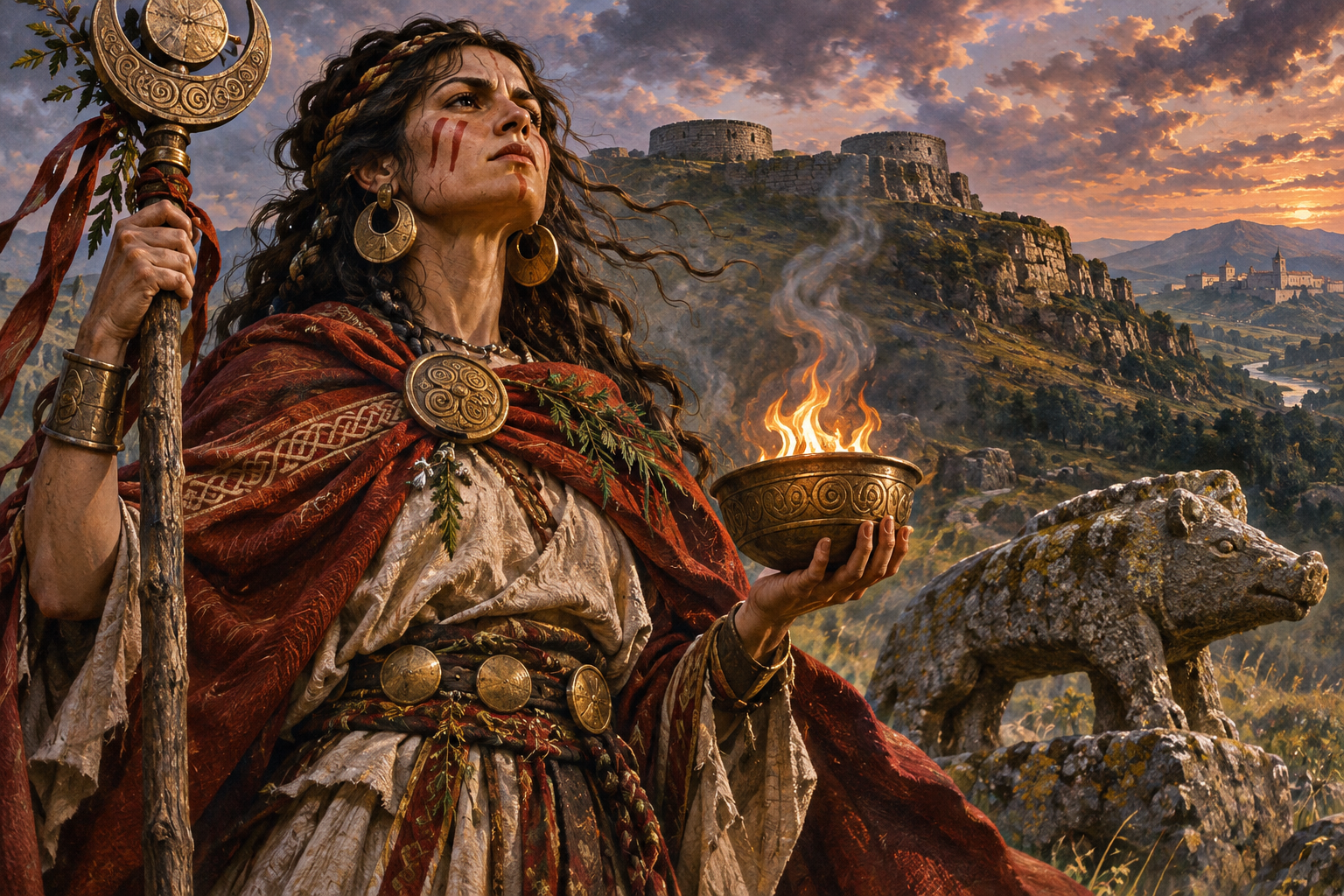
Hero artwork: original painted illustration of a ritual priestess, ceremonial fire and sacred landscape, representing the living regional traditions of Iberia. The pictured figure and symbols are artistic interpretations, not identified ancient depictions of a particular deity.
Keep this reference growing
If this page helped with your reading or game, you can support its upkeep or explore the curated books.
Explore the Bookshop — epics, classics and stories behind imagined worlds.