
Cardiff — Castle, Port and the Lordship of Glamorgan
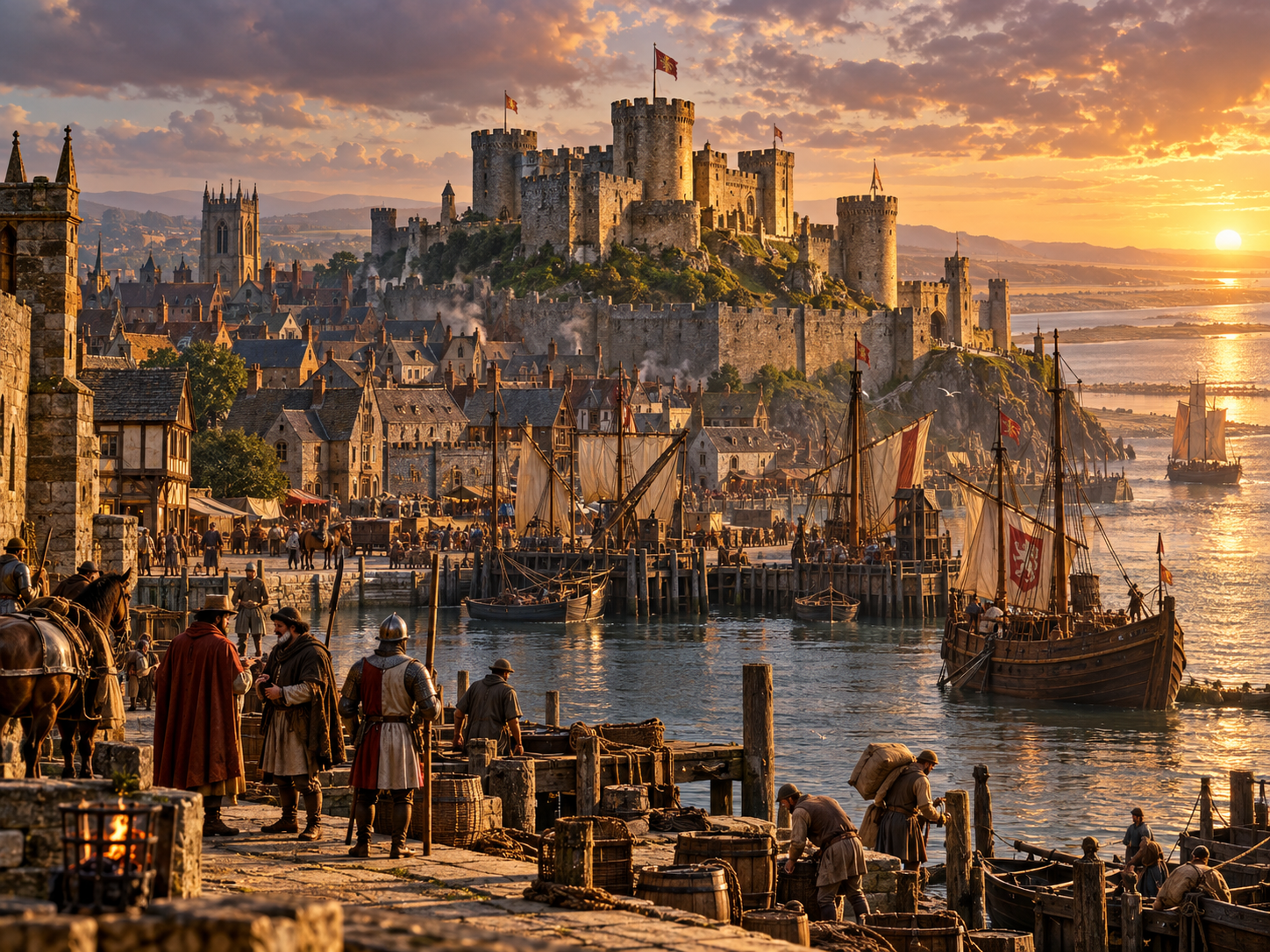
South Wales · Marcher stronghold · Port · Castle town
At a Glance
| Region | Glamorgan, south Wales |
|---|---|
| Character | Fortified marcher town, port and administrative centre |
| Key stronghold | Cardiff Castle |
| Best for | Marcher politics, urban investigations, port intrigue, courts, smuggling, prisoners and layered ruins |
| Routes | Bristol Channel, Glamorgan coast, roads into the Marches and inland valleys |
| Supernatural layer | Roman foundations, buried shrines, river spirits, ghosts and disputes between written title and older sacred ownership |
Cardiff is a fortified town and port built around one of the great power centres of Glamorgan. Roman walls, a Norman castle, marcher authority, Welsh communities and Bristol Channel trade occupy the same ground, making the town a natural meeting point between law, commerce and older claims.
What Is Happening Right Now?
Authority in Cardiff is concentrated but never simple. Castle officers, local elites, keepers of civic sanctuaries, merchants and neighbouring landholders all possess different kinds of power. Marcher customs and privileges complicate appeals to ordinary royal law, while Welsh kinship, local oath and long memory can matter as much as a sealed document.
The port widens every dispute. Ships connect Cardiff to Bristol, Ireland and other Bristol Channel harbours. A prisoner can vanish onto a vessel, a forbidden grimoire can arrive hidden inside wool, and a supernatural object found upriver can be sold abroad before anybody understands what it is. North of the town, reports of the Red of Bannau Brycheiniog are treated as economic and political intelligence.
Run Cardiff Tonight
The Roman Door
Repairs inside the castle expose a blocked Roman passage descending beneath later foundations. The chamber beyond contains a dedication to a local power whose worship predates both the castle and the town’s later sanctuaries. The seal on the inner door has been broken from the far side.
The Ship Without a Master
A coastal vessel enters harbour under reduced sail with no captain aboard. The crew insist he walked over the side after answering somebody calling his name from the water. At dusk, the same voice begins calling from beneath the quay.
The Marcher Prisoner
A noble detainee claims the court holding him has no jurisdiction. His argument is legally plausible, politically explosive and complicated by the fact that someone has already tried to kill him in custody. The prisoner offers the party proof that one of the castle’s oldest charters is false.
Castle and Town
Cardiff Castle occupies a site fortified since Roman times. The medieval stronghold is residence, prison, court, treasury, armoury and statement of lordship at once. Garrison routines continue above chambers whose stones were laid by earlier rulers, and every repair risks revealing something that the present household would rather control.
The town outside the walls is no mere dependency. Merchants, craftsmen, boatmen, innkeepers, money-changers, drovers and legal clerks make Cardiff function. Market disputes become political when toll rights are involved; private feuds become public when a household claims sanctuary or protection; rumours from the quays can reach the castle before an official messenger does.
Law, Trade and the March
In Cardiff, the Welsh Marches become urban. Documents matter. So do witnesses, household affiliations, toll rights, hostage agreements and the distinction between what a lord is legally entitled to do and what nearby communities will tolerate.
Sea travel gives fugitives, merchants, spies and adventurers routes that inland authorities cannot easily close. Cargo arriving from Bristol may be legal at the quay and forbidden inland; a shipmaster may answer to a distant patron; a Welsh claimant may hold local support that no castle writ can erase.
Landmarks & Places to Know
Cardiff Castle
The castle is the town’s defining landmark and the clearest symbol of authority. Roman masonry, later fortification and occupied medieval buildings stand on the same ground, giving the stronghold visible layers that become more dangerous below street level.
The Town Walls, Gates and Market Streets
Cardiff’s gates control road traffic while the market streets gather merchants, craftsmen, drovers, clerks and servants into a compact space. For adventurers, this is where notices appear, strangers are noticed and disputes become public.
The Taff Quay and Crossing
The river edge links the castle town to the Bristol Channel. Barges, fishing craft and shallow-draught vessels bring goods and people close to the walls, while the crossing controls movement toward the roads and estates beyond.
Taverns, Inns & Lodgings
Castle-Gate Alehouses
These are the obvious drinking places for guards off duty, messengers, craftsmen and people waiting on court business. They are convenient, busy and poor choices for anyone hoping not to be recognised.
Quayside Lodging Houses
Sailors, boatmen and merchants who need an early tide stay close to the river. Rooms range from respectable chambers to crowded lofts above stores. Dock gossip, cargo work and discreet passage across the Channel are easiest to find here.
Drovers’ Inns Beyond the Gates
Travellers with animals need yards, fodder and space that the town centre cannot easily provide. Inns on the landward approaches are cheaper, rougher and well placed for characters meeting guides, hiring pack animals or leaving Cardiff before dawn.
The Taff, the Levels and the Bristol Channel
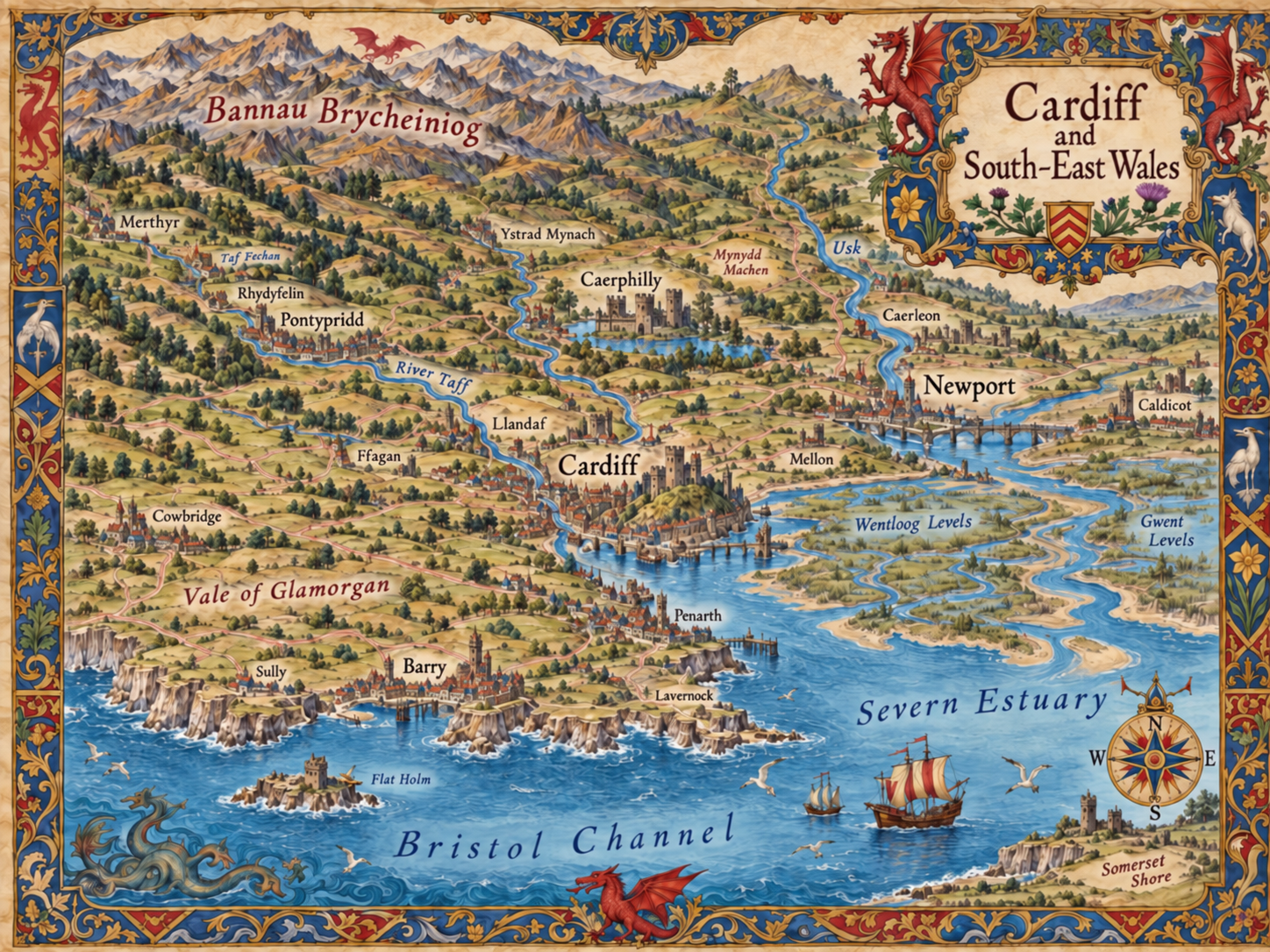
The River Taff ties the castle to the sea and the valleys beyond. Barges, fishing craft and shallow-draught boats move goods and people through a landscape where mud, tide and weather can be as decisive as armed men. Penarth and Barry watch the western approaches, while the Severn Estuary opens eastward toward Bristol and the wider sea.
East of Cardiff, the Wentloog and Gwent Levels form a low, wet country of drainage channels, reed beds, raised tracks and sudden mist. Smugglers know which banks remain firm after rain. Spirits know older paths that no surveyor has marked. Northward, roads toward Caerphilly and the Bannau Brycheiniog climb into harsher ground where news of dragon movement can close a route before any mortal army appears.
Dungeon: The Castle Under Cardiff
The strongest dungeon in Cardiff is not an abandoned ruin beyond the town. It is the occupied castle itself, descending through centuries of construction into spaces that remain physically connected to the living stronghold above.
The Working Castle
Cellars, store rooms, prison spaces, wells and service passages belong to the active household. Guards, prisoners, servants and officials move through them every day. Any descent begins inside a place that has owners, routines and consequences.
The Roman Underfort
Behind later masonry survive blocked Roman corridors, wall footings, drains and sealed chambers from successive forts. Some passages were filled deliberately when the medieval castle rose; others remain accessible through cracked floors, old wells or forgotten stairways. A collapsed section can lead beneath an occupied tower while still carrying sound from the rooms above.
Cisterns, Cells and Forgotten Passages
Waterworks and prison spaces make the lower levels dangerous even without monsters. Flooded culverts rise with heavy rain and tide. A breached wall can drain a cistern into an older chamber. A prisoner who discovers a Roman void may escape into the foundations rather than out of the castle, forcing pursuers into territory no gaoler understands.
The Chamber Before the Fort
Below the Roman layers lies older ground: a stone-lined sacred chamber built around a spring and a dark standing stone. The place remembers vows made before written charters. Its power does not care which lord currently holds Cardiff. Disturbing it can sour the castle well, call a river spirit into the Taff, or awaken a claimant whose right to the land is older than the fort above.
Nothing below Cardiff stays isolated from the town. A opened passage changes prison security. A poisoned spring changes market life. A released spirit changes river traffic. A recovered tablet can destroy a legal claim in the court above. The dungeon and the living city are the same location seen at different depths.
Creatures of Cardiff and Glamorgan
Gwyllion
Gwyllion haunt the mountain roads north of Glamorgan, especially where mist closes over steep paths leading toward Bannau Brycheiniog. Travellers who follow the wrong voice may walk for hours and return to the same stone, or vanish into country where ordinary roads no longer lead.
Bendith y Mamau
The Bendith y Mamau keep to old field boundaries, hidden hollows and places where the Vale of Glamorgan still remembers older agreements between mortals and the fair folk. Gifts, insults, broken promises and the treatment of children can matter more to them than coin or law.
Hounds of Arawn
Hounds of Arawn cross the southern roads on nights when the boundary with Annwn thins. Their distant cries are heard over the Levels, along river mist and on lonely tracks beyond the town walls. They are not stray beasts; their presence means the Otherworld has taken an interest.
Sea Serpents
Sea serpents move through the deeper waters of the Bristol Channel and Severn approaches. Most ships never see one clearly, but a single territorial serpent can close a fishing ground, scatter coastal traffic and make every damaged hull arriving at Cardiff a source of anxious rumour.
The Red Dragons of Southern Wales
The mountains north of Cardiff lie within the wider territory of the Red of Bannau Brycheiniog, a Chaotic Evil great red dragon of Wales. It rules through fear, treasure and exemplary destruction. Its principal lairs lie far from the town, but its hunting range, tribute demands and political influence reach south into Glamorgan.
Cardiff’s merchants know the cost of that proximity. Scorched livestock, closed upland roads, missing caravans and sudden demands for treasure can alter prices at the port within days. Welsh claimants and marcher lords also understand the greater danger: a dragon that recognises a ruler, accepts tribute from a house or destroys a rival can change mortal politics without ever entering the town.
Younger red dragons and displaced scions sometimes descend from the uplands seeking treasure, territory or recognition. Cardiff therefore treats dragon sightings as political intelligence as much as monster reports.
People in Cardiff’s Wider World
Taliesin is known in Glamorgan’s halls as poet, seer and dangerous keeper of old memory. His presence can turn a political quarrel into a contest over ancestry, prophecy or the true name of a place.
King Arthur remains part of the political and mythic landscape of southern Wales, with Caerleon to the east carrying the weight of his court and campaigns. Merlin is sought when Roman ruins, prophecy and older Brittonic powers begin speaking through the same place.
Gwyn ap Nudd, king of Annwn and lord of the Wild Hunt, is felt less through formal audiences than through thresholds: impossible mist, spectral hounds, riders heard where no road runs and bargains that bind the living to the Otherworld.
Old Powers and Sacred Boundaries
Cardiff’s sacred life is layered like its walls. River offerings belong to the Taff and its local spirits; household rites belong to families and guilds; older stones keep powers whose names are not spoken casually. The Welsh and Brittonic powers are not interchangeable, and no single cult controls the town.
Arawn‘s authority is strongest where roads, burial grounds, river mist and dream touch Annwn. His hounds are feared because they announce a boundary becoming active. Farther north, Math fab Mathonwy rules a very different sacred field of court-law, oath, naming and magical judgement. Cardiff lies outside Math’s core power in Gwynedd, but jurists, bards and Welsh nobles know exactly what his stories mean when a forged genealogy or broken oath enters a court.
Aeron is invoked where river crossings become battlefields and blood enters running water, but the Taff is not her river. In Cardiff her name is heard chiefly among warriors and travellers who have brought her rites from elsewhere in Wales.
Historical and Mythological Context
The castle’s layered structure has a firm historical foundation. Archaeology and the castle’s own history record a sequence of Roman forts beginning in the first century, with a later stone fort establishing much of the footprint that medieval builders reused. Norman lords then raised a motte-and-bailey castle within the Roman defences before the site developed into the major medieval stronghold that dominates Cardiff.
South Wales also places Cardiff beside one of Britain’s densest meeting points between archaeology and Arthurian tradition. Caerleon’s Roman amphitheatre, east of Cardiff, was later identified in medieval tradition with Arthur’s Round Table. Near Cardiff, the great chambered tomb at St Lythans carries a possible name-link to Culhwch and Olwen, while the Book of Taliesin was copied by a scribe probably working in Glamorgan and preserves poems of Arthur, Annwn and early Brittonic memory.
Cardiff Castle — History · Cardiff Castle — Timeline · Cadw — Lords of the Southern March · Cadw — Caerleon Roman Amphitheatre · Cadw — Chambered Tomb near Cardiff · National Library of Wales — Book of Taliesin
Keep this reference growing
If this page helped with your reading or game, you can support its upkeep or explore the curated books.
Explore the Bookshop — epics, classics and stories behind imagined worlds.