
Orkney — Norwegian Earldom at Scotland’s Northern Gate
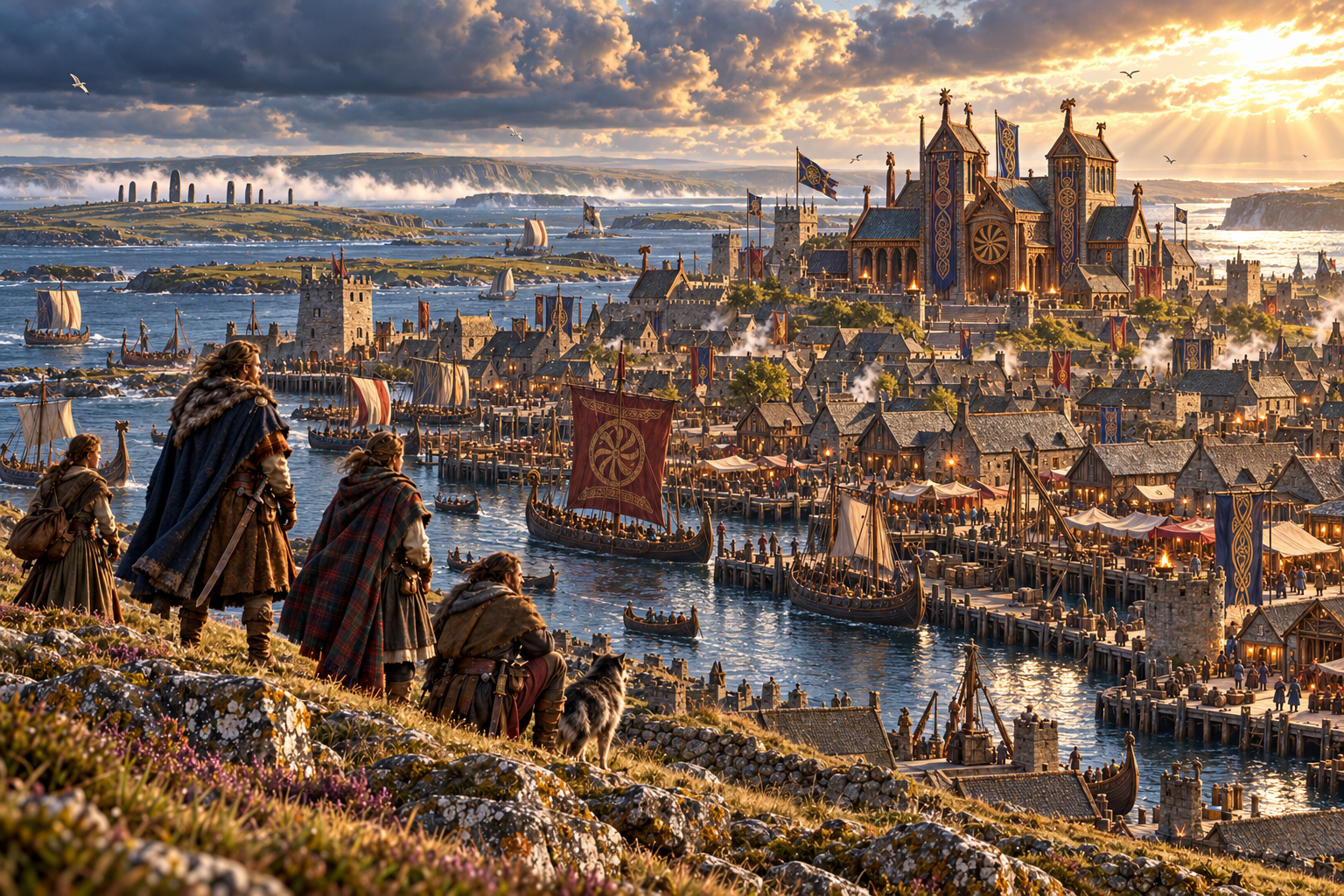
North Atlantic · Norwegian fief · Sinclair earldom · Norse-Scottish crossroads
Orkney sits close to Scotland but does not yet belong to the Scottish Crown. In 1454 it remains a Norwegian fief held by William Sinclair, Earl of Orkney, a magnate deeply involved in Scottish politics and appointed Chancellor of Scotland in this same year.
At a Glance
| Status | Earldom held as a fief of the Norwegian Crown |
|---|---|
| Earl | William Sinclair, Earl of Orkney |
| Principal centre | Kirkwall and the Great Sanctuary of Magnus |
| Languages and culture | Norse/Norn traditions, Scots connections, ritual speech, heroic cults and maritime culture |
| Best for | Sea travel, divided loyalties, Norse ruins, sanctuary mysteries, ancient monuments and island horror |
| Signature threat | Nuckelavee |
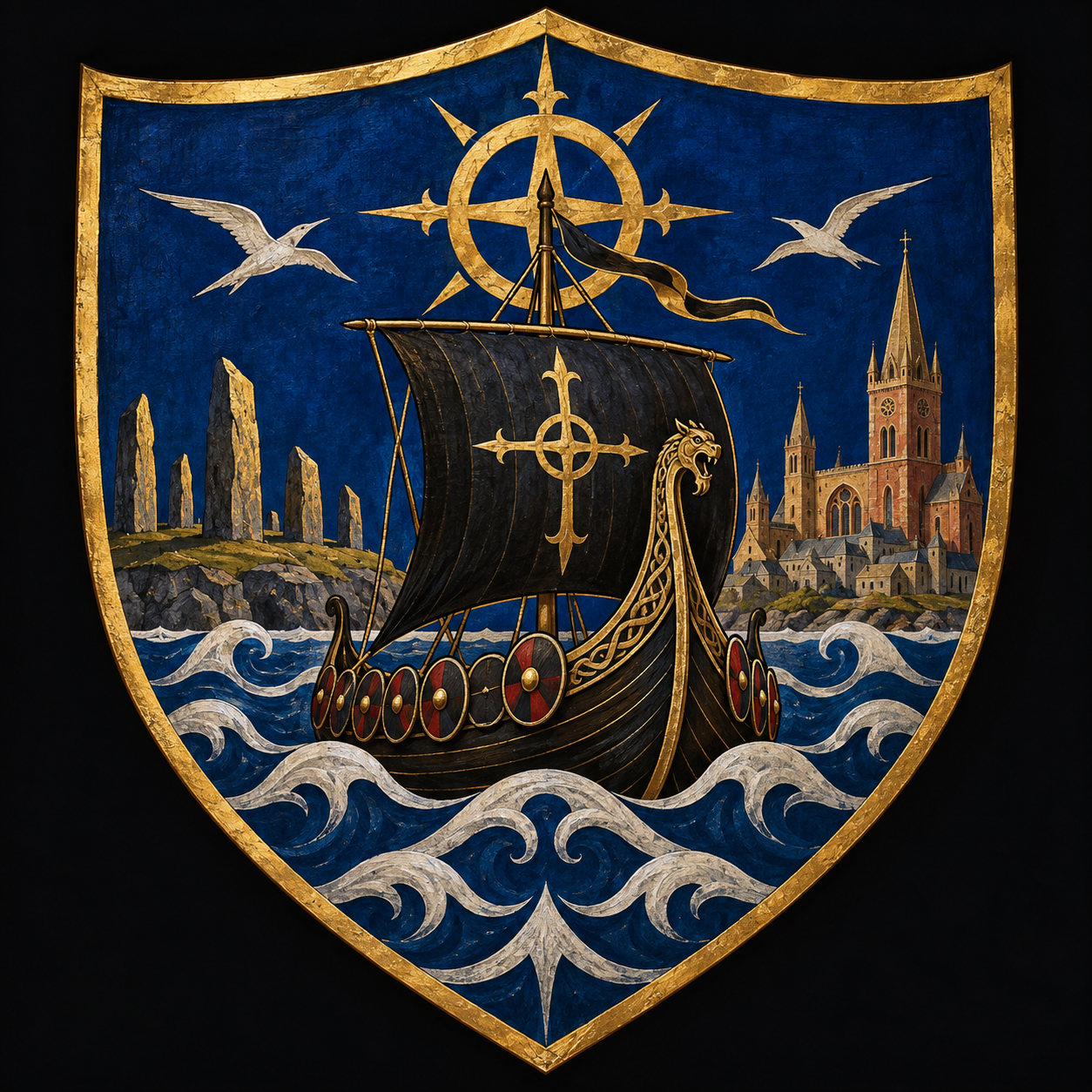
What Is Happening Right Now?
William Sinclair’s position embodies Orkney’s political tension. He holds the earldom under Norwegian sovereignty yet serves at the highest levels of Scottish government. A letter from Bergen and a command from James II can therefore pull the same household in different directions without either side considering the contradiction theoretical.
Orkney’s sea-roads also connect Scotland to Norway and the wider North Atlantic. Sailors carry news faster than officials can control it. A ship arriving from the north can bring merchants, temple envoys, law-speakers, royal messages, monsters or proof that somebody has lied about what happened offshore.
Run Orkney Tonight
The Norwegian Seal
A royal messenger disappears carrying sealed instructions concerning the earldom. Scottish agents want the letter recovered before anyone reads it. A Norwegian representative wants proof the seal was never broken.
The Horse Without Skin
Livestock die along a shore and every local refuses to travel after sunset. The signs point toward the Nuckelavee. The problem is not merely killing it; island tradition insists that disturbing the wrong water will release it again.
The Stone House Beneath the Field
A collapsed field reveals masonry far older than the Great Sanctuary of Magnus. A local family claims ancestral rights to whatever lies below. A scholar from Glasgow argues that the discovery belongs to learning. Something inside recognises neither claim.
Kirkwall and the Great Sanctuary of Magnus
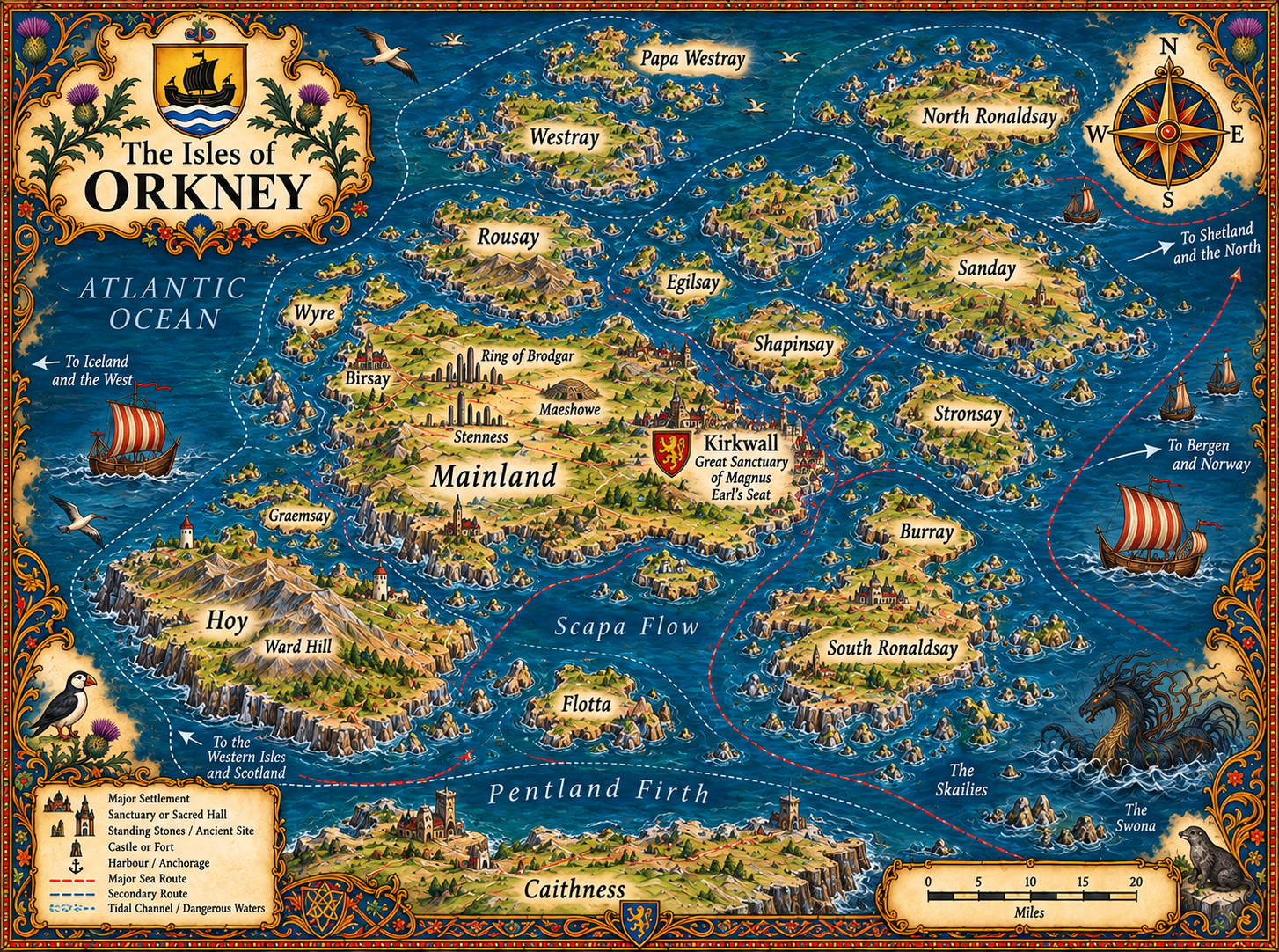
Kirkwall is the political and ritual centre of the islands. The Great Sanctuary of Magnus gives the town sacred weight and a physical link to Orkney’s Norse past. Earl Magnus is honoured here through an ancestral hero-cult woven into Orcadian law, memory and sea-lordship. The sanctuary, the earl’s officers, merchants and sea captains make Kirkwall the natural starting point for an island campaign.
The Dungeon Beneath the Sanctuary
The Great Sanctuary is not an abandoned ruin. Its upper halls are active every day: oath-taking, legal judgments, public rites, feasts, petitions and meetings with the earl’s officers all take place above ground. Adventurers can enter openly, but that does not give them the right to go below.
Beneath the public sanctuary lie older Norse foundations used as oath-vaults, ancestral chambers, sealed treasuries and restricted ritual rooms. These passages are guarded, mapped and known to the sanctuary’s keepers. A party reaching them is trespassing, acting under exceptional authority or following a crisis that has made the forbidden levels suddenly necessary.
Deeper still is the true dungeon: an undercroft that predates the Norse sanctuary. Its masonry does not match the halls above, some passages descend toward the harbour, and others end in stonework older than Kirkwall itself. Sealed doors, forgotten burial chambers, drowned tunnels and places where the island’s ancient sacred landscape presses close to the present turn this lowest level into dangerous exploration rather than ordinary temple storage.
Run the sanctuary in three layers: living sanctuary above, restricted ancestral vaults below, ancient dungeon beneath both. Trouble in the deepest level should threaten the functioning city overhead, so exploring it is never separate from Orkney’s politics, law and ritual life.
Ancient Orkney
Orkney’s monumental landscape is much older than the earldom. Maeshowe, the Stones of Stenness, Skara Brae and related sites belong to deep human history rather than to elves, dwarves or giants. They can still hold supernatural consequences, but their builders remain the ancient island communities established elsewhere in the timeline.
This matters at the table: an old chamber is not automatically a monster lair. It may be a burial place, ritual site, archive, sealed crossing or location protected by descendants who still remember what outsiders have forgotten.
Arthurian and Norse Connections
Orkney also sits naturally beside the site’s Arthurian material. Characters such as Sir Gawain and Sir Gareth of Orkney carry legendary connections to the islands, while the region’s historical political identity remains Norse and North Atlantic rather than simply Scottish.
Sea Routes and Travel
Orkney is a maritime region. Kirkwall, Scapa Flow and the channels between the islands connect local settlements to Caithness, the western seaways, Shetland, Bergen and the wider North Atlantic. Weather, tide and local pilots matter as much as distance.
Historical and Mythological Context
Orkney’s medieval identity grew from centuries of Norse rule rather than from simple proximity to Scotland. Historic Environment Scotland — Earl’s Bu at Orphir preserves archaeological and documentary context for the Norse earldom and is closely associated with the Orkneyinga Saga, which recounts the history of the earldom from its legendary Norwegian conquest through the age of the Norse earls. The saga itself was written long after the earliest events it describes, so it is best used alongside archaeology rather than as a literal contemporary chronicle.
Magnus is honoured in Orkney as an ancestral heroic power whose death during a struggle over the earldom became central to island memory. Historic Environment Scotland — Egilsay and Earl Magnus preserves the real-world historical landscape associated with his death. The Great Sanctuary of Magnus in Kirkwall draws its monumental architecture and civic prominence from the real-world structure documented by Historic Environment Scotland — Kirkwall monument record. Its rites are Norse-Orcadian, centred on heroic memory, law, oaths, sea-lordship and public ritual.
The islands’ sacred geography reaches much further back. The Heart of Neolithic Orkney contains Skara Brae, Maeshowe, the Stones of Stenness and the Ring of Brodgar, one of the richest surviving Neolithic landscapes in western Europe. Maeshowe is especially useful for the setting because Norse visitors later carved runic graffiti into the prehistoric tomb, leaving one of the largest surviving collections of runic inscriptions outside Scandinavia.
Orcadian folklore adds another layer rather than replacing those histories. Nineteenth-century folklorist Walter Traill Dennison recorded sea tales learned from Sanday crofters and cottars; Orkney Museums describes his work as the most important preserved collection of traditional Orcadian folk tales. His records include the skinless sea-monster Nuckelavee, whose breath brings blight and disease and which fears fresh running water. The surviving written account is late, so it should be treated as evidence of a long oral tradition rather than proof that every detail was told in exactly the same form in 1454.
Orkney Museums — Walter Traill Dennison and Orcadian Folklore · Orkney Museums — The Vikings’ Arrival and the Orkneyinga Saga
Historical Foundation
William Sinclair received formal investiture as Earl of Orkney in 1434 under the Norwegian king and was summoned to renew allegiance in 1446. He became Chancellor of Scotland in 1454. Orkney did not pass into Scottish control until the later fifteenth century.
Scandinavian Journal of History — The Earldom of Orkney in 1434 · Historic Environment Scotland — Ravenscraig and William Sinclair