
Tower Shield
A tower shield is a massive wooden barrier carried into a fight. It can screen its bearer from arrows and help hold a dangerous approach, but its bulk occupies a hand and makes attacking harder. In every edition, it is built for defenders who would rather hold their ground than chase an enemy.
Tower Shield at a Glance
- Form: a massive wooden shield, roughly as tall as its wielder; a protective barrier rather than a light duelling shield.
- Best use: holding exposed approaches and shielding the bearer from missiles, with a trade-off in freedom of movement and attacks.
- Hand and weapon: the bearer cannot use the shield hand for another task or make a shield bash with it in the legacy rules.
- Legacy trade-off: Pathfinder 1e and D&D 3.5e grant +4 shield AC, alongside hefty armour-check and attack penalties.
- In fifth edition: +3 AC in hand, or three-quarters cover when braced against one direction.
Rules by edition · Using cover in play · Original Pathfinder reference

Tower Shield Rules by Edition
Select an edition for the shield’s protection, bracing manoeuvre and movement penalties.
Tower Shield — D&D 2024
Campaign equipment · Shield. A tall, reinforced wooden shield built to screen a defender from arrows and hold a passage.
| Armor | Armor Class (AC) | Strength | Stealth | Weight | Cost |
|---|---|---|---|---|---|
| Tower Shield | +3 (Shield Training) | Str 15 | Disadvantage | 45 lb. | 30 GP |
Wielding: Shield Training is required for the AC bonus. If your Strength is below 15, your Speed is reduced by 10 feet. A tower shield occupies one hand, cannot be used for a shield bash, and does not stack with another Shield. Donning or doffing takes the Utilize action.
Brace for cover: take the Utilize action to plant the shield and choose one direction. Until the start of your next turn, you gain Three-Quarters Cover (+5 to AC and Dexterity saving throws) from attacks and effects originating beyond that side instead of the tower shield’s +3 AC bonus. While braced your Speed is 0, and you cannot make attacks. Enemies attacking from other directions receive no benefit from the planted shield; resume its +3 Shield AC bonus once you unbrace.
Tower Shield — D&D 2014
Campaign equipment · Shield. This great wooden barrier demands strength and keeps a defender alive under heavy missile fire.
| Armor Name | Cost | Armor Class (AC) | Strength | Stealth | Weight |
|---|---|---|---|---|---|
| Tower Shield | 30 gp | +3 | Str 15 | Disadvantage | 45 lb. |
Wielding: shield proficiency is required. If your Strength is below 15, your speed is reduced by 10 feet while you wield it. The shield hand cannot hold another item, the shield cannot bash, and you cannot benefit from two shields. Donning or doffing takes one action.
Brace for cover: as an action, plant the shield to protect a chosen direction until the start of your next turn. Against attacks and effects from that side, you gain three-quarters cover (+5 AC and Dexterity saving throws) instead of its +3 shield AC bonus; the two bonuses do not stack. While braced, your speed is 0 and you cannot attack. Attacks from other sides bypass the cover.
Tower Shield — Pathfinder 1e
Published tower shield. The stray superscript 3 in the original catalogue referred to a cover footnote, not the decimal +4.3.
Category: Shield.
| Armor | Cost | Armor/Shield Bonus | Maximum Dex Bonus | Armor Check Penalty | Arcane Spell Failure Chance | Speed (30 ft.) | Speed (20 ft.) | Weight |
|---|---|---|---|---|---|---|---|---|
| Shield, tower | 30 gp | +4 | +2 | −10 | 50% | — | — | 45 lb. |
Edition-specific rules:
- Attacking: –2 on attack rolls when using the tower shield.
- Cover: As a standard action, select one edge of your space to gain total cover against attacks crossing it until your next turn; restrictions apply to targeted spells. It cannot be used to shield bash.
In play: Hold the passage against incoming archers, but weigh the attack penalty, occupied hand and which direction the cover actually protects.
Source: Pathfinder 1e equipment rules.
Tower Shield — D&D 3.5e
Published D&D 3.5e tower shield. Read its cover and action rules in the 3.5e source even where values resemble Pathfinder.
Category: Shield.
| Armor | Cost | Armor/Shield Bonus | Maximum Dex Bonus | Armor Check Penalty | Arcane Spell Failure Chance | Speed (30 ft.) | Speed (20 ft.) | Weight |
|---|---|---|---|---|---|---|---|---|
| Shield, tower | 30 gp | +4 | +2 | −10 | 50% | — | — | 45 lb. |
Edition-specific rules:
- Attacking: –2 penalty on attack rolls because of the shield’s encumbrance.
- Cover: You can use a tower shield as total cover instead of attacking (give up your attacks to do so). The D&D 3.5e SRD does not describe this as Pathfinder’s choose-one-edge standard-action procedure. Targeted spells may still affect you; you cannot bash with this shield or use the shield hand for anything else.
In play: The 3.5e shield bonus is not extra AC from a second shield; its total-cover action changes how the shield is used in that turn.
Source: D&D 3.5e equipment rules.
Using a Tower Shield in Play
Hold an arrow lane. The shield bearer stands at the mouth of a narrow passage as archers fire down it. In Pathfinder 1e, the bearer can use a standard action to choose the threatened edge of their space, treating it as a wall for qualifying attacks until the beginning of their next turn. A foe approaching from another direction can get around that protection; a spellcaster targeting the bearer may still target the held shield.
The 3.5e choice differs. That edition permits the shield to be used as total cover instead of attacking: the bearer gives up attacks to shelter behind it, rather than applying Pathfinder’s specified edge-and-standard-action procedure. In fifth edition, bracing the shield also gives three-quarters cover against the chosen approach, replacing its shield AC bonus; a foe circling behind it finds the defender exposed.
What it costs: the published legacy tower shield weighs 45 lb., occupies the shield hand, imposes a –2 attack penalty, and has a –10 armour check penalty. It cannot make shield-bash attacks. That is a meaningful equipment choice for a defender, not an extra +4 that everyone should take.
Construction and Historical Use
A large battlefield shield needs a broad wooden body strong enough to stop arrows yet manageable by its owner, with a sound grip or carrying arrangement and a finish that resists the weather. Splits, loose joints and damaged bindings matter most when its job is to catch a volley. A timber shield is easier to patch than an ornate metal harness, but replacing badly broken boards can still require a shield-maker.
Do not confuse the game item with every large shield in history. A medieval pavise could be planted or braced as cover for a crossbowman while reloading. A Roman scutum belonged to another large-shield tradition. Neither is evidence that the Pathfinder and D&D 3.5e cover actions existed in actual medieval combat. Use the history to make encounters believable, and the edition’s rules to settle attacks.
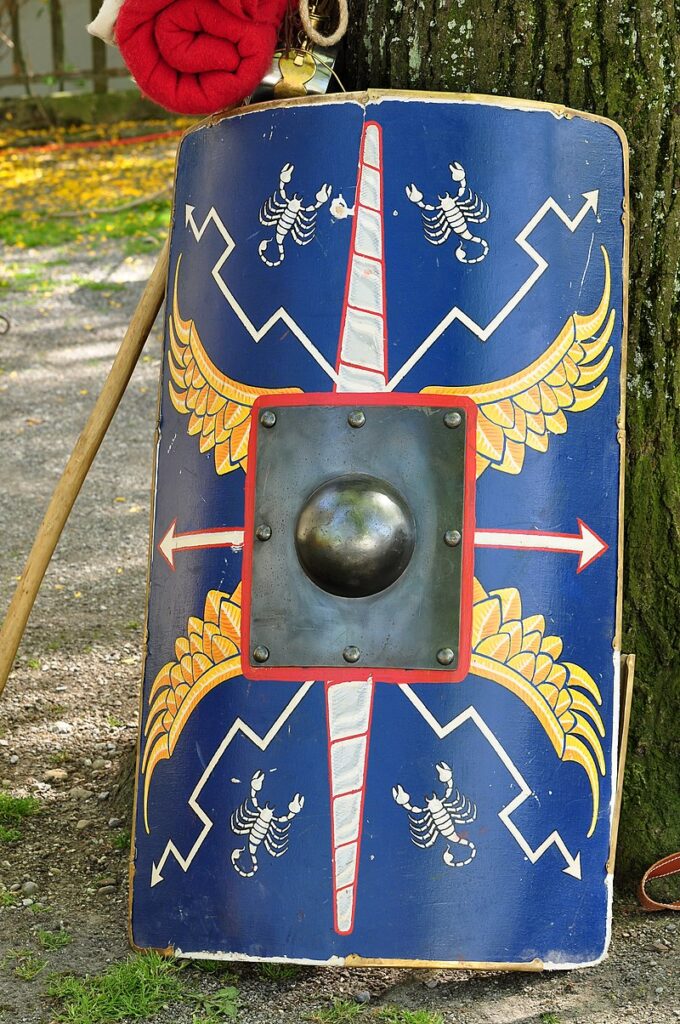
Historical comparison — a Roman scutum
This site’s original photograph shows a Roman legionary reenactment rather than a medieval pavise. It remains here as an example of a different large-shield tradition.
Original Pathfinder 1e Reference
The older Pathfinder stat table is retained here in a legible form. Its +4 shield bonus was followed by a source footnote about cover; it was never the decimal number +4.3. Expand the source below if you need its full wording.
Show the original tower shield statistics and Pathfinder description
| Shield | Cost | Shield bonus | Max. Dex bonus | Armour check penalty | Arcane spell failure | Speed (30 ft. base) | Speed (20 ft. base) | Weight |
|---|---|---|---|---|---|---|---|---|
| Tower shield | 30 gp | +4 (cover note) | +2 | –10 | 50% | — | — | 45 lb. |
This massive wooden shield is nearly as tall as its bearer. It can block an arrow lane or a narrow passage, but its weight and attack penalty make it awkward when the bearer needs a free hand.
Pathfinder 1e cover: as a standard action you choose one edge of your space. Attacks passing through that edge are blocked as if by a solid wall, until the beginning of your next turn; other directions get no cover. This does not stop targeted spells through the held shield. The shield cannot be used to bash and its hand is not free. A tower-shield user takes a –2 attack penalty for encumbrance.
Source of these legacy values: Pathfinder Roleplaying Game Core Rulebook — Equipment.
Related Equipment and Sources
Armour & Shields directory · Full Plate · Armor Class (legacy additive AC rules). Rules: D&D 2024, D&D 2014, Pathfinder 1e, D&D 3.5e SRD.
Rules Credits and Licence
The original Pathfinder tower shield data is drawn from Pathfinder Roleplaying Game Core Rulebook, Copyright 2009, Paizo Publishing, LLC, author Jason Bulmahn (based on material by Jonathan Tweet, Monte Cook and Skip Williams), under Open Game License v1.0a. Related legacy sources include System Reference Document, Copyright 2000, Wizards of the Coast, Inc., and Open Game License v1.0a, Copyright 2000, Wizards of the Coast, Inc. D&D fifth-edition SRD comparisons use Wizards of the Coast material under CC BY 4.0; the surrounding commentary is original editorial material.
Keep this reference growing
If this page helped with your reading or game, you can support its upkeep or explore the curated books.
Explore the Bookshop — epics, classics and stories behind imagined worlds.