
Sceaduinar — Void-Raptor of the Negative Energy Plane
A sceaduinar is living entropy given wings: not undead, not mortal, and hateful toward both life and unlife.
Overview
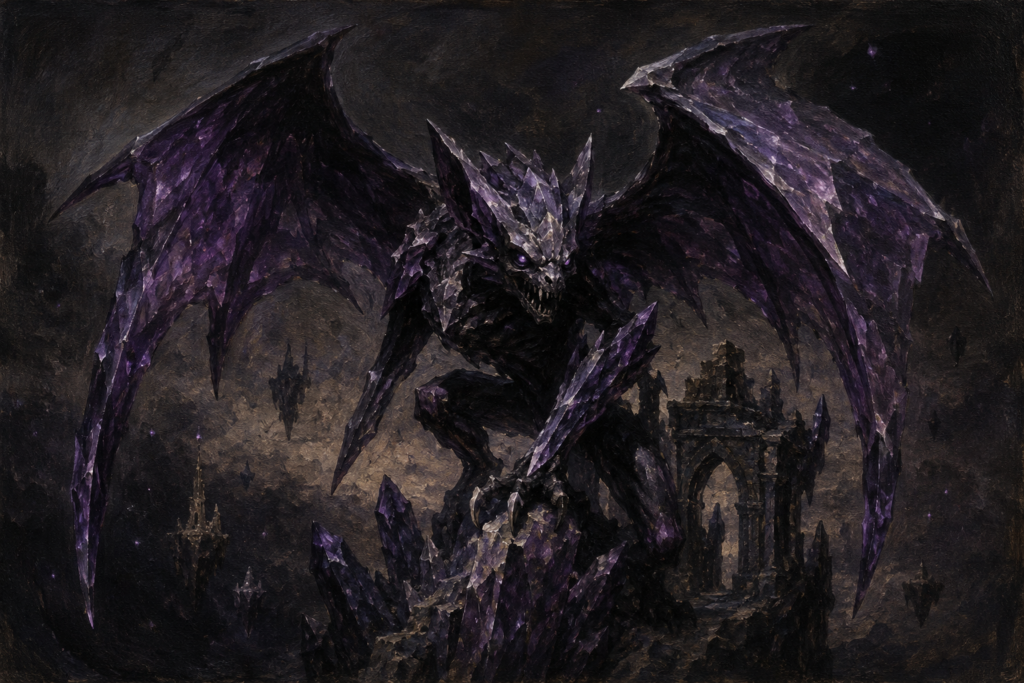
A sceaduinar is born where the Negative Energy Plane condenses into impossible crystal. In the deep Void, matter fails, light collapses, and black-violet entropy grows in jagged formations like frozen wounds. When one of these formations reaches the right pressure of silence, hunger, and anti-life, it cracks. A fully grown sceaduinar tears itself free from the crystal and takes wing without childhood, parent, memory, or mercy.
It is not an undead creature. It is not a demon. It is not a shadow wearing a body. It is a native thing of negative energy: intelligent, cruel, and almost religiously offended by creation.
Living beings offend it because they carry warmth, breath, growth, and soul. Undead offend it because they are failed endings, corpse-motion pretending that death has not completed its work. To a sceaduinar, both life and undeath are violations.
A party may first meet one while it is destroying a necromancer’s servants, tearing apart a wraith, or hunting a vampire through the ruins of a dead-world fragment. That does not make it an ally. It simply has not reached the party yet.
Appearance
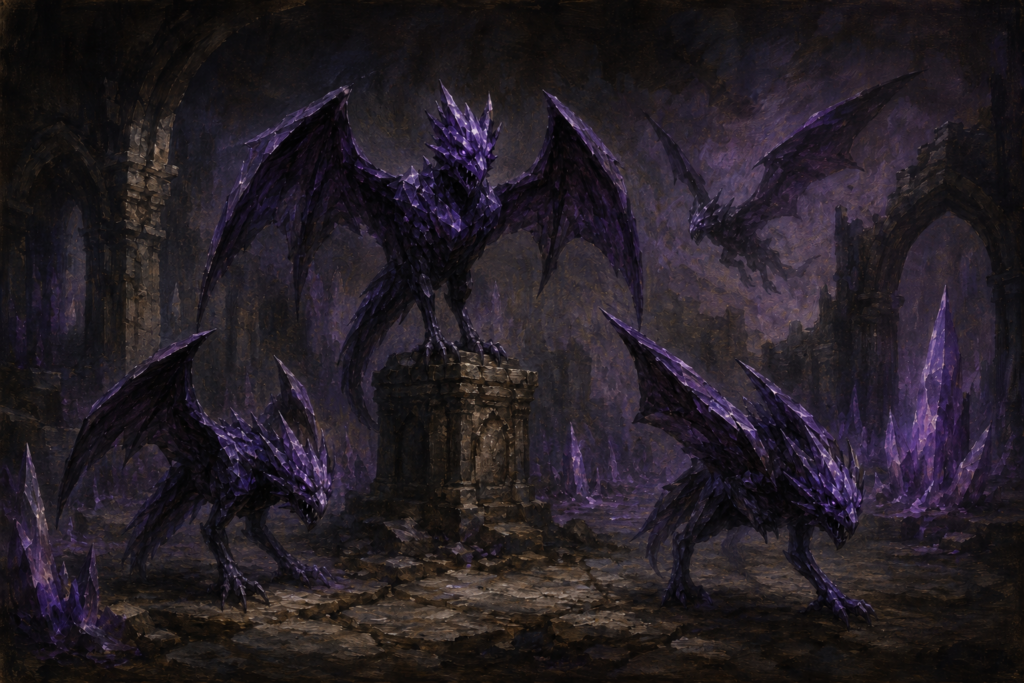
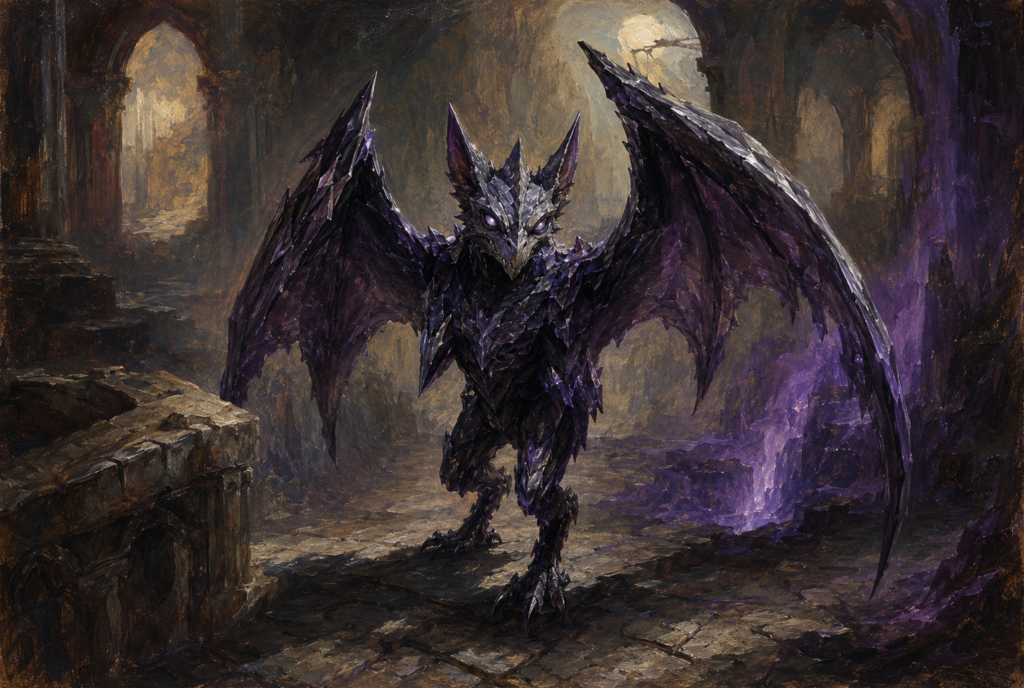
A sceaduinar resembles a crystalline gargoyle or void-raptor. It stands taller than a human, but its body is unnervingly light, as if the inside is made from hollow mineral lattices rather than organs. Its limbs are long, hooked, and serrated. Its skull is bat-like, narrow, and predatory. Its wings are not soft skin but thin plates of living black-purple crystal that flex through impossible angles.
Its colour ranges from dark amethyst to bruised violet, obsidian, dead silver, and starless black. Thin cracks of cold light move beneath its surface. These cracks do not glow with warmth; they seem to reveal an absence behind the creature, as if the world is thinner wherever it stands.
When wounded, a sceaduinar does not bleed. It sheds black glass, grey dust, and flakes of darkness that vanish before they touch the ground.
Habitat
Sceaduinars are most common in the Deep Void and around entropy-crystal birth-fields of the Negative Energy Plane. They may also appear near the plane’s border regions when a portal, necromantic engine, failed resurrection, dead-world fragment, or black-star threshold opens a route into mortal reality.
They are especially likely around:
- entropy-crystal fields;
- failed necromantic gates;
- dead-world ruins drifting in the Void;
- tomb-machines built to resist death;
- lich laboratories harvesting negative energy;
- black-star portals above mortal cities;
- sealed resurrection chambers where a soul failed to return;
- gravewind-scarred regions where life, memory, and magic are being stripped away.
Sceaduinars can exist on the Material Plane for extended periods, but they do not settle there comfortably. Mortal reality is too warm, too fertile, too loud, and too full of unfinished life. A sceaduinar stranded outside the Void usually becomes more violent, not less.
Ecology
A sceaduinar does not reproduce by mating, infection, corpse-making, or soul theft. It emerges from entropy crystal.
These crystals grow in places where negative energy becomes dense enough to imitate matter. Most remain inert hazards or valuable planar reagents. A few form birth-knots. When disturbed by mining, magic, battle, or planar pressure, such a knot may split and release a sceaduinar.
This gives sceaduinar broods an alien rhythm. A birth-field may remain silent for centuries, then release several void-raptors in one night. The new creatures do not recognise family in a mortal sense, but they do recognise the field that produced them. They defend it with territorial violence.
Sceaduinars do not build cities. They do not farm, trade, marry, sing for joy, raise children, or keep written law. They do have tactics, memory, spite, hierarchy during crisis, and a cold understanding of planar geometry. Their gatherings are practical: death squads, crystal-wardens, portal packs, void hunters, and temporary war-flocks.
Behaviour
A lone sceaduinar is a patient hunter. It circles before it strikes, watching breath, light, healing magic, fear, holy marks, necromantic auras, and the behaviour of the dead. It prefers to attack from darkness, height, or a broken angle of terrain.
A sceaduinar pack is worse. A death squad moves like a flock of knives. One forces the front line to turn. One dives at the healer. One harasses spellcasters. Others wait for panic, separation, or a failed retreat.
They are intelligent enough to speak, bargain, and plan, but most do not enjoy conversation with living creatures. If a sceaduinar negotiates, it does so because a target matters more than its hatred. It may briefly tolerate mortals who lead it to a lich, nightshade servant, soul-thief, or stolen entropy crystal. Once the immediate purpose ends, the bargain becomes fragile.
Sceaduinars do not respect undeath. They cut ghosts, wraiths, spectres, vampires, lich-servants, and corpse-things with the same hatred they show the living. They may even be useful enemies against undead tyrants, but only a reckless party mistakes that for friendship.
Personhood and Consequence
A sceaduinar is an intelligent extraplanar being. In most mortal lands, killing one after it emerges from a portal and begins slaughter is treated as defence against a hostile planar predator.
The issue becomes complicated on the planes. In the Negative Energy Plane, sceaduinars are not invaders. They are native people. Mining their birth-fields, binding them into engines, or harvesting their entropy crystals can be trespass, theft, desecration, or war, depending on who claims the region and what has been damaged.
A sceaduinar rarely surrenders. It may retreat, bargain, mislead, or trade information, but surrender implies a value for continued existence that many sceaduinars barely possess. If captured, it is likely to offer portal routes, undead locations, crystal-field warnings, or the name of a greater threat.
Mechanics Tabs
The rules below are mechanics compatible for different game editions.
Sceaduinar 5.5e
Sceaduinar Pathfinder 1e / 3.5e
Sceaduinar 5.5e-Compatible Rules
Sceaduinar
Medium Outsider, Neutral Evil
Armor Class 17
Initiative +5
Hit Points 119 (14d8 + 56)
Speed 40 ft., fly 90 ft.
Proficiency Bonus +3
| STR | DEX | CON | INT | WIS | CHA |
|---|---|---|---|---|---|
| 17 (+3) | 20 (+5) | 18 (+4) | 13 (+1) | 14 (+2) | 17 (+3) |
Saving Throws Dex +8, Con +7, Wis +5
Skills Intimidation +6, Perception +8, Stealth +11
Damage Resistances acid, lightning, thunder; bludgeoning, piercing, and slashing from nonmagical attacks
Damage Immunities cold, necrotic, poison
Condition Immunities poisoned
Senses darkvision 120 ft., lifesense 60 ft., passive Perception 18
Languages Aklo; understands one mortal language learned from victims or planar travellers
Challenge 7 (2,900 XP)
Traits
Entropic Flesh. When a creature within 5 feet of the sceaduinar hits it with a melee attack, that creature takes 3 (1d6) necrotic damage. A creature attacking with a reach weapon avoids this damage if it is not within 5 feet of the sceaduinar.
Ghost-Cutting Body. The sceaduinar’s natural weapons are magical. Its natural attacks affect incorporeal creatures normally.
Lifesense. The sceaduinar senses living creatures and undead within 60 feet, unless they are behind total cover. This sense does not reveal constructs or objects.
Negative Energy Native. The sceaduinar is not undead. Effects that specifically turn, command, detect, or destroy undead do not affect it unless they also affect outsiders or creatures of negative energy.
Void Against Undeath. Necrotic damage dealt by the sceaduinar ignores resistance to necrotic damage possessed by undead. If an undead creature would normally regain hit points from necrotic damage, it takes the damage from the sceaduinar instead.
Void Child. The sceaduinar has advantage on saving throws against effects that target its soul, reveal its true identity, or locate it through divination. If a spell or magical effect would restore a destroyed sceaduinar to life, the spell fails unless the caster has direct divine aid, a wish-level effect, or a prepared entropy-crystal core from the creature’s birth-field.
Magic Resistance. The sceaduinar has advantage on saving throws against spells and other magical effects.
Actions
Multiattack. The sceaduinar makes three attacks: one Bite attack and two Wing Razor attacks.
Bite. Melee Weapon Attack: +8 to hit, reach 5 ft., one target. Hit: 8 (1d6 + 5) piercing damage plus 7 (2d6) necrotic damage. If the target is a creature, it must succeed on a DC 15 Constitution saving throw or its hit point maximum is reduced by the necrotic damage taken. This reduction lasts until the target finishes a long rest. The target dies if this effect reduces its hit point maximum to 0.
Wing Razor. Melee Weapon Attack: +8 to hit, reach 10 ft., one target. Hit: 8 (1d6 + 5) slashing damage plus 3 (1d6) necrotic damage.
Entropic Touch. Melee Spell Attack: +8 to hit, reach 5 ft., one creature. Hit: 21 (6d6) necrotic damage, and the target cannot regain hit points until the start of the sceaduinar’s next turn.
Void Spellcasting. The sceaduinar casts one of the following spells, requiring no material components. Charisma is its spellcasting ability, spell save DC 14, +6 to hit with spell attacks.
At will: chill touch, darkness, detect magic
3/day each: dispel magic, enervation, silence
1/day each: antilife shell, harm, teleport self only
Bonus Actions
Void Skim. The sceaduinar teleports up to 30 feet to an unoccupied space it can see that is in dim light, darkness, or within 10 feet of an entropy crystal.
Reactions
Crystal Recoil. When the sceaduinar takes radiant damage or force damage from a creature it can see within 60 feet, it sheds a burst of black crystal. The attacker must succeed on a DC 15 Dexterity saving throw or take 7 (2d6) necrotic damage.
D&D 5.5e Variant Sceaduinars
Use these variants when a normal sceaduinar is too simple or when a death squad needs distinct roles.
Crystal-Warden
A crystal-warden guards a birth-field or entropy-crystal formation.
Adjustment: Increase hit points by 20.
Crystal-Bound Defence. The crystal-warden has advantage on saving throws while within 30 feet of an entropy crystal.
Entropy Crystal Eruption, 1/day. The crystal-warden chooses one entropy crystal it can see within 60 feet. Creatures within 10 feet of that crystal must make a DC 15 Dexterity saving throw, taking 14 (4d6) necrotic damage on a failed save, or half as much damage on a successful one.
Suggested Challenge: 8.
Shardsinger
A shardsinger collects death-cries, undead wails, gravewind tones, and the last sounds of extinguished souls.
Adjustment: Increase Charisma to 21.
Void Chime. Each creature of the shardsinger’s choice within 30 feet that can hear it must succeed on a DC 16 Wisdom saving throw or be frightened until the end of the shardsinger’s next turn. Undead have disadvantage on this saving throw.
Suggested Challenge: 8.
Splinter Twin
A splinter twin emerges from a malformed birth-crystal with extra limbs, doubled jaws, or a partially fused second body.
Adjustment: The splinter twin is Large. Increase hit points by 40.
Bite. Its Bite deals 12 (2d6 + 5) piercing damage plus 7 (2d6) necrotic damage.
Multiattack. The splinter twin makes four attacks: one Bite attack and three Wing Razor attacks.
Suggested Challenge: 9.
Void Hunter
A void hunter specialises in stalking a particular enemy: undead, mortal priests, necromancers, planar scholars, or positive-energy servants.
Chosen Prey. Choose one prey type: living humanoids, undead, celestials, spellcasters, or creatures carrying positive-energy magic. Once per turn, the void hunter deals an extra 7 (2d6) necrotic damage to a creature of that prey type when it hits with an attack.
Suggested Challenge: 8.
Wing Leader
A wing leader commands a death squad.
Adjustment: Increase Intelligence to 16 and hit points by 15.
Death-Squad Command. Allied sceaduinars within 60 feet that can see or hear the wing leader gain a +2 bonus to initiative rolls.
Reposition the Flock. Once per round, when an allied sceaduinar within 60 feet hits a creature with an attack, the wing leader may use its reaction to let that ally move up to half its speed without provoking opportunity attacks.
Suggested Challenge: 8.
Sceaduinar Pathfinder 1e / 3.5e-Compatible Rules
Sceaduinar
CR 7
XP 3,200
NE Medium outsider extraplanar
Init +5; Senses darkvision 120 ft., lifesense, low-light vision; Perception +17
Defence
AC 20, touch 16, flat-footed 14
hp 85
Fort +10, Ref +11, Will +5
Defensive Abilities entropic flesh, negative energy affinity, void child
DR 10/adamantine or good
Immune cold, death effects, disease, energy drain, poison
Resist acid 10, electricity 10, sonic 10
SR 18
Offence
Speed 40 ft., fly 90 ft. good
Melee bite +14 (1d6+3 plus 1d6 negative energy), 2 wings +9 (1d4+1 plus 1d6 negative energy)
Special Attacks energy drain, entropic touch
Spell-Like Abilities CL 9th; concentration +12
Constant: entropic shield, hide from undead
At will: bleed, dimension door self only, dispel magic
3/day: death knell, deeper darkness, enervation, inflict serious wounds, silence
1/day: antilife shell, greater teleport self plus carried objects only, harm, slay living
Statistics
| STR | DEX | CON | INT | WIS | CHA |
|---|---|---|---|---|---|
| 17 | 20 | 18 | 13 | 14 | 17 |
Base Atk +9; CMB +12; CMD 28
Feats Dodge, Mobility, Skill Focus Perception, Step Up, Weapon Finesse
Skills Escape Artist +17, Fly +9, Intimidate +15, Knowledge nature +13, Knowledge planes +17, Perception +17, Sense Motive +14, Stealth +25
Racial Modifiers +4 Knowledge planes, +8 Stealth
Languages Aklo, one mortal language
Special Abilities
Energy Drain Su. A living creature hit by the sceaduinar’s bite gains 1 negative level. The DC is 17 to remove the negative level. The save DC is Charisma-based.
Entropic Flesh Ex. A creature that hits the sceaduinar with a melee attack takes 1d6 negative energy damage. A creature attacking with a reach weapon avoids this damage if it is not adjacent to the sceaduinar.
Entropic Touch Ex. The sceaduinar’s natural attacks function against incorporeal creatures as ghost touch weapons. Its natural attacks deal an additional 1d6 negative energy damage. This negative energy does not heal undead or other creatures normally healed by negative energy.
Negative Energy Affinity Su. The sceaduinar is sustained by negative energy, but it is not undead. It is treated as undead only for effects that heal or harm creatures through negative energy, positive energy, or similar life-force manipulation. It cannot be turned, commanded, rebuked, or controlled as undead.
Void Child Ex. The sceaduinar is immune to effects that target souls or require knowledge of its true identity. When destroyed, it cannot be restored except by miracle, wish, or direct divine intervention.
Lifesense Su. The sceaduinar notices living creatures and undead within 60 feet as if using blindsense, though barriers that block line of effect also block this sense.
Variant Sceaduinars
Use these variants when a normal sceaduinar is too simple or when a death squad needs distinct roles.
Crystal-Warden
A crystal-warden guards a birth-field or entropy-crystal formation.
CR Adjustment: +1
Defensive Adjustment: Increase natural armour by +2.
Crystal-Bound Defence Su. While within 30 feet of an entropy crystal, the crystal-warden gains a +2 resistance bonus on saving throws.
Entropy Crystal Eruption Su, 1/day. The crystal-warden causes one entropy crystal within 60 feet to erupt. Creatures within 10 feet of the crystal take 4d6 negative energy damage, Reflex DC 17 half. The save DC is Charisma-based.
Shardsinger
A shardsinger collects death-cries, undead wails, gravewind tones, and the last sounds of extinguished souls.
CR Adjustment: +1
Statistics Adjustment: Increase Charisma to 21.
Additional Spell-Like Abilities:
3/day: sound burst, enthrall
1/day: fear
These effects manifest as crystal resonance, gravewind tones, and stolen death-voices rather than normal song.
Splinter Twin
A splinter twin emerges from a malformed birth-crystal with extra limbs, doubled jaws, or a partially fused second body.
CR Adjustment: +2
Size Adjustment: Large
Statistics Adjustment: Increase Strength by +4 and Constitution by +2.
Defensive Adjustment: Increase natural armour by +2.
Melee Adjustment: Add one additional bite attack.
A splinter twin’s body is less graceful than a normal sceaduinar, but much harder to kill.
Void Hunter
A void hunter specialises in stalking a particular enemy: undead, mortal priests, necromancers, planar scholars, or positive-energy servants.
CR Adjustment: +1
Chosen Prey Ex. Choose one enemy group, usually undead, humans, divine spellcasters, arcane spellcasters, or outsiders with the good subtype. The void hunter gains a +4 bonus on Bluff, Knowledge, Perception, Sense Motive, and Survival checks against creatures of that group, and a +4 bonus on weapon damage rolls against them.
Wing Leader
A wing leader commands a death squad.
CR Adjustment: +1
Statistics Adjustment: Increase Intelligence to 16.
Bonus Feats: Combat Reflexes, Spring Attack.
Death-Squad Command Ex. Allied sceaduinars within 60 feet that can see or hear the wing leader gain a +2 bonus to initiative checks.
Reposition the Flock Ex. Once per round, when an allied sceaduinar within 60 feet hits a creature with a melee attack, that ally may move up to half its speed as an immediate action without provoking attacks of opportunity.
Combat Tactics
A sceaduinar is a flying skirmisher. It should not stand still unless it has trapped a victim, guards a birth-field, or knows the battlefield punishes pursuit.
Opening Moves
A sceaduinar begins with height, shadow, and separation. It uses darkness, ruins, dead-world debris, stalactite-like entropy crystals, broken towers, tomb arches, or black-star shadows to conceal its approach. If it has warning, it attacks from above.
Its first target is usually:
- the healer;
- the creature carrying a positive-energy relic;
- the obvious necromancer;
- an undead servant;
- the weakest isolated traveller;
- anyone damaging entropy crystals.
During the Fight
It uses Bite against living targets when it wants long-term harm. It uses Wing Razor to keep distance and punish movement. It uses Entropic Touch when healing needs to be shut down immediately.
Void Skim keeps it mobile. It should appear behind a healer, vanish into the underside of a bridge, cross a broken chamber without provoking easy retaliation, or retreat to a crystal ledge after forcing the party to split.
Against Undead
Against undead, the sceaduinar is direct and vicious. It does not hesitate, bargain, or preserve undead for later. It uses Ghost-Cutting Body and Void Against Undeath to make incorporeal undead vulnerable. This makes it useful as a third-party threat in adventures involving vampires, wraiths, liches, or necromantic courts.
Against Strong Melee Parties
The sceaduinar tries to make melee characters chase it. Entropic Flesh punishes adjacent attackers, while Wing Razor lets it use reach. It prefers ledges, open shafts, floating debris, high vaults, broken bridges, and unstable crystal fields.
Against Spellcasters
It uses silence, darkness, line-of-sight breaks, and sudden teleportation. It is not a genius archmage, but it is intelligent enough to understand that healing magic, sunlight, resurrection magic, and banishment are serious threats.
Encounter Use
One Sceaduinar, One Portal
A single void-raptor guards a failing rift. It is not defending treasure in the ordinary sense. It is preventing living souls, undead mockeries, or stolen crystals from passing through.
Best for: first contact, portal accidents, failed resurrection scenes, and mid-level planar horror.
Death Squad
Two to five sceaduinars move as an aerial pack. They attack from different angles, break formations, and retreat into darkness when injured.
Best for: major Negative Energy Plane encounters, undead-war complications, and high-pressure expeditions.
Crystal Birth-Field
The party finds a field of violet-black entropy crystals. Some crystals are inert. Some are valuable. Some are eggs.
Best for: moral pressure, resource temptation, and consequences for careless mining.
Enemy of the Undead
A vampire, lich, necromancer, or ghost-court asks the party for help against sceaduinars. The problem is real. The employer is still dangerous.
Best for: alliances of necessity, undead politics, and scenes where “enemy of my enemy” is not simple.
Third Force in a Battle
The party fights undead when a sceaduinar arrives and attacks both sides. This immediately changes the battlefield.
Best for: chaotic mid-combat escalation, failed control over planar forces, and showing that the Void has its own agenda.
Adventure Hooks
The Crystal That Screams
A mine breaks into a vein of violet-black crystal. At first the miners think they have found a rare planar gemstone. Then the crystals begin screaming in voices no one recognises. The first sceaduinar hatches inside the lower gallery and kills the undead guards before turning on the living workers.
The party must decide whether to seal the mine, harvest the remaining crystals, destroy the birth-field, or find someone who understands what has been violated.
The Undead Ask for Help
A hidden undead court sends an envoy under truce. Something from the Negative Energy Plane is killing vampires, ghosts, and mortal servants without distinction. The court offers coin, names, maps, and old secrets if the party destroys the void-raptors.
The job is genuine. The truce is temporary. The sceaduinars are not wrong about the court.
The Resurrection Failed
A noble household pays for a forbidden resurrection. The dead heir does not return. Instead, a rift opens for one breath, and a sceaduinar slips through.
Now everyone involved in the rite is being hunted: priests, witnesses, corpse-bearers, scribes, and the grieving parent who paid for it. The creature believes they tried to steal a soul from proper ending.
Treasure and Remains
A sceaduinar leaves no ordinary corpse. Its body collapses into cold shards, hollow crystal, grey dust, and a few dangerous remains.
Void Crystal Shards
Jagged fragments of dark violet crystal.
Value: 250 gp for a usable handful.
Use: Necromancy, anti-necromancy, death wards, planar banishment, weapons that harm incorporeal creatures.
Risk: Unprotected handling chills the skin and may spoil healing potions stored beside it.
Entropy Core
A rare central crystal from the creature’s chest.
Value: 1,500 gp.
Use: Rituals involving the Negative Energy Plane, ghost-binding, resurrection interference, void compasses, anti-undead weapons, and black-star gate research.
Risk: A damaged core may attract sceaduinar attention if taken near a birth-field.
Wing-Glass
Thin sheets of black crystalline wing material.
Value: 200 gp if harvested intact.
Use: Alchemical razors, ritual mirrors, anti-spirit blades, and instruments that produce gravewind tones.
Risk: Brittle. On a failed crafting attempt, it shatters into harmful dust.
Black Dust
Powdered remains from the shattered body.
Value: 50 gp per vial.
Use: Revealing invisible undead, spoiling false resurrection rites, staining holy or unholy water grey, and marking portals to the Void.
Risk: Breathing the dust causes nightmares of lightless flight and falling stars.
Running the Sceaduinar
A sceaduinar should make the Negative Energy Plane feel stranger than “the undead place.”
It is not a zombie, vampire, wraith, demon, or shadow-monster. It is a native intelligence of negation. Its hatred is not hunger alone. It has a worldview, even if that worldview is almost impossible for living creatures to accept.
Use it when the adventure needs one of these pressures:
- the party has damaged something that may be sacred to an alien native people;
- undead enemies are not the only threat in the Void;
- negative energy has produced life-like intelligence without producing life;
- a portal has opened and something native has come through;
- resurrection, soul magic, or necromancy has drawn attention;
- the party must decide whether a useful crystal is treasure, egg, weapon, or crime scene.
Table Pressure Questions
When a sceaduinar appears, answer at least one of these at the table:
- What has the party done that attracted it?
- What does it hate more in this scene: the living, the undead, or the crystal thief?
- Where can it fly that the party cannot easily follow?
- What light, healing, or resurrection magic is it trying to shut down?
- What happens if it retreats and reports to a larger death squad?
- What does killing it imply if the party is inside a birth-field?
Mythic and Historic Context
The sceaduinar is a modern fantasy planar monster rather than a direct creature from medieval bestiary tradition. Its strongest mythic use comes from older fears about darkness, negation, and the failure of proper death. It is not simply a shadow with claws. It is a creature built around the idea that absence can become active, intelligent, and hostile.
The name is useful at the table because Old English sceadu sits behind later English words for shade and shadow. This gives the creature a linguistic connection to darkness, concealment, and the unreal edge of visible things. For word history, see the Online Etymology Dictionary entry for shadow.
The creature’s crystal body creates a productive contradiction. Crystals suggest pattern, geometry, and order, while entropy suggests breakdown, dispersal, and loss. A sceaduinar should therefore look beautiful for one second too long before the viewer understands that its beauty is not alive. For a general scientific overview of entropy as a concept, see EBSCO’s overview of entropy.
In a late-medieval campaign, sceaduinars are best treated as planar intrusions or alien natives rather than familiar folklore. A miner may call one a crystal devil. A monk may call it a punishment for stolen resurrection. A necromancer may call it a rival claimant to death. A ghost may call it the knife that cuts endings clean. None of those explanations needs to be fully correct.
Keep this reference growing
If this page helped with your reading or game, you can support its upkeep or explore the curated books.
Explore the Bookshop — epics, classics and stories behind imagined worlds.