
The Sampo — The Mill of Abundance
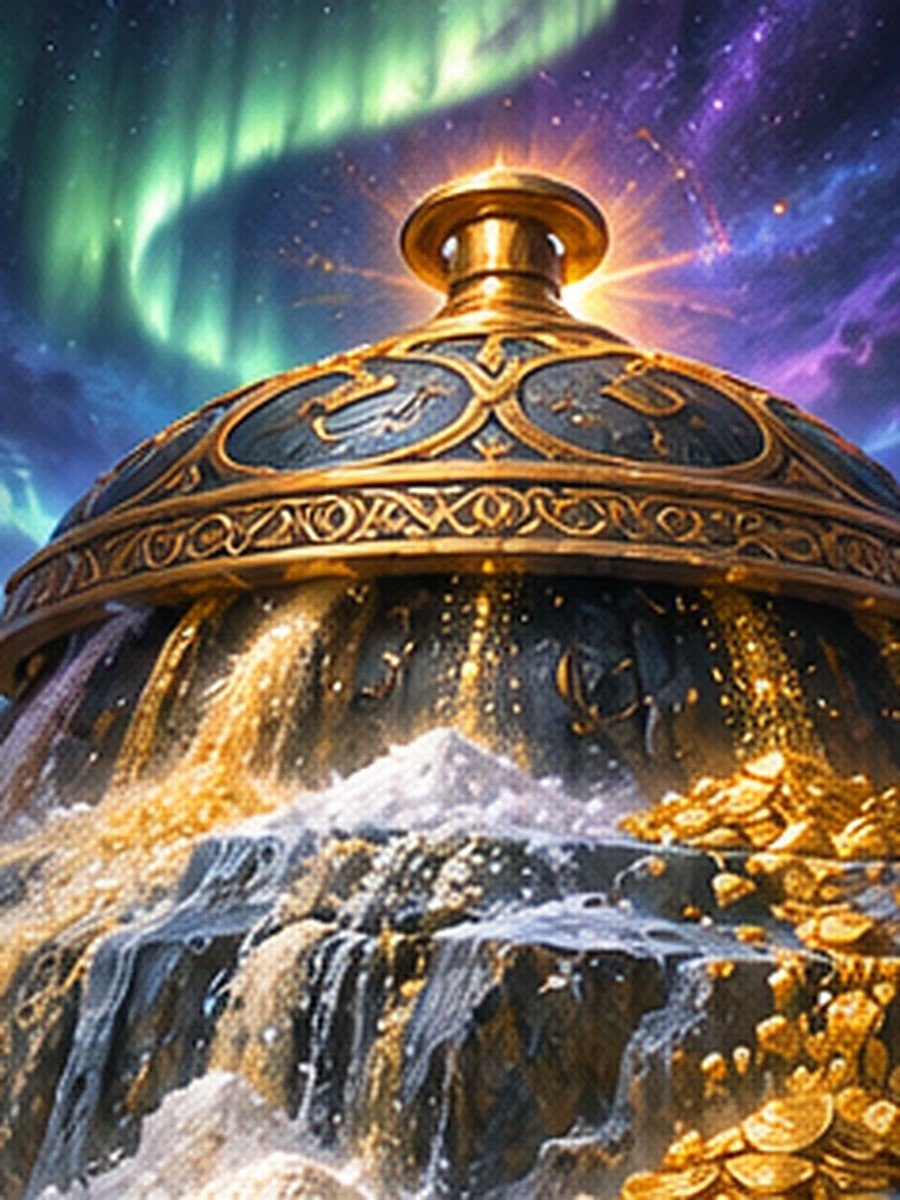
At a Glance
| Name | The Sampo, the mill of abundance, the many-coloured lid |
|---|---|
| Nature | Unique mythic artifact whose precise shape is debated among the old singers |
| Origin | Forged by Ilmarinen for Louhi |
| Tradition | Finnish and Karelian runo poetry; the Kalevala |
| First treasury | The copper mountain and stone vault of Pohjola |
| Known gifts | Grain or flour, salt and money; prosperity that can feed a people or provoke war |
| Present state | The original was broken in the battle at sea. Fragments survive on northern shores and in rival treasuries |
| People seeking it | Väinämöinen, Louhi, rival smiths, hungry settlements and ambitious rulers |
| Associated sea being | Iku-Turso, sent against those carrying it away |
| Plane | The Material Plane, in the northern lands and seas of Midgard |
The wedding feast is ready, but the granary is empty. A bride’s uncle has produced a tiny gleaming fragment that turns a handful of rye into enough flour to feed the whole hall. Across the water, fishermen report their nets have fallen barren, and Louhi’s riders have appeared at the harbour. The guests must decide whether to share the gift, return it or fight to keep it before the wedding bells ring.
The Sampo was a wonder of the smith’s forge, said to bring flour, salt and money through the work of its many-coloured lid. It made Pohjola prosperous while it was held beneath the mountain. When Väinämöinen, Ilmarinen and Lemminkäinen carried it away, Louhi pursued them. The Sampo shattered in their struggle. The pieces that washed ashore brought good fortune to the land, while the greater mass was lost to the sea.
What Is Happening Right Now?
A Granary Full in Winter
One isolated village has enough grain for the whole winter, though its fields were ruined by frost. A neighbouring village has none. A merchant offers to buy the mysterious source of grain and remove it before anyone fights. The characters must discover whether the village possesses a real fragment and find a settlement both communities can live with.
The Bride and the Smith’s Debt
A noble demands that a smith forge a new Sampo as payment for a marriage contract. The intended bride refuses the bargain. The smith claims to know a surviving verse of Ilmarinen’s craft, but the ingredients he seeks include an object that cannot be taken without harming its owner. The party may save the bride, test the verse and prevent an impossible commission from becoming a massacre.
The Lid below the Keel
A ship returning from Pohjola carries a piece of a richly patterned metal lid. It cannot leave harbour: the water has become perfectly still and a voice questions those aboard. Iku-Turso is bound by an ancient promise, but his servants are not. The heroes must recover the fragment before the captain orders his crew to throw the witnesses into the sea.
How the Sampo Was Forged
Ilmarinen, the eternal smith, forges the Sampo after Louhi sets him a task that no lesser craftsman could complete. The old verses describe failed attempts before the true wonder emerges: a bow, a boat, a cow and a plough are all rejected. Finally the forge yields the many-coloured lid and a device that produces flour, salt and money. Its shape is not described in enough detail for every teller to agree upon it.
Louhi takes the finished wonder into the mountain of Pohjola and seals it behind nine locks. It brings abundance to her northern people. The smith cannot simply ask for it back. To recover the Sampo, Väinämöinen, Ilmarinen and Lemminkäinen must enter Louhi’s country, lull her household to sleep and carry the immense object away.

The Sea Battle and the Shattered Wonder
When Louhi learns the Sampo has been taken, she pursues the raiders across the water. In the struggle it breaks. The greatest pieces sink beneath the sea; smaller fragments reach the shores and bring good harvests. Väinämöinen gathers and plants the pieces so that his people may prosper. Louhi returns to Pohjola with a fragment of the patterned cover, and her land loses much of its former abundance.
The Sampo is therefore not an intact treasure casually carried by a merchant in the present day. A fragment may be discovered in a fisherman’s net, a mountain vault or the foundation of a granary. A complete Sampo would have to be made again—or restored by a feat worthy of its first creation.
The Price of Abundance
A village can survive winter because of a handful of grain from the Sampo. A ruler who controls the whole mill might provision an army without harvesting a field. Neither benefit makes its possessor safe: Louhi’s loss impoverished her homeland, and the fragments are now sought by people who can scarcely agree on what abundance should mean.
The Sampo has no personal alignment or desire to corrupt its bearer. Its danger arises from the people around it. A village can share the grain or withhold it; a smith may be asked to rebuild the wonder and refuse to treat a bride as payment. A fragment can save lives without making war inevitable, provided those who hold it can defend their decision.
Recognising a Fragment
A genuine fragment bears a pattern that does not repeat, even when examined from different angles. Grain grows readily near it, salt remains dry in winter fog and small coins ring strangely against its surface. These signs are clues, not an automatic way to identify every forgery. A skilled smith may compare the metal with Ilmarinen’s other works.
Where to Find It
Look along the northern beaches where pieces came ashore, in the depths of the sea where the heavier parts sank, and among Louhi’s guarded relics in Pohjola. Iku-Turso once rose against the vessel that carried the stolen Sampo. His ancient oath makes the waters dangerous in a way no ordinary shipwreck does.
Game Statistics
These rules describe a Sampo restored to wholeness and the far smaller fragments found in adventures. The original is broken; its full powers are included for campaigns in which someone succeeds in restoring it.
The Sampo
Wondrous Item, Artifact (Requires Attunement)
Unique. The Sampo is a mill of patterned metal with a many-coloured cover. A restored Sampo weighs 500 pounds. Only one creature can be attuned to it at a time, but it cannot be carried as normal adventuring equipment.
Mill of Three Stores. The attuned creature spends 1 hour turning the Sampo and speaking its old words. At the end of the hour, it creates one of the following in containers placed beneath it: 10 pounds of edible flour, 1 pound of salt or 100 ordinary gold pieces. It can operate for additional hours, with one product chosen for each completed hour. Food spoils and coins circulate normally; the artifact does not protect stores or grant ownership of land.
Patterned Lid. The attuned creature can tell whether a nearby fragment of the original Sampo is genuine by touching it. The mill cannot magically recall fragments, and neither Mending nor Fabricate is sufficient to restore a shattered artifact.
Fragment of the Sampo
Wondrous Item, Legendary (Requires Attunement)
A fragment of the patterned cover can be activated once per dawn by a creature attuned to it. After 1 hour of careful work, the fragment creates either 10 pounds of flour, 1 pound of salt or 10 ordinary gold pieces. Afterward it becomes dormant until the next dawn. Two fragments cannot be combined by ordinary crafting to restore the Sampo.
Unmaking the Sampo
The Sampo is an artifact and cannot be destroyed by ordinary weapon damage. The conditions of its shattering are linked to the struggle over its possession at sea. Restoring it requires a work of exceptional smithcraft and a decision about who will control its bounty.
The Sampo
Wondrous item, artifact (requires attunement)
Weight. 500 lb. A restored Sampo is a unique mill with a many-coloured lid. It cannot be worn or carried in a pack.
Threefold Abundance. While attuned, a creature can spend 1 hour working the mill. At the end of that hour, it produces 10 lb. of edible flour, 1 lb. of salt or 100 gp. The creature chooses one product for each hour the mill is worked. The products are ordinary, nonmagical goods and must be collected and stored.
Broken Wonder. The intact Sampo does not exist in common circulation. It is an artifact that cannot be restored with a casting of mending or fabricate; its destruction and restoration require a story-worthy conflict and a master smith.
Sampo Fragment
Wondrous item, legendary (requires attunement)
Once per dawn, the bearer can work the fragment for 1 hour to produce 10 lb. of edible flour, 1 lb. of salt or 10 gp. The effect does not create magic coins and does not remove the need to guard a harvest or protect the people who eat it.
The Sampo
Aura overwhelming transmutation; CL 19th; Slot none; Weight 500 lbs.; Price — (major artifact)
DESCRIPTION
This vast, many-coloured mill produces ordinary provisions and wealth. A creature that knows its operating words and works the restored mill continuously for 1 hour causes it to produce 10 pounds of flour, 1 pound of salt or 100 gp. One type of product is chosen for each completed hour. The output is nonmagical. The artifact has no charges and cannot be purchased or constructed by normal item-creation rules.
SAMPO FRAGMENT
Aura strong transmutation; CL 19th; Slot none; Weight 1 lb.; Price — (minor artifact)
Once per day, a creature that spends 1 hour working a genuine fragment and speaking the old words can produce 10 pounds of flour, 1 pound of salt or 10 gp. The fragment does not grant the complete Sampo’s powers, and combining fragments requires a unique ritual of smithcraft.
DESTRUCTION
The Sampo cannot be destroyed by ordinary sunder attempts. The original was shattered during a struggle at sea; a restored one can be broken only by an extraordinary conflict of comparable power, at the GM’s discretion.
The Sampo
Major Artifact
Caster Level 19th; Weight 500 lb.; Slot —; Market Price —
Threefold Mill (Su). A creature that knows the command words and operates a restored Sampo for 1 uninterrupted hour produces one of three things: 10 lb. of meal, 1 lb. of salt or 100 gp. The operator chooses one output per hour. The Sampo has no daily charges; its output is ordinary material, not a conjured object that disappears after a spell duration.
Artifact Nature. Normal item creation, repair spells and weapon damage cannot reproduce or restore the lost Sampo. A work equal to Ilmarinen’s first forging is needed.
Fragment of the Sampo
Minor Artifact; Caster Level 19th; Weight 1 lb.
Once per day, after 1 hour spent operating a true fragment, a creature creates 10 lb. of meal, 1 lb. of salt or 10 gp. A fragment cannot produce enough to replace the original and cannot be combined by ordinary smithing alone.
Adventure Hooks
The Empty Granary
Louhi’s storehouses hold a scrap of the patterned lid, but a northern village has lost the grain it received from the fragment. An adviser to the queen proposes that a neighbouring settlement be stripped of its harvest. The heroes must find the missing grain, expose the thief and prevent two hungry communities from fighting over a gift that cannot feed everyone at once.
The Last Piece below the Ship
A deep-water diver brings a fragment to the surface, and a fleet of boats is sent to seize it. The fragment creates enough flour to save a fishing village but brings no safe harbour for those who carry it. The party must protect the boat and its passengers from the warriors sent by rival claimants and the creatures that guard the sunken Sampo.
The Smith Who Refuses
An ambitious noble asks Ilmarinen to reforge the Sampo and offers him a captive bride in payment. Ilmarinen refuses the bargain. The noble threatens to close the only road to a village whose winter food supplies depend on the work. The characters must free the captive, secure another source of food and convince the noble to end his demand.
People, Powers and Places
Ilmarinen · Louhi · Väinämöinen · Lemminkäinen · Iku-Turso · Pohjola · Finnish Pantheon
Sources and Attribution
The forging and many-coloured lid are described in Kalevala, Runo X. The recovery from Pohjola and voyage are in Runo XLII, and the struggle that breaks the Sampo, leaving fragments on the shore, is in Runo XLIII.
The original game-item description published on this site credited Timothy S. Brannan and the Netbook of Witches and Warlocks team, distributed in the D20 / D&D 3e netbook community. That attribution is retained for the meal, salt and gold output and the legacy caster-level and weight convention. The artifact’s current state, fragment mechanics, adventures and other game statistics are original campaign adaptations, not statements that every early source described the Sampo as an ordinary physical mill. Game terminology from SRD 5.2.1 is adapted under CC BY 4.0 where applicable; legacy game terms follow the relevant open-game licences.
Keep this reference growing
If this page helped with your reading or game, you can support its upkeep or explore the curated books.
Explore the Bookshop — epics, classics and stories behind imagined worlds.