Dominate Person Spell – D&D 5.5e, Pathfinder 1e & 3.5e

Enchantment · Compulsion · D&D 5.5e · Pathfinder 1e · D&D 3.5e

Dominate Person

A commander gives the order in his own voice. His signet is genuine. His officers know his face, his habits and his authority. Only one thing is false: the decision is no longer his.

Dominate Person is the hard edge of enchantment. Where Charm Person distorts trust and Suggestion places magical force behind a course of action, Dominate Person establishes continuing control over a humanoid mind. The victim may still possess rank, knowledge, memory, skill and lawful authority while another will directs what those things are used to accomplish.

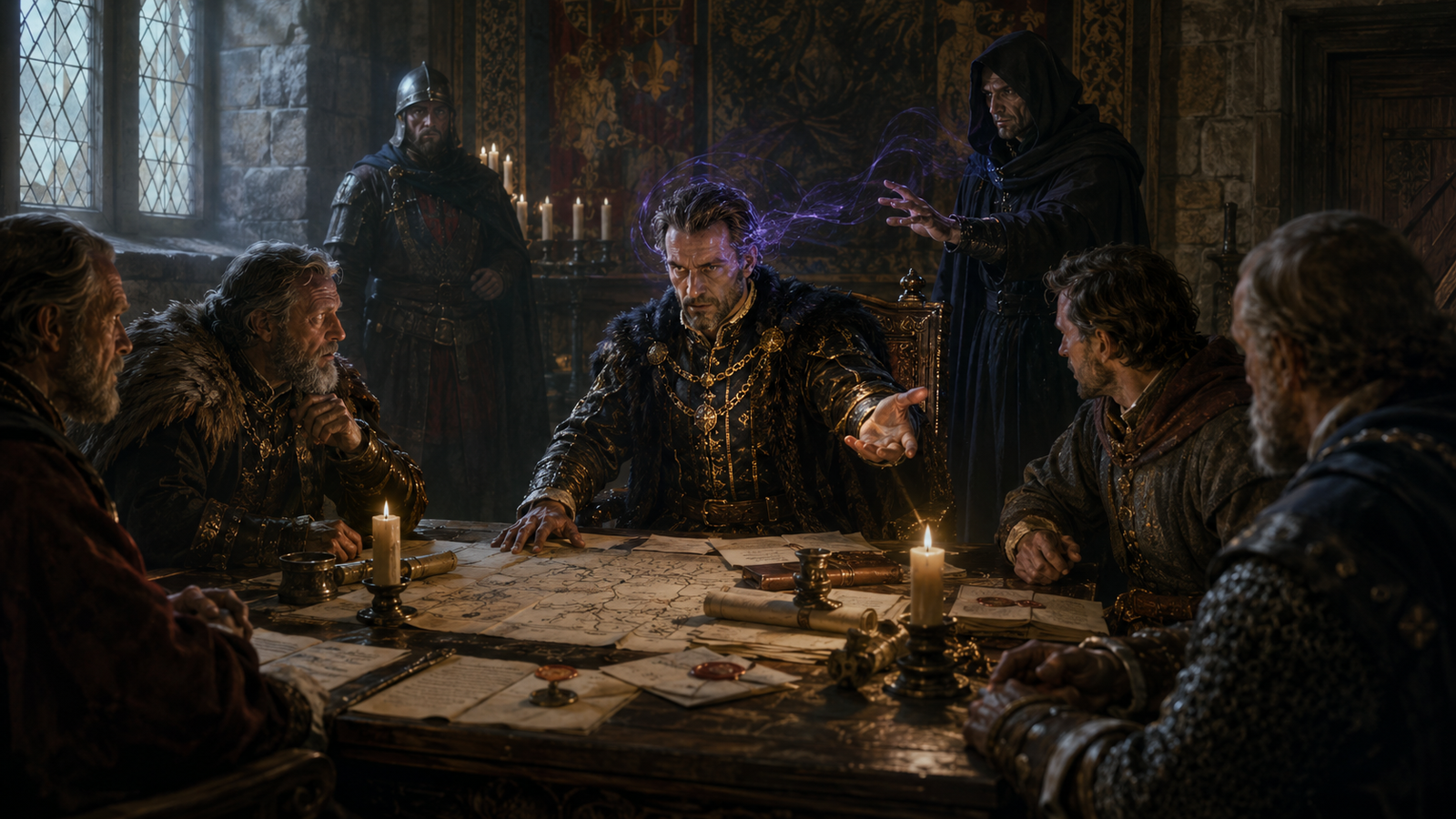
A concealed enchanter magically dominates a noble issuing orders during a tense council in 1454. Expand or collapse the Dominate Person illustration.
Dominate Person — Authority Without Free Will. A concealed enchanter controls an apparently legitimate commander during a council in 1454. Original SpiralWorlds illustration created with ChatGPT. Click the image to enlarge; click again to reduce it.

Game Mechanics

Choose the rules edition being used. Each version below stands on its own: similar language does not make their control, resistance or duration rules interchangeable.

D&D 5.5e / 2024 — Dominate Person

Level & School
Level 5 Enchantment
Classes
Bard, Sorcerer, Wizard
Casting Time
Action
Range
60 feet
Components
V, S
Duration
Concentration, up to 1 minute
Target
One Humanoid you can see
Saving Throw
Wisdom

One visible Humanoid within range makes a Wisdom saving throw. On a failure, it has the Charmed condition for the duration. The target has Advantage on its initial save if you or your allies are fighting it.

Whenever the target takes damage, it repeats the Wisdom save. A success ends Dominate Person on that creature.

While you and the target remain on the same plane, a telepathic link lets you issue commands on your turn without spending an action. The target tries to carry out those orders on its turn. Once an order is finished and no replacement is given, it acts for itself and concentrates on protecting itself.

You can order the target to use a Reaction, but doing so also requires your Reaction.

Charmed

The target cannot attack the creature charming it or target that creature with damaging abilities or magical effects. The charmer also has Advantage on ability checks made to interact with it socially.

Higher-Level Spell Slots

Concentration can last up to 10 minutes with a level 6 slot, 1 hour with a level 7 slot, or 8 hours with a level 8 or higher slot.

5.5e ruling: use the current spell on its own terms. The older rules for a special precise-control action, a +2 save against commands contrary to the victim’s nature, and automatic rejection of obviously self-destructive orders are not part of this version.

Pathfinder 1e — Dominate Person

Class Levels
Arcanist 5, Bard 4, Mesmerist 4, Occultist 5, Psychic 5, Shaman 5, Skald 4, Sorcerer 5, Spiritualist 5, Witch 5, Wizard 5
School
Enchantment (Compulsion) [Mind-Affecting]
Casting Time
1 round
Components
V, S
Range
Close (25 ft. + 5 ft./2 levels)
Target
One humanoid
Duration
1 day/level
Saving Throw
Will negates
Spell Resistance
Yes

The spell establishes telepathic control over one humanoid. With a shared language, the caster can give detailed instructions that remain within the creature’s capabilities. Without a common language, only simple commands can be conveyed.

The caster knows what the subject is experiencing, but does not receive direct sensory input from it, and the subject cannot communicate with the caster telepathically.

The subject pursues an assigned order ahead of other activities except ordinary survival. Changing an order or issuing a new one is a move action. A Sense Motive check against DC 15 can recognise that enchantment is influencing the creature’s behaviour.

A standard action spent concentrating allows the caster to receive full sensory input as interpreted by the subject’s mind, though the subject still cannot communicate telepathically with the caster. This is not literal sight through the subject’s eyes.

An order against the subject’s nature grants another Will save with a +2 bonus, and obviously self-destructive orders are refused.

Established control works at any distance while caster and subject remain on the same plane. The caster need not see the subject to control it. The caster must spend at least 1 round concentrating on the spell each day or the subject receives another saving throw.

Protection from Evil or similar protection can suppress active control and the telepathic link without automatically dispelling the domination.

Mythic Dominate Person

The Mythic version increases the Sense Motive DC used to notice the domination by twice the caster’s mythic tier. The caster can give orders to the target even when it is protected by non-mythic effects that block magical control, such as Protection from Evil.

If the target is protected by a mythic effect, the caster can attempt to overcome that defence with a caster level check against DC 15 + the caster level of the protective effect. Add the caster’s mythic tier to the roll and add the opposing caster’s mythic tier to the DC.

If the target succeeds on its Will save to break the caster’s control, the caster can spend one use of mythic power as an immediate action to force the target to reroll the save and use the lower result.

D&D 3.5e — Dominate Person

School
Enchantment (Compulsion) [Mind-Affecting]
Levels
Bard 4, Sorcerer/Wizard 5
Components
V, S
Casting Time
1 round
Range
Close (25 ft. + 5 ft./2 levels)
Target
One humanoid
Duration
1 day/level
Saving Throw
Will negates
Spell Resistance
Yes

The caster creates a telepathic link that permits control of one humanoid. A shared language allows detailed instructions within the creature’s abilities; without one, communication is limited to basic commands.

The caster knows what the subject is experiencing, but does not receive direct sensory input from it, and the subject cannot communicate with the caster telepathically.

The dominated creature concentrates on carrying out its order except for ordinary survival needs. A Sense Motive check against DC 15 can notice the unnatural influence. Redirecting the creature or giving a new command is a move action.

By spending a standard action concentrating, the caster receives full sensory information as interpreted by the subject’s mind, though the subject still cannot communicate telepathically with the caster. The caster does not literally see through the subject’s eyes.

An instruction contrary to the subject’s nature grants another saving throw with a +2 bonus. Obviously self-destructive orders are not followed.

Once control is established, it has unlimited range while both creatures remain on the same plane. The caster need not see the subject to control it.

If the caster fails to spend at least 1 round concentrating on the spell during a day, the subject gains another save. Protection from Evil can suppress control and the telepathic link while its protection applies without automatically dispelling Dominate Person.

Charm Is Not Domination

SpiralWorlds’ Charm and Compulsion rules draw a useful distinction. Charm changes the relationship through which a subject makes choices; compulsion overrides free will or changes how the mind operates.

Dominate Person belongs firmly on the compulsion side of that divide in Pathfinder 1e and D&D 3.5e. That distinction also remains useful as ordinary language when comparing the spell with Charm Person or Suggestion, even though the D&D 5.5e rules organise their game terms differently.

Commands, Resistance & Counters

Giving Orders

In D&D 5.5e, commands use the same-plane telepathic link without an action on the caster’s turn; commanding a Reaction costs the caster’s Reaction. PF1e and 3.5e instead make changed instructions a move action and restrict complex orders when no language is shared.

Breaking Free

In 5.5e, damage triggers another Wisdom save and loss of concentration ends the spell. PF1e and 3.5e instead provide their own repeat saves for commands against the subject’s nature and for failure to perform the required daily concentration.

Detecting Control

PF1e and 3.5e explicitly use Sense Motive DC 15. D&D 5.5e has no equivalent Dominate Person detection DC, so it should not inherit one from an older edition.

Ending or Suppressing It

Dispel Magic can attack an ongoing spell under the rules of the edition being played. In the legacy editions, Protection from Evil can interrupt control without necessarily removing the underlying domination.

Important Dominate Person Rulings

Attacking Allies

Dominate Person can turn a humanoid against former allies, but the edition determines how resistance works. In D&D 5.5e the spell itself gives attack commands as an example of the telepathic control. PF1e and 3.5e permit coercive orders but may grant the subject another save when a command runs against its nature.

Self-Destructive Commands

Pathfinder 1e and D&D 3.5e explicitly reject obviously self-destructive orders. D&D 5.5e does not contain that legacy blanket prohibition. A 5.5e table should therefore resolve the particular instruction through the current spell, the target’s capabilities and the normal rules rather than silently importing the older sentence.

Memory

Dominate Person does not erase the target’s memory. It should not gain the separate function of Modify Memory. At the same time, the spell does not by itself make every victim automatically know the identity of an unseen controller; what the creature can later identify depends on what it actually perceived and learned.

Remote Senses

PF1e and 3.5e provide their specific concentration-based sensory-information rule. Before that concentration is used, the caster knows what the subject is experiencing but receives no direct sensory input, and the subject cannot communicate telepathically back. D&D 5.5e does not provide the legacy sensory-sharing mechanic.

Zone of Truth Does Not Restore Free Will

Zone of Truth and Dominate Person solve different problems. Zone of Truth can prevent an affected speaker from knowingly making a deliberate lie; it does not itself end domination, expose the controller or prove that a statement is voluntary.

A dominated witness can therefore become a particularly dangerous problem. The witness may give an entirely truthful answer because the controlling caster ordered them to reveal what they genuinely know. Conversely, an order to remain silent or answer evasively does not become a lie merely because investigators dislike it.

Truth is not consent. A truthful statement establishes what was said without proving that the speaker was free to choose to say it.

Using Dominate Person in Play

Battlefield Control

A successful domination can remove a dangerous humanoid from the enemy’s plan while forcing that creature’s own abilities into service. Commanding a guard to bar a doorway, a veteran to interfere with a spellcaster or an officer to withdraw can matter more than another attack.

In D&D 5.5e, attacking the dominated target creates an obvious risk because damage gives it another saving throw. A controlled enemy is often more useful when allies avoid striking it unless breaking the spell would be worth the trade.

Intrigue

The spell is more disturbing away from combat. A gate captain can admit the wrong company, a magistrate can release the wrong prisoner, a guild officer can surrender a ledger, a courier can divert sealed orders, and a commander can reposition troops while every ordinary sign of identity remains genuine.

The crucial difference is that the victim’s authority has not been forged. It has been captured.

Espionage

PF1e and 3.5e make a dominated creature useful for remote observation through their explicit sensory-information mechanic. The caster must devote a standard action to full concentration to receive that sensory input, and even then the subject cannot communicate telepathically back. D&D 5.5e does not provide that feature. The caster may command an agent at a distance on the same plane, but information must still reach the caster by whatever means the current rules actually provide.

Domination in the World of 1454

In 1454, authority is carried by people as much as parchment. A captain controls gates because soldiers recognise his office. A guildmaster controls property because clerks recognise her seal. A magistrate can imprison someone because officers accept the authority behind the warrant. Dominate Person attacks that system without needing to counterfeit any of it.

A seal can prove authority. It cannot prove free will.

For that reason, princely courts, Free Imperial Cities, wealthy guilds, mercenary companies and great households develop different habits for dealing with extraordinary orders. One council might require two witnesses before a treasury is opened. Another might require a countersigned command before a city gate is surrendered. A military captain might be unable to overturn standing defensive orders without another officer confirming the instruction.

None of this forms a universal magical law. Customs vary between cities, courts, guilds and armies, and many institutions are much less prepared than they imagine.

Learned Magical Natural Philosophy

University masters, court magicians, guild-trained practitioners and private scholars can study enchantment as part of learned magical natural philosophy. They know that sensation, memory, truth, emotion and volition are not the same phenomenon, and that one magical test cannot be assumed to answer every question about the mind.

This knowledge does not create a universal automatic method of recognising Dominate Person. Where an edition provides a detection rule, use it. Otherwise suspicion must be supported by behaviour, testimony, investigative magic and whatever expertise is actually available.

When an Official Suddenly Changes Course

An unexplained command to open a gate, release a prisoner, empty a treasury, abandon a fortification or betray an ally may cause experienced subordinates to delay long enough to seek corroboration. A compromised official might be separated from messengers and seals while a trusted practitioner examines the situation or attempts Dispel Magic, Break Enchantment or another appropriate countermeasure.

The Spell Ends; the Consequences Do Not

Breaking domination does not rewind events. A gate already opened remains open. Soldiers sent into an ambush may already be dead. A prisoner may have escaped, coin may have changed hands, and a diplomatic insult may already have crossed a border.

Whether the former victim is legally, politically or morally responsible is not decided by the spell description. Courts, councils, guilds and commanders can reach very different conclusions, especially when proof of magical control is incomplete.

Binding Magic Before the Middle Ages

Dominate Person is a fantasy game mechanic, but the fear that magic might constrain another person’s actions has ancient parallels. Greek and Roman magical traditions included inscribed binding tablets intended to restrain, obstruct or supernaturally influence named people.

One surviving Athenian lead tablet, dated to approximately 345–335 BCE, names a large group of people and invokes the binding of their words and deeds. Ancient curse tablets could be associated with political conflict, litigation, commerce, competition, erotic concerns and private hostility.

Slander by George Woolliscroft Rhead, showing a young woman surrounded by ominous supernatural and human figures in woodland. Expand or collapse the Slander illustration.
George Woolliscroft Rhead, Slander (1900). Though not a depiction of the spell itself, the image suits the older fear behind domination magic: hidden malice, whispered influence and harm worked through another person’s reputation, judgement or will. Illustration provenance . Click the image to enlarge; click again to reduce it.

This is best treated as historical atmosphere rather than a claim that ancient defixiones worked like the RPG spell. The shared idea is older and simpler: power over another person’s choices is frightening precisely because the victim may remain visibly themselves.

Historical reference: National Archaeological Museum — Athenian lead binding tablet .

Dominate Person FAQ

Can Dominate Person make somebody attack their allies?

Yes, but use the edition’s own resistance rules. D&D 5.5e explicitly supports attack commands. PF1e and D&D 3.5e can grant another save when an order is contrary to the subject’s nature.

Can Dominate Person force the target to kill itself?

Pathfinder 1e and D&D 3.5e: obviously self-destructive commands are expressly rejected.

D&D 5.5e: the current spell does not contain that older blanket restriction. Resolve the specific command using the current spell and ordinary game rules rather than importing the legacy sentence.

Does the victim forget what happened?

No memory-erasure effect is supplied by Dominate Person. If memories are to be altered, that is the territory of effects such as Modify Memory.

Can the caster see through the target’s eyes?

Not literally. PF1e and 3.5e allow the caster to receive full sensory input as interpreted by the subject’s mind by concentrating fully as a standard action, but the subject still cannot communicate telepathically back. D&D 5.5e does not provide an equivalent remote-sensory feature.

Does moving beyond the original spell range end control?

PF1e and D&D 3.5e explicitly allow established control at unlimited distance while caster and subject remain on the same plane, and the caster need not see the subject. D&D 5.5e requires the target to be within 60 feet when cast, but its telepathic command link subsequently operates while both creatures remain on the same plane.

Does damage grant another saving throw?

In D&D 5.5e, yes. Whenever the target takes damage, it repeats its Wisdom save and ends the spell on itself on a success. PF1e and D&D 3.5e do not use damage as an automatic repeat-save trigger.

Does Protection from Evil dispel Dominate Person?

In PF1e and D&D 3.5e, it can suppress the caster’s ability to exercise control or use the telepathic link while the protection applies, but it does not automatically dispel the existing domination.

Can Zone of Truth prove somebody was not dominated?

No. Zone of Truth governs deliberate lies; it does not establish freedom from magical control. A dominated creature can be ordered to tell the truth, remain silent or give a truthful but damaging answer.

Rules Sources & Licensing

D&D 5.5e / SRD 5.2.1: Includes material from the System Reference Document 5.2.1 by Wizards of the Coast LLC. See the SRD and Creative Commons Attribution 4.0 International License .

Pathfinder 1e: Pathfinder Roleplaying Game Core Rulebook © 2009, Paizo Publishing, LLC. Pathfinder Roleplaying Game Mythic Adventures © 2013, Paizo Publishing, LLC. Relevant Open Game Content is used under the Open Game License v1.0a. See Archives of Nethys licensing information .

D&D 3.5e: System Reference Document © 2000–2003, Wizards of the Coast, Inc. Relevant Open Game Content is used under the Open Game License v1.0a. See the OGL and copyright notices .

Scroll to Top