
Factions · Mercenary companies and military employers
Free Companies — Mercenaries, Contracts & Captains
At a Glance
| Faction type | Independent or contracted military companies; an umbrella for rival organisations |
|---|---|
| Operating sphere | France, Italy, the Empire, the Alpine approaches and other markets for armed service |
| Leadership | Individual captains, subordinate officers, paymasters and contracting patrons |
| What they want | Pay, food, legal protection, prizes, safe passage, honour and another contract |
| What they offer | Soldiers, escorts, siege specialists, scouts, route security, training and military intelligence |
| Principal danger | Disputed contracts, pillage, escalating reprisals and men who no longer have an employer |
| Current turning point | Post-war French reforms and Italian peace negotiations reshape the mercenary market |
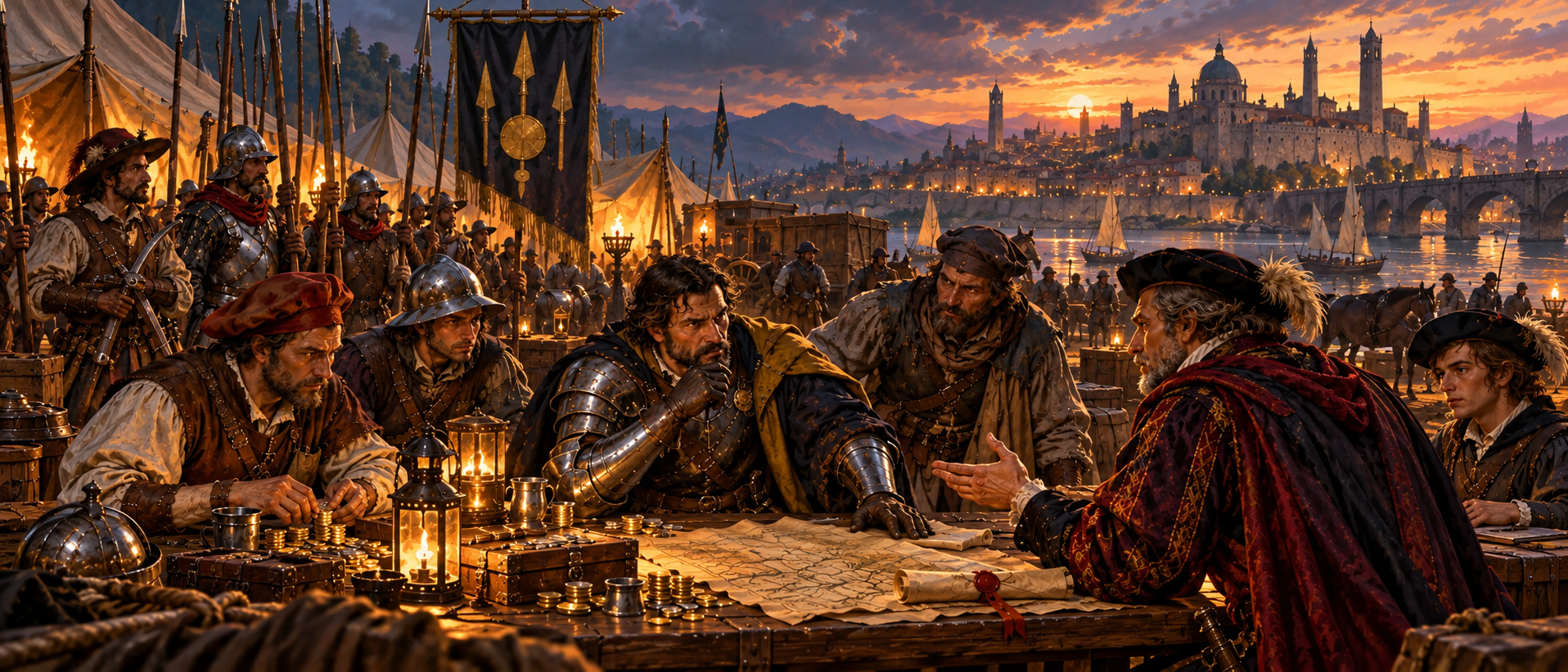
An army is waiting outside the city gate. The captain has a signed contract. The treasurer has an empty chest. The people inside will pay almost anything to learn which one matters more.
Free companies turn professional violence into a business. Their captains recruit soldiers, secure patrons, arrange provisions, enforce discipline, bargain over fortified places and argue about unpaid wages. Some protect merchants and towns with impressive reliability. Others are dangerous when the contracts stop. There is no single worldwide Free Company, no universal captain and no shared code binding every mercenary. This directory connects distinct regional traditions and actual companies.
What Is Happening Right Now?
The end of a war rarely means the end of its soldiers. In France, royal military reforms are bringing selected men into more regular paid service, while other veterans try to find work, return home or impose their maintenance on a frightened countryside. In Italy, powerful cities have spent years hiring captains whose personal loyalties and political ambitions do not always align with the employer’s treasury. The Peace of Lodi gives rulers new reasons to reconsider expensive contracts without removing the armies already on their payrolls.
The Quartermaster’s Deadline
A town owes a company six weeks’ pay. The captain promises there will be no looting until the next market day. The treasurer says the money left yesterday. The characters can protect the stores, find the chest or expose the official who sold the same funds twice.
The Bridge with Two Contracts
Two patrons have hired rival bands to hold the same river crossing. Both carry valid seals, but the documents name different tolls. The players can broker common passage, choose a side or reveal who benefits if neither company survives.
The Lost Muster Roll
A muster list names soldiers who never existed and soldiers who died months ago. The fictitious wages have been financing a secret patron. Recover the roll before the captain pays the entire company with worthless paper.
Free Companies by Region
These regional names describe overlapping traditions, not united armies. Two companies operating a day’s march apart may answer to different patrons, compete for the same wages or be at war.
English Free Companies and Routiers
War veterans, displaced garrisons and mixed bands have spent generations serving patrons or living by force along disputed routes. An English-origin captain need not command exclusively English troops. In post-war France, a band may seek wages from nobles, take escort work or become a danger to villages it once defended.
A seized ferry or threatened harvest can draw outsiders into the dispute; a cautious captain may instead offer them paid escort work.
Écorcheurs
The feared Écorcheurs were particularly notorious during the earlier fifteenth century. The label describes raiding and marauding military bands, not one coherent nationwide order. By 1454 their peak belongs to the recent past, but their veterans, practices and local memories remain potent.
A village may pay for protection from the same veterans who once raided it. The party must decide whether the captain’s promises are worth trusting.
Italian Condottieri
Across Italy, rulers and city councils hire captains through condotte: agreements addressing service, pay and obligations. A company is a mobile employer as well as a battlefield force. The captain’s political interests can matter as much as the troops’ fighting skill.
Missing contract copies, an intercepted paymaster or a quietly negotiated change of allegiance can turn a routine escort into a political crisis.
Swiss Fighting Companies
Confederate cantons, their war bands and experienced foot soldiers are increasingly important to Alpine warfare and foreign recruitment. Some contingents answer to a canton for a limited campaign; others follow individual captains abroad. Their officers, pay and obligations may differ sharply even when they march under neighbouring banners.
When soldiers camp on a village’s only pasture, the question is whether the passage can be secured without ruining the community that supplies it.
German Mercenary Bands
Men-at-arms, town soldiers and hired companies serve competing nobles, cities and frontier rulers across the Empire. Their loyalties are local and contractual. A town might trust its own watch but fear the troops hired by a neighbouring prince; the captain’s seal decides whose orders the men will obey.
A toll dispute, a mine’s silver shipment or a garrison tempted by better pay can bring the company into direct conflict with its employer.
Named Companies and Captains to Meet
Colleoni and Piccinino command formidable Italian companies, while John Hawkwood’s White Company remains active around Florence. A fresh peace leaves captains bargaining over garrisons, roads and unpaid wages. A ruler who dismisses one company may soon find it in a rival’s service.
Colleoni’s Company
Captain: Bartolomeo Colleoni. Sphere: Venice and Lombardy. The company’s new Venetian contract in 1454 brings experienced soldiers, powerful creditors and delicate frontier obligations into a fragile peace.
Jacopo Piccinino’s Bracceschi
Captain: Jacopo Piccinino. Sphere: north Italian military and exile networks. The future of this formidable following becomes uncertain when Venice prepares to end its contract in 1454.
The White Company — Active Since 1435
Captain: Sir John Hawkwood. Born in England in 1400, Hawkwood founded the White Company in 1435. His veterans are active around Florence in 1454, competing with other Italian captains for contracts.
How a Free Company Works
Most patrons do not hire a faceless horde. A captain needs an agreement, credit, recruitment and enough authority to make subordinates obey it. The ordinary chain of command may include a marshal, smaller-unit captains, a paymaster, scouts, specialists and camp followers. The balance differs by place and company. A company’s colours and sign identify that company, not the whole military trade.
| Contract clause | What the employer believes | What the company needs | Where adventure begins |
|---|---|---|---|
| Wages and advances | Paid men will obey | Real coin and recognised debts | Missing payroll; false muster |
| Term and discharge | Service ends at a date | Safe exit and settled accounts | Old garrison refuses to depart |
| Supplies and quarters | Villages will provide lodgings | Grain, forage, shelter and roads | Requisition threatens a hungry town |
| Prisoners and ransom | Captives have a cash value | Rules over custody and shares | Wrong captive, hidden identity |
| Authority and jurisdiction | The commission excuses force | A seal others will recognise | Two employers claim the same bridge |
Employers, Enemies and Neutral Communities
Potential employers include town councils, magnates, military households, merchant interests and sovereign courts. The supposed enemy may be another free company, a rebel commander, a raiding monster or even the patron who has stopped paying. Ordinary communities become political actors when they refuse supplies, shelter a deserter, testify to abuses or pay for an escort to keep a road open.
Who Can Join?
Characters may offer themselves as scouts, guards, negotiators, healers, engineers, interpreters or specialist monster-hunters. A dwarf’s knowledge of stonework may make a besieged tower survivable; a local tracker may spare an entire troop a night in dangerous marshland. A company’s captain evaluates what a recruit can actually do and whom the recruit owes, not their character class.
Using Free Companies in Play
Start with a tangible obligation. Someone wants a road cleared, a payroll delivered, a soldier found, a captive released or a company removed from a settlement. The company has its own understandable goal; the civilians have theirs. Competing solutions are better than a mandatory battle.
Joining for a Contract
The party signs on to protect a merchant caravan until it reaches a border city. Halfway through, the captain receives orders to hold a bridge instead. The players can insist on their original terms, negotiate a bonus, leave honourably or follow the army into someone else’s war.
Leading a Company
Give player captains choices over wages, supplies, camp discipline, lawful targets and alliances. Reputation should open or shut doors: a company known for paying for food has an easier time entering friendly towns than one notorious for seizure. An army cannot simply march forever without rest, horses, provisions and money.
Consequences if No One Interferes
The unpaid soldiers begin by selling spare equipment. A week later, an officer levies an unauthorised toll. A rival patron offers the captain temporary rescue in return for one strategic fortress. If the party acts, it can change that chain of events; if it does nothing, the new bargain redraws local power without the town’s consent.
Further Paths, Historical Basis and Notes
Explore France, Italy, the Empire or return to Guilds, Factions & Organisations. For research: Cambridge History of War — Italian mercenary systems; William Caferro on historical free companies; Colleoni; Piccinino.
Historical names, broad regional chronology and contract traditions are separated from fictional hooks and decisions. The regional groups are directories, not invented centralised states; scenarios and unnamed officers are material for the game table.
Keep this reference growing
If this page helped with your reading or game, you can support its upkeep or explore the curated books.
Explore the Bookshop — epics, classics and stories behind imagined worlds.