
Tristan of Lyonesse — Knight of Cornwall and Iseult’s Champion
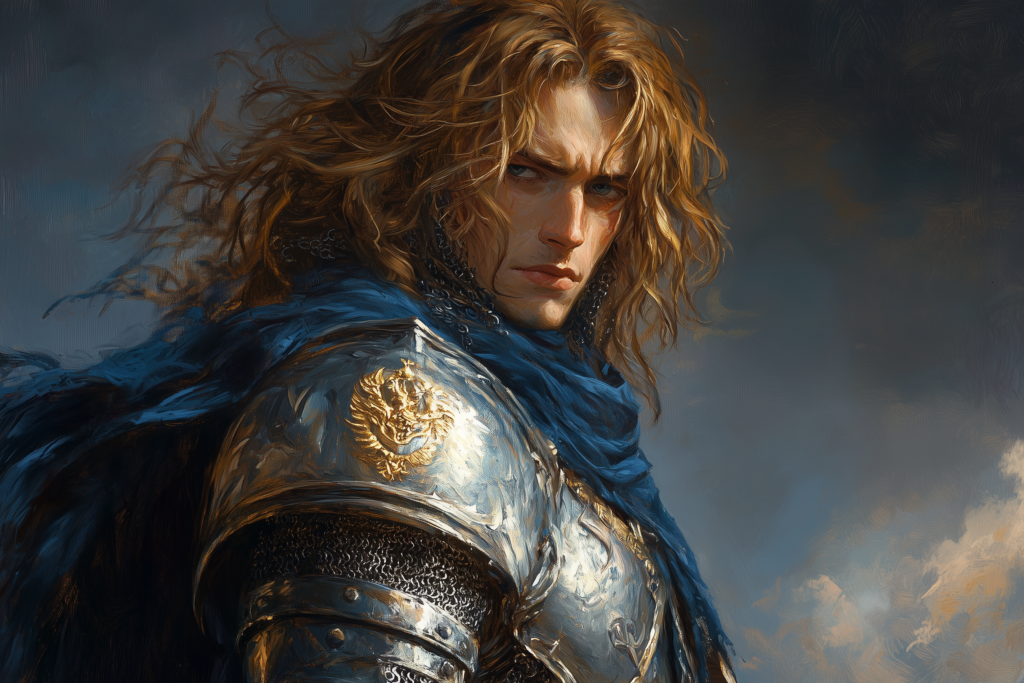
In the Cornwall of Arthur’s age, before Camlann, Tristan of Lyonesse is the finest swordsman in Cornwall and one of the most accomplished harpers at Arthur’s court. He has survived the voyage that bound him to Iseult by a powerful love potion. Now King Mark has ordered Tristan to leave the coast, and a messenger from Palamedes carries a warning that Mark’s soldiers are preparing a false accusation. The queen has arranged a meeting beneath a garden tree, but the king’s watchers already know its place. The characters can expose the conspiracy, protect the witnesses, or let a private betrayal become a public murder.
At a Glance
- Identity
- Tristan (Tristram, Tristran) of Lyonesse, nephew of King Mark
- Nature
- Human, master swordsman, harper and mounted knight
- Homeland
- Lyonesse; frequently travels between Cornwall, Ireland, Brittany and Arthur’s court
- Allegiance
- King Arthur‘s fellowship, the people of Lyonesse, and his promises to those he loves
- Family
- King Meliodas of Lyonesse and Elizabeth in common romance traditions; King Mark is his uncle
- Love and danger
- Iseult of Ireland; the love potion and Mark’s wrath endanger both of them
- Rival
- Sir Palamedes, a capable and honourable knight who also loves Iseult
- Alignment
- Neutral Good; compassionate and brave, but willing to deceive a king when honour and love conflict
- Languages
- Brythonic, Cornish, Irish court speech and the learned language of travelling minstrels
- Abilities
- Swordsmanship, harp and song, chess, hunting, navigation and care of horses
- Immediate threat
- Mark’s spies have prepared a false witness to force Tristan into a fatal confrontation
What Is Happening Right Now?
A courtier has told Mark that Tristan meets Iseult beneath a tree near the queen’s apartments. Two guards are posted there with orders to arrest anyone who approaches. Brangaine, Iseult’s trusted companion, fears the king’s officers will use a drugged servant as their witness. Palamedes has heard the same accusation, but chooses to warn Tristan rather than exploit his rival’s danger. The characters may find the spy, rescue the servant and carry a message to Iseult before midnight.
First Meeting
Tristan is sitting in the guest hall with a harp on his knees, playing an unfinished melody while his sword lies close by. He is weary from travel but rises to greet a stranger courteously. When a page brings a letter sealed in Mark’s name, Tristan does not open it until the page has been offered food. His first question is whether Iseult is safe, not what reward the king has offered.
Three Scenes Tonight
- The hidden watcher: a noble’s servant conceals himself among the branches of the queen’s garden while a second witness waits beside a locked gate.
- The wrong message: Palamedes’s warning has been copied, and one version urges Tristan to draw steel against an unarmed man.
- The harp-string: a string breaks just before Tristan performs for Mark; a hidden note is tied to the replacement.
Appearance and Manner
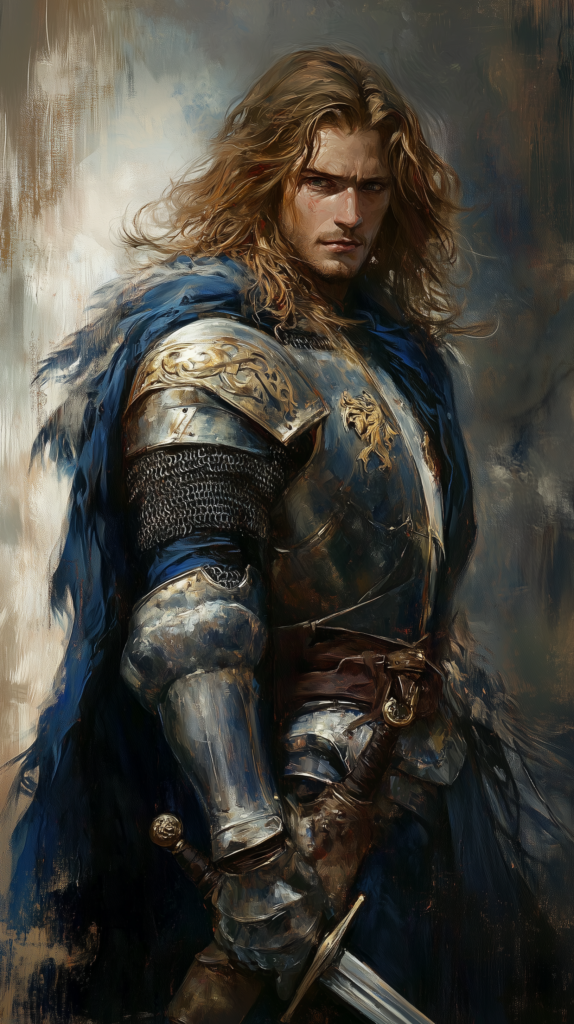
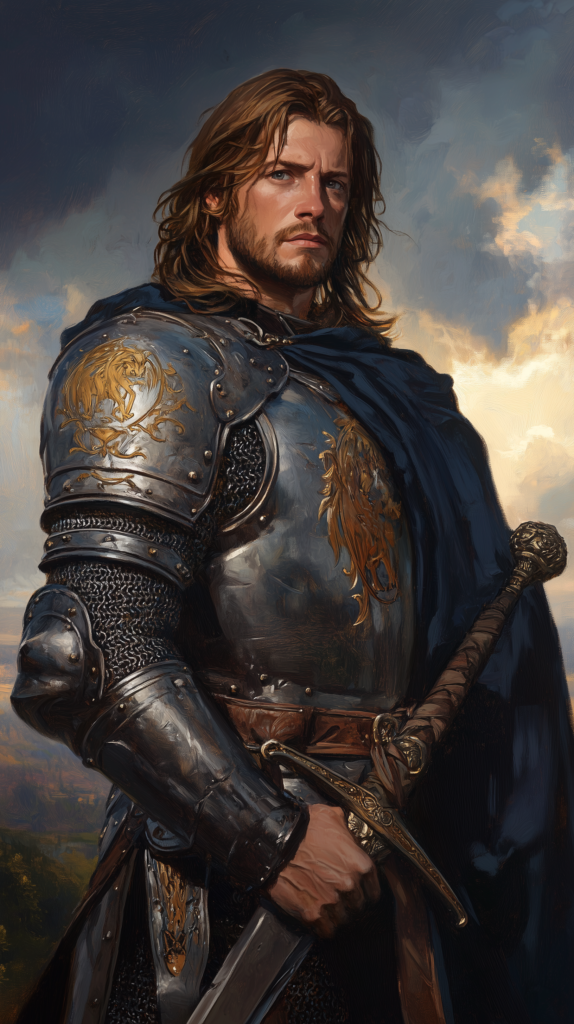
Tristan is a lean, seasoned knight with long dark hair, an expressive face and a scar from an older poisoned wound. His armour is practical and beautifully maintained; his harp case is more battered than his saddle. He can be playful and generous among friends, then silent and reckless when he fears for Iseult. He despises cruelty but has committed betrayals that cannot be excused simply because his affection is sincere.
Ambition, Pressure and Private Knowledge
- Ambition: win a place at Arthur’s court without abandoning those Mark has placed in danger.
- Pressure: love for Iseult, the secrecy of the potion and the obligations of kinship to Cornwall.
- Private knowledge: the potion intended for Mark and Iseult was drunk on the voyage, and Brangaine knows who prepared it.
- Wound: Tristan knows that even a real enchantment does not erase every choice he has made afterwards.
- Flaw: he becomes reckless when a rumour suggests Iseult has been harmed.
- Turning point: he may trust Palamedes with a rescue, proving that rivalry need not condemn both knights to hatred.
Relationships and Allegiances
- Iseult of Ireland: an accomplished healer and queen whose decisions are not possessions that knights may win.
- King Mark: uncle and overlord; Tristan has defended him in battle but no longer trusts his promises.
- Palamedes: a proud rival whose honour can overcome jealousy and save Tristan’s life.
- Brangaine: Iseult’s companion, who remembers how the potion reached the travellers.
- King Arthur: sovereign whose court offers a refuge and whose knights may mediate the dispute.
- Sir Dinadan: wry companion who sometimes sees through the dangerous romance more clearly than the lovers do.
- Sir Lamorak: formidable knight with whom Tristan has crossed arms and paths on his journeys.
- King Esclabor: Palamedes’s father, whom Tristan must not treat as the author of his son’s desires.
Game Statistics
Tristan is a mortal master of swordplay, riding and the harp. The love potion is a powerful part of his history, not an innate charm spell that he casts on other people. He makes a single mounted lance attack on a charge, then fights with a sword. Choose one independent rules edition below.
Tristan of Lyonesse — D&D 2024
Medium Humanoid (Human), Neutral Good
Armor Class 20 (plate armor, shield); Initiative +3 (13); Hit Points 204 (24d8 + 96); Speed 30 ft.; Challenge 12 (8,400 XP; PB +4)
| STR | DEX | CON | INT | WIS | CHA |
|---|---|---|---|---|---|
| 22 (+6) | 16 (+3) | 18 (+4) | 14 (+2) | 16 (+3) | 18 (+4) |
Saving Throws Str +10, Dex +7, Wis +7; Skills Athletics +10, Insight +7, Perception +7, Performance +12, Persuasion +8, Survival +7; Senses Passive Perception 17; Languages Brythonic, Cornish, Irish court speech.
Traits
Master Harper. Tristan has Advantage on Charisma (Performance) checks made with a harp or voice. Defender’s Resolve. He has Advantage on saving throws against being Frightened while an ally he can see has fewer than half its Hit Points remaining.
Actions
Multiattack. Tristan makes three Longsword attacks. A mounted Lance attack is a separate, single-attack action.
Longsword. Melee Attack Roll: +10, reach 5 ft. Hit: 15 (2d8 + 6) Slashing damage.
Shield Bash. Melee Attack Roll: +10, reach 5 ft. Hit: 13 (2d6 + 6) Bludgeoning damage; a Large or smaller target makes a DC 18 Strength saving throw or has the Prone condition.
Lance (Mounted Only). Melee Attack Roll: +10, reach 10 ft. Hit: 19 (2d12 + 6) Piercing damage, plus 9 (2d8) Piercing damage if his mount travelled at least 20 feet straight toward the target immediately before the attack. Tristan makes one Lance attack.
Bonus Action
Rally the Escort (Recharge 5–6). One ally Tristan can see within 30 feet gains 12 Temporary Hit Points and can move 10 feet without provoking Opportunity Attacks.
Reaction
Parry. Tristan adds 4 to his AC against one melee attack that would hit him, provided he can see the attacker and is holding his sword.
Legendary Actions
Legendary Action Uses: 2. Immediately after another creature’s turn, Tristan may spend one use to move half his Speed without provoking Opportunity Attacks, or both uses to make one Longsword attack. All uses return at the start of his turn.
Tactics
Tristan seeks a route that shields bystanders and prisoners. He will withdraw from a duel to rescue Iseult or a servant, but may need a witness to recognise that the approaching opponent is Palamedes rather than Mark’s assassin.
Tristan of Lyonesse — D&D 2014
Medium humanoid (human), neutral good
Armor Class 20 (plate, shield); Hit Points 204 (24d8 + 96); Speed 30 ft.
| STR | DEX | CON | INT | WIS | CHA |
|---|---|---|---|---|---|
| 22 (+6) | 16 (+3) | 18 (+4) | 14 (+2) | 16 (+3) | 18 (+4) |
Saving Throws Str +10, Dex +7, Wis +7; Skills Athletics +10, Insight +7, Perception +7, Performance +12, Persuasion +8, Survival +7; Senses passive Perception 17; Languages Brythonic, Cornish, Irish court speech; Challenge 12 (8,400 XP).
Traits
Master Harper. Tristan has advantage on Charisma (Performance) checks made with a harp or with his singing voice. Defender’s Resolve. He has advantage on saving throws against being frightened while an ally he can see has fewer than half its hit points remaining.
Actions
Multiattack. Tristan makes three longsword attacks. The lance charge is one separate attack, not part of Multiattack.
Longsword. Melee Weapon Attack: +10 to hit, reach 5 ft., one target. Hit: 15 (2d8 + 6) slashing damage.
Shield Bash. Melee Weapon Attack: +10 to hit, reach 5 ft., one Large or smaller creature. Hit: 13 (2d6 + 6) bludgeoning damage; DC 18 Strength saving throw or knocked prone.
Lance (Mounted Only). Melee Weapon Attack: +10 to hit, reach 10 ft., one target. Hit: 19 (2d12 + 6) piercing damage plus 9 (2d8) after a straight 20-foot mounted approach. A single attack only.
Bonus Actions
Rally the Escort (Recharge 5–6). One ally within 30 feet who can see Tristan gains 12 temporary hit points and can move 10 feet without provoking opportunity attacks.
Reactions
Parry. Tristan adds 4 to his AC against one melee attack that would hit him if he can see the attacker and holds his sword.
Legendary Actions
Tristan has two legendary actions, spent one at the end of another creature’s turn. He regains spent actions at the start of his turn. Advance: move half his speed without provoking opportunity attacks (1 action). Sword Cut: one longsword attack (2 actions).
Tactics
A credible warning from Palamedes will stop Tristan from attacking a mistaken opponent. He prefers a public hearing before Arthur if it will prevent Mark from harming the witnesses.
Tristan of Lyonesse — Pathfinder 1e
CR 13; XP 25,600; Male human fighter 14; NG Medium humanoid (human); Init +7; Senses Perception +13.
Defense
AC 27, touch 14, flat-footed 24 (+10 armor, +3 shield, +3 Dex, +1 deflection); hp 147 (14d10 + 56 plus 14 Toughness); Fort +13, Ref +7, Will +9; Defensive Abilities bravery +4 against fear.
Offense
Speed 30 ft. (armor training); Melee +1 longsword +27/+22/+17 (1d8 + 15/17–20); Alternative masterwork lance +24 (1d8 + 9/×3; one mounted charge at +26); Space/Reach 5 ft./5 ft.
Statistics
Str 24, Dex 16, Con 18, Int 14, Wis 16, Cha 18; Base Atk +14; CMB +21; CMD 34.
Feats Weapon Focus (longsword), Weapon Specialization (longsword), Greater Weapon Focus (longsword), Greater Weapon Specialization (longsword), Improved Critical (longsword), Mounted Combat, Ride-By Attack, Spirited Charge, Power Attack, Improved Initiative, Toughness, Iron Will, Combat Reflexes, Dodge, Cleave, Quick Draw.
Skills Ride +18, Perception +13, Survival +13, Perform (harp) +18; Languages Brythonic, Cornish, Irish court speech.
Gear +1 full plate, +1 heavy steel shield, +1 longsword, masterwork lance, ring of protection +1, harp, warhorse and travel kit.
Special Abilities and Tactics
Weapon Training (Ex). +3 heavy blades and +2 spears; these bonuses are included in the attacks and damage. Armor Training (Ex). Tristan retains his normal 30-foot movement and adds his +3 Dexterity bonus in full plate. He makes one mounted lance charge, then uses his longsword iteratives when stationary. The love potion is a plot device, not a bonus to melee damage.
Tristan of Lyonesse — D&D 3.5e
Male human fighter 14; Neutral Good Medium humanoid (human); CR 14; Init +7; Senses Listen +3, Spot +3.
Defense
AC 24, touch 12, flat-footed 23 (+9 armor, +3 shield, +1 Dex, +1 deflection); hp 136 (14d10 + 56 plus 3 Toughness); Fort +13, Ref +7, Will +9.
Offense
Speed 20 ft.; Melee +1 longsword +24/+19/+14 (1d8 + 12/17–20); Alternative masterwork lance +22 (1d8 + 7/×3; one mounted charge at +24); Space/Reach 5 ft./5 ft.; Base Atk +14; Grp +21.
Statistics
Str 24, Dex 16, Con 18, Int 14, Wis 16, Cha 18; Skills Ride +12, Perform (harp) +12, Diplomacy +11, Listen +3, Spot +3.
Feats Weapon Focus (longsword), Weapon Specialization (longsword), Greater Weapon Focus (longsword), Greater Weapon Specialization (longsword), Improved Critical (longsword), Mounted Combat, Ride-By Attack, Spirited Charge, Power Attack, Improved Initiative, Toughness, Iron Will, Combat Reflexes, Cleave; Languages Brythonic, Cornish, Irish court speech.
Special Abilities and Tactics
His longsword attack includes Strength, the +1 magical enhancement and the two Weapon Focus feats; damage includes both Weapon Specialization feats. He does not gain Pathfinder weapon training or armor training in this edition. A mounted charge permits one lance strike rather than a full attack.
Possessions +1 full plate, +1 heavy shield, +1 longsword, masterwork lance, harp, warhorse, ring of protection +1 and travel kit.
Run the Encounter
Tristan’s skill is not the question: he can defeat almost any knight who draws upon him. The difficulty is finding an honourable path for the people caught between his love for Iseult and Mark’s jealousy. The characters can expose false witnesses, carry a message, persuade Palamedes to act as a mediator or help Iseult leave Cornwall by her own choice. A confrontation with Mark becomes dangerous if everyone relies upon force instead of testimony.
Five Encounters
- The garden watcher: a spy hides in the branches while Tristan and Iseult arrange a dangerous meeting beneath the tree.
- The tournament rival: Palamedes challenges Tristan over a disputed result; a third party has altered the written score.
- The poisoned blade: a guard bears a weapon marked by the same poison Tristan survived years ago, and a healer recognises its scent.
- Brangaine’s testimony: the queen’s companion carries proof of the love potion, but the court wants to use it as evidence against Iseult.
- The false betrayal: King Mark offers the heroes a reward for bringing Tristan bound to his hall, though the warrant bears a forged seal.
Six Adventure Hooks
- An Irish vessel reaches Cornwall with a medicine chest matching the one used during Tristan and Iseult’s first voyage.
- Palamedes asks the party to stop a duel he has promised, without destroying his reputation for keeping oaths.
- A court musician disappears after hearing a song that reveals the tree where Tristan meets Iseult.
- A knight of Lyonesse asks Tristan to return and defend the coast while Mark threatens to seize his inheritance.
- Iseult’s personal healer is accused of supplying poison to a servant; the bottle was planted by a courtier.
- A ship approaches with its sail altered to send a false signal about whether a healer has reached a wounded knight.
Equipment and Resources
Plate armour, shield, longsword, lance, trained warhorse, harp, chess pieces, hunting bow, travel cloak and a small household escort. The sword is treated as an ordinary named weapon in the narrative unless its specific enchantment is established in play. The love potion is an external enchantment from the history of the voyage, not a power Tristan can bestow on anyone else.
Lore, History and Timeline
Tristan’s story appears in medieval French, German and English versions. The great common episodes include his service to King Mark, the defeat of Morholt, healing by Iseult in Ireland, the voyage back to Cornwall, an enchantment intended for Iseult and Mark that the wrong couple drinks, and a dangerous love affair. Tristan’s gifts as a harper, hunter and chess player stand alongside his prowess with sword and lance.
Palamedes admires Tristan’s ability even as he resents his place in Iseult’s affections, and their rivalry can turn into friendship rather than bloodshed. The romances give different endings to Tristan and Iseult, from poisoned wounds to King Mark’s betrayal. The lovers’ meetings, their household danger and the choices that surround them belong to the earlier Arthurian age. In 1454 no reigning Cornish court openly names Tristan as its champion; an encounter with the lovers requires a crossing into their time, a return from Faerie or some other extraordinary breach in history. Iseult’s choices remain her own in any such encounter.
Gallery — Other Arthurian Artwork


Related People and Places
Arthurian characters · Iseult · King Mark · Palamedes · Brangaine · Arthur · Dinadan · Lamorak
Sources and Artwork
- Joseph Bédier, The Romance of Tristan and Iseult (English translation by Hilaire Belloc, public-domain text) — the voyage, love potion and tragic traditions.
- Malory, Le Morte d’Arthur, Book VIII — Tristan, Iseult, King Mark and Palamedes.
- Encyclopaedia Britannica (1911), Tristan — variants of the romance.
- All three existing painted Tristan illustrations and both historical/reference artworks are retained. The heraldic reference by Jean-Claude Even was credited in the original media metadata as CC BY-SA 4.0 (Wikimedia Commons attribution); the other historical art is Rogelio de Egusquiza. The playable scenes and four RPG adaptations are original unofficial campaign material.
Keep this reference growing
If this page helped with your reading or game, you can support its upkeep or explore the curated books.
Explore the Bookshop — epics, classics and stories behind imagined worlds.