
Cheetah — The Swift Hunter of Open Grasslands
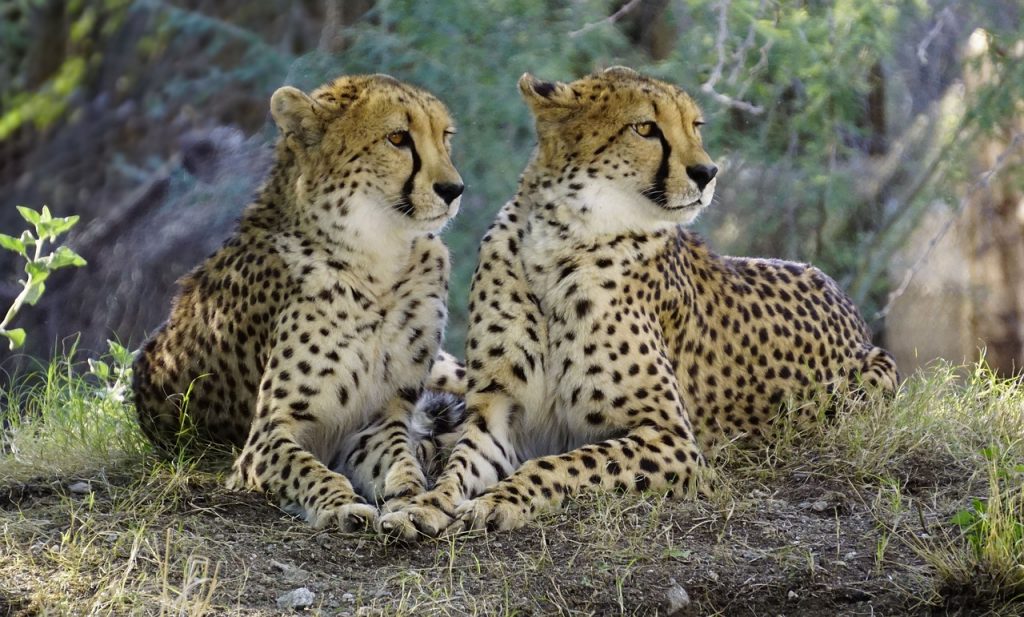
The spotted cat lifts its head above the grass, fixes upon a moving gazelle and starts to run. Within heartbeats it has crossed ground that would take a person much longer. The cheetah’s hunting country is a place of open sightlines and sudden movement, where even a short chase can change a caravan’s path.
At a Glance
- Identity: Cheetah (Acinonyx jubatus), a spotted running cat of open country
- Build: Long-legged, slim-bodied feline with tear-mark facial lines and claws adapted for traction
- Habitat: Savanna, open grassland, dry scrub and other terrain allowing rapid pursuit
- Range: Predominantly parts of Africa; a smaller historical Asian population occurs in parts of the Middle East and India
- Behaviour: Stalks close to prey before a brief sprint; rests after exertion and usually avoids a dangerous confrontation with people
- Signs: Narrow feline tracks, disturbed grass, short high-speed pursuits and prey brought down in the open
- Encounter role: Prey-chase hazard, rival for a carcass, clue to nearby herds or swift animal trapped near a trading route
- Distinction: An extraordinary dire cheetah is a separate fantasy beast, not a larger version automatically found among ordinary cheetahs
Game Statistics
The D&D 2024 and 2014 cheetahs are original Panther-based conversions, while the Pathfinder 1e and D&D 3.5e Cheetahs are published creatures. The separate Dire Cheetah is retained as an attributed optional third-party variant in the 2014 panel.
Cheetah — CR 1/4
Medium Beast, Unaligned
AC 13 · Initiative +3 (13) · HP 13 (3d8) · Speed 60 ft.
| STR | DEX | CON | INT | WIS | CHA |
|---|---|---|---|---|---|
| 14 (+2) | 16 (+3) | 10 (+0) | 3 (−4) | 14 (+2) | 7 (−2) |
Skills Perception +4, Stealth +7
Senses Darkvision 60 ft.; Passive Perception 14
Languages None
CR 1/4 (50 XP; PB +2)
Traits
Sprint (1/Hour). At the start of its turn, the cheetah can increase its Speed to 120 feet until the end of that turn. It can’t use Sprint again for 1 hour.
Actions
Rend. Melee Attack Roll: +5, reach 5 ft. Hit: 6 (1d6 + 3) Slashing damage.
Bonus Actions
Nimble Escape. The cheetah takes the Disengage or Hide action.
Original D&D 2024 Cheetah adaptation of the SRD 5.2.1 Panther. Sprint is original; no separate official 2024 Cheetah appears in the SRD.
Cheetah — CR 1/4
Medium beast, unaligned
Armor Class 12
Hit Points 13 (3d8)
Speed 60 ft.
| STR | DEX | CON | INT | WIS | CHA |
|---|---|---|---|---|---|
| 14 (+2) | 16 (+3) | 10 (+0) | 3 (−4) | 14 (+2) | 7 (−2) |
Skills Perception +4, Stealth +7
Senses passive Perception 14
Languages —
Challenge 1/4 (50 XP)
Traits
Keen Smell. Advantage on Wisdom (Perception) checks that rely on smell.
Sprint (1/Hour). Once per hour the cheetah can take the Dash action as a bonus action and its Speed increases to 80 feet until the end of that turn.
Actions
Bite. Melee Weapon Attack: +4 to hit, reach 5 ft., one target. Hit: 5 (1d6 + 2) piercing damage.
Claw. Melee Weapon Attack: +4 to hit, reach 5 ft., one target. Hit: 4 (1d4 + 2) slashing damage.
Dire Cheetah — original third-party CR 1 variant
Large beast, unaligned; CR 1 (200 XP). AC 16 (natural armor), HP 32 (5d10 + 5), Speed 70 ft., climb 20 ft. Str 17 (+3), Dex 18 (+4), Con 13 (+1), Int 3 (−4), Wis 14 (+2), Cha 7 (−2). Skills Perception +4, Stealth +8. Passive Perception 14.
Keen Smell. Advantage on Perception checks relying on smell. Stealthy. It doubles its proficiency bonus on Stealth checks.
Pounce. After moving 20 feet straight towards a creature and hitting with a Claw attack, the target must make a DC 13 Strength save or be knocked prone. If prone, the dire cheetah may make a Bite as a bonus action.
Running Leap. With a 10-foot running start its long jump reaches 25 feet and its high jump reaches 10 feet.
Bite. +6 to hit, 8 (1d8 + 4) piercing damage. Claw. +6 to hit, 7 (1d6 + 4) slashing damage.
Dire Cheetah artwork. View the original illustration. Artwork was attributed to NightCafe Creator on the old page.
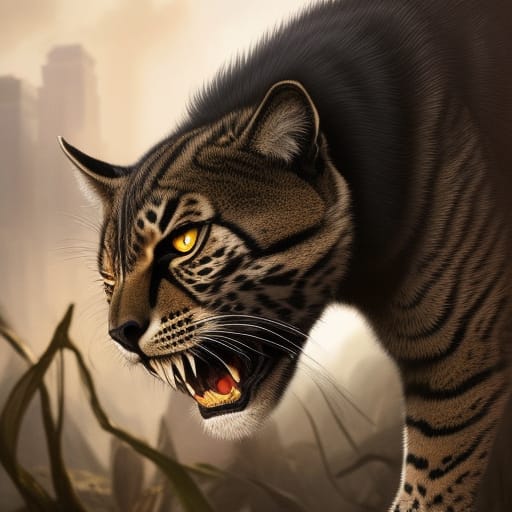
Third-party Dire Cheetah from Book of Monstrous Might (© 2021 Total Party Kill Games), authors Brian Berg, Mark A. Hart and Danny Grimes, retained as an explicitly optional creature. It is not a normal cheetah and its old treasure table is not a biological property of wild cats.
Original 2014 Cheetah conversion based on the SRD 5.1 Panther, not a published official Cheetah. The third-party Dire Cheetah is optional and separately attributed.
Cheetah — CR 2
XP 600 · N Medium animal
Init +8; Senses low-light vision, scent; Perception +5
Defense
AC 15, touch 14, flat-footed 11 (+4 Dex, +1 natural)
hp 19 (3d8 + 6)
Fort +5, Ref +7, Will +2
Offense
Speed 50 ft.; sprint
Melee bite +6 (1d6 + 3 plus trip), two claws +6 (1d3 + 3)
Space/Reach 5 ft./5 ft.
| STR | DEX | CON | INT | WIS | CHA |
|---|---|---|---|---|---|
| 17 | 19 | 15 | 2 | 12 | 6 |
Base Atk +2; CMB +5; CMD 19 (23 vs. trip)
Feats Improved Initiative, Weapon Finesse
Skills Acrobatics +8, Perception +5, Stealth +8 (+12 in tall grass)
Racial Modifiers +4 Stealth in tall grass
Special Abilities
Sprint (Ex). Once per hour, this cheetah can move ten times its normal speed (500 feet) when it makes a charge. This is a specific Pathfinder rule, not an ordinary unrestricted running speed.
Ecology
Environment warm plains
Organization solitary or pair
Treasure none
Published Pathfinder Roleplaying Game Bestiary Cheetah (Paizo, OGL). Trip on the bite and Sprint use Pathfinder combat manoeuvre and charge rules.
Cheetah — CR 2
Medium Animal; Always neutral
Hit Dice 3d8 + 6 (19 hp)
Initiative +4
Speed 50 ft. (10 squares)
Armor Class 15 (+4 Dex, +1 natural), touch 14, flat-footed 11
Base Attack/Grapple +2/+5
Attack bite +6 melee (1d6 + 3)
Full Attack bite +6 melee (1d6 + 3) and two claws +1 melee (1d2 + 1)
Space/Reach 5 ft./5 ft.
Special Attacks trip
Special Qualities low-light vision, scent, sprint
Saves Fort +5, Ref +7, Will +2
| STR | DEX | CON | INT | WIS | CHA |
|---|---|---|---|---|---|
| 16 | 19 | 15 | 2 | 12 | 6 |
Skills Hide +6, Listen +4, Move Silently +6, Spot +4
Feats Alertness, Weapon Finesse
Environment warm plains
Organization solitary, pair or family (3–5)
Treasure none
Combat
Trip (Ex). On a successful Claw or Bite, the cheetah may attempt a trip (+3 check modifier) as a free action without a melee touch attack or attack of opportunity. If the attempt fails the target cannot trip it back.
Sprint (Ex). Once per hour, the cheetah can move ten times its usual Speed (500 feet) when charging.
D&D 3.5 System Reference Document, Cheetah, under OGL 1.0a. The charge, sprint and trip procedures differ from Pathfinder and modern D&D.
The Cheetah in the Living World
In the grasslands, a cheetah’s narrow body seems made to disappear into dry stalks. Its long legs, flexible spine and light build serve a particular kind of hunt: stalking close to prey and then accelerating in a burst of extraordinary speed. A chase lasts only a short time; the cat cannot spend a whole day racing across a plain. Once it has brought prey down, exhaustion and the attention of larger predators can be as dangerous as the pursuit itself.
A cheetah does not hunt like the heavier Leopard. It is less suited to dragging a large carcass into a tree and is more dependent on open ground and rapid acceleration. The black tear-like marks on its face, small rounded head and lean shape distinguish it from other spotted cats. Its real ecological needs, rather than a fantastical title, give players the clearest idea of what it may do.
Grass, Shade and Water
Cheetahs inhabit open savannas, grasslands and dry scrub where prey and cover are both available. They may use a low hill or termite mound as a lookout. In parts of Africa, hunters and herders may see them near antelope country. In the historic Asian ranges, the cheetah is an uncommon presence with its own regional story; it should not be scattered through every forest of India simply to add another predator.
Lives and Social Bonds
Adult females often travel alone except while raising young. Males may form alliances with brothers or other males and move or hunt together. That is not the same as a wolf pack with a family den, nor does it grant the animal a combat bonus in editions that do not list one. Cubs need shelter and the protection of their mother. A cheetah separated from cover or chased by hunters may respond differently from one resting beside a successful hunt.
A village keeper may value the animal as part of the surrounding countryside, fear losses near goat pens or covet it as a gift for a noble court. Those people have motives; the cat itself seeks prey, safety and a place to raise young.
Signs Before the Chase
Four-toed cat tracks lead through sandy grass. A patch of flattened stalks near an antelope trail, claw marks in hard earth and a short line of churned ground may indicate a sprint. A patient tracker can distinguish the place where a cat waited from where the prey turned. Survival helps read the route; Perception may reveal a spotted shape pausing on a distant rise.
A cheetah that looks up from prey and begins to withdraw may not want a fight. A frightened cat forced into a narrow ravine or defending cubs has less room to escape. Show the party that ground, distance and wind are part of the encounter before initiative is rolled.
Running a Cheetah Encounter
What It Wants
Food, safety and access to a successful hunting route. A female with cubs is seeking shelter for them; a pair of males may be travelling together through open country. A cheetah does not plot against adventurers, and it cannot sprint endlessly no matter which game system is used.
If Violence Starts
Cheetahs use speed to catch prey and generally do not favour a protracted struggle with heavily armed opponents. The 2024 and 2014 conversions give a manageable fast-running beast for low-level encounters; their Sprint abilities are original adaptations. Pathfinder 1e and D&D 3.5e explicitly give the animal a once-per-hour extraordinary Sprint as part of a charge, but apply the differing procedures of each edition. The optional Dire Cheetah is much stronger and should be chosen deliberately.
Counterplay
Stay together, avoid chasing the cat into a vulnerable narrow pass, give it space to leave a carcass, and protect young livestock by moving pens away from its hunting route. A guide who knows nearby water and prey trails may steer a caravan around the animal without a confrontation. A patient party may watch the chase from a safe distance and learn much about its surroundings.
Consequences
Driving an animal off its feeding grounds can change where it hunts and which farms experience losses. Rescuing a trapped cheetah may earn a guide’s respect, while a rash hunt can lose the favour of a village whose elders warned the party to leave it alone.
Encounters and Adventure Hooks
The Sprint Across the Track
Opening: A spotted cat bursts through the grass in pursuit of a young gazelle just as merchant Amina’s caravan reaches a narrow crossing. The pack animals panic, and a heavy cart blocks the road behind them.
Choices: Calm the animals, hold the carts in place, wait for the chase to pass or try to force the crossing. A rushed response may send valuable goods into a ditch. Amina remembers whether the party helped the people or made a dangerous scene worse.
The Trapper’s Stakes
Opening: Herder Musa finds a cheetah caught by a tethered leg near the boundary of shared pasture. He fears the trapper who set it, because the snare is far closer to the village path than the trapper admits.
Choices: Free the frightened cat, find a safe way to release the snare, question the trapper or leave it until an experienced handler arrives. A careless rescue is dangerous; a successful one may expose a dispute over hunting rights and make Musa a lasting ally.
The Borrowed Hunting Cat
Opening: A noble’s trained cheetah has escaped its keeper during a journey between courts. The keeper offers a reward but warns that the animal will not respond to strangers. A farmer nearby claims it has been stealing from his pen.
Choices: Follow the tracks, ask about the animal’s training, inspect the pen or negotiate a return with the keeper. It is hunting wild hares rather than the farmer’s goats; the stolen livestock has another explanation. Recovering it without accusation brings a court contact and could settle the farmer’s losses.
The Brothers on the Ridge
Opening: Two cheetahs appear on a rocky rise above the road. A guide calls them a breeding pair and urges the caravan to attack before they descend. In fact they are male companions travelling through their hunting range.
Choices: Observe, change the caravan route, secure its animals or allow the cats to pass. Knowing that not every pair is defending a den prevents an avoidable fight. The guide may rethink his assumptions if the party handles the encounter well.
The Empty Antelope Plain
Opening: A settlement reports fewer antelope than usual, and hunters blame a single cheetah seen near an old water hole. Water levels have fallen, and herders have moved their grazing animals into the same area.
Choices: Track the herds, examine the water supply, interview shepherds or follow the cheetah’s trail. The scarcity is caused by the changing water and grazing routes rather than one predator. Helping the villagers identify another source can save animals and families long after the adventure has moved on.
Trade, Rumours and Aftermath
Cheetahs carry no coins or treasure. A hunter or noble may pay highly for a rare trained animal, but that price depends on training, availability and local relationships. The dire variant’s old random treasure table represented an unrelated fantasy reward and is not a property of ordinary cheetahs.
The cat that runs without tiring: Witnesses may confuse a single sprint with endless speed. The animal needs rest and can be vulnerable after its chase.
The hunting cats of the palace: Some courts keep trained cheetahs, but this does not make every wild animal obedient to a handler.
Related Animals, Places and Rules
Compare the climbing Leopard, the much heavier Tiger and the smaller Lynx. The Animal Bestiary covers further animals encountered along the same journeys. Grassland and trading scenes can lead to African landscapes or travel across India. Use Survival, Perception and edition-specific tracking and movement rules.
Sources and Rules Notices
D&D 2024 and 2014 use original Cheetah adaptations of the Panther in SRD 5.2.1 and SRD 5.1 (CC BY 4.0); no separate official Cheetah is claimed in those references. Pathfinder 1e draws on the published Cheetah in the Pathfinder Bestiary (Paizo, OGL); D&D 3.5e uses the Cheetah from the 3.5 System Reference Document (OGL 1.0a).
The optional Dire Cheetah came from Book of Monstrous Might, © 2021 Total Party Kill Games; authors Brian Berg, Mark A. Hart and Danny Grimes. It is kept as an attributed third-party variant, separate from the natural animal. The two existing site images have been retained. Named characters, encounters and consequences are original campaign content.
Keep this reference growing
If this page helped with your reading or game, you can support its upkeep or explore the curated books.
Explore the Bookshop — epics, classics and stories behind imagined worlds.