
Shout Spell
The Shout spell turns a single cry into a weapon. Air buckles under magical pressure, hearing collapses beneath the blast, and glass or crystal can answer the voice by breaking apart.
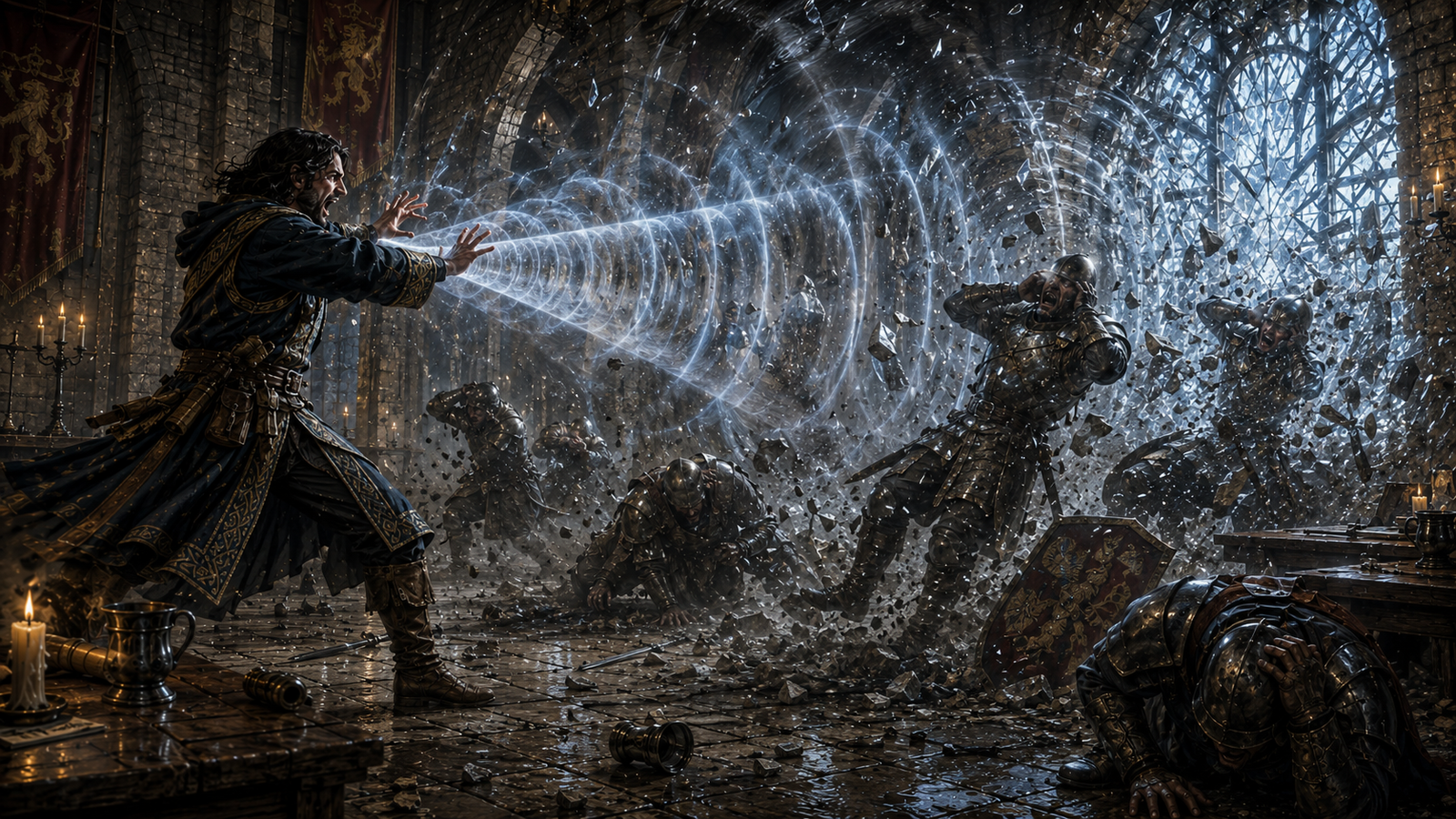
Shout Spell — SpiralWorlds 5.5e Adaptation
- Level
- 4 Evocation
- Classes
- Bard, Sorcerer, Wizard
- Casting Time
- Action
- Range
- Self (30-foot Cone)
- Components
- V
- Duration
- Instantaneous
- Saving Throw
- Constitution
- Damage
- Thunder
You release a magically amplified cry that erupts from you in a 30-foot Cone. Each creature in the Cone makes a Constitution saving throw.
Failed Save: The creature takes 5d8 Thunder damage and has the Deafened condition for 1 minute.
Successful Save: The creature takes half as much damage and isn’t Deafened.
A Deafened creature repeats the saving throw at the end of each of its turns, ending the condition on itself on a success.
A creature made primarily of crystal or glass has Disadvantage on its saving throw against the spell.
A nonmagical object in the Cone that isn’t being worn or carried also takes the spell’s Thunder damage. If that object is made primarily of crystal, glass, ceramic, or porcelain, treat every damage die rolled against it as an 8.
The spell can’t affect a creature or object entirely inside an area where sound can’t exist, such as Silence, and its Cone can’t pass through such an area.
Shout — Pathfinder 1e
- School
- Evocation [sonic]
- Level
- Bard 4, Sorcerer/Wizard 4
- Casting Time
- 1 standard action
- Components
- V
- Range
- 30 ft.
- Area
- Cone-shaped burst
- Duration
- Instantaneous
- Saving Throw
- Fortitude partial or Reflex negates (object); see text
- Spell Resistance
- Yes (object)
You emit an ear-splitting yell that deafens and damages creatures in its path. Any creature within the cone takes 5d6 sonic damage and becomes Deafened for 2d6 rounds.
A successful Fortitude save halves the damage and negates the Deafened condition.
An exposed brittle or crystalline object, or a crystalline creature, instead takes 1d6 sonic damage per caster level, to a maximum of 15d6.
An affected crystalline creature can make a Fortitude save for half damage. A creature holding fragile objects can negate damage to them with a successful Reflex save.
Shout cannot penetrate a Silence spell.
Shout — D&D 3.5e
- School
- Evocation [Sonic]
- Level
- Bard 4, Sorcerer/Wizard 4
- Components
- V
- Casting Time
- 1 standard action
- Range
- 30 ft.
- Area
- Cone-shaped burst
- Duration
- Instantaneous
- Saving Throw
- Fortitude partial or Reflex negates (object); see text
- Spell Resistance
- Yes (object)
You release an ear-splitting yell through a 30-foot cone. Creatures in the area take 5d6 sonic damage and become Deafened for 2d6 rounds.
A successful Fortitude save halves the damage and negates the Deafened condition.
Exposed brittle or crystalline objects and crystalline creatures take 1d6 sonic damage per caster level, maximum 15d6.
An affected crystalline creature can make a Fortitude save for half damage, while a creature carrying fragile objects can protect them with a successful Reflex save.
Shout cannot penetrate a Silence spell.
Shout Spell: Practical Rulings
Does the save prevent Deafened?
Yes. When the relevant rules panel allows a successful save to prevent the condition, the target takes the reduced damage but does not become Deafened.
Does crystal damage stack with normal damage?
No. Where brittle or crystalline targets receive their own damage treatment, that replaces the ordinary damage treatment rather than adding a second damage roll.
What happens to carried fragile objects?
The older rules explicitly protect carried fragile objects with the holder’s Reflex save. The modern adaptation instead limits object damage to unattended nonmagical objects.
Does Silence stop Shout?
Yes. Silence remains the defining counter to destructive voice magic.
Best Uses for the Shout Spell
The Shout spell rewards positioning. Its cone is short enough to make casting it a commitment, but broad enough to punish enemies packed into corridors, stairs, gatehouses, ship decks, workshops, or dense melee formations.
The Deafened condition can matter as much as the initial damage. Enemy spellcasters, officers, messengers, musicians, scouts, and creatures that depend heavily on hearing can all become less effective even when the blast itself is not decisive.
Brittle and crystalline targets give the spell its second identity. Glass, crystal, ceramic fittings, delicate vessels, and crystalline creatures are far more vulnerable than ordinary masonry. Shout is destructive resonance, however, not a universal wall-breaking spell.
Voice and Resonance in the World
Learned natural philosophers describe Shout as evidence that sound can be disciplined into force. The caster does not simply make a louder noise. Magical technique gives the spoken cry coherence, driving pressure through the air until hearing, flesh, and vulnerable material respond to the same wave.
Bell-founders, glassmakers, instrument makers, artillerymen, fortress engineers, and university scholars all have reasons to study such magic. They already know that a change in shape, thickness, alloy, or material can alter the way vibration travels. Shout makes those observations violently practical.
Commanders therefore value the spell less as a substitute for artillery than as a sudden assault on close formations and enclosed spaces. A guardroom, guildhall, treasury, ship interior, glasshouse, or council chamber can become hazardous in a single breath.

Shout Spell in History and Myth
Historical Echo: The Medieval Bell
A powerful voice made physical has an obvious historical counterpart in the medieval bell. Surviving bells reveal an advanced practical understanding of casting, shape, metal, and resonance. A North Italian church bell made around 1411 survives in the collection of the Metropolitan Museum of Art.
See the c.1411 North Italian church bell at The Metropolitan Museum of Art .
Mythic Echo: Stentor
Greek epic provides an almost perfect legendary analogue. In Homer’s Iliad, Hera takes the likeness of Stentor, the brazen-voiced herald whose cry is said to equal the voices of fifty ordinary men. His name eventually gave English the adjective stentorian.
Read the Stentor passage in Homer’s Iliad, Book 5, at Perseus .
Related Magic
| Spell or Page | Connection |
|---|---|
| Silence | The defining magical counter to Shout and other effects dependent on sound. |
| Shatter | A lower-level sonic spell particularly concerned with brittle objects and crystalline creatures. |
| Sound Burst | A lower-level area attack in the same broad family of destructive sound magic. |
| Greater Shout | The stronger development of the same magical principle. |
| Deafened | The spell’s defining condition and one of the main reasons it matters beyond raw damage. |
| Bard | A core class associated with magical voice, music, performance, and destructive sound. |
| Sorcerer | A natural home for the spell’s sudden release of concentrated magical force. |
Rules sources: Pathfinder Roleplaying Game Core Rulebook / legacy PRD; Pathfinder Roleplaying Game Mythic Adventures; Revised v.3.5 System Reference Document.
Pathfinder and D&D 3.5e rules material on this page is Open Game Content used under the Open Game License v1.0a where applicable.
The modern Shout rules panel is a SpiralWorlds adaptation designed for the current rules framework and is not presented as SRD 5.2.1 rules text.
Keep this reference growing
If this page helped with your reading or game, you can support its upkeep or explore the curated books.
Explore the Bookshop — epics, classics and stories behind imagined worlds.