
Transmutation and concealment magic · hidden writing, false documents and protected archives
Secret Page Spell
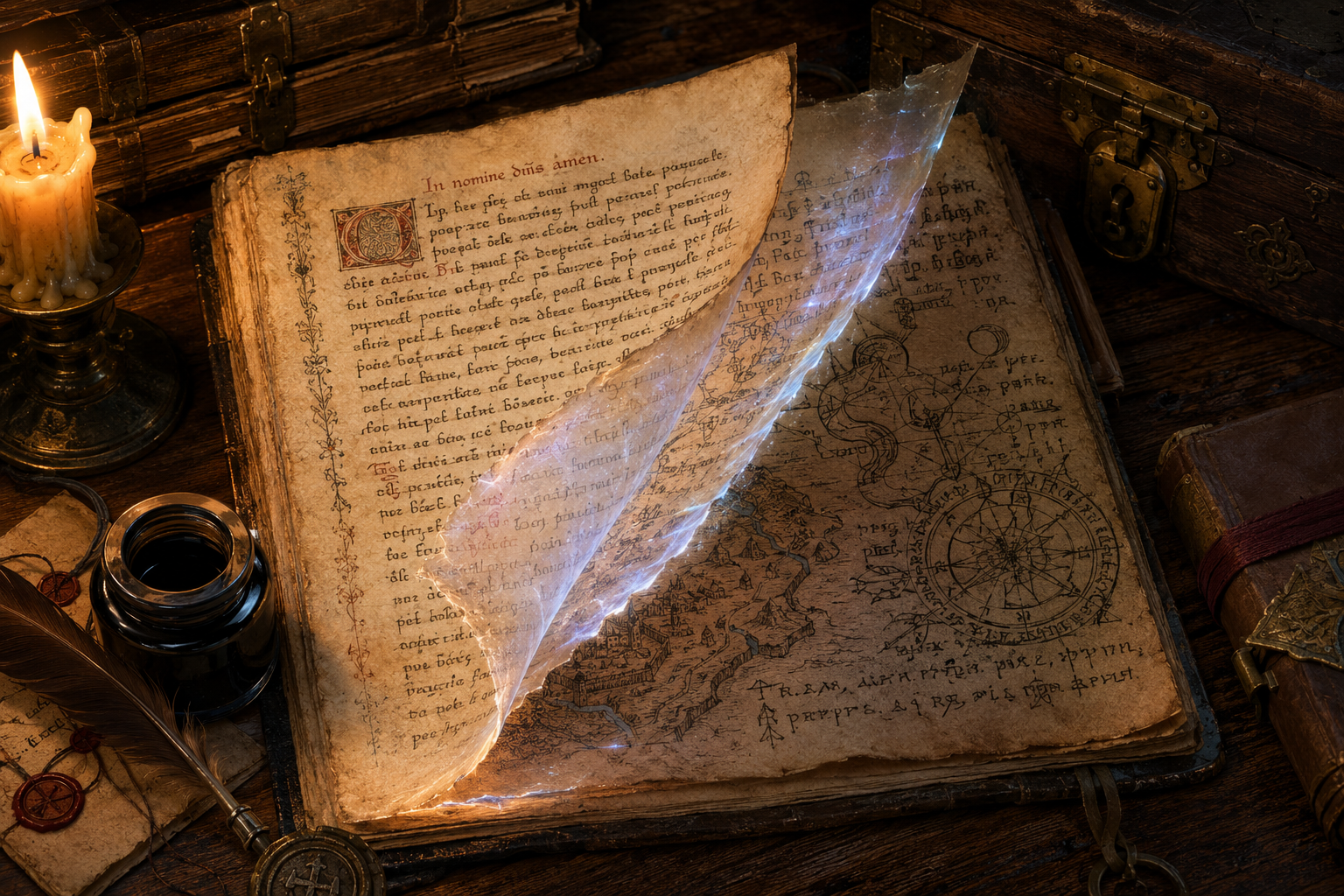
Secret Page lets a document survive in plain sight. A military map can appear to be household accounts, a dangerous formula can resemble a harmless lesson, and a private ledger can show an intruder exactly the false information its owner wants found.
Secret Page Mechanics
Secret Page — 5.5e / 2024 Conversion
SpiralWorlds conversion. Secret Page is presented here as a modern conversion of the older spell rather than as an official SRD 5.2.1 spell.
False Writing
You alter the visible contents of the target so that its writing appears to be different writing of your choice. The false writing can resemble a letter, account, map legend, legal record, spell formula, diary entry, cipher sheet or other written material that could reasonably fit on the surface.
The real writing remains beneath the magical alteration. Secret Page changes what is seen; it does not physically scrape away, replace or rewrite the original ink.
False Spell Text
The false writing may imitate the appearance of a spell, but it has no magical function. It cannot be cast, prepared, copied into a spellbook as a genuine spell, used to create a magic item, or satisfy any rule that requires authentic spell writing.
The Special Word
When you cast the spell, choose a special word. While touching the page, you can take a Magic action and speak that word to switch the page between its true and false forms.
While touching the page, you can speak the special word twice as part of the same Magic action to end Secret Page permanently.
Knowing the word is not enough. The spell gives control of the transformation to the caster. Merely overhearing or discovering the word does not grant another creature authority over the page.
Detecting the Magic
Detect Magic can reveal that the page bears magic under that spell’s normal rules, but it does not expose the concealed writing or identify the false text as false merely by being active.
Comprehend Languages
Comprehend Languages does not reveal the hidden page by itself. It can translate writing the caster can actually perceive, but it does not decode a secret message merely because the hidden text exists beneath the false one.
Truesight
A creature with Truesight can distinguish the magical false writing from the real writing and perceive the concealed text. The creature must still understand the language in order to understand what the true page says.
If the creature can perceive the concealed writing but does not know its language, Comprehend Languages can supply its literal meaning while the normal requirements of that spell are met.
Dispel Magic
A successful Dispel Magic ends Secret Page. The false writing disappears and the original writing remains. Dispelling the concealment does not erase or damage the document.
Spell Scrolls
Secret Page can conceal the visible writing on a spell scroll, but it does not change which spell the scroll contains, change the stored spell’s level, create a second usable spell, or suppress the scroll’s magical nature.
Other Wards
The page can carry other compatible protective magic. For example, Glyph of Warding may be used when all of that spell’s own placement and trigger requirements are satisfied.
Secret Page does not override the other ward’s restrictions. A Glyph of Warding placed on a book or page still ends if its warded object is moved beyond the distance permitted by that spell.
Damage and Copying
Secret Page protects information, not paper. Fire, water, tearing, rot, scraping or other physical destruction affects the document normally.
A creature copying the page by ordinary means copies whatever writing it can currently perceive. A scribe looking only at the false page therefore makes a copy of the false text, not the concealed original.
Secret Page — Pathfinder 1e
Effect
The spell makes the actual contents of one page appear to be entirely different writing. The original material remains concealed beneath the altered appearance.
Changing Spell Text
If the concealed page contains a spell, the false page can appear to contain another spell only if the substitute spell is of equal or lower level and is known by the caster.
Pathfinder restriction: do not import the broader wording from the older rules. The substitute-spell limit is part of this version of Secret Page.
Spell Scrolls
Secret Page cannot change the spell contained on a spell scroll into a different spell. It can, however, conceal the scroll beneath false writing. The actual stored spell remains unchanged.
Layering Written Wards
Explosive Runes or Sepia Snake Sigil can be placed upon a Secret Page.
The Special Word
The caster establishes a special word when creating the page. Speaking it reveals the actual contents to the caster, who can then return the page to its disguised form.
Repeating the special word twice removes Secret Page completely.
Command-word ruling: the spell text grants this control to the caster. It does not state that anyone who overhears the special word can reveal or dismiss the page.
Comprehend Languages
Comprehend Languages by itself does not reveal the concealed contents.
Detect Magic
Detect Magic reveals dim magic on the affected page, but it does not reveal the true contents.
True Seeing
True Seeing reveals that hidden material is present but does not by itself make the concealed writing readable.
Used together with Comprehend Languages, it can expose and interpret the protected text.
Dispel Magic
Secret Page can be removed with Dispel Magic. Ending the spell removes the concealment; it does not erase the underlying mundane writing.
Erase
Erase can destroy the hidden writing itself. This is materially different from dispelling Secret Page: one removes the magical disguise, while the other can destroy the protected text.
Material Component
Powdered herring scales and a vial of will-o’-wisp essence.
Secret Page — D&D 3.5e
Effect
The spell changes the apparent contents of a page so that the true writing is concealed beneath an entirely different visible page.
Changing Spell Text
A page containing a spell can be made to appear to contain another spell.
Important distinction: this rules text does not include Pathfinder’s requirement that the false spell be equal or lower level and known by the caster. Do not import that later restriction into this version.
Scrolls
This rules text also lacks Pathfinder’s explicit prohibition on changing the apparent spell text of a spell scroll.
Secret Page still changes appearance rather than the underlying magical function. A false spell displayed on a scroll does not replace the actual spell stored there or create a second usable spell.
Layering Written Wards
Explosive Runes and Sepia Snake Sigil can be cast upon the affected page.
The Special Word
The caster can speak a special word to reveal the original contents and can return the page to its disguised state afterward.
Repeating the special word twice removes Secret Page completely.
Command-word ruling: the ability to reveal, restore and remove the page is granted to the caster. The spell does not say that another creature gains that ability merely by learning the word.
Comprehend Languages
Comprehend Languages alone cannot reveal the true contents.
Detect Magic
Detect Magic reveals dim magic on the affected page but does not expose the concealed writing.
True Seeing
True Seeing reveals the presence of hidden material but does not by itself reveal its readable contents.
Combined with Comprehend Languages, it can reveal and interpret the concealed text.
Dispel Magic
Dispel Magic can end Secret Page. Once the spell ends, the false appearance is gone and the underlying writing remains.
Erase
Erase can destroy the hidden writing rather than merely removing the concealment.
Material Component
Powdered herring scales and will-o’-wisp essence.
Using Secret Page in Play
Hide a Map
A military route, tunnel plan, treasure map or city defence diagram can appear to be a harmless letter, inventory or page of arithmetic.
Disguise a Spellbook
Dangerous formulae can appear to be lesser magic, mundane notes or useless exercises, giving a thief the wrong impression about what has actually been stolen.
Protect Intelligence
Names of agents, rendezvous points, troop strengths, passwords and payment records can remain physically present while presenting an interceptor with convincing false information.
Create a Decoy Record
The strongest deception is sometimes not an unreadable document but a perfectly readable one containing exactly the harmless explanation an investigator expected to find.
What Secret Page Does Not Do
- It does not protect the document from damage. A hidden secret burns with the paper carrying it.
- It does not make the false information true. The spell changes apparent writing, not reality, ownership, memory or historical fact.
- It does not create a functioning second spell. False magical notation remains false.
- It is not perfect cryptography. Once the real page is exposed, its actual language, cipher and meaning must still be dealt with normally.
- It does not make magic undetectable. Effects that detect magic can still reveal that something supernatural is present according to their own rules.
Good Combinations
- Illusory Script — conceals meaning through a different form of magical writing and is useful when access should depend on the reader rather than on toggling a page.
- Explosive Runes — turns a concealed document into a dangerous trap where the rules permit both effects to coexist.
- Sepia Snake Sigil — adds a reader-triggered defence to books, ledgers and other important written material.
- Oozing Script — protects forbidden books through a fear-inducing illusion rather than by substituting one page for another.
- Glyph of Warding — useful for fixed archives, sealed rooms and stationary records where concealment and active defence should overlap.
Related Spells
Secret Page in 1454
Written information is becoming a weapon in its own right. Courts, city governments, merchant houses and military commanders depend upon letters, ledgers, reports, contracts, copies and archived correspondence. In the Italian states especially, the growth of diplomatic networks around the middle of the fifteenth century is producing an extraordinary volume of written intelligence that must be organised, transmitted and protected.
Secret Page does not replace cipher alphabets, trusted couriers, seals or locked archives. Careful chanceries use several protections at once. A dispatch might be written in cipher, sealed, carried by a sworn messenger and concealed beneath an innocent-looking account. A captured page therefore presents several separate problems: finding it, recognising that it matters, exposing its real contents and finally understanding what those contents mean.
Wizards, professional scribes, university scholars, court secretaries and specialist cryptographers all have reasons to value the spell. Merchant syndicates hide debt books and private contracts; rulers protect instructions to envoys; guilds conceal formulas; spies carry false letters designed to survive a search; and magical schools disguise dangerous research as routine exercises. The result is an information war in which the document most worth stealing may be the one that appears least interesting.
Adventure Hooks
- The harmless ledger: a captured financial book appears to contain nothing more important than grain purchases, yet several people have already killed to recover it.
- The wrong spellbook: thieves steal a famous wizard’s grimoire and discover pages filled with unimpressive apprentice magic. The real question is whether they stole the correct book after all.
- The intercepted dispatch: an enemy courier carries orders that seem to direct troops away from the frontier. Acting on the visible message could be exactly what the sender intends.
Sources, Attribution and Licensing
Rules References
- System Reference Document 5.2.1 — modern rules framework used for the SpiralWorlds conversion.
- Pathfinder Reference: Secret Page — Pathfinder spell mechanics, including the substitute-spell and scroll restrictions.
- Pathfinder Core Rulebook: Rune Domain — Secret Page as the Rune domain’s 2nd-level spell.
- D&D 3.5 SRD: Secret Page — legacy spell mechanics and interactions.
Historical References
- Filippo de Vivo, “Archival Intelligence: Diplomatic Correspondence, Information Overload, and Information Management in Italy, 1450–1650” — diplomatic correspondence, archives and information management.
- Isabella Lazzarini, “Records, Politics and Diplomacy: Secretaries and Chanceries in Renaissance Italy” — chanceries, secretaries and written statecraft.
Artwork
Secret Page hero illustration, SpiralWorlds, 2026.
SRD 5.2.1 Attribution
This work includes material from the System Reference Document 5.2.1 (“SRD 5.2.1”) by Wizards of the Coast LLC. SRD 5.2.1 is licensed under the Creative Commons Attribution 4.0 International License .
Legacy Open Game Content
The mechanical rules material within the Pathfinder 1e and D&D 3.5e mechanics panels is designated as Open Game Content and is used under the Open Game License Version 1.0a.
No other portion of this page is designated as Open Game Content. The modern conversion, artwork, presentation, CSS, examples, rulings commentary, historical discussion, setting material and other SpiralWorlds editorial material are excluded from that designation.
Open Game License v1.0a + applicable Section 15 notices
OPEN GAME LICENSE Version 1.0a
The following text is the property of Wizards of the Coast, Inc. and is Copyright 2000 Wizards of the Coast, Inc (“Wizards”). All Rights Reserved.
1. Definitions: (a) “Contributors” means the copyright and/or trademark owners who have contributed Open Game Content; (b) “Derivative Material” means copyrighted material including derivative works and translations (including into other computer languages), potation, modification, correction, addition, extension, upgrade, improvement, compilation, abridgment or other form in which an existing work may be recast, transformed or adapted; (c) “Distribute” means to reproduce, license, rent, lease, sell, broadcast, publicly display, transmit or otherwise distribute; (d) “Open Game Content” means the game mechanic and includes the methods, procedures, processes and routines to the extent such content does not embody the Product Identity and is an enhancement over the prior art and any additional content clearly identified as Open Game Content by the Contributor, and means any work covered by this License, including translations and derivative works under copyright law, but specifically excludes Product Identity; (e) “Product Identity” means product and product line names, logos and identifying marks including trade dress; artifacts; creatures; characters; stories, storylines, plots, thematic elements, dialogue, incidents, language, artwork, symbols, designs, depictions, likenesses, formats, poses, concepts, themes and graphic, photographic and other visual or audio representations; names and descriptions of characters, spells, enchantments, personalities, teams, personas, likenesses and special abilities; places, locations, environments, creatures, equipment, magical or supernatural abilities or effects, logos, symbols, or graphic designs; and any other trademark or registered trademark clearly identified as Product Identity by the owner of the Product Identity, and which specifically excludes the Open Game Content; (f) “Trademark” means the logos, names, mark, sign, motto, designs that are used by a Contributor to identify itself or its products or the associated products contributed to the Open Game License by the Contributor; (g) “Use”, “Used” or “Using” means to use, Distribute, copy, edit, format, modify, translate and otherwise create Derivative Material of Open Game Content; (h) “You” or “Your” means the licensee in terms of this agreement.
2. The License: This License applies to any Open Game Content that contains a notice indicating that the Open Game Content may only be Used under and in terms of this License. You must affix such a notice to any Open Game Content that you Use. No terms may be added to or subtracted from this License except as described by the License itself. No other terms or conditions may be applied to any Open Game Content distributed using this License.
3. Offer and Acceptance: By Using the Open Game Content You indicate Your acceptance of the terms of this License.
4. Grant and Consideration: In consideration for agreeing to use this License, the Contributors grant You a perpetual, worldwide, royalty-free, non-exclusive license with the exact terms of this License to Use the Open Game Content.
5. Representation of Authority to Contribute: If You are contributing original material as Open Game Content, You represent that Your Contributions are Your original creation and/or You have sufficient rights to grant the rights conveyed by this License.
6. Notice of License Copyright: You must update the COPYRIGHT NOTICE portion of this License to include the exact text of the COPYRIGHT NOTICE of any Open Game Content You are copying, modifying or distributing, and You must add the title, the copyright date, and the copyright holder’s name to the COPYRIGHT NOTICE of any original Open Game Content you Distribute.
7. Use of Product Identity: You agree not to Use any Product Identity, including as an indication as to compatibility, except as expressly licensed in another, independent Agreement with the owner of each element of that Product Identity.
You agree not to indicate compatibility or co-adaptability with any Trademark or Registered Trademark in conjunction with a work containing Open Game Content except as expressly licensed in another, independent Agreement with the owner of such Trademark or Registered Trademark. The use of any Product Identity in Open Game Content does not constitute a challenge to the ownership of that Product Identity.
The owner of any Product Identity used in Open Game Content shall retain all rights, title and interest in and to that Product Identity.
8. Identification: If you distribute Open Game Content You must clearly indicate which portions of the work that you are distributing are Open Game Content.
9. Updating the License: Wizards or its designated Agents may publish updated versions of this License. You may use any authorized version of this License to copy, modify and distribute any Open Game Content originally distributed under any version of this License.
10. Copy of this License: You MUST include a copy of this License with every copy of the Open Game Content You Distribute.
11. Use of Contributor Credits: You may not market or advertise the Open Game Content using the name of any Contributor unless You have written permission from the Contributor to do so.
12. Inability to Comply: If it is impossible for You to comply with any of the terms of this License with respect to some or all of the Open Game Content due to statute, judicial order, or governmental regulation then You may not Use any Open Game Material so affected.
13. Termination: This License will terminate automatically if You fail to comply with all terms herein and fail to cure such breach within 30 days of becoming aware of the breach. All sublicenses shall survive the termination of this License.
14. Reformation: If any provision of this License is held to be unenforceable, such provision shall be reformed only to the extent necessary to make it enforceable.
15. COPYRIGHT NOTICE
Open Game License v 1.0 Copyright 2000, Wizards of the Coast, Inc.
System Reference Document. Copyright 2000, Wizards of the Coast, Inc.; Authors Jonathan Tweet, Monte Cook, Skip Williams, based on original material by E. Gary Gygax and Dave Arneson.
Pathfinder Roleplaying Game Core Rulebook. Copyright 2009, Paizo Publishing, LLC; Author Jason Bulmahn, based on material by Jonathan Tweet, Monte Cook, and Skip Williams.
Keep this reference growing
If this page helped with your reading or game, you can support its upkeep or explore the curated books.
Explore the Bookshop — epics, classics and stories behind imagined worlds.