
Oozing Script Spell – Illusion Ward for Forbidden Books, “Ink of the Devouring Page”
Oozing Script Spell – Illusion Ward for Forbidden Books, “Ink of the Devouring Page”
The book does not need a lock when the wrong reader is afraid to look at the page.
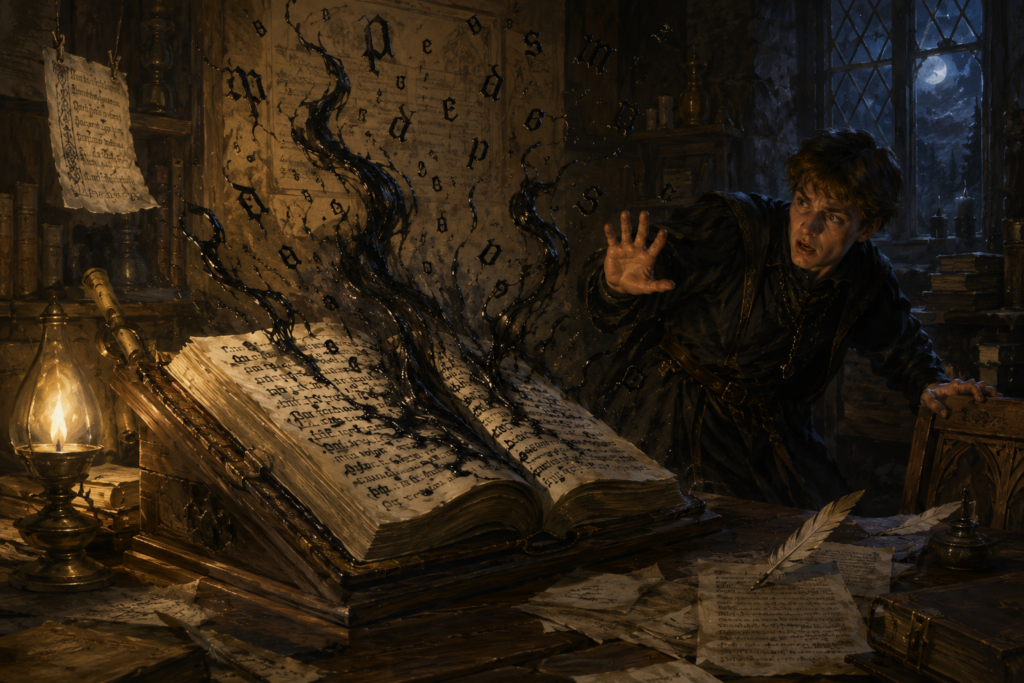
Oozing Script is a defensive illusion for spellbooks, ledgers, coded correspondence, blackmail records, forbidden rites, and dangerous research. It does not destroy the text, hide the book, or make the volume physically monstrous. Instead, it turns unauthorized reading into a moment of fear.
When the wrong reader opens the protected book and tries to read, the writing seems to thicken, run, and pour down the page like living ink. The victim believes the script is trying to devour them. The book remains intact, but the reader’s nerve breaks.
This is a spell about guarding knowledge, not winning fights. Its best use is in libraries, studies, court archives, cult shrines, guild counting rooms, wizard towers, and locked chests where a written secret must remain available to its owner but dangerous to thieves.
Used well, Oozing Script creates an immediate scene: a spy opens the wrong ledger, the letters seem to crawl from the page, and the intruder flees screaming while the evidence remains exactly where it was.
Effect
Oozing Script wards a book so that authorized readers can read it normally, while unauthorized readers see the writing distort into oozing, predatory streams of ink. The spell does not damage the book, erase the text, or make the ink physically alive. It protects the act of reading by making the wrong reader unable to trust the page.
At the table, the spell should feel like a defensive ward on knowledge: the book remains present, the clue remains recoverable, but unauthorized access becomes frightening, noisy, and difficult.
The best scene is not the ink becoming real. It is everyone else seeing a dry, ordinary page while the reader backs away from it in terror.
Oozing Script 5.5e / 2024
Oozing Script, Pathfinder 1e / 3.5e
Oozing Script, 3.0e
Oozing Script 5.5e / 2024
Alternative Spell Name: Ink of the Devouring Page
3rd-Level Illusion
Casting Time: 1 minute
Range: Touch
Components: V, S, M (octopus ink)
Duration: 24 hours
Target: One book, journal, ledger, codex, spellbook, or bound written work weighing no more than 10 pounds
Authorized readers can read the book normally.
When an unauthorized creature tries to read the book, the text becomes unintelligible to that creature. The ink appears to swell, run, and pour down the page like living black fluid.
The creature must make a Wisdom saving throw. On a failed save, it has the Frightened condition for 1 minute. When it first fails this saving throw, it must immediately use its Reaction, if available, to move up to half its Speed away from the book by the safest available route. If the creature has no Reaction available, it must use its movement on its next turn to move away from the book.
While frightened in this way, the creature cannot willingly move closer to the book or willingly look at its open pages. At the end of each of its turns, the creature can repeat the saving throw, ending the frightened effect on itself on a success.
Whether the creature succeeds or fails on the saving throw, it cannot read the protected text while the spell lasts. A creature that failed the initial saving throw also refuses to willingly read, touch, or closely inspect the book for 1 hour after the frightened effect ends.
This lingering refusal is a phantasmal aversion, not absolute control. The creature may still be restrained, magically compelled, or forced into the book’s presence, but the spell continues to prevent it from reading the text unless the ward is bypassed or removed.
A creature with Truesight can see the real writing and read the book, provided it understands the language.
At Higher Levels: When you cast this spell using a spell slot of 4th level or higher, the duration increases by 24 hours for each slot level above 3rd.
Oozing Script, Pathfinder 1e / 3.5e
School: Illusion (phantasm)
Level: Sorcerer/Wizard 3
Components: V, S, M
Casting Time: 1 minute
Range: Touch
Target: One book weighing 10 lb. or less
Duration: 1 day/level
Saving Throw: Will negates panic; see text
Spell Resistance: Yes
At the time of casting, you designate a number of authorized readers up to your caster level. You are automatically authorized and do not count against this limit.
Authorized readers can read the protected book normally.
When an unauthorized creature attempts to read the book, the script becomes unreadable to that creature. The ink appears to shift, liquefy, and ooze down the page in dark streams. The creature must attempt a Will save.
On a failed save, the creature believes the ink is trying to devour it. It becomes panicked for 1 round per caster level and flees from the book by the safest available route. Once the panic ends, the creature refuses to read, touch, or willingly view the book for 1 hour per caster level, resisting attempts to force it to do so.
On a successful save, the creature ignores the frightening phantasm, but still cannot decipher the script while the spell lasts.
True seeing allows the viewer to read the actual text, provided the viewer comprehends the language.
Material Component: Octopus ink.
Oozing Script, 3.0e

At the time of the spell’s casting, you authorize a number of readers no greater than your caster level to read the targeted book. You do not count toward this limit, nor is there any requirement to authorize anyone other than yourself to read the book. Whenever an authorized reader attempts to read the book, the ink apparently alters its shape, forming oozing streams of liquid that pour down the page.
Ink and Quill
Author Thomas Knauss
Series Dragonwing Games/Bastion Press
Publisher DWBP
Publish date 2002
Illusion (Phantasm)
Level: Sorcerer, Wizard 3
Components: V,S,M
Casting Time: 1 minute
Range: Touch
Target: 1 book weighing 10 lb. or less
Duration: 1 day/level
Saving Throw: Will negates (see text)
Spell Resistance: Yes
The creature must then make a Will save; otherwise it believes that the ink is trying to devour it. A successful save ignores this effect, but still does not allow the reader to decipher the script. Failure panics the stricken creature for one round per caster level, forcing it to flee. Such creatures utterly refuse any attempts to read the work for one hour per caster level, violently resisting all efforts to even view the book. true seeing enables the viewer to read the text, provided that she comprehends the text’s language.
Arcane Material Component: Octopus ink.
Why This Spell Is Dangerous in the World
Oozing Script makes written secrets defend themselves.
A lock keeps out the careless. A hidden compartment keeps out the lazy. This spell punishes the reader who has already crossed the line. That makes it useful to wizards, magistrates, spies, bankers, temple scribes, poisoners, smugglers, and anyone else whose power depends on records.
The spell is dangerous because it leaves the book usable by the right people and terrifying to the wrong ones. A villain can protect a ledger without moving it. A court wizard can ward a travelling spellbook. A cult can guard its rites while still allowing chosen initiates to read them. A noble can leave a false diary where thieves are expected to search.
Its real power is not the panic alone. It is the delay, noise, exposure, and uncertainty caused by the failed reading. The victim may not know whether the book is cursed, possessed, poisoned, guarded by an ooze, or protected by illusion. That confusion buys time.
Best Uses
Protecting a spellbook: The spell gives a travelling wizard a practical defence against thieves who steal first and read later.
Guarding ledgers and legal records: Debt books, tax accounts, inheritance records, blackmail lists, and court testimony become dangerous to unauthorized readers.
Securing forbidden lore: Necromantic formulae, infernal names, plague notes, sealed prophecies, and dangerous maps can remain physically present without being easy to exploit.
Baiting intruders: A warded decoy book can expose spies, apprentices, burglars, or disloyal servants.
Delaying a mystery reveal: The party can find the right book before they can safely read it. That keeps the clue in play without handing over the answer too easily.
Best Trigger
The spell should trigger when a creature makes a genuine attempt to read the protected text.
Good triggers include:
- reading a line;
- studying a passage;
- copying the text;
- examining a spell formula;
- trying to decode a cipher;
- using ordinary magical translation to understand the writing.
Poor triggers include:
- touching the cover;
- carrying the closed book;
- seeing the book across a room;
- recognizing the title;
- hearing someone describe the book.
This distinction keeps the spell fair. Oozing Script protects reading. It is not a general fear trap attached to a random object.
Rules Clarifications
Can the book still be stolen? Yes. The spell does not stop the book being carried, hidden, damaged, burned, or thrown away.
Can an unauthorized creature open the book? Yes. The spell triggers when the creature tries to read the protected writing.
Does the spell hide the text from everyone? No. Authorized readers can read normally. Unauthorized readers cannot decipher the writing while the spell lasts.
Does a successful save allow the creature to read the book? No. A successful save prevents panic, but the text remains unreadable.
Does comprehend languages bypass the spell? No. The problem is not language. The creature is not perceiving the true script correctly.
Does detect magic reveal the ward? Yes. Detect magic should reveal illusion magic on the book, but it does not reveal the protected writing.
Does dispel magic remove it? Yes. A successful dispel magic against the spell ends the ward.
Does true seeing bypass it? Yes. True seeing reveals the real writing. The viewer must still understand the language.
Can the caster change the authorized readers later? No. Readers are chosen when the spell is cast. Changing them later should require recasting the spell.
Can someone force the victim to read the book? A creature under the lingering refusal resists. Use grappling, restraints, opposed checks, social pressure, or magic as appropriate. Even then, the text remains unreadable unless the spell is removed, bypassed with true seeing, or the duration ends.
Tactics
For player characters: Use Oozing Script on anything that would cause trouble if stolen: spellbooks, maps, coded notes, patron letters, confessions, passwords, research journals, and treasure records. It is strongest when combined with simple physical precautions such as wax seals, locked cases, false covers, and alarm spells.
For villains: Place it on a book the characters need. The spell should not stop the adventure; it should complicate the scene. The party may need to find an authorized reader, dispel the ward, use true seeing, steal the book for later, or work out why this particular text was protected.
For mystery play: The spell is useful because the clue remains present. Players can point to the book and say, “That is important.” They simply have to solve the problem of access.
DM Notes
Do not turn Oozing Script into a death trap. It is better as a pressure spell than as a punishment spell.
A failed save should create consequences: noise, delay, embarrassment, suspicion, lost time, or exposure. The thief screams in the archive. The apprentice refuses to return to the study. The court scribe drops the ledger in front of witnesses. The spy bolts from the room and reveals which book mattered.
Let observant characters learn from the scene. The book is dry. The ink has not actually moved. Other people may see only an open page and a terrified reader. Those details tell the party they are dealing with illusion, not a real ooze.
This spell works best when the party still has options. They can dispel it, bypass it, steal the book, interrogate someone authorized, watch who can read it, or use the ward itself as evidence.
Do not put Oozing Script on every important book. It works best when the warded text is politically, magically, legally, or personally dangerous enough to justify protection.
Good Combinations
- Alarm: The reader panics, and the owner knows exactly when the book was disturbed.
- Arcane Lock: One spell protects the container or room; the other protects the text.
- Secret Page: The book presents a false or harmless surface while the real writing remains hidden and warded.
- Illusory Script: Excellent for layered deception. The intruder may see false writing, unreadable writing, or a terrifying phantasm depending on how the protections are arranged.
- Sepia Snake Sigil: A strong defence for a major grimoire, royal ledger, infernal contract, or forbidden codex.
- Explosive Runes: Cruel and dangerous. Use this only for ruthless casters, trapped villain archives, or texts meant to injure as well as frighten.
Adventure and Worldbuilding Hooks
The Screaming Clerk: A court clerk opens a noble ledger in a crowded hall and recoils as the ink seems to run, swell, and bare teeth from the page. By the time witnesses reach him, the book is dry and ordinary, but the clerk is shaking too hard to speak. The ledger may conceal treason, debt fraud, false lineage, or the first written trace of an infernal pact.
The Wrong Authorized Reader: The characters capture a messenger who can read a protected book that terrifies everyone else. The messenger insists they have never seen the volume before and do not know why the ward accepts them. Their authorization may point to bloodline, stolen identity, hidden service, magical compulsion, or a patron who marked them without consent.
The Black Trial Record: A magistrate keeps a warded court book and claims the spell protects honest testimony from tampering. In truth, the book hides forged judgments, altered witness statements, and names of people condemned by false record. Anyone frightened away from the page is treated as guilty, unstable, or magically suspect.
Using Oozing Script in Your Game
Use Oozing Script when protected information should stay in the story. A missing book ends the trail. A destroyed document kills the clue. A warded book keeps the object present and forces the players to deal with it.
The spell is strongest in adventures about archives, inheritance, blackmail, forbidden magic, temple records, guild secrets, espionage, and wizard politics. It turns literacy into risk without making books feel randomly lethal.
The best version of the spell is not “the book attacks you.” The best version is “the wrong reader cannot trust what the page is doing.”
Source and Literary Context
Oozing Script is adapted from Ink & Quill by Thomas Knauss, published by Bastion Press / Dragonwing Games for the d20 system. The sourcebook focuses on writing, literacy, scribes, books, professional knowledge, and the written word as active parts of fantasy roleplaying. A concise product reference is available at RPG Resource: Ink & Quill.
The spell belongs to the literary territory of forbidden books, cursed manuscripts, sealed ledgers, occult grimoires, and texts that punish readers who cross a boundary of permission. In historical and literary tradition, grimoires are books of magical instruction, ritual practice, and hidden knowledge; for a useful reference, see Encyclopedia.com: Grimoires.
Its horror is not that the book becomes a monster, but that reading itself becomes unsafe. The strongest table image is simple: everyone else sees a dry, ordinary page while the trespasser sees the letters loosen, run, and reach for them.
Keep this reference growing
If this page helped with your reading or game, you can support its upkeep or explore the curated books.
Explore the Bookshop — epics, classics and stories behind imagined worlds.