
Healing and Abjuration • Venom, Antidotes and Warding
Neutralize Poison
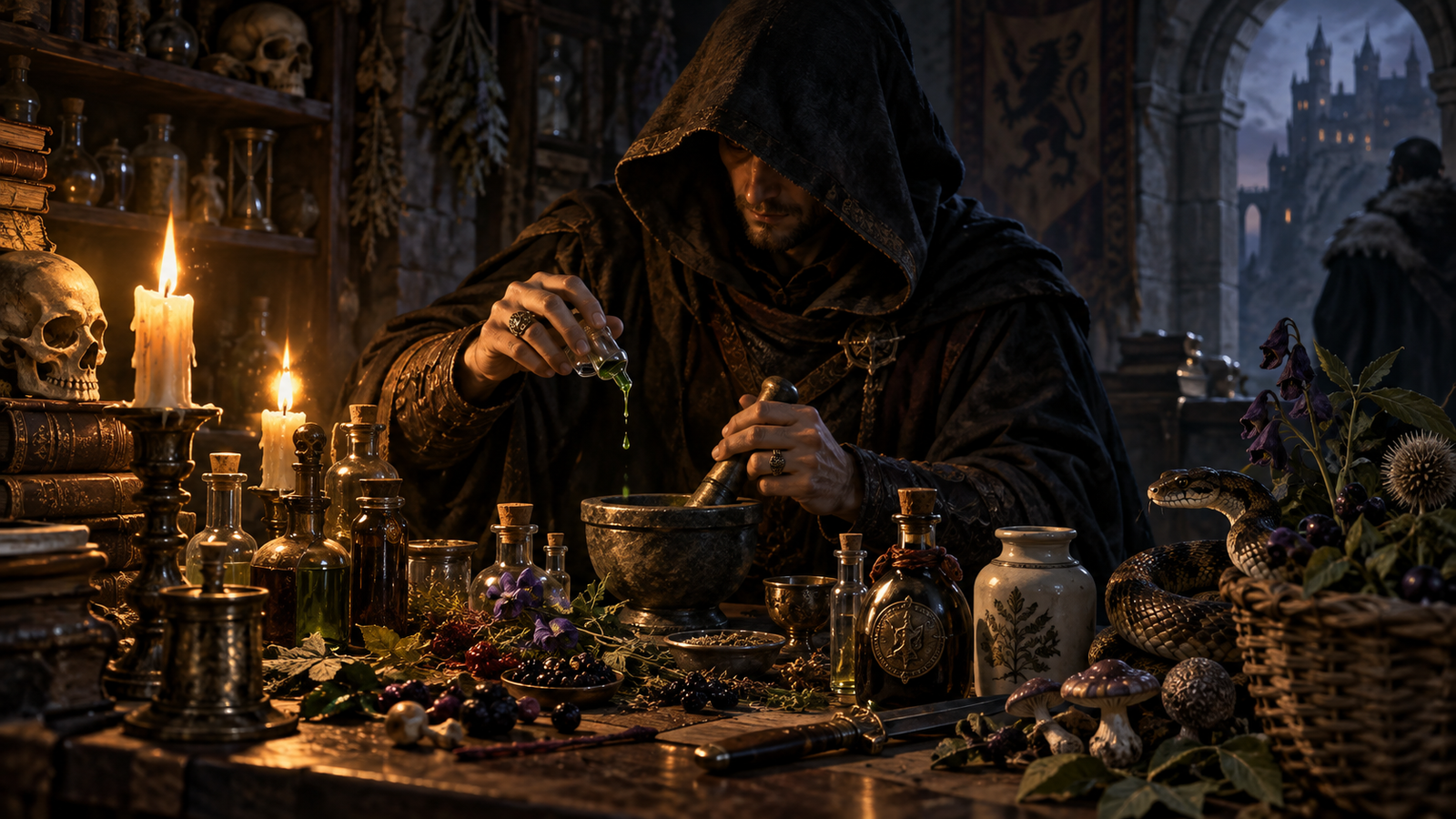
Neutralize Poison stops venom already at work and can render a poisonous creature or object temporarily harmless. Pathfinder requires a caster-level check against each active poison; D&D 3.5e instead removes existing poison and protects against further exposure for 10 minutes per level. Two distinct, fully playable optional fourth-level conversions use modern rules without passing off the original as an official fifth-edition spell.
Neutralize Poison at a Glance
| 5.5e / 2024 | Optional 4th-level Abjuration: Touch; cure two ongoing poisons, detoxify one object or protect a creature for 1 hour |
|---|---|
| 5e / 2014 | Optional 4th-level abjuration: Touch; same three playable modes. Official Protection from Poison is a separate 2nd-level spell |
| Pathfinder 1e | Official Witch 4, Bard/Cleric 4, Druid/Ranger 3, Paladin 4; caster-level check against each poison DC, or suppress a venomous creature/object for 10 min./level |
| D&D 3.5e | Official Bard/Cleric 4, Druid/Ranger 3, Paladin 4; removes active poison and grants immunity against further poisoning for 10 min./level |
Rules distinction: Pathfinder’s spell may fail to neutralize one poison if the caster-level check misses its DC. D&D 3.5e has no corresponding check and grants temporary poison immunity. The 2024/2014 fourth-level entries are optional new conversions, not renamed copies of the second-level Protection from Poison.
Spell Rules by Edition
Neutralize Poison — 5.5e / 2024
Original, optional 2024 conversion, not an official spell. A complete fourth-level adaptation with three modes: treating a poisoned creature, cleaning a poisoned object, or protecting a creature in advance. The official second-level Protection from Poison remains a different spell.
| Level / School | 4th-level Abjuration |
|---|---|
| Suggested Classes | Cleric, Druid, Paladin, Ranger; optional Witch by GM approval |
| Casting Time | Action |
| Range | Touch |
| Components | V, S, M (a crumb of charcoal, not consumed) |
| Target | One touched creature, or one unattended object no larger than a 5-foot Cube |
| Duration | Instantaneous (cure or cleanse); 1 hour (protect), no Concentration |
| Saving Throw | None (willing creature or unattended object) |
| Effect | Cure up to two active poisons, clean one object, or grant 1-hour resistance and Advantage against poison |
| Damage | None; does not heal existing Hit Point loss |
Choose one use when casting:
Cure a Creature
Touch a creature and end its Poisoned condition (if present) and the continuing effects of up to two poisons currently affecting it. This can end a continuing debuff expressly identified as arising from those poisons, but does not remove unrelated conditions or reverse Hit Point damage, death, or another effect already resolved instantaneously. The Games Master identifies which effects actually originate from poison. If more than two ongoing poisons are present, choose the two you know about; if you cannot distinguish them, choose randomly.
Neutralize a Poisoned Object
Touch one unattended object no larger than a 5-foot Cube and neutralize any ordinary poison present in or on it. A poisonous plant, harvested venom, tainted blade, or vial can be detoxified; the spell does not destroy the object, cleanse disease, purify every liquid in a lake, or affect an unwilling creature as though it were an object.
Protect a Creature
Instead of immediately ending poison effects, touch one willing creature and ward it for 1 hour. For that time the creature has Resistance to Poison damage and Advantage on saving throws against being poisoned or against poison effects. This ward does not make the target immune to poison, and does not cure an existing poisoning. This 4th-level spell cannot be cast as a Ritual and requires no Concentration.
Limits and counterplay. The spell cannot restore lost Hit Points or reverse resolved damage. An ongoing ward can be ended by appropriate dispelling magic, while a detoxification already completed is instantaneous and cannot simply be undone with Dispel Magic. Undetected poisons are resolved by the specific rule above; no caster-level check or 3.5e poison immunity is imported from the legacy spell.
Compare the official 2024 rules: the 2024 Protection from Poison (2nd-level Abjuration) ends the Poisoned condition and grants one-hour Resistance to Poison damage and Advantage on saves to avoid or end the Poisoned condition. It does not explicitly remove every ongoing noncondition effect of a poison. The extra object-cleaning and multiple-poison options above are part of this optional fourth-level conversion, not published fifth-edition mechanics.
Neutralize Poison — 5e / 2014
Original, optional undefined conversion, not an official spell. A complete fourth-level adaptation with three modes: treating a poisoned creature, cleaning a poisoned object, or protecting a creature in advance. The official second-level Protection from Poison remains a different spell.
| Level / School | 4th-level abjuration |
|---|---|
| Suggested Classes | Cleric, Druid, Paladin, Ranger; optional Witch by GM approval |
| Casting Time | 1 action |
| Range | Touch |
| Components | V, S, M (a crumb of charcoal, not consumed) |
| Target | One touched creature, or one unattended object no larger than a 5-foot Cube |
| Duration | Instantaneous (cure or cleanse); 1 hour (protect), no Concentration |
| Saving Throw | None (willing creature or unattended object) |
| Effect | Cure up to two active poisons, clean one object, or grant 1-hour resistance and Advantage against poison |
| Damage | None; does not heal existing Hit Point loss |
Choose one use when casting:
Cure a Creature
Touch a creature and end its Poisoned condition (if present) and the continuing effects of up to two poisons currently affecting it. This can end a continuing debuff expressly identified as arising from those poisons, but does not remove unrelated conditions or reverse Hit Point damage, death, or another effect already resolved instantaneously. The Games Master identifies which effects actually originate from poison. If more than two ongoing poisons are present, choose the two you know about; if you cannot distinguish them, choose randomly.
Neutralize a Poisoned Object
Touch one unattended object no larger than a 5-foot Cube and neutralize any ordinary poison present in or on it. A poisonous plant, harvested venom, tainted blade, or vial can be detoxified; the spell does not destroy the object, cleanse disease, purify every liquid in a lake, or affect an unwilling creature as though it were an object.
Protect a Creature
Instead of immediately ending poison effects, touch one willing creature and ward it for 1 hour. For that time the creature has Resistance to Poison damage and Advantage on saving throws against being poisoned or against poison effects. This ward does not make the target immune to poison, and does not cure an existing poisoning. This 4th-level spell cannot be cast as a Ritual and requires no Concentration.
Limits and counterplay. The spell cannot restore lost Hit Points or reverse resolved damage. An ongoing ward can be ended by appropriate dispelling magic, while a detoxification already completed is instantaneous and cannot simply be undone with Dispel Magic. Undetected poisons are resolved by the specific rule above; no caster-level check or 3.5e poison immunity is imported from the legacy spell.
Compare the official undefined rules: the 2014 Protection from Poison (2nd-level abjuration) neutralizes one poison affecting the target and then grants one-hour Poison-damage resistance and Advantage on saves against being poisoned. The extra object-cleaning and multiple-poison options above are part of this optional fourth-level conversion, not published fifth-edition mechanics.
Neutralize Poison — Pathfinder 1e
Official Pathfinder spell, including Witch 4 from the Advanced Player’s Guide Witch list; Core Rulebook spell text.
| School | conjuration (healing) |
|---|---|
| Level | Bard 4, Cleric 4, Druid 3, Paladin 4, Ranger 3; Witch 4 (Advanced Player’s Guide) |
| Casting Time | 1 standard action |
| Components | V, S, M/DF (charcoal) |
| Range | touch |
| Target | creature or object of up to 1 cu. ft./level touched |
| Duration | instantaneous or 10 min./level; see text |
| Saving Throw | Will negates (harmless, object) |
| Spell Resistance | yes (harmless, object) |
You detoxify any sort of venom in the creature or object touched. If the target is a creature, you must make a caster level check (1d20 + caster level) against the DC of each poison affecting the target. Success means that the poison is neutralized. A cured creature suffers no additional effects from the poison, and any temporary effects are ended, but the spell does not reverse instantaneous effects, such as hit point damage, temporary ability damage, or effects that don’t go away on their own.
This spell can instead neutralize the poison in a poisonous creature or object for 10 minutes per level, at the caster’s option. If cast on a creature, the creature receives a Will save to negate the effect.
Neutralize Poison — D&D 3.5e
Cleric spell level 4. Edition source.
| School | Conjuration (Healing) |
|---|---|
| Level | Brd 4, Clr 4, Drd 3, Pal 4, Rgr 3 |
| Components | V, S, M/DF |
| Casting Time | 1 standard action |
| Range | Touch |
| Target | Creature or object of up to 1 cu. ft./level touched |
| Duration | 10 min./level |
| Saving Throw | Will negates (harmless, object) |
| Spell Resistance | Yes (harmless, object) |
You detoxify any sort of venom in the creature or object touched. A poisoned creature suffers no additional effects from the poison, and any temporary effects are ended, but the spell does not reverse instantaneous effects, such as hit point damage, temporary ability damage, or effects that don’t go away on their own.
The creature is immune to any poison it is exposed to during the duration of the spell. Unlike with delay poison, such effects aren’t postponed until after the duration —the creature need not make any saves against poison effects applied to it during the length of the spell.
This spell can instead neutralize the poison in a poisonous creature or object for the duration of the spell, at the caster’s option.
Arcane Material Component: A bit of charcoal.
What Changed Between Editions?
- 5.5e / 2024: this page provides a playable optional fourth-level Abjuration to cure up to two active poison effects, detoxify one object or ward a creature for an hour. The actual 2024 second-level Protection from Poison ends the Poisoned condition and supplies Resistance to Poison damage and Advantage against the condition.
- 5e / 2014: the separate fourth-level conversion uses 2014 terminology. The official second-level Protection from Poison neutralizes one identified (or random) poison and protects the creature for an hour.
- Pathfinder 1e: a 4th-level Witch spell as well as Cleric/Bard 4 and Druid/Ranger 3. The caster makes a separate 1d20 + caster level check against each active poison’s DC. The separate venom-source suppression mode lasts 10 minutes per level.
- D&D 3.5e: the official spell has no individual poison-DC checks and instead grants poison immunity for 10 minutes per caster level after neutralizing existing toxins.
Worked Example: The Serpent’s Cup
A poisoned messenger is brought before the party. Two venoms may still be acting upon him, and the messenger’s cup retains traces of another toxin. The caster must decide whether to treat the messenger or detoxify the cup; one casting does not automatically do both.
5.5e / 2024 — optional fourth-level conversion
A 7th-level Cleric touches the messenger and casts the optional 4th-level Abjuration using the Cure a Creature mode. The spell ends the Poisoned condition and the ongoing effects of up to two active poisons. It does not restore lost Hit Points or reverse damage already suffered. Alternatively the Cleric could detoxify the cup, or grant one willing creature one hour of Resistance to Poison damage and Advantage on poison saving throws. Those are three different modes, and this optional spell is not the published second-level Protection from Poison.
5e / 2014 — optional fourth-level conversion
The 2014 adaptation works with a 1-action casting time and the same optional three modes. The official Protection from Poison instead neutralizes one poison on the touched creature before granting its one-hour protection. Do not silently apply the 2024 condition-only wording to the published 2014 spell.
Pathfinder 1e — official spell
An 8th-level Witch touches a messenger suffering two poisons: one with a DC of 17, the other DC 22. She rolls 1d20 + 8 separately against each DC. She needs a natural result of 9 or higher against DC 17 and 14 or higher against DC 22. Each success neutralizes that poison and ends its continuing effects, but existing hit-point or ability damage is not restored. Instead of curing the messenger, the Witch can cast the spell to neutralize venom in a poisonous creature or object for 80 minutes (10 minutes per caster level); a hostile creature may resist that use with a Will save.
D&D 3.5e — official spell
An 8th-level Cleric casts Neutralize Poison on the messenger. No Pathfinder-style check against each poison DC occurs. Existing poison is neutralized and the creature is immune to new poison exposure for 80 minutes. Instantaneous damage already suffered is not repaired. The Cleric can alternatively neutralize venom in a poisonous object or creature for the same duration, under that edition’s targeting and saving-throw rules.
Practical Counterplay and Rulings
Visible clue. A poisoned patient’s continuing affliction ceases, or a tainted blade loses its venomous danger after the casting. The spell does not erase older scars or instantly heal wounds.
Identify the poison. In Pathfinder, identify each separate active poison and make the caster-level check independently. In the 2014 official second-level comparison, identify which poison is being neutralized; the optional fourth-level adaptation has its own two-poison limit.
Object versus patient. Choose the target and mode before the spell is resolved. Touching a cup or venomous animal is not the same as treating someone who drank from it.
Protection versus cure. Pathfinder may detoxify presently active venom or suppress a venomous source; D&D 3.5e also provides temporary immunity to further poisoning. The optional fifth-edition ward instead grants resistance and Advantage, not outright poison immunity.
Limits. No version automatically repairs previously lost Hit Points or permanent injury. Dispel Magic may interrupt an ongoing ward or suppression but should not reverse instantaneous neutralization without an explicit edition rule.
Neutralize Poison — At the Table
- Choose the target: a creature or an eligible poisoned object.
- Check the edition: choose the published Pathfinder/3.5e mechanics or an explicitly optional fifth-edition conversion.
- Resolve poison: use individual caster-level checks in Pathfinder, automatic neutralization and duration-based immunity in 3.5e, or the defined modes in the optional modern tabs.
- Record duration: ongoing 10-minute-per-level suppression or immunity in legacy play, or a one-hour ward in the optional modern rules.
- Keep old damage: no version retroactively restores already-lost Hit Points or automatically heals an unrelated injury.
Mythical Context
Ancient Greek tradition gave the healing arts to Asclepius, whose serpent-entwined staff became a familiar sign of medicine. In a story preserved by Hyginus, a serpent brings a healing herb to a fallen companion, and the same herb reveals a way to reverse death. This is a mythic model for the healer who knows the correct remedy, though the ancient tale supplies none of the spell’s caster-level checks or immunities.
Asclepius: ancient accounts of the serpent and curative herbs
Historical Context
Ancient and medieval physicians sought antidotes for venomous bites and dangerous plants. Pedanius Dioscorides described remedies and potentially toxic substances in De Materia Medica during the first century CE; the work influenced pharmacy for centuries. The famous theriac was a multi-ingredient preparation advertised as a general antidote. Its historical reputation should not be confused with reliable protection against every poison, and no real antidote operates as automatically as the game spell.
Vanderbilt University: Dioscorides and De Materia Medica · Historical research on theriac as an antidote
Related Magic
Rules Sources and Licensing
5.5e / 2024: the published Protection from Poison is a 2nd-level Abjuration spell that ends the Poisoned condition and provides Resistance to Poison damage and Advantage against the condition. 5e / 2014: the published Protection from Poison neutralizes one poison, then grants one hour of resistance and Advantage. These are different spells from the original optional fourth-level Neutralize Poison conversions provided here. The fifth-edition terminology is informed by SRD 5.2.1 and SRD 5.1, licensed under CC BY 4.0.
Pathfinder 1e: Neutralize Poison — Core Rulebook, with Witch 4 access from the Advanced Player’s Guide. D&D 3.5e: Neutralize Poison — System Reference Document. The legacy spell mechanics are Open Game Content under the Open Game License v1.0a, whose complete text and Section 15 copyright notices follow below. The original illustration, optional fifth-edition conversions, worked examples and contextual essays are not designated here as newly copied third-party Open Game Content.
Open Game License v1.0a and copyright notices
Permission to copy, modify and distribute the files collectively known as the System Reference Document (“SRD”) is granted solely through the use of the Open Gaming License, Version 1.0a.
This material is being released using the Open Gaming License Version 1.0a and you should read and understand the terms of that license before using this material.
The text of the Open Gaming License itself is not Open Game Content. Instructions on using the License are provided within the License itself.
The following items are designated Product Identity, as defined in Section 1(e) of the Open Game License Version 1.0a, and are subject to the conditions set forth in Section 7 of the OGL, and are not Open Content: Dungeons & Dragons, D&D, Player’s Handbook, Dungeon Master, Monster Manual, d20 System, Wizards of the Coast, d20 (when used as a trademark), Forgotten Realms, Faerûn, proper names (including those used in the names of spells or items), places, Red Wizard of Thay, the City of Union, Heroic Domains of Ysgard, Ever-Changing Chaos of Limbo, Windswept Depths of Pandemonium, Infinite Layers of the Abyss, Tarterian Depths of Carceri, Gray Waste of Hades, Bleak Eternity of Gehenna, Nine Hells of Baator, Infernal Battlefield of Acheron, Clockwork Nirvana of Mechanus, Peaceable Kingdoms of Arcadia, Seven Mounting Heavens of Celestia, Twin Paradises of Bytopia, Blessed Fields of Elysium, Wilderness of the Beastlands, Olympian Glades of Arborea, Concordant Domain of the Outlands, Sigil, Lady of Pain, Book of Exalted Deeds, Book of Vile Darkness, beholder, gauth, carrion crawler, tanar’ri, baatezu, displacer beast, githyanki, githzerai, mind flayer, illithid, umber hulk, yuan-ti.
All of the rest of the SRD is Open Game Content as described in Section 1(d) of the License.
More information on the Open Game License can be found at www.wizards.com/d20.
The terms of the Open Gaming License Version 1.0a are as follows:
OPEN GAME LICENSE Version 1.0a
The following text is the property of Wizards of the Coast, Inc. and is Copyright 2000 Wizards of the Coast, Inc (“Wizards”). All Rights Reserved.
1. Definitions: (a)”Contributors” means the copyright and/or trademark owners who have contributed Open Game Content; (b)”Derivative Material” means copyrighted material including derivative works and translations (including into other computer languages), potation, modification, correction, addition, extension, upgrade, improvement, compilation, abridgment or other form in which an existing work may be recast, transformed or adapted; (c) “Distribute” means to reproduce, license, rent, lease, sell, broadcast, publicly display, transmit or otherwise distribute; (d)”Open Game Content” means the game mechanic and includes the methods, procedures, processes and routines to the extent such content does not embody the Product Identity and is an enhancement over the prior art and any additional content clearly identified as Open Game Content by the Contributor, and means any work covered by this License, including translations and derivative works under copyright law, but specifically excludes Product Identity. (e) “Product Identity” means product and product line names, logos and identifying marks including trade dress; artifacts; creatures characters; stories, storylines, plots, thematic elements, dialogue, incidents, language, artwork, symbols, designs, depictions, likenesses, formats, poses, concepts, themes and graphic, photographic and other visual or audio representations; names and descriptions of characters, spells, enchantments, personalities, teams, personas, likenesses and special abilities; places, locations, environments, creatures, equipment, magical or supernatural abilities or effects, logos, symbols, or graphic designs; and any other trademark or registered trademark clearly identified as Product identity by the owner of the Product Identity, and which specifically excludes the Open Game Content; (f) “Trademark” means the logos, names, mark, sign, motto, designs that are used by a Contributor to identify itself or its products or the associated products contributed to the Open Game License by the Contributor (g) “Use”, “Used” or “Using” means to use, Distribute, copy, edit, format, modify, translate and otherwise create Derivative Material of Open Game Content. (h) “You” or “Your” means the licensee in terms of this agreement.
2. The License: This License applies to any Open Game Content that contains a notice indicating that the Open Game Content may only be Used under and in terms of this License. You must affix such a notice to any Open Game Content that you Use. No terms may be added to or subtracted from this License except as described by the License itself. No other terms or conditions may be applied to any Open Game Content distributed using this License.
3.Offer and Acceptance: By Using the Open Game Content You indicate Your acceptance of the terms of this License.
4. Grant and Consideration: In consideration for agreeing to use this License, the Contributors grant You a perpetual, worldwide, royalty-free, non-exclusive license with the exact terms of this License to Use, the Open Game Content.
5.Representation of Authority to Contribute: If You are contributing original material as Open Game Content, You represent that Your Contributions are Your original creation and/or You have sufficient rights to grant the rights conveyed by this License.
6.Notice of License Copyright: You must update the COPYRIGHT NOTICE portion of this License to include the exact text of the COPYRIGHT NOTICE of any Open Game Content You are copying, modifying or distributing, and You must add the title, the copyright date, and the copyright holder’s name to the COPYRIGHT NOTICE of any original Open Game Content you Distribute.
7. Use of Product Identity: You agree not to Use any Product Identity, including as an indication as to compatibility, except as expressly licensed in another, independent Agreement with the owner of each element of that Product Identity. You agree not to indicate compatibility or co-adaptability with any Trademark or Registered Trademark in conjunction with a work containing Open Game Content except as expressly licensed in another, independent Agreement with the owner of such Trademark or Registered Trademark. The use of any Product Identity in Open Game Content does not constitute a challenge to the ownership of that Product Identity. The owner of any Product Identity used in Open Game Content shall retain all rights, title and interest in and to that Product Identity.
8. Identification: If you distribute Open Game Content You must clearly indicate which portions of the work that you are distributing are Open Game Content.
9. Updating the License: Wizards or its designated Agents may publish updated versions of this License. You may use any authorized version of this License to copy, modify and distribute any Open Game Content originally distributed under any version of this License.
10. Copy of this License: You MUST include a copy of this License with every copy of the Open Game Content You Distribute.
11. Use of Contributor Credits: You may not market or advertise the Open Game Content using the name of any Contributor unless You have written permission from the Contributor to do so.
12. Inability to Comply: If it is impossible for You to comply with any of the terms of this License with respect to some or all of the Open Game Content due to statute, judicial order, or governmental regulation then You may not Use any Open Game Material so affected.
13. Termination: This License will terminate automatically if You fail to comply with all terms herein and fail to cure such breach within 30 days of becoming aware of the breach. All sublicenses shall survive the termination of this License.
14. Reformation: If any provision of this License is held to be unenforceable, such provision shall be reformed only to the extent necessary to make it enforceable.
15. COPYRIGHT NOTICE
Open Game License v 1.0a Copyright 2000, Wizards of the Coast, Inc.
System Reference Document Copyright 2000-2003, Wizards of the Coast, Inc.; Authors Jonathan Tweet, Monte Cook, Skip Williams, Rich Baker, Andy Collins, David Noonan, Rich Redman, Bruce R. Cordell, John D. Rateliff, Thomas Reid, James Wyatt, based on original material by E. Gary Gygax and Dave Arneson.
Pathfinder Roleplaying Game Core Rulebook. © 2009, Paizo Publishing, LLC; Author: Jason Bulmahn, based on material by Jonathan Tweet, Monte Cook, and Skip Williams.
Pathfinder Roleplaying Game Advanced Player’s Guide. © 2010, Paizo Publishing, LLC; Author: Jason Bulmahn.
END OF LICENSE
Keep this reference growing
If this page helped with your reading or game, you can support its upkeep or explore the curated books.
Explore the Bookshop — epics, classics and stories behind imagined worlds.