
Abjuration · Mental Defence
Mind Blank
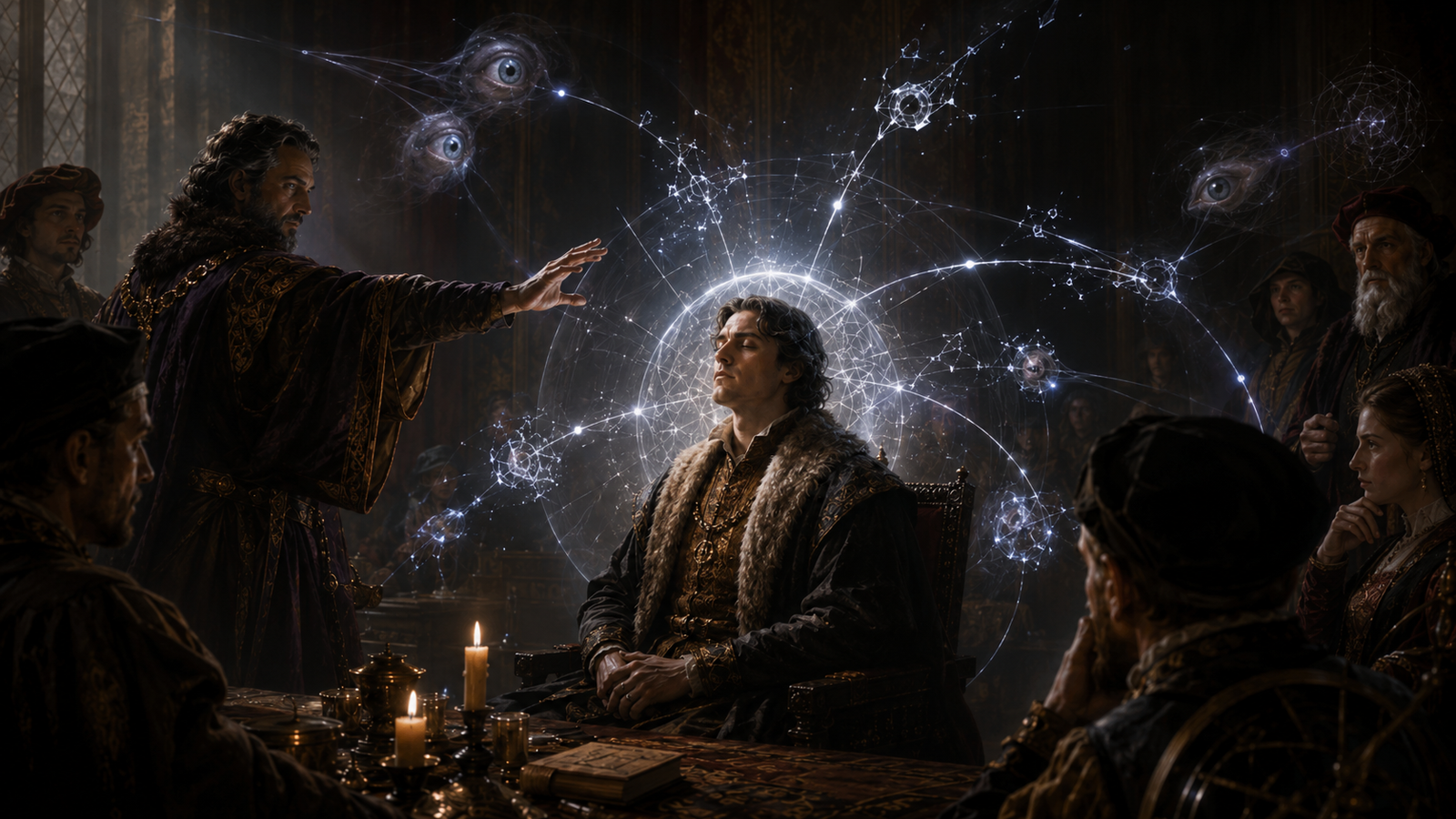
Mind Blank is a 24-hour defence against supernatural intrusion and observation. The name persists across editions, but the exact protection changes sharply: modern D&D grants explicit Psychic and Charmed immunities, Pathfinder strengthens saves against mind-affecting effects, and D&D 3.5e blocks mind-affecting effects outright.
Rules
Mind Blank by Edition
Mind Blank — 5.5e / 2024
| Level | 8th-level Abjuration |
|---|---|
| Classes | Bard, Wizard |
| Casting Time | Action |
| Range | Touch |
| Components | V, S |
| Duration | 24 hours |
| Target | One willing creature |
The target is immune to Psychic damage and the Charmed condition. It is unaffected by effects that sense its emotions or alignment, read its thoughts, or magically detect its location.
No spell—not even Wish—can gather information about the target, observe it remotely, or control its mind while the protection lasts.
Mind Blank — 5e / 2014
| Level | 8th-level Abjuration |
|---|---|
| Classes | Bard, Wizard |
| Casting Time | 1 action |
| Range | Touch |
| Components | V, S |
| Duration | 24 hours |
| Target | One willing creature |
The target is immune to Psychic damage, the Charmed condition, divination spells, and effects that would sense its emotions or read its thoughts.
The ward also defeats Wish and magic of comparable power when used to affect the target’s mind or obtain information about it.
Mind Blank — Pathfinder 1e
| School | Abjuration |
|---|---|
| Level | Sorcerer/Wizard 8 |
| Casting Time | 1 standard action |
| Range | Close (25 ft. + 5 ft./2 levels) |
| Components | V, S |
| Target | One creature |
| Duration | 24 hours |
| Saving Throw | Will negates (harmless) |
| Spell Resistance | Yes (harmless) |
The subject is protected from devices and spells that gather information about it through divination magic. It also gains a +8 resistance bonus on saving throws against all mind-affecting spells and effects.
Limited wish, miracle and wish cannot obtain information about the protected subject. Area scrying can still function, but does not detect the subject; scrying aimed specifically at the subject fails.
Mind Blank — D&D 3.5e
| School | Abjuration |
|---|---|
| Level | Protection 8, Sorcerer/Wizard 8 |
| Casting Time | 1 standard action |
| Range | Close (25 ft. + 5 ft./2 levels) |
| Components | V, S |
| Target | One creature |
| Duration | 24 hours |
| Saving Throw | Will negates (harmless) |
| Spell Resistance | Yes (harmless) |
The subject is protected from effects that detect, influence or read emotions or thoughts, from all mind-affecting spells and effects, and from information-gathering divinations.
Limited wish, miracle and wish are foiled when used to affect the subject’s mind or gather information about it. Area scrying continues to show the area but not the protected creature; targeted scrying fails.
Edition Changes
What Changed?
- 2024 and 2014: Mind Blank is an 8th-level Bard/Wizard spell with Touch range and a 24-hour duration.
- 2024 wording: explicitly blocks magical location detection, remote observation and spell-based mind control while retaining Psychic and Charmed immunity.
- Pathfinder 1e: does not give blanket immunity to mind-affecting effects; it grants a +8 resistance bonus on saves against them.
- D&D 3.5e: protects outright against all mind-affecting spells and effects.
- Legacy access: PF1e is Sorcerer/Wizard 8; 3.5e is Sorcerer/Wizard 8 and Protection 8, not Bard.
The Unreadable Mind
In 1454, Mind Blank is one of the most politically dangerous defensive spells in the world because its greatest value appears before swords are drawn. A ruler can protect an envoy before negotiation. A commander can conceal plans carried only in memory. A courier can cross a hostile court with no written message to steal. A scholar can enter a chamber of rival diviners knowing that the contents of the mind are harder to seize than the books carried beneath one arm.
In learned circles, the spell represents an extreme form of defensive natural philosophy: not the strengthening of flesh, but the establishment of a boundary between a thinking person and supernatural observation. Universities, court scholars, private masters and specialist magical circles argue over what that boundary actually protects, while rulers care about a simpler question — whether their secrets survive the meeting.
Courts and Diplomacy
A protected ambassador can carry military intentions, secret alliances, names of agents or negotiating limits directly into a hostile palace without committing them to paper.
War and Intelligence
Generals fear maps being stolen. They fear diviners even more. The most sensitive plan may therefore exist only inside the head of someone whose thoughts cannot easily be taken.
Scholars and Forbidden Knowledge
A researcher entrusted with a dangerous name, formula or location may be safer carrying the knowledge mentally than hiding it inside a manuscript that can be stolen.
Espionage and Counter-espionage
An operative who cannot be magically questioned becomes valuable — and suspicious. The presence of such protection can itself imply that a secret worth hiding is nearby.
Using Mind Blank in a Story
The spell works best when secrecy already matters. It should not make investigation irrelevant; it changes which forms of investigation remain useful. Witnesses still remember. Servants still notice strange visitors. Horses leave tracks. Letters can be intercepted. A guarded face can still betray exhaustion, injury or fear to an observant person even when magic cannot simply open the mind.
That distinction keeps the spell powerful without making intrigue disappear. Magical intelligence fails, so mundane intelligence becomes important again.
Protect the person who knows too much
The ideal subject is often not the strongest combatant but the person carrying knowledge that would change a war, succession, trial or diplomatic settlement.
Force enemies back into the physical world
When thought-reading and remote observation fail, opponents must follow, infiltrate, bribe, threaten, steal documents or recruit witnesses instead.
Make failed divination a clue
A blank result does not have to end an investigation. It can prove that the investigators have finally found someone important enough to protect.
Remember that protection can be removed
A confident envoy may enter a hostile chamber believing every secret secure, only to discover that an enemy abjurer has prepared to strip the ward first.
Historical and Mythic Context
Protective Magic Carried on the Person
Ancient Egyptian amulets provide a useful historical parallel for the idea that supernatural protection can accompany an individual rather than defend only a building or sacred place. Their intended efficacy could depend on form, material, colour, inscription and ritual words or acts associated with them. They were physical objects rather than equivalents of this spell, but they show how old the idea of portable supernatural protection is.
The Metropolitan Museum of Art — Ancient Egyptian AmuletsOdysseus, Circe and Moly
In the Odyssey, Hermes gives Odysseus the mysterious herb moly before he enters Circe’s house. The protection prevents Circe’s enchantment from overcoming him even after he drinks what she has prepared. The parallel is not exact, but the narrative principle is close: one supernatural protection denies another power access to the intended victim.
Perseus Digital Library — Homer, Odyssey, Book 10The Helm of Hades
Greek tradition gives Hades a helm that makes its wearer impossible to see, and Perseus later uses such concealment during his quest against Medusa. The helm protects perception rather than the mind, making it a useful mythic parallel for the anti-observation side of Mind Blank: an observer can possess extraordinary supernatural senses and still find that the protected subject is simply unavailable to them.
Theoi — Hades’ Estate and the Helm of InvisibilityMind Blank Adventure Hooks
The Silent Envoy
A diplomat arrives carrying no sealed letters, codes or written instructions. Enemy agents realise the treaty terms exist only in the envoy’s protected memory. The problem is no longer how to steal a document, but how to keep the envoy alive long enough for the protection to end.
The Missing Figure in the Vision
A magical investigation reveals a murder chamber perfectly: furniture, witnesses, blood, weapons and an open window. Yet every vision contains an impossible empty place where someone should be standing. Identifying the absent person becomes the entire case.
The Ward Before the Trial
A powerful defendant appears at court already protected against supernatural intrusion. The protection proves neither innocence nor guilt, but it prevents magical interrogation and turns the hearing into a battle over witnesses, documents and ordinary evidence.
The Stolen Secret That Cannot Be Read
A scholar has memorised the location of a dangerous vault and destroyed every map leading to it. The scholar disappears. Several factions begin hunting the one person who possesses the secret, while diviners discover that simply finding the answer through magic is not an option.
Mind Blank Rules Sources and Licensing
The mechanics above are separated into their respective rules panels so that rules language from one game system does not overwrite another.
SRD 5.2.1
This work includes material derived from the System Reference Document 5.2.1 (“SRD 5.2.1”) by Wizards of the Coast LLC. The SRD 5.2.1 is licensed under the Creative Commons Attribution 4.0 International License . The material on this page has been reformatted, restated and accompanied by additional explanatory material.
Pathfinder 1e and D&D 3.5e Open Game Content
The Pathfinder 1e and D&D 3.5e rules material on this page uses Open Game Content distributed under the Open Game License Version 1.0a.
Designation of Open Game Content: the Pathfinder 1e and D&D 3.5e game mechanics reproduced or adapted from the cited Open Game Content sources are Open Game Content to the extent required by those sources and the Open Game License.
Excluded from Open Game Content: original setting material, narrative prose, adventure hooks, artwork, captions and page presentation are excluded except where material is already Open Game Content or otherwise separately licensed.
Open Game License v1.0a + applicable Section 15 notices
THIS LICENSE IS APPROVED FOR GENERAL USE. PERMISSION TO DISTRIBUTE THIS LICENSE IS MADE BY WIZARDS OF THE COAST!
OPEN GAME LICENSE Version 1.0a
The following text is the property of Wizards of the Coast, Inc. and is Copyright 2000 Wizards of the Coast, Inc (“Wizards”). All Rights Reserved.
1. Definitions: (a)”Contributors” means the copyright and/or trademark owners who have contributed Open Game Content; (b)”Derivative Material” means copyrighted material including derivative works and translations (including into other computer languages), potation, modification, correction, addition, extension, upgrade, improvement, compilation, abridgment or other form in which an existing work may be recast, transformed or adapted; (c) “Distribute” means to reproduce, license, rent, lease, sell, broadcast, publicly display, transmit or otherwise distribute; (d)”Open Game Content” means the game mechanic and includes the methods, procedures, processes and routines to the extent such content does not embody the Product Identity and is an enhancement over the prior art and any additional content clearly identified as Open Game Content by the Contributor, and means any work covered by this License, including translations and derivative works under copyright law, but specifically excludes Product Identity. (e) “Product Identity” means product and product line names, logos and identifying marks including trade dress; artifacts; creatures characters; stories, storylines, plots, thematic elements, dialogue, incidents, language, artwork, symbols, designs, depictions, likenesses, formats, poses, concepts, themes and graphic, photographic and other visual or audio representations; names and descriptions of characters, spells, enchantments, personalities, teams, personas, likenesses and special abilities; places, locations, environments, creatures, equipment, magical or supernatural abilities or effects, logos, symbols, or graphic designs; and any other trademark or registered trademark clearly identified as Product identity by the owner of the Product Identity, and which specifically excludes the Open Game Content; (f) “Trademark” means the logos, names, mark, sign, motto, designs that are used by a Contributor to identify itself or its products or the associated products contributed to the Open Game License by the Contributor (g) “Use”, “Used” or “Using” means to use, Distribute, copy, edit, format, modify, translate and otherwise create Derivative Material of Open Game Content. (h) “You” or “Your” means the licensee in terms of this agreement.
2. The License: This License applies to any Open Game Content that contains a notice indicating that the Open Game Content may only be Used under and in terms of this License. You must affix such a notice to any Open Game Content that you Use. No terms may be added to or subtracted from this License except as described by the License itself. No other terms or conditions may be applied to any Open Game Content distributed using this License.
3. Offer and Acceptance: By Using the Open Game Content You indicate Your acceptance of the terms of this License.
4. Grant and Consideration: In consideration for agreeing to use this License, the Contributors grant You a perpetual, worldwide, royalty-free, non-exclusive license with the exact terms of this License to Use, the Open Game Content.
5. Representation of Authority to Contribute: If You are contributing original material as Open Game Content, You represent that Your Contributions are Your original creation and/or You have sufficient rights to grant the rights conveyed by this License.
6. Notice of License Copyright: You must update the COPYRIGHT NOTICE portion of this License to include the exact text of the COPYRIGHT NOTICE of any Open Game Content You are copying, modifying or distributing, and You must add the title, the copyright date, and the copyright holder’s name to the COPYRIGHT NOTICE of any original Open Game Content you Distribute.
7. Use of Product Identity: You agree not to Use any Product Identity, including as an indication as to compatibility, except as expressly licensed in another, independent Agreement with the owner of each element of that Product Identity. You agree not to indicate compatibility or co-adaptability with any Trademark or Registered Trademark in conjunction with a work containing Open Game Content except as expressly licensed in another, independent Agreement with the owner of such Trademark or Registered Trademark. The use of any Product Identity in Open Game Content does not constitute a challenge to the ownership of that Product Identity. The owner of any Product Identity used in Open Game Content shall retain all rights, title and interest in and to that Product Identity.
8. Identification: If you distribute Open Game Content You must clearly indicate which portions of the work that you are distributing are Open Game Content.
9. Updating the License: Wizards or its designated Agents may publish updated versions of this License. You may use any authorized version of this License to copy, modify and distribute any Open Game Content originally distributed under any version of this License.
10. Copy of this License: You MUST include a copy of this License with every copy of the Open Game Content You Distribute.
11. Use of Contributor Credits: You may not market or advertise the Open Game Content using the name of any Contributor unless You have written permission from the Contributor to do so.
12. Inability to Comply: If it is impossible for You to comply with any of the terms of this License with respect to some or all of the Open Game Content due to statute, judicial order, or governmental regulation then You may not Use any Open Game Material so affected.
13. Termination: This License will terminate automatically if You fail to comply with all terms herein and fail to cure such breach within 30 days of becoming aware of the breach. All sublicenses shall survive the termination of this License.
14. Reformation: If any provision of this License is held to be unenforceable, such provision shall be reformed only to the extent necessary to make it enforceable.
15. COPYRIGHT NOTICE
Open Game License v 1.0a Copyright 2000, Wizards of the Coast, Inc.
System Reference Document Copyright 2000-2003, Wizards of the Coast, Inc.; Authors Jonathan Tweet, Monte Cook, Skip Williams, Rich Baker, Andy Collins, David Noonan, Rich Redman, Bruce R. Cordell, John D. Rateliff, Thomas Reid, James Wyatt, based on original material by E. Gary Gygax and Dave Arneson.
Pathfinder Roleplaying Game Core Rulebook. Copyright 2009, Paizo Publishing, LLC; Author: Jason Bulmahn, based on material by Jonathan Tweet, Monte Cook, and Skip Williams.
Pathfinder Roleplaying Game Ultimate Combat. Copyright 2011, Paizo Publishing, LLC; Authors: Jason Bulmahn, Tim Hitchcock, Colin McComb, Rob McCreary, Jason Nelson, Stephen Radney-MacFarland, Sean K Reynolds, Owen K.C. Stephens, and Russ Taylor.
Pathfinder Roleplaying Game Reference Document. Copyright 2011, Paizo Publishing, LLC; Author: Paizo Publishing, LLC.
Mind Blank Spell — Rules and Uses. Copyright 2026.
END OF LICENSE
Original explanatory, historical, setting, tactical and adventure material is © 2026 except where otherwise licensed or credited. Rules names and game terms remain the property of their respective owners.
Keep this reference growing
If this page helped with your reading or game, you can support its upkeep or explore the curated books.
Explore the Bookshop — epics, classics and stories behind imagined worlds.