
Pyrotechnics Spell
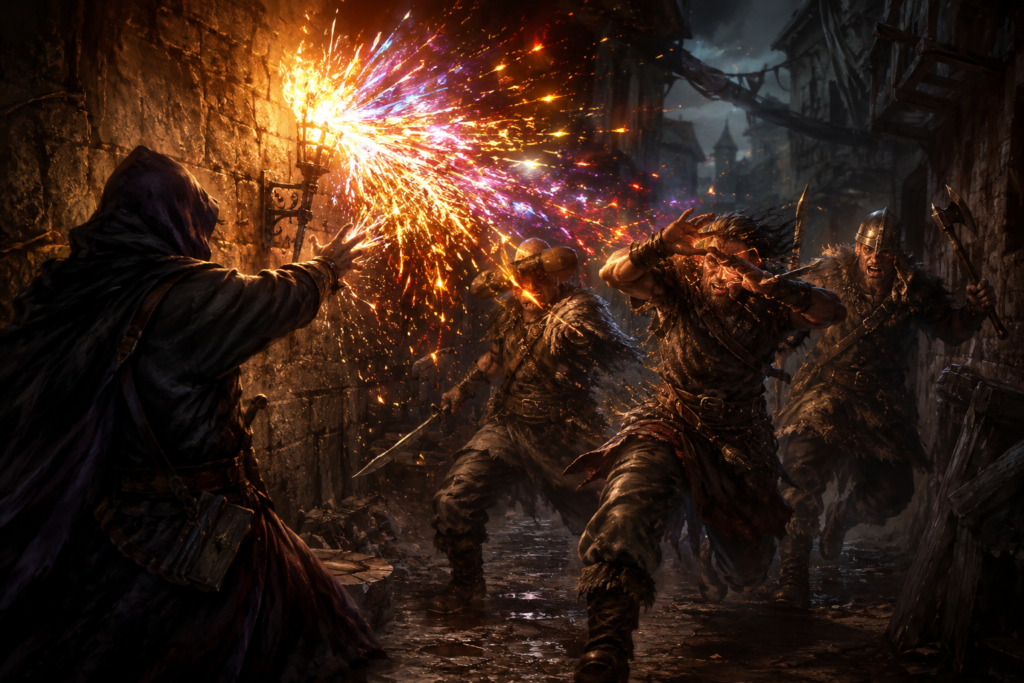
A torch becomes an ambush, a brazier becomes panic, and an ordinary flame becomes sudden battlefield magic.
Pyrotechnics is a transmutation spell that turns an existing fire into either a burst of dazzling magical fireworks or a choking smoke cloud. It does not create flame of its own. Instead, it seizes a nearby fire and makes that fire betray everyone who trusted it. In the right hands, that makes the spell far more dangerous than it first appears. A watchfire can blind sentries. A hall torch can throw a court into confusion. A shrine lamp can become sacrilege. A campfire can become cover for retreat, murder, or escape.
This is a strongly scene-dependent spell, which is part of its identity. In an empty stone room with no open flame, it does little. In a feast hall, gatehouse, ship deck, forge, temple, mine, caravan camp, or siege line, it becomes a control spell with real teeth. It rewards preparation, terrain awareness, and opportunism.
Quick Rules Reference
- Current D&D / 2014-era spell: 2nd-level Transmutation; 60-foot range; V, S; requires a visible area of nonmagical flame fitting inside a 5-foot cube.
- Fireworks: creatures within 10 feet make a Constitution save or are Blinded until the end of your next turn.
- Smoke: 20-foot-radius heavily obscured cloud; spreads around corners; lasts 1 minute or until strong wind disperses it.
- PF1e / 3.5e: long range; fire source up to a 20-foot cube; much larger and longer-lasting fireworks/smoke effects.
- Legacy fireworks: creatures within 120 feet with line of sight make a Will save or are blinded for 1d4+1 rounds.
- Legacy smoke: 20-foot spread, 1 round/level, blocks sight and can impose –4 Strength and Dexterity on a failed Fortitude save.
- Key split: modern D&D only uses nonmagical flame; PF1e/3.5e can also use magical fire without extinguishing it and can damage a fire-based creature used as the source.
Effect
When you cast Pyrotechnics, you choose one valid fire source within range. You then transform that fire into one of two effects: Fireworks or Smoke Cloud.
A valid fire source is an actual flame: a torch, brazier, campfire, lantern flame, oil fire, forge flame, hearth, signal fire, candle flame, or similar burning source. Mere heat, glowing metal, dead embers, sparks, or a hot surface do not normally qualify unless they ignite into open flame.
The spell usually extinguishes the chosen fire as part of its effect. If the source is larger than the spell can fully affect, only the chosen portion is extinguished or transformed. In older rules versions, magical fire may behave differently, and fire-based creatures can interact with the spell in a special way.
Rules
Pyrotechnics by Edition
Pyrotechnics — 5.5e / Current D&D
| Level | 2nd-level Transmutation |
|---|---|
| Classes | Bard, Sorcerer, Wizard |
| Casting Time | 1 Action |
| Range | 60 feet |
| Components | V, S |
| Duration | Instantaneous; smoke can persist 1 minute |
| Source | Visible nonmagical flame fitting within a 5-foot cube |
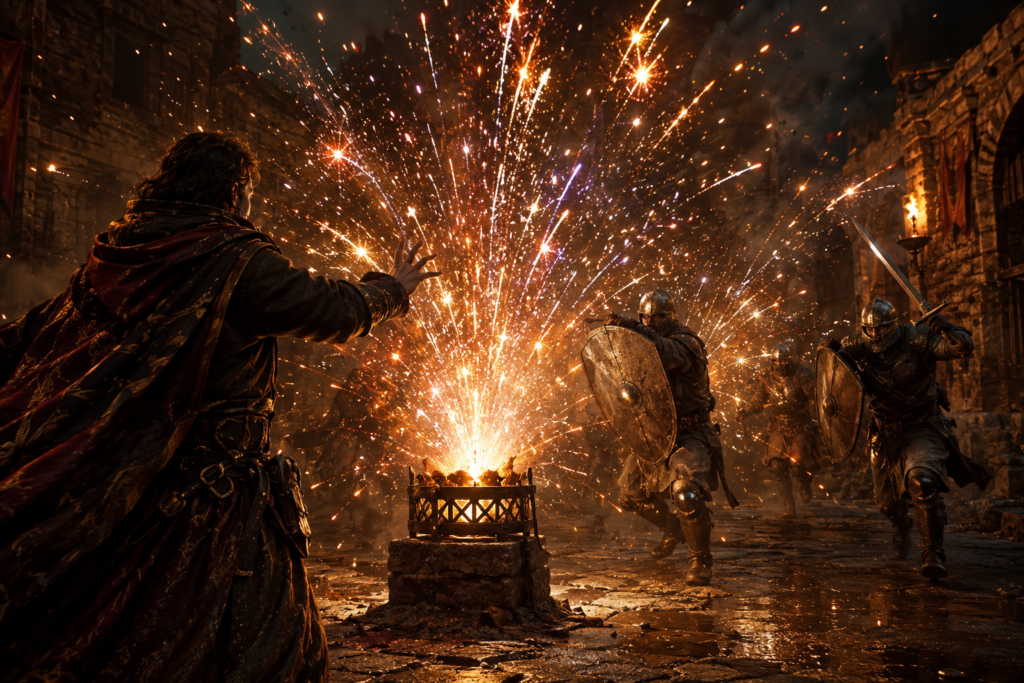
You extinguish the chosen area of nonmagical flame and create one of two effects.
Fireworks: each creature within 10 feet of the source makes a Constitution saving throw. On a failure it is Blinded until the end of your next turn.
Smoke: thick black smoke spreads 20 feet from the source, moves around corners, and heavily obscures the area. It lasts 1 minute or until strong wind disperses it.
Current-rules note: D&D Beyond currently lists this spell for current Bard, Sorcerer and Wizard play without presenting a separate rewritten 2024 spell text.
Pyrotechnics — 5e / 2014-era Rules
| Level | 2nd-level Transmutation |
|---|---|
| Classes | Bard, Sorcerer, Wizard |
| Casting Time | 1 action |
| Range | 60 feet |
| Components | V, S |
| Source | Visible nonmagical flame fitting within a 5-foot cube |
Fireworks: each creature within 10 feet makes a Constitution save or is blinded until the end of your next turn.
Smoke: a 20-foot-radius heavily obscured cloud spreads around corners and lasts for 1 minute or until strong wind disperses it.
The modern/2014-era published spell has no attack damage and no higher-slot scaling.
Pyrotechnics — Pathfinder 1e
| School | Transmutation |
|---|---|
| Level | Bard 2, Sorcerer/Wizard 2 |
| Casting Time | 1 standard action |
| Components | V, S, M (one fire source) |
| Range | Long (400 ft. + 40 ft./level) |
| Target | One fire source, up to a 20-ft. cube |
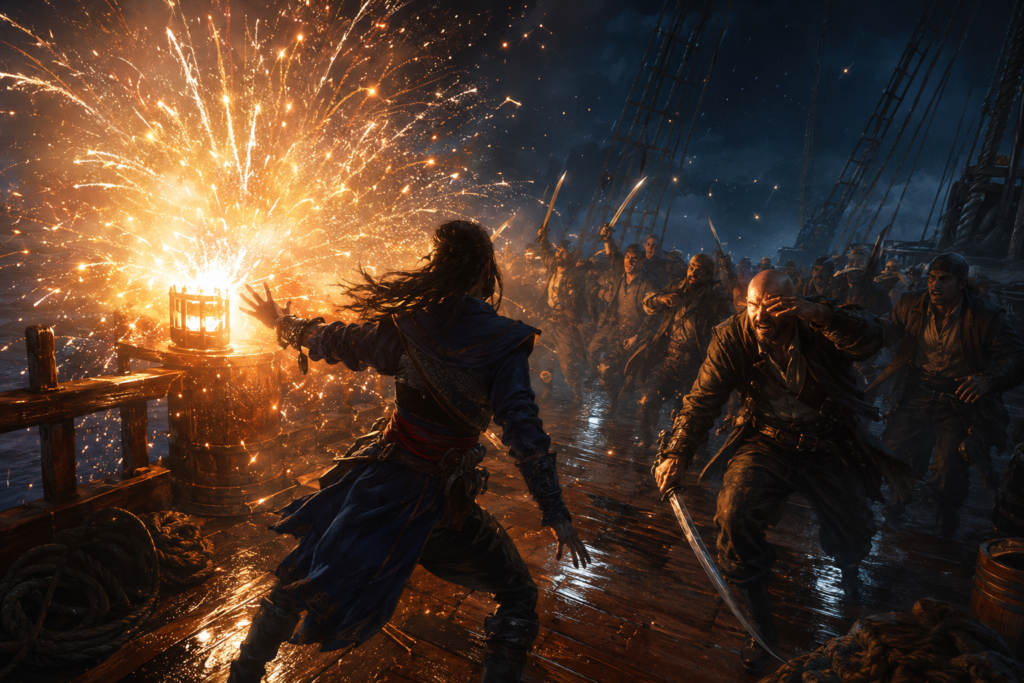
Fireworks: creatures within 120 feet that have line of sight to the fire are blinded for 1d4+1 rounds unless they succeed on a Will save. Spell Resistance applies.
Smoke Cloud: smoke spreads 20 feet in all directions for 1 round per caster level. All sight, including Darkvision, fails through it. Creatures within take –4 Strength and Dexterity unless they succeed on a Fortitude save; those penalties last 1d4+1 rounds after leaving or after the cloud ends. Spell Resistance does not apply.
The fire source is extinguished. A larger fire is only partly extinguished. Magical fire is not extinguished, and a fire-based creature used as the source takes 1 damage per caster level.
Pyrotechnics — D&D 3.5e
| School | Transmutation |
|---|---|
| Level | Bard 2, Sorcerer/Wizard 2 |
| Casting Time | 1 standard action |
| Components | V, S, M |
| Range | Long (400 ft. + 40 ft./level) |
| Target | One fire source, up to a 20-ft. cube |
Fireworks: creatures within 120 feet with line of sight to the source make a Will save or are blinded for 1d4+1 rounds. Spell Resistance applies.
Smoke Cloud: a 20-foot spread lasts 1 round per caster level, defeats all sight including Darkvision, and imposes –4 Strength and Dexterity on a failed Fortitude save; the penalties linger 1d4+1 rounds. Spell Resistance does not apply.
Normal fire is extinguished, oversized fire is partly extinguished, magical fire remains, and a fire-based creature used as the source takes 1 damage per caster level.
What Changed?
- Modern D&D shrinks the range dramatically: 60 feet instead of long range.
- The fire source shrank from a 20-foot cube to a 5-foot cube and must be nonmagical in the modern spell.
- Modern fireworks are much smaller and shorter: 10-foot radius, Constitution save, blinded only until the end of your next turn. PF1e/3.5e reaches 120 feet and can blind for 1d4+1 rounds.
- Modern smoke is simpler: heavy obscurity for 1 minute or until strong wind. PF1e/3.5e adds Strength/Dexterity penalties and caster-level duration.
- Legacy magical-fire interactions were removed: modern D&D does not use magical fire or fire creatures as the source.
Legacy 3.0e Pyrotechnics
Transmutation
Level: Bard 2, Sorcerer/Wizard 2
Components: V, S, M
Casting Time: 1 standard action
Range: Long (400 ft. + 40 ft./level)
Target: One fire source, up to a 20-ft. cube
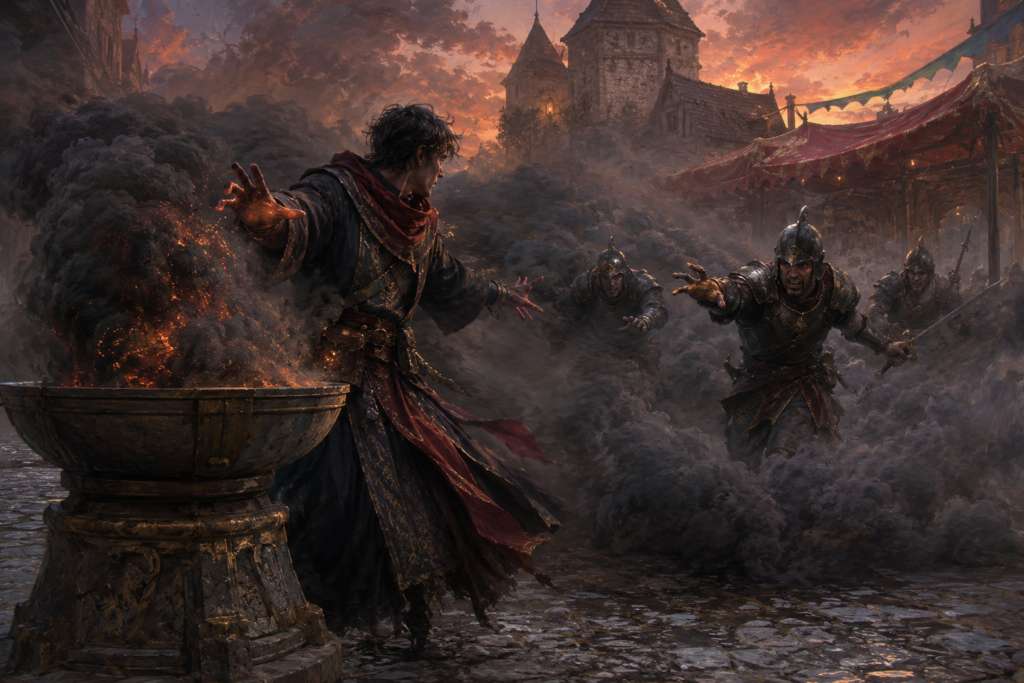
The spell turns fire into blinding fireworks or choking smoke. Fireworks can blind creatures within 120 feet for 1d4+1 rounds; smoke spreads 20 feet, blocks sight and imposes Strength/Dexterity penalties. Normal fire is extinguished; magical fire remains.
Rules Clarifications and Edge Cases
- The modern spell needs nonmagical flame. A torch, candle, brazier, hearth or other visible nonmagical flame can work if the chosen area fits within a 5-foot cube.
- Modern fireworks do not require a separate line-of-sight clause in the spell text. Creatures within 10 feet make the Constitution save; apply ordinary cover and effect rules as appropriate. PF1e/3.5e explicitly requires line of sight to the fire.
- Smoke blocks vision, not movement. The modern cloud is Heavily Obscured; PF1e/3.5e explicitly says all sight, including Darkvision, is ineffective through it.
- Strong wind is a modern rule. Current D&D smoke can be dispersed by strong wind. The PF1e/3.5e spell instead lasts 1 round per caster level.
- Fire-source size is edition-specific. Modern D&D uses an area of flame fitting inside a 5-foot cube. PF1e/3.5e can use a fire source up to a 20-foot cube and only partly extinguishes larger fires.
- Magical fire is legacy-only. PF1e/3.5e lets magical fire act as the source without extinguishing it and deals 1 damage per caster level to a fire-based creature used as the source. Modern D&D specifies nonmagical flame instead.
- This is not a fire-damage spell. Its core effects are blindness and vision control.
Good Combinations
- Create Bonfire: not a valid source for current D&D Pyrotechnics because the spell requires nonmagical flame. Legacy PF1e/3.5e allows magical fire to serve as the source without extinguishing it, subject to that edition’s rules.
- Control Flames — helps position, shape, or preserve a useful mundane flame before you trigger Pyrotechnics.
- Fog Cloud — stacks layered concealment and confusion across a battlefield.
- Darkness — combines vision denial with smoke or post-fireworks confusion.
- Gust of Wind — disperses your own smoke when the concealment has done its job, or clears an enemy’s smoke screen.
Why This Spell Is Dangerous in the World
Pyrotechnics is dangerous because it attacks trust in ordinary flame.
People light torches to see. They keep braziers in halls, watchfires on walls, altar flames in temples, lanterns on ships, and cooking fires in camp. This spell turns those safe and familiar lights into magical hazards. A guard’s torch can blind him. A gatehouse brazier can become cover for infiltrators. A sacred flame can be publicly humiliated. A noble feast can become sudden chaos.
That gives the spell a social and political edge as well as a tactical one. It is not only useful in battle. It is useful in theft, espionage, escape, sabotage, and ceremonial violation.
Adventure Hooks
The Sacred Flame Profaned
A temple’s sacred fire erupts into dazzling magical light during a royal ceremony, leaving priests and guards half-blind while a relic disappears. The temple blames blasphemy, but the theft may be tied to court politics, rival priesthoods, or a hidden sorcerer with access to the shrine.
Smoke at the West Gate
During a night attack, the braziers at a city gate turn into choking smoke, and defenders lose sight of the breach. By dawn, the watch accuses smugglers, demons, and traitors in equal measure. The truth may be much smaller and more dangerous: one infiltrator, one prepared fire, and one well-timed spell.
The Feast of Blind Princes
At a treaty feast lit by hundreds of candles and wall torches, a single burst of magical fireworks throws the chamber into confusion. By the time the light clears, one prince is dead, one is missing, and every realm present believes another did it.
Historical and Mythic Context
Pyrotechnics belongs to two old experiences of fire: fire as spectacle and fire as confusion. Bright flames, sparks, beacon-fires, ceremonial lights, and sudden colour have long been associated with celebration, warning, victory, ritual, and supernatural display. Smoke, by contrast, belongs to concealment, panic, battlefield disorder, and the collapse of ordinary sight.
The fireworks side of the spell draws on the public power of sudden light. A burst of flame in the dark can become an omen, a royal display, a victory sign, or a terrifying interruption. Fireworks have deep roots in Chinese firecraft and later ceremonial display, where controlled flame became public wonder, political theatre, and a sign of mastery over danger. In a fantasy world, that same tradition becomes magical: the spell turns a trusted fire into a blinding sign that forces everyone nearby to look, flinch, and lose control of the moment.
The smoke side of the spell is more practical and more dangerous. Smoke ruins distance, direction, formation, and confidence. It hides movement, breaks archery lines, blinds watchmen, and makes familiar ground feel hostile. The same flame that was meant to reveal danger becomes the thing that hides it. This makes Pyrotechnics especially effective in gatehouses, torchlit streets, ships, tunnels, feast halls, shrines, mines, and siege camps.
In mythic terms, the spell weaponises the social role of fire. A torch is meant to reassure. A hearth is meant to gather people safely. A shrine lamp is meant to sanctify. A beacon is meant to warn or guide. Pyrotechnics twists each of those meanings. It makes the safe flame treacherous, the sacred flame disruptive, and the public flame politically dangerous.
For background on the history of fireworks and controlled fire display, see the Encyclopaedia Britannica article on fireworks. For the wider military idea of concealment and visual deception, see the Encyclopaedia Britannica article on camouflage.
Keep this reference growing
If this page helped with your reading or game, you can support its upkeep or explore the curated books.
Explore the Bookshop — epics, classics and stories behind imagined worlds.