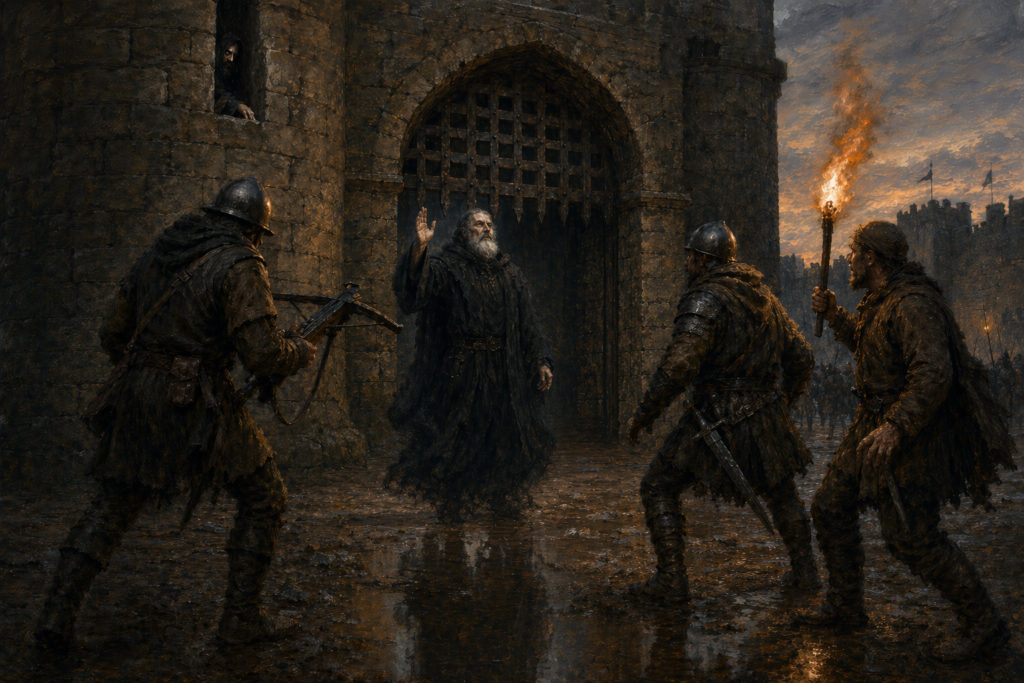
Project Image spell, “Shadow Effigy”
You draw a quasi-real double from the Plane of Shadow, sending your voice, senses, and magic through a false body while your true form remains out of reach.

Some illusion spells deceive the eye. Project Image deceives the battlefield.
This spell does not merely create a visible double. It lets a caster speak, watch, listen, and cast from a shadow-born likeness while the true body remains elsewhere. In a throne room, it is the spell of the hidden sovereign. In a war chamber, it is the spell of the unseen commander. In a dungeon, it lets an archmage stand where no living body should risk standing.
Overview
Project Image creates a convincing shadow duplicate of the caster: a quasi-real illusion that looks, sounds, smells, speaks, gestures, and moves like the original. It is not a summoned creature, a clone, or a second body. It is a magical likeness shaped from shadow-stuff, useful because enemies may treat it as the caster until they have reason to doubt it.
The spell’s power lies in separation. The caster can remain behind a guarded screen, within a locked chamber, beyond a gate, or among trusted allies while the image appears in the dangerous place. Enemies may waste attacks, reveal tactics, negotiate with the wrong figure, or defend against a spellcaster who is not physically present.
Unlike simpler illusion magic, Project Image also functions as a conduit. The caster can see and hear through the image, and spells with a range of touch or greater can originate from the image’s position. This makes the spell a potent tool for battlefield control, magical ambush, courtly deception, and villainous survival.
Its limits are just as important. The projected image is intangible, depends on line of effect, and ends if that connection is broken. A clever enemy can test it. A sealed wall can defeat it. A teleportation spell can sever it. Project Image is dangerous because it lets a caster be present without being vulnerable, but it is still a spell of shadow, distance, and deception rather than true incarnation.
Effect
You create one quasi-real, illusory duplicate of yourself, drawn from the Plane of Shadow. The projected image appears within range and resembles you in sight, sound, scent, speech, posture, and manner. It is intangible and cannot physically manipulate objects, block movement, carry equipment, open doors, trigger pressure plates by weight, or touch creatures.
The image normally mimics your actions, including speech, unless you direct it to behave differently. You can see through the image’s eyes and hear through its ears as though you were standing in its space. While using the image’s senses, your own body is blinded and deafened.
Any spell you cast with a range of touch or greater may originate from the projected image instead of from your actual body, provided all normal requirements of the spell are met. The projected image cannot cast spells on itself except illusion spells. Spells cast through the image affect their targets normally.
Creatures that interact with the image may attempt to disbelieve it. Objects are treated as though they automatically succeed on any disbelief save against the image.
You must maintain line of effect to the projected image at all times. If line of effect is obstructed, the spell ends. If you use dimension door, teleport, plane shift, or any similar effect that breaks line of effect even momentarily, the spell ends.
Edition Tabs
Project Image 5.5e / 2024
Project Image Pathfinder / 3.5e
Project Image 3.0
Project Image 5.5e / 2024

7th-Level Illusion Spell
Casting Time: Action
Range: 150 feet
Components: V, S, M
Material Component: A small doll, carved figure, wax image, or other replica of yourself worth at least 5 gp
Duration: Concentration, up to 1 minute
Available To: Bard, Sorcerer, Wizard
Alternative Spell Name: Shadow Effigy
You create a shadowy illusory duplicate of yourself in an unoccupied space you can see within range. The duplicate looks, sounds, and smells like you, but it is intangible and cannot physically interact with creatures or objects.
The duplicate mimics your movements and speech unless you use a Bonus Action to direct it to behave differently. A creature that uses its action to examine the duplicate can make an Intelligence (Investigation) check against your spell save DC. On a success, the creature recognises the duplicate as an illusion.
You can see through the duplicate’s eyes and hear through its ears as though you were in its space. You can switch between your own senses and the duplicate’s senses at the start of each of your turns. While perceiving through the duplicate, you are blinded and deafened with regard to your own surroundings.
When you cast a spell with a range of Touch or greater, you can cause that spell to originate from the projected image instead of from you. The spell otherwise follows all its normal rules, including components, attack rolls, saving throws, concentration, and targeting restrictions. The projected image cannot be the target of your spells except for illusion spells.
The spell ends if the projected image moves outside the spell’s range, if you lose line of effect to it, if you cast a teleportation or planar travel spell that breaks the connection even momentarily, or if you dismiss the spell.
At Higher Levels
When you cast this spell using an 8th-level spell slot or higher, the range increases by 100 feet for each slot level above 7th.
Project Image Pathfinder / 3.5e
Illusion (Shadow)
Level: Bard 6, Sorcerer/Wizard 7
Components: V, S, M
Casting Time: 1 standard action
Range: Medium, 100 ft. + 10 ft./level
Effect: One shadow duplicate
Duration: 1 round/level (D)
Saving Throw: Will disbelief, if interacted with
Spell Resistance: No
Material Component: A small replica of you, such as a doll, worth 5 gp
You tap energy from the Plane of Shadow to create a quasi-real, illusory version of yourself. The projected image looks, sounds, and smells like you, but is intangible.
The projected image mimics your actions, including speech, unless you direct it to act differently, which is a move action. You can see through its eyes and hear through its ears as if you were standing where it is. During your turn, you may switch from using the image’s senses to using your own senses, or back again, as a free action. While using the image’s senses, your own body is considered blinded and deafened.
Any spell you cast whose range is touch or greater can originate from the projected image instead of from you. The projected image cannot cast spells on itself except illusion spells. Spells affect other targets normally, despite originating from the projected image.
Objects are affected by the projected image as if they had succeeded on their Will save. You must maintain line of effect to the projected image at all times. If your line of effect is obstructed, the spell ends. If you use dimension door, teleport, plane shift, or a similar spell that breaks your line of effect, even momentarily, the spell ends.
Project Image
You tap energy from the Plane of Shadow to create a quasi-real, illusory version of yourself.
This material is Open Game Content, and is licensed for public use under the terms of the Open Game License v1.0a.
Illusion (Shadow)
Level Bard 6, Sorcerer/Wizard 7
Components V, S, M
Casting Time 1 standard action
Range Medium (100 ft. + 10 ft./level)
Effect One shadow duplicate
Duration 1 round/level (D)
Saving Throw Will disbelief (if interacted with)
Spell Resistance No
The projected image looks, sounds, and smells like you but is intangible. The projected image mimics your actions (including speech) unless you direct it to act differently (which is a move action).
You can see through its eyes and hear through its ears as if you were standing where it is, and during your turn you can switch from using its senses to using your own, or back again, as a free action. While you are using its senses, your body is considered blinded and deafened .If you desire, any spell you cast whose range is touch or greater can originate from the projected image instead of from you. The projected image can’t cast any spells on itself except for illusion spells. The spells affect other targets normally, despite originating from the projected image.
Objects are affected by the projected image as if they had succeeded on their Will save.
You must maintain line of effect to the projected image at all times. If your line of effect is obstructed, the spell ends. If you use dimension door, teleport, plane shift, or a similar spell that breaks your line of effect, even momentarily, the spell ends.
Material Component A small replica of you (a doll), which costs 5 gp to create.
Why This Spell Is Dangerous in the World
Project Image makes presence uncertain. A ruler can address rebels from a balcony while the true body remains in a sealed chamber. A court wizard can bargain with fiends from behind locked doors. A necromancer can appear at the mouth of a tomb while standing safely behind stone and wards. The spell allows the powerful to speak, threaten, negotiate, and cast without occupying the place where their enemies see them.
Its danger is not raw damage. Its danger is misdirection. An enemy who believes the image is real may waste an attack, reveal a hidden position, answer the wrong question, trigger a trap, or direct an entire defence against empty shadow. Even after the illusion is suspected, the true question remains: where is the caster?
In courts, Project Image can become a tool of tyranny. In war, it lets commanders survive assassination attempts. In wizardly duels, it punishes enemies who rely on sight alone. In dungeons, it allows a villain to confront intruders before the final chamber, giving the party a voice to hate before they find the body that voice belongs to.
Best Uses
- Cast from safety: Place the image in the open while the true caster remains behind cover, a guarded screen, a murder hole, a portcullis, or another defended position.
- Deliver spells through misdirection: Use the image as the apparent origin point of your magic, forcing enemies to misjudge range, direction, and threat.
- Scout hazardous spaces: Look and listen through the image before exposing your actual body to traps, ambushes, negotiations, or magical wards.
- Control public appearances: Let a ruler, archmage, masked adviser, or hidden villain appear before others without truly entering the room.
- Waste enemy actions: Encourage foes to spend attacks, countermeasures, spells, or movement on a target they cannot physically harm.
Tactics
Project Image rewards preparation. It is strongest when the caster knows where the real body will stand, how line of effect will be maintained, and what enemies are likely to see first. A projected image standing in the open while the true caster hides behind a carefully chosen barrier can reshape an encounter.
The spell also requires sensory discipline. Seeing through the image is valuable, but while doing so the caster’s real body is vulnerable to anything happening nearby. A cautious caster keeps guards, allies, alarms, familiars, or other protections close to the true body.
In combat, Project Image works best with battlefield control, enchantments, illusion spells, counter-magic, and long-range effects. It is less useful for brute force and more useful for forcing enemies to make bad assumptions.
DM Notes
Project Image should feel powerful because it changes where the caster appears to be, not because it gives the caster a second body.
The image cannot lift objects, open doors, hold weapons, provide physical cover, make opportunity attacks, block a passage, carry equipment, or trigger mechanisms by weight. It is a magical point of perception and spell origination.
Line of effect should matter. A curtain, open grille, arrow slit, or magical viewing aperture may allow the spell to function, depending on the situation. A sealed stone wall, closed iron door, blocked passage, or teleportation effect should normally sever the connection.
Do not have every enemy automatically recognise the trick. The spell is high-level and should deceive ordinary observers. Intelligent enemies, rival spellcasters, diviners, and experienced monster-hunters may test the image with thrown objects, dust, area effects, divination, or careful questioning.
Good Combinations
- Greater Invisibility: Keeps the true caster hidden while the projected image draws attention.
- Wall of Force: Protects the real caster while allowing a carefully staged confrontation, subject to line of effect.
- Major Image: Adds environmental misdirection around the projected image, making the false presence more convincing.
- Mislead: Creates layered confusion between invisibility, false location, and illusory presence.
- Counterspell: Lets the caster appear to challenge enemy magic from a false position.
- Arcane Eye: Gives another method of remote observation, useful before choosing where the projected image should appear.
- Dimension Door: Useful before casting Project Image, but dangerous after casting it, because teleportation that breaks line of effect ends the spell.
Using Project Image in Your Game
Project Image is ideal for archmages, paranoid rulers, shadow sorcerers, hidden cult leaders, masked courtiers, fey-touched illusionists, and villains who understand that survival often depends on never standing where enemies expect.
For player characters, the spell rewards clever positioning rather than direct damage. It is most satisfying when players use architecture, cover, politics, or battlefield awareness to turn the image into a tactical advantage.
For villains, Project Image is an excellent way to let an antagonist confront the party early without wasting the final encounter. The image can taunt, bargain, threaten, plead, cast, or mislead while the real enemy remains somewhere else. When the party finally discovers the caster’s true location, the reveal feels earned.
Spellcasting Culture and Worldbuilding Hooks
In some courts, Project Image is considered a coward’s spell: a way for rulers to pass judgment without facing the judged. In others, it is a sign of sovereignty. The monarch’s shadow speaks with the monarch’s authority, and attacking it is still treason.
Shadow colleges may teach the spell only after a student carves, sews, or wax-moulds the required replica by hand. The doll is not merely a component; it is an admission that identity can be copied, moved, and weaponised.
Among spies, a recovered casting doll is dangerous evidence. Among inquisitors and mage-hunters, it may prove that the accused was present in a place where their body never stood.
Adventure Hooks
- The Empty Throne: A ruler has not physically attended court for months, but their projected image still gives orders. No one knows whether the monarch is ill, imprisoned, dead, or willingly hidden.
- The Witness Who Was Not There: A wizard gives vital testimony at a trial, but later evidence proves their body never entered the hall. The testimony may be true, but the method exposes a deeper conspiracy.
- The Doll in the Wall: The party finds a tiny wax replica of a missing archmage sealed inside a castle wall. Someone has been using it to project an image through the fortress.
- The False Duel: A notorious spellcaster challenges a hero to single combat. The figure at the appointed place can cast spells, but the true body is hidden nearby.
- The Shadow Ambassador: A foreign envoy is discovered to be only a projected image. Killing it means nothing, but tracing the line of effect could prevent a war.
Buy me a coffee